
A New Kind of War
The fall of Berlin did not end the threat to Europe. It simply changed its face. By the late 1940s, Soviet armor sat poised along the inner German border, a steel tide of T-34 and IS-3 tanks threatening to overwhelm the thinly stretched conventional forces of the nascent North Atlantic Treaty Organization. The lessons of World War II, with its grinding land campaigns, dictated a new and urgent requirement. The United States Army needed a force that could deploy faster than ships could sail, a global fire brigade that could materialize anywhere to seize a foothold or stiffen a crumbling allied line. This strategic reality reshaped the very identity of the Army’s elite paratroopers. The era of tactical paradrops, dropping regiments to seize bridges and road junctions as in Normandy, was evolving. The new doctrine, championed by airborne veterans like General Matthew B. Ridgway and General Maxwell D. Taylor, demanded the strategic deployment of entire divisions as a projection of national will.
The 82nd and 101st Airborne Divisions, blooded in the skies over France and Holland, became the nucleus of this new spearhead. Their role shifted from tactical support to strategic reserve. In 1958, the Army formalized this concept by creating the Strategic Army Corps, or STRAC. STRAC consisted of the 82nd and 101st Airborne Divisions and the 1st and 4th Infantry Divisions, held in a high state of readiness in the continental United States. Both President Truman and President Eisenhower deliberately kept the 82nd Airborne out of the Korean War, preserving it as a global reaction force. Its mission was to be ready for a Soviet ground attack anywhere in the world. This doctrine centered on the concept of forcible entry, the ability to seize a hostile airfield and rapidly build up combat power. The paratroopers would jump first, securing the airstrip. Then, a new generation of heavy transport aircraft would land, disgorging the division’s muscle. This was a profound change, turning the airborne division from a temporary light infantry shock force into a self-sustaining lodgment capable of independent combat operations.
The Workhorse of Global Reach
The concept of an air-landed army remained theoretical until the right machine arrived. That machine was the Douglas C-124 Globemaster II. Developed between 1947 and 1949 and entering service with the Military Air Transport Service (MATS) in 1950, the C-124 was born from the hard-won lessons of the Berlin Airlift. Nicknamed "Old Shaky" by its crews for its tendency to vibrate in flight, the piston-engined giant was a quantum leap in strategic airlift. It was powered by four massive Pratt & Whitney R-4360 Wasp Major radial engines, each producing 3,800 horsepower. The aircraft dwarfed its WWII-era predecessors like the C-47 Skytrain and even the larger C-54 Skymaster.
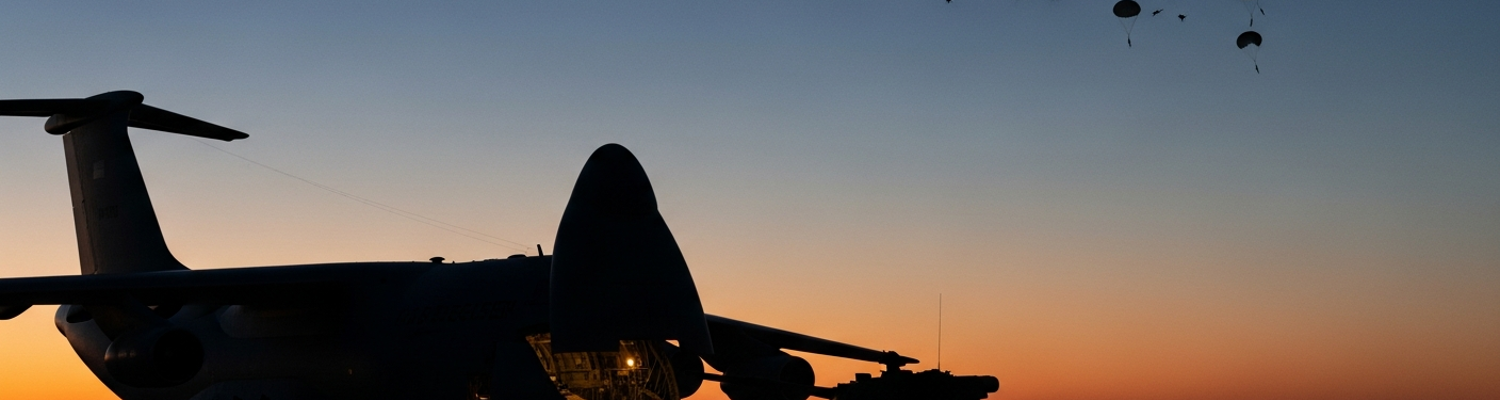
What made the C-124 revolutionary for the Army were its nose-mounted clamshell doors and integrated hydraulic ramps. For the first time, the Army could load its heaviest divisional equipment, fully assembled, and fly it across oceans. A 77-foot-long cargo bay could swallow M41 Walker Bulldog light tanks, 155mm howitzers, bulldozers, and prime mover trucks. A single C-124 could lift a payload of nearly 74,000 pounds or transport 200 fully equipped soldiers in its cavernous double-decked cabin. This single airframe fundamentally altered the logic of airborne operations. The operational sequence became a three-part symphony of force projection. First, pathfinders would jump into a drop zone to mark it. Second, the main assault echelons from the 82nd or 101st would parachute from C-119 or C-123 aircraft to seize the objective airfield and establish a perimeter. Third, the stream of C-124s would begin landing, one after another, disgorging the heavy equipment that gave the division its teeth. No longer were paratroopers a light infantry force, vulnerable once their initial surprise wore off. The Globemaster meant they could be reinforced within hours by their own engineering equipment to build fortifications, their own trucks for logistics, and their own artillery and tanks for heavy firepower. The airborne spearhead now had a hardened steel shaft.
The Louisiana Proving Ground
The Army and Air Force needed to test this powerful new doctrine under the most demanding conditions imaginable. They designed Exercise Sage Brush, held in the fall of 1955. It was the largest joint military maneuver on American soil since World War II, a massive undertaking that sprawled across Louisiana. For 45 days, from October 31 to December 15, some 150,000 personnel engaged in simulated combat. The exercise scenario was brutal. It was designed to test the Army’s new "Pentomic Division" structure under the terrifying conditions of a nuclear battlefield. The 11th Airborne Division, acting as the Aggressor force, invaded the United States through the Gulf Coast. The defenders, led by the 82nd Airborne Division and the 1st Armored Division, had to repel them in an environment where umpires declared the simulated use of 76 tactical atomic weapons.
The central challenge was how to fight and supply a force that had to remain dispersed to survive atomic strikes. The 82nd Airborne Division and other units grappled with the immense logistical problems this created. Units were scattered across the landscape in small, mobile battle groups. The exercise quickly revealed that maintaining command, control, and communications in a nuclear environment was a nightmare. Radio traffic was jammed and unreliable. The very dispersion needed for survival made it nearly impossible to mass combat power effectively. The final report concluded that the tested Pentomic divisional structures could not sustain high-tempo, dispersed operations. Sage Brush was a useful failure. It exposed deep flaws in the Pentomic concept and forced a doctrinal reset toward more robust, flexible formations. It also created significant friction between the services. The Army’s experimental use of H-21 Shawnee and H-13 Sioux helicopters for reconnaissance and medevac in a concept called "Sky Cavalry" directly challenged the Air Force’s belief that all air operations, including those just above the battlefield, belonged to its fixed-wing aircraft. The arguments in the Louisiana swamps were a direct precursor to the airmobility debates that would define the lead-up to the Vietnam War.
A Shadow Over the Iron Curtain
The Army’s airborne spearhead was more than a military capability. It was a powerful instrument of geopolitics. The demonstrated ability to project a division-sized force across the globe in a matter of days cast a long shadow. This capability directly underpinned NATO’s deterrence strategy, providing a credible and rapid reinforcement for Western Europe. The Berlin Airlift of 1948-1949 had already proven that strategic airlift could function as an effective political tool, demonstrating American resolve without firing a shot. The STRAC concept took this to a new level. During the 1958 Lebanon Crisis, elements of a STRAC airborne brigade were rapidly deployed to the Middle East, signaling Washington's commitment to its allies in the region. The most complete validation of the doctrine came in 1965 during Operation Power Pack. The 82nd Airborne Division conducted its first major combat jump since World War II, deploying into the Dominican Republic to stabilize a volatile civil war. The operation was a textbook execution of forcible entry and rapid buildup, all enabled by the strategic airlift fleet.
Exercises like Sage Brush, despite their internal lessons, were also a public message to the Soviet Union. They were a display of America’s reach and its serious planning for the most dire of Cold War scenarios. This airborne capability forced Soviet military planners to account for a threat that could emerge deep in their rear, compelling them to dedicate forces to protect critical infrastructure far from the front lines. The Soviets’ own airborne forces, the VDV, watched closely and accelerated their own development of strategic airborne capabilities. This doctrine, forged in the post-war threat environment and made real by aircraft like the Globemaster, established a new paradigm of strategic mobility. Its legacy continued directly into the formation of the Rapid Deployment Joint Task Force in 1980, the forerunner of U.S. Central Command, ensuring that the concept of a global airborne spearhead would define America’s military posture for decades to come.