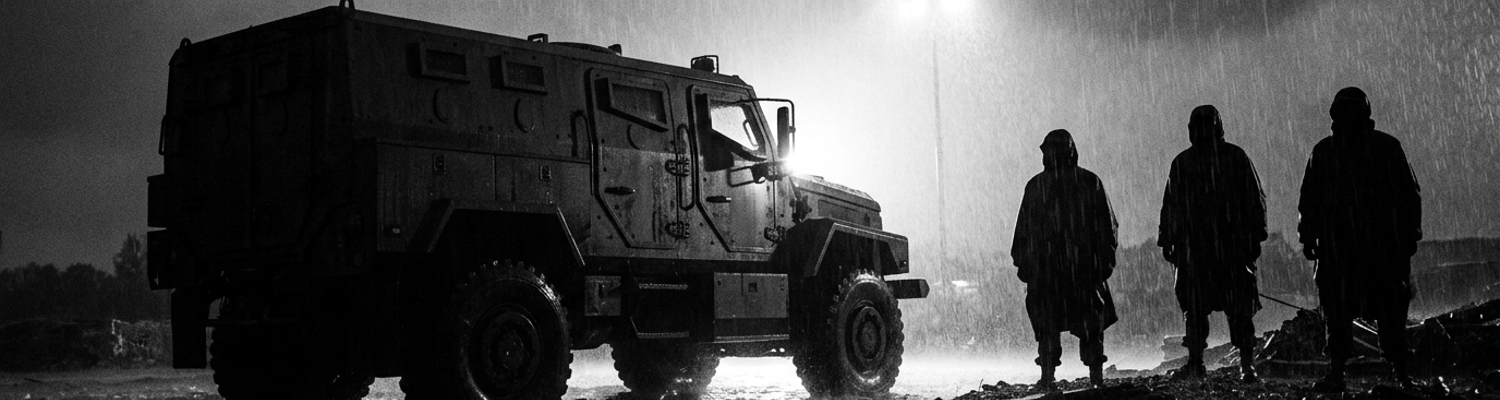

Cadillac Gage Peacekeeper Development and Air Force Procurement
A close review of operational logs from Strategic Air Command security detachments indicates that physical exhaustion consistently set in long before any armed perimeter breach occurred. Enlisted security police airmen stood twelve-hour perimeter watches on windswept flightlines. They shivered in heavy parkas that soaked through with slush. Patrol boots froze solid against cracked concrete runways. Hunger gnawed through missed mess-hall rotations during extended defensive exercises. Sentries sustained themselves on cold rations eaten while marching five-mile perimeter loops in blowing snow. Feet blistered. Sleep debt degraded reaction times to near-paralysis. The physical mechanics of walking active flightlines exposed a glaring defensive vulnerability across northern tier bases.
Static foot sentries simply could not secure miles of exposed tarmac.
Archival records show that Headquarters United States Air Force formalized an urgent requirement in the late 1970s for a lightweight internal security vehicle. Planners needed a four-wheel-drive platform designed to patrol exposed aircraft dispersal areas and isolated weapons storage compounds. Nuclear strike bases like Minot, Malmstrom, and Grand Forks sprawled over thousands of flat acres. Alert B-52 bombers and KC-135 tankers sat parked under open skies. Base defense doctrines mandated rapid-response forces capable of intercepting armed saboteurs within three minutes of an electronic sensor tripping along the double-fenced exclusion areas. Tracked armored personnel carriers like the M113 tore up tarmac. They drank excessive quantities of fuel. They demanded hours of heavy maintenance that Air Force motor pools were unequipped to handle. Soft-skin pickup trucks provided mobility but offered zero ballistic cover against small-arms fire. Air Force planners wanted a wheeled transport that could cruise at highway speeds on base perimeter roads. It needed to squeeze through narrow security gates and seat a four-man fire team behind armor.
Cadillac Gage answered with an off-the-shelf compromise.
Engineers at Cadillac Gage bypassed clean-sheet design costs by mounting a welded armored hull directly onto a modified commercial Chrysler Dodge four-wheel-drive truck chassis. Beneath the angular shell lay the mechanical running gear of a standard civilian Dodge Ram. The powertrain consisted of a Chrysler 360-cubic-inch five-point-nine-liter gasoline V8 engine and a three-speed Loadflite automatic transmission. Dana front and rear drive axles pushed the power to the ground. Onto this commercial pickup backbone, the factory welded an armored tub constructed of Cadloy. This proprietary high-hardness steel alloy was originally developed for the Commando armored car series. Cadloy plates measured roughly one-quarter to three-eighths of an inch in thickness. This provided ballistic protection against seven-point-six-two-millimeter ball ammunition and fragmentation. The vehicle carried an operational curb weight of approximately nine thousand pounds. This mass pushed the leaf springs, universal joints, and stock hydraulic braking systems to their absolute engineering tolerances. Off-road performance suffered in heavy mud. The high center of gravity and narrow commercial-width tires caused the chassis to bottom out against its axles.
Budget considerations took precedence over heavy cross-country mobility.
When examining the procurement records, the Air Force purchased several hundred Peacekeeper units between 1980 and 1983. Unit cost figures remained far lower than purpose-built combat vehicles. Vehicle maintenance teams at bases like Grand Forks in North Dakota received vehicles with standard commercial parts manuals. This enabled airmen to source replacement water pumps, alternators, and brake shoes directly from regional Chrysler automotive distribution hubs. The Air Force assigned these trucks directly to Security Police squadrons guarding weapons storage areas at geographic coordinates 47 degrees 57 minutes North 097 degrees 24 minutes West.
START I Mandates and Grand Forks Missile Field Security
Archival evidence shows that by late 1995, the 321st Missile Group began the systematic deactivation of its 150 Minuteman III launch facilities. These silos were scattered across eight thousand square miles of eastern North Dakota. Implementation directives under the Strategic Arms Reduction Treaty forced Twentieth Air Force to execute rapid de-mating sequences at launch facilities across Grand Forks, Walsh, Nelson, and Griggs counties. Specialized missile handling teams unbolted launch tube headworks. They descended twenty feet into hardened equipment rooms. Technicians hoisted Mark 12 and Mark 12A reentry vehicles clear of the missile stages. Crews separated the three W62 and W78 thermonuclear warheads from their booster guidance sets. They secured the live physics packages into white tractor-drawn Type II Payload Transporters. Each uncoupling left multi-megaton explosive yields exposed inside soft-sided field shelters during the loading sequence. This turned isolated silos near geographic coordinates 47 degrees 58 minutes North 097 degrees 45 minutes West into top-tier ground security liabilities.
Nuclear transport permitted zero mechanical margin.
Strict security directives required the 321st Security Police Squadron to maintain continuous armed escorts around every warhead on public roads. Security personnel drawn from the host 319th Security Police Squadron at Grand Forks Air Force Base augmented these details. Peacekeepers patrolled the perimeter while technicians winched the weapons from the launch tube collar. Drivers positioned their Cadloy hulls between the handling cranes and open country roads. Convoys crawled across secondary gravel routes at twenty miles per hour. Standard convoy operations positioned one Peacekeeper two miles ahead to clear farm crossings and blind knolls. Two additional armored vehicles rode directly off the trailer wheels of the transport truck. A rear chase team traveled fifty yards behind. They carried an eight-man fire team armed with GAU-5 carbines, M60 machine guns, and shoulder-fired anti-armor weapons.
Convoy duty broke the commercial running gear.
A close review of operational logs indicates that the Chrysler 360 V8 gasoline engines failed repeatedly under the strain of low-speed highway escort. Crawling at twenty miles per hour behind diesel transporter rigs starved the stock cooling fans of sufficient airflow. Coolant temperatures pushed past two hundred and forty degrees Fahrenheit. Transmission fluid inside the three-speed Loadflite gearboxes boiled. This disintegrated internal clutch packs and blew front pump seals across the frozen roadway. Cadloy armor plating concentrated dead weight over the front axle. Standard civilian leaf spring bundles snapped when traversing frost-heaved gravel washboards. Maintenance teams in the 321st field bays worked through the night replacing shattered steering knuckles on the front Dana 44 axles. Exhausted security teams sat in freezing hulls. Standard cab heaters blew cold air because engine thermostats stuck open in negative thirty-degree blizzards.
Ice coated the inside of the uninsulated vision blocks.
Command officers in the 321st Missile Group recognized that the vehicles were breaking faster than depot parts could arrive from regional suppliers. Convoys continued through freezing rain across Traill County without functional cabin heat or defrosters. Airmen scraped frost off armored glass with survival knives while keeping weapons aimed out the side ports. By early 1997, dozens of Peacekeeper hulls accumulated deadlined status in motor pools across the missile complex. They sat parked side by side with stripped suspension linkages and burned transfer cases awaiting parts shipments from civilian distributors.
The 1997 Red River Flood Inundation
When examining the historical record of the Red River basin in mid-April 1997, five consecutive blizzards followed by rapid spring thawing forced the Red River of the North past its designed containment limits. At the Grand Forks river gauge, flood stages climbed steadily toward an unprecedented crest of 54.35 feet. This exceeded flood level by over twenty-six feet. On April 18, torrential runoff overtopped temporary sandbag dikes along Lincoln Park and Belmont Road. Millions of gallons of freezing water poured directly into residential districts and municipal corridors. Secondary earthen levees protecting the western approaches along the English Coulee drainage basin failed hours later. Rural infrastructure spanning Grand Forks, Traill, and Walsh counties disintegrated as drainage ditches backed up across the low-gradient Red River Valley. County roads 2, 4, and 15 vanished under sheets of brown current varying between three and eight feet in depth. Saturated road foundations turned into liquefied clay. Entire sections of rural asphalt sheared off into ditches. Underground telephone switches drowned. Electrical sub-stations failed across rural sections near geographic coordinates 47 degrees 55 minutes North 097 degrees 02 minutes West. Culvert collapses cut off ground access to isolated Minuteman launch facilities.
Rising currents swallowed every primary supply route.
Archival evidence shows that the collapse of off-base utility grids prompted the 319th Air Refueling Wing commander to issue a mandatory evacuation order on April 18. This applied to all non-essential personnel and military dependents. Grand Forks Air Force Base lost its municipal water supply and regional sewage connections. The cantonment area operated on emergency diesel generators and bottled rations. Wing leadership mobilized hundreds of private vehicles and government buses. They moved more than eight thousand military dependents and non-essential support personnel westward toward temporary billeting at Minot Air Force Base. Others went south toward emergency reception centers in Fargo. Only mission-essential operational personnel stayed behind wire perimeters. Core security elements from the 319th Security Police Squadron stayed on station to enforce absolute physical security over exposed strategic assets. Stationary bunkers and mobile patrols guarded alert aprons housing KC-135R Stratotankers. Dedicated armed response teams held the weapons storage area at geographic coordinates 47 degrees 57 minutes North 097 degrees 24 minutes West. Airmen stood continuous twelve-hour watches in sub-freezing rain and standing floodwaters to prevent unauthorized access across unsecured base boundaries.
No relief convoys could enter the compound.
A close review of operational logs indicates that the Cadillac Gage Peacekeeper hulls suffered devastating mechanical breakdowns when sent into the submerged approaches of the Grand Forks perimeter. Chrysler designed the underlying Dodge truck chassis for civilian roads. This left critical engine components vulnerable to minor water ingress. The 360-cubic-inch V8 powerplants utilized standard Prestolite distributors positioned low on the rear of the engine blocks. Wake wash pushed past the front grille immediately soaked the unsealed ignition caps and killed engine spark. Cold silty water entered the open axle breathers of the Dana 44 front and Dana 60 rear differentials. This replaced 90-weight gear oil with abrasive slurry and scoured ring gears down to metal shavings. Inside the crew compartments, unsealed floor seams let freezing runoff pour onto the metal decking. This shorted out lower junction boxes in the commercial twelve-volt electrical system and disabled communication transceivers. Silt collected inside the Dodge rear drum brake assemblies. Hydraulic wheel cylinders stuck wide open and locked the rear tires against the axle tubes. Drivers attempted to ford flooded gravel roads to check remote perimeter sensors. The nine-thousand-pound curb weight pushed commercial-tread tires into waterlogged road shoulders. Vehicles sank to their frame rails. Hydrostatic pressure snapped front tie rods.
Armored Security Convoys on Flooded North Dakota Corridors
Archival evidence shows that by April 20, floodwaters submerged sixty-four Minuteman III Launch Facilities and five Missile Alert Facilities across Nelson, Grand Forks, and Traill counties. Saturated clay soil caused subterranean power cables to short. This tripped automated security sensor loops and cut off remote telemetry to the 321st Missile Group command post. Security police detachments dispatched four-man Cadillac Gage Peacekeeper crews to establish static armed perimeters directly over flooded silo headworks. At Launch Facility Juliet-04 near geographic coordinates 47 degrees 43 minutes North 097 degrees 36 minutes West, two feet of turbid runoff covered the concrete launcher closure door. This drowned the primary security response team shore power tie-in. To maintain the mandated twelve-minute response capability against hostile tampering, the team parked vehicle serial number 81-0034 directly across the access road apron. They used the Cadloy armored hull as a stationary fighting position. Gun crews operated under standing orders to shoot anyone breaching the perimeter fence line. The Chrysler 360 V8 engines ran continuously for seventy-two consecutive hours to power the vehicular radio sets and cab blowers. This burned through fuel reserves and built thick carbon crusts on the exhaust valves. Fuel tankers could not negotiate the washed-out access spurs. Security airmen hand-carried five-gallon jerry cans half a mile through knee-deep mud to keep the engines running.
Floodwater breached the door seals.
A close review of operational logs indicates that the mechanical modifications made to the Dodge running gear failed under static water immersion. Silt-choked current from the Goose River basin reached the axle hubs of Peacekeepers stationed outside Missile Alert Facility Mike-01. High water backed up into the unsealed Dodge steering boxes. This contaminated the hydraulic fluid and seized the recirculating-ball mechanisms. Airmen seated inside the uninsulated crew compartments stripped floorboard panels to monitor bilge accumulation. They bailed water with empty ammunition tins to protect the twelve-volt radio mountings. Exterior diesel generators at the launch control facilities failed due to water intake. The armored trucks served as the sole physical communications relay between the subterranean capsule crews and Twentieth Air Force headquarters. Sentries posted on the rear jump seats rotated outside every twenty minutes. They scanned the flooded cornfields with night-vision scopes while freezing winds drove surface waves against the quarter-inch Cadloy side armor.
When examining the historical record of the 321st Missile Group deactivation, the scheduled transfer of de-mated Mark 12 reentry vehicles could not be postponed despite the flooding. Convoys assembled under emergency orders to move tractor-trailer Type II Payload Transporters containing live W62 thermonuclear physics packages away from threatened silos. They traveled along North Dakota Highway 18 and Traill County Road 1. Peacekeepers drew escort assignments at the vanguard and rear of each payload transporter. They held tactical intervals across two-lane rural causeways where water lapped against the asphalt shoulders. Weight limitations turned every bridge crossing into a calculated hazard. The sixty-thousand-pound payload transporter combined with nine-thousand-pound armored escorts exceeded the compromised load ratings of softened roadbeds. Convoy commanders ordered the Peacekeeper point vehicles to maintain a steady speed of eight miles per hour through four-inch sheets of surface runoff. This pushed bow waves aside so the trailing transporters could see the roadway centerline. Drivers cracked their heavy side doors open and unhooked their seat harnesses. They prepared to jump clear if the water undermined the underlying gravel embankment and tipped the armored chassis into six-foot-deep agricultural drainage ditches.
Gravel roadbeds washed out beneath the wheels.
Technical debriefs compiled after the operations along County Road 4 reveal that mechanical breakdowns hit the escort formations mid-transit. Outside the town of Northwood, an armored Peacekeeper riding rear guard behind a live warhead transport suffered complete transmission failure. Its three-speed Loadflite gearbox ingested muddy water through an unsealed dipstick tube. The transmission slipped out of drive. This left the escort truck stranded dead on a submerged section of roadbed while the payload transporter continued forward. Standing nuclear surety protocols prohibited the nuclear cargo from stopping on an open route. The forward Peacekeeper accelerated to cover both flanks alone. The stranded crew unlimbered GAU-5 carbines and took up defensive fighting stances in the freezing current. Support personnel from Grand Forks Air Force Base dispatched a five-ton recovery truck with heavy tow chains to extract the flooded Peacekeeper. Mechanics discovered that the front Dana 44 axle differential had sheared teeth off the ring gear under hydrostatic drag. They winched the disabled vehicle onto a lowboy trailer at geographic coordinates 47 degrees 44 minutes North 097 degrees 34 minutes West. Inspection logs recorded over eight gallons of silt-laden river water pooled inside the rear troop compartment.
Submerged NBC Filtration Failures and Toxic Silt Contamination
Archival evidence shows that Cadillac Gage designed the Peacekeeper positive-pressure nuclear, biological, and chemical (NBC) system exclusively for airborne fallout and aerosolized vapor clouds. It was never rated for hydrostatic liquid immersion. Mounted externally along the rear upper quarter of the Cadloy hull, each overpressure unit housed an electric blower motor, a coarse dust pre-cleaner, and dual M13A1 gas-particulate filter canisters. These canisters were packed with pleated fiberglass and impregnated activated charcoal. On April 21, security teams from the 319th Security Police Squadron encountered deep backflow pooling across low-lying patrol sectors near the western perimeter fence of Grand Forks Air Force Base. Vehicles descended into water-filled drainage hollows where depths exceeded forty inches. Bow displacement forced churning surface water over the intake louvers. Cold floodwater saturated the external intake ports. The 24-volt electric blowers continued spinning at maximum revolutions. They drew liquid sewage, decomposing livestock effluent, and suspended clay sediment directly through the canister housings.
Blowers forced contaminated river water straight into the sealed cabin.
A close review of operational logs indicates that the activated charcoal substrates collapsed within minutes of liquid saturation. Wetting caused the dense carbon matrices to disintegrate into an impermeable slurry. This suffocated intake airflow and reversed the positive pressure gradient required to keep chemical agents out of the crew compartment. Suction from the failing blower fans pulled contaminated water through the overhead ventilation ducting. Toxic muck sprayed across the four-man security teams strapped inside. Technical sergeants in the field faced an immediate tactical dilemma. Operating the blower drowned the interior. Switching the unit off disabled crew ventilation completely and allowed moisture from airmen breathing to fog the unheated bulletproof vision blocks. Squadron maintenance officers issued emergency field orders instructing crews to unbolt the external canister retainers and discard the ruined filter packs entirely. Airmen stuffed rolled wool blankets into the hull intake valves to prevent backflow. They forfeited all positive-pressure contamination defenses while patrolling strategic dispersal sites.
Industrial farm chemicals accelerated the destruction of the chassis running gear.
When examining the historical record of agricultural runoff across the Red River Valley, spring meltwater washed thousands of tons of anhydrous ammonia, dissolved nitrogen fertilizers, and organophosphate pesticides out of flooded farm silos directly into the road channels. This chemical cocktail acted as an aggressive electrolyte across the Peacekeeper commercial Dodge electrical systems. Standard civilian wiring harnesses ran along the interior channels of the frame rails. They were encased only in split plastic conduits and non-waterproof vinyl friction tape. Waterlogged silt packed tightly into the chassis looms. This held caustic chemicals against unsealed automotive connectors. Copper wiring strands blackened and dissolved under galvanic reaction within forty-eight hours of prolonged submersion. Short circuits tripped the primary fusible links behind the dashboard. This cut power to the external blackout marker lamps and disabled windshield wipers during heavy rain squalls.
Deadly electrical shorts spread rapidly into the mission communications arrays.
Maintenance records from the 321st Missile Group confirm that the vehicle communication suites suffered catastrophic degradation from corrosive silt intrusion. Armored Peacekeepers carried an AN/VRC-90 VHF-FM radio set and an MX-7777 transient suppression unit bolted directly to the interior troop compartment floor. Floodwater mixed with fine clay seeped past the lower door gaskets. It filled the footwells and submerged the radio mounting baseplates. Chemical-laden silt bridged the unsealed pin connections of the vehicle C-10456 intercom control boxes. This produced deafening static across crew headsets and burned out internal audio amplifier cards. Roof-mounted AS-3900 antenna bases collected saline spray thrown up by passing heavy recovery trucks. This shorted the antenna feedhorns directly to the Cadloy armor plating. High standing-wave ratios instantly blew the power transistors in the RT-1523 transceivers whenever drivers keyed the microphone to report perimeter status. By April 23, depot teams at Grand Forks had exhausted their entire spare inventory of wiring harnesses and radio mount brackets. Technicians spliced raw civilian trailer wire directly into corroded alternator leads.
Drivetrain Stresses and Transfer Case Ruptures
A close review of operational logs indicates that the standard commercial drivetrain components under the Cadillac Gage Peacekeeper were never engineered for extended hydrostatic submersion. Patrol units from the 319th Security Police Squadron entered four-foot standing water along the western approaches of Grand Forks Air Force Base. The sudden temperature drop flash-cooled the Dana 44 front and Dana 60 rear axle housings. This rapid thermal contraction caused the air inside the differential cavities to shrink violently. It created an immediate internal vacuum. Chrysler fitted these civilian axles with short open-ended rubber breather tubes secured only to the upper frame horns. Water breached the vent lines instantly. Cold silt-laden runoff surged straight through the differential breathers and past the spring-loaded neoprene pinion seals. These seals were rated only for surface road splash rather than positive head pressure. Within minutes, hypoid 90-weight gear oil mixed with suspended clay to create an abrasive brown emulsification.
Water displaced the lubricant completely.
Depot maintenance reports compiled at the Grand Forks motor pool recorded repeated instances of hydrostatic locking inside the axle pumpkins. Water fully occupied the differential housing. The high-speed rotation of the ring and pinion gears attempted to compress an incompressible fluid within the unvented casting. Hydraulic pressure spiked inside the differential carrier. This blew the axle shaft seals outward and forced muddy water down the axle tubes into the wheel hub bearings. Under driving loads, the incompressible liquid trapped between the gear teeth caused instantaneous mechanical binding. Pinion shafts seized against their tapered roller bearings. They stripped teeth off the ring gears with an audible crack that disabled vehicles mid-crossing. Mechanics pulling inspection covers on deadlined Peacekeepers at coordinates 47 degrees 58 minutes North 097 degrees 23 minutes West discovered fractured differential pins. They found sheared spider gears and housings filled with gallons of gritty river sludge.
The Red River Valley lakebed offered zero traction.
Archival evidence shows that saturated Brenna formation clay generated unprecedented mechanical resistance against the Peacekeeper running gear. This heavy glaciolacustrine gumbo exhibited extreme plastic cohesion. It adhered to tire treads until the nine-thousand-pound armored hulls sank up to their frame rails on submerged access spurs. To break the suction of the clay, security police drivers pinned their Chrysler 360 V8 engines at full throttle while shifting the New Process transfer cases into four-wheel-drive low range. The resulting mechanical advantage multiplied engine torque through a two-to-one gear reduction. This directed heavy rotational energy into commercial-grade drivelines already bogged down by hundreds of pounds of clinging mud. Cast-aluminum transfer case housings could not withstand the torsional shock loads. Cases split down their center seams under the force. They dumped internal lubricating oil into the flooded muck and shed shift forks.
In instances where transfer case housings held together, the excessive torque migrated down the driveline to the thinnest mechanical links. Drive shafts constructed from standard thin-wall tubular steel twisted until the metal buckled. They sheared along the seam weld under full throttle application. Spicer 1310-series universal joint crosses sheared at their trunnions. Severed driveshaft segments violently whipped against the underside of the Cadloy floorboards before dropping into the mire. On April 22, convoy commanders from the 321st Missile Group issued emergency operating directives. They forbade drivers from utilizing four-wheel-drive low range on secondary county roads near geographic coordinates 47 degrees 41 minutes North 097 degrees 31 minutes West. Field recovery teams brought in M984 heavy wreckers to drag immobilized Peacekeepers out of drainage ditches. Over forty percent of deployed hulls suffered sheared rear output shafts or cracked transfer case adapters.
Field Maintenance Expedients and Fleet Attrition
Archival evidence shows that by April 24, the 319th Logistics Support Squadron faced complete supply exhaustion at Grand Forks Air Force Base. Civil supply routes across U.S. Highway 2 lay submerged under four feet of moving water. This cut the flightline maintenance bays off from regional Chrysler parts warehouses in Fargo and Minneapolis. Sixty percent of the Cadillac Gage Peacekeeper fleet sat deadlined by contaminated fuel systems, stripped steering knuckles, and waterlogged starters. Maintenance officers initiated emergency cross-leveling procedures. Hangar 540 became an ad-hoc strip yard. Mechanics tore unusable vehicles down to their bare Cadloy shells. They needed to keep six core patrol hulls running along the alert apron and the weapons storage boundary. Enlisted airmen unbolted functional Prestolite electronic distributors, uncorroded twelve-volt alternator assemblies, and uncracked Holley two-barrel carburetors from hulls with bent frames or fractured axles. Silt-choked Dodge Loadflite transmissions were dropped onto cold concrete floors using transmission jacks. They were gutted for usable forward clutch packs and rebuilt into serviceable units by mixing and matching dry friction discs from three different dead vehicles.
Spare parts did not exist.
A close review of operational logs indicates that squadron commanders signed formal cannibalization authorizations twice daily. This bypassed normal Air Force Supply requisition cycles. Mechanics stripped leaf spring packs from deadlined chassis number 80-0112 to reinforce the flattened front suspensions of patrol hulls assigned to the alert parking aprons. Dry ignition wiring harnesses ran out. Ground crews pulled insulated cabin wiring out of radio mountings. They spliced the wires directly into starter solenoids with rubber friction tape. Front-line vehicles guarding the nuclear weapons storage perimeter received undamaged front Dana 44 axles salvaged from rear-ended convoy hulls. Scavenged kerosene from aircraft defueling drains washed fine river sediment out of wheel bearings. Technicians repackaged the roller assemblies with standard chassis grease and hammered them back onto scarred spindle shafts. By noon on April 25, eleven stripped Peacekeeper hulls sat resting on oak cribbing blocks outside Hangar 540. Their engines, driveshafts, and hub assemblies were gutted to maintain nine operational units on perimeter watch.
The flood mud swallowed armor whole.
When examining the historical record of recovery actions along County Road 2 and the western airfield boundaries, patrol Peacekeepers regularly slipped off submerged crown roads into six-foot-deep agricultural drainage ditches. Glaciolacustrine clay acted as an anchor against the flat Cadloy belly pans. Standard recovery attempts with light utility trucks tore bumper shackles off their frame bolts. Emergency calls redirected recovery personnel from the 319th Civil Engineer Squadron. They mobilized heavy M939-series five-ton six-wheel-drive cargo trucks and base-assigned Caterpillar 30-ton industrial recovery tractors. Operating near coordinates 47 degrees 56 minutes North 097 degrees 25 minutes West, rigging teams ran double-braided three-quarter-inch wire tow cables through snatch blocks anchored to commercial front winches on the M939 trucks. Culvert mud held vehicles pinned beyond single-winch ratings. Operators linked two M939 trucks in tandem on dry asphalt sections. They chained the rear frame of the lead truck to the front pintle of the second to double pulling power.
Steel recovery cables snapped under hydrostatic friction.
Civil engineer heavy equipment operators drove Caterpillar industrial tractors into four-foot-deep ditch water. They chained front-end loader buckets directly around the rear leaf spring hangers of submerged Peacekeepers. Hydraulic vertical lift from the tractor broke the suction of the saturated silt while an M939 truck applied horizontal winching tension from the roadbed. Swamped Peacekeepers emerged with brown river sediment filling their cabin footwells up to the bottom of the driver seat cushions. Towed vehicles rolled straight into the wash racks at Base Operations. Airmen drained two to three gallons of standing water out of their bellhousings before pushing them into the cannibalization line. Recovery logs record that between April 21 and April 26, M939 recovery teams extracted fourteen separate swamped Peacekeepers from roadside ditches along a five-mile security corridor surrounding Grand Forks Air Force Base.
Post-Flood Evaluations and Transition to Modern Platforms
Archival evidence shows that as floodwaters receded across the Red River Valley in May 1997, Air Force Materiel Command dispatched technical inspection teams to Grand Forks Air Force Base. Their mandate required a comprehensive structural and mechanical evaluation of the surviving Cadillac Gage Peacekeeper fleet. Inspectors from the 319th Logistics Group walked the flightline at coordinates 47 degrees 57 minutes North 097 degrees 23 minutes West. They documented the catastrophic toll of prolonged hydrostatic immersion on commercial-grade truck chassis. The findings dictated immediate operational changes. Over seventy percent of the deployed fleet exhibited severe frame rail warping. The nine-thousand-pound Cadloy hulls had twisted the underlying Dodge steel channels during heavy winching extractions from the Brenna formation clay. Ultrasonic thickness gauges revealed that the protective Cadloy armor plates retained their ballistic integrity. The commercial mounting points connecting the armor tub to the suspension hangers had sheared or suffered severe stress fracturing.
The damage was permanent.
A close review of operational logs indicates that the electrical systems presented the most severe barrier to fleet rehabilitation. The galvanic corrosion initiated by agricultural chemicals in the floodwater had compromised every primary wiring loom. Technicians attempting to start recovered vehicles experienced spontaneous electrical fires behind the dashboards. Corroded ignition switches shorted directly to the grounded steering columns. The Air Force determined that rewiring the fleet required completely unbolting the armored hulls from the chassis to access the primary routing channels. This depot-level maintenance procedure exceeded the cost of procuring replacement commercial trucks. The Chrysler 360 V8 engines that survived the flood exhibited severe internal scoring on their cylinder walls. Silt had bypassed the air intake filters and mixed with the engine oil. This created a grinding paste that destroyed main bearing clearances. Transmissions rebuilt during the emergency cannibalization phase failed load tests. The mixed friction discs slipped under the weight of the armor.
The era of the commercial armored truck ended.
When examining the historical record of Air Force security procurement following the 1997 flood, the mechanical failures of the Peacekeeper accelerated a branch-wide shift toward purpose-built military platforms. The 319th Security Police Squadron could no longer rely on modified civilian Dodge trucks to secure nuclear assets in extreme weather conditions. Air Force Materiel Command officially designated thirty-two Peacekeeper hulls at Grand Forks as beyond economical repair. Base logistics personnel drained the remaining fluids from the deadlined vehicles. They removed the AN/VRC-90 radio sets and stripped the GAU-5 weapon mounts from the roof hatches. Flatbed trailers transported the gutted Cadloy shells to the Defense Reutilization and Marketing Office lot on the southern edge of the installation. By the early 2000s, the Air Force replaced the remaining operational Peacekeepers with the M1114 Up-Armored HMMWV. This platform featured a sealed military-grade electrical system, geared hub portal axles, and a fording depth specifically engineered to survive the environmental extremes that had destroyed the Cadillac Gage fleet. The scrapped Peacekeeper hulls sat rusting in the DRMO yard at coordinates 47 degrees 56 minutes North 097 degrees 24 minutes West until contractors cut them apart for scrap steel.