
Continental Troop Exhaustion Along the Pennsylvania Encampments
Freezing rain and dense river fog coated the clay river bluffs of eastern Pennsylvania throughout mid-December 1776. Standing water across Bucks County froze into jagged sheets of surface ice overnight. This ice dissolved by midday into knee-deep gray mire. Wagons sank up to their wheel hubs. Raw northwesterly gales drove wind chill levels well below freezing along the Delaware River corridor. No dry ground existed within three miles of the riverbank.
Frostbite set in before darkness fell.
Archival evidence shows that this relentless moisture struck an army already broken down mechanically during the four-week retrograde withdrawal across New Jersey. Major General Nathanael Greene's division evacuated Fort Lee on November 20. Subsequent rear-guard units marched over one hundred miles across muddy roads through Hackensack, Newark, New Brunswick, and Princeton. Constant forced night marches under the immediate pursuit of Lieutenant General Charles Cornwallis wore down pack animals. Iron wagon axletrees snapped. Heavy baggage trains were abandoned along the route. Pennsylvania units took the brunt of the rear-guard delay actions.
Colonel Edward Hand's 1st Pennsylvania Continental Regiment struggled to maintain cohesive company ranks.
The remnants of Samuel Miles' Pennsylvania Rifle Regiment and Samuel Atlee's Musketry Battalion suffered identical degradation. Both units had taken heavy casualties months earlier at Long Island. Daily morning muster rolls recorded steady drops in personnel. Exhausted soldiers fell out of marching columns along the Kings Highway. They could not keep pace with the ten-mile-per-day retreat velocity. Washington's rearguard crossed the Delaware River at Trenton Ferry on December 8. They seized all local watercraft. Entire regiments existed as skeletal formations of forty to sixty combat-effective men.
The retreat stripped away the functional core of the army.
A close review of operational logs indicates that this physical exhaustion intersected with a hard institutional deadline set for midnight on December 31, 1776. Over two-thirds of the Continental infantry regiments encamped along the Pennsylvania shoreline held contracts expiring on that exact date. Enlistment agreements contained no legal extension mechanism for crisis conditions. Washington's general staff at the Keith house headquarters near Newtown recognized the threat. Within eighteen days the field force would evaporate into civilian life.
Letters sent by Adjutant General Joseph Reed to field commanders revealed panic.
Whole brigades might simply pick up their muskets and walk south to Philadelphia or west toward Lancaster. Officers could not use standard military discipline against men whose legal duty was days from ending. Cornwallis would face an empty riverbank once the Delaware froze solid enough to support British cavalry and artillery trains.
When examining the historical record of regimental quartermasters along the Delaware cantonments, the material conditions of the Pennsylvania troops bordered on total breakdown. Summer linen coats issued eight months earlier were reduced to shredded rags. These garments failed to stop the river wind. Soldiers lacked standard wool breeches, overcoats, and wool stockings. Dozens of men in Hand's rifle battalions stood guard along the riverbank at Coryell's Ferry with bare feet. They wrapped their feet in scraps of animal hide or strips of discarded tent canvas.
Blankets were almost entirely absent.
Quartermaster tallies (NARA Record Group 93) showed single blankets shared among four men. Others burrowed into shallow earth pits covered with cedar boughs and decaying straw to survive sub-freezing nights. Food supplies failed along the supply line running north from Philadelphia. Rations were reduced to coarse flour mixed with river water. Men baked this directly on flat rocks into hard firecake. Half-spoiled salt beef occasionally supplemented this diet. The bad meat worsened camp dysentery. Out of the six thousand men listed on general headquarters strength returns in mid-December, field returns categorized over two thousand men as sick and unfit for active field service.
Logistical Schedule Collapse at McConkeys Ferry
Archival evidence shows that the environmental breakdown began in earnest around eleven o'clock on Christmas night. A rapid barometric drop dragged a severe north-easterly gale directly down the river valley. Freezing rain quickly shifted into driving sleet and dense snow. The storm hammered against the staging grounds along the Pennsylvania shore. At the western assembly points near McConkeys Ferry, Continental infantry stood clustered in total darkness along the cut road leading down to the river slip.
Light discipline was enforced without compromise.
Commanders forbade campfires, torches, and smoking pipes. They needed to shield troop presence from Hessian patrols posted two miles downstream at Trenton. Men from Lord Stirling's reserve brigade and Colonel Edward Hand's Pennsylvania riflemen stood exposed to forty-mile-per-hour gusts. The wind drove ice needles straight into their eyes. Junior officers were blinded as they tried to verify company rolls. Clothing soaked through during the five-mile approach march from Newtown froze stiff within minutes. Wool trousers and raw linen shirts locked to the skin of shivering soldiers.
Men stood motionless in the freezing slush until their limbs went numb.
When examining the historical record of the river crossing, the hydrographic conditions of the Delaware created an immediate mechanical failure. Sub-zero temperatures upstream had shattered the surface ice north of the ferry crossing. Loose sheets of shelf ice churned downriver into McConkeys slipway. Slush dams and dense slush pack formed along the shoreline eddies. These formations wedged solid barriers between the flat-bottomed ferry scows and the gravel embarkation slips.
Normal ferry operations at this crossing relied on heavy hemp hauling cables.
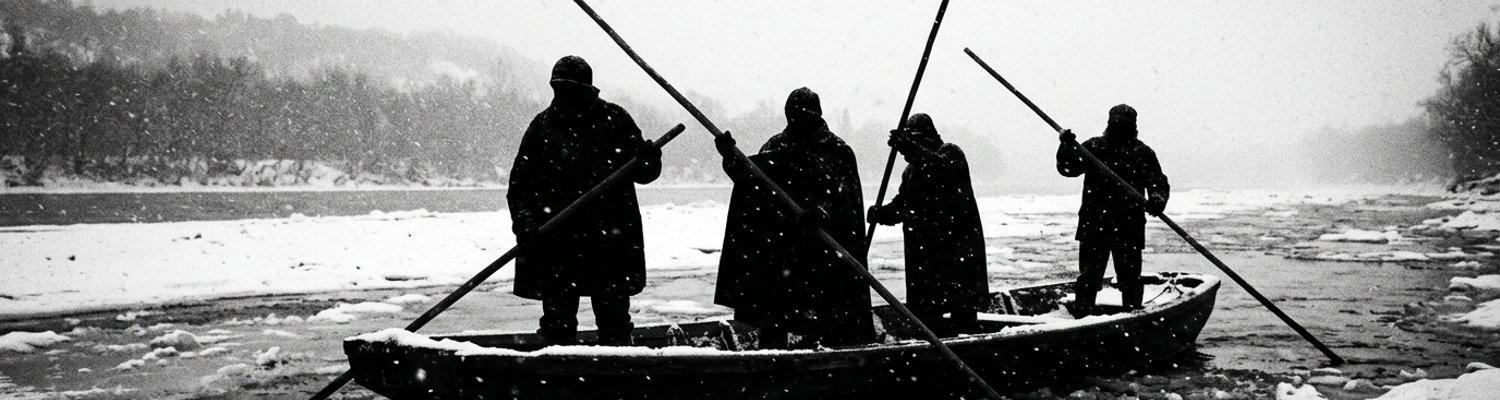
These cables were anchored to heavy oak bollards on both riverbanks. Floating ice floes bore down against these taut guide lines with hundreds of tons of lateral force. The ice threatened to snap the hemp cables or rip the timber stanchions out of the bank. Colonel John Glover's 14th Continental Regiment had to abandon the ferry cable system completely. Glover's Marblehead mariners took up eighteen-foot iron-shod setting poles. They manually fought the crushed ice pans. The sixty-foot Durham boats drifted dangerously close to capsizing in mid-current.
Ice struck the timber hulls with continuous concussive impacts.
A close review of operational logs indicates that this mechanical bottleneck shattered the tactical timeline. The formal operations order drafted by Washington's staff scheduled the entire expeditionary force of twenty-four hundred men, eighteen cannon, and several hundred draft horses to complete the river transit within a four-hour window. That window ended precisely at midnight.
That schedule fell apart within the first ninety minutes.
The loading of Colonel Henry Knox's artillery train caused disastrous delays at the water's edge. Frigid, frightened draft horses refused to step onto the ice-slicked wooden ramps of the flatboats. Animals slipped into the black current. Others kicked out sideboards and splintered wagon tongues. Knox used his heavy voice to guide boat crews across the blinding spray. Each return trip across the eight-hundred-foot river channel required nearly forty minutes instead of the calculated ten. Midnight came and went with less than half of Stirling's infantry landed on the Jersey shore. The last battery of three-pounder field guns and ammunition tumbrils did not clear the Pennsylvania slips until three o'clock in the morning on December 26. The final crossing was pushed three hours past its operational cutoff.
Durham Boat Navigation and Riverine Bottlenecks
Archival evidence shows that the primary transport craft assembled at McConkeys Ferry were forty-ton-capacity Durham iron boats. These vessels were originally engineered to haul bulk pig iron from the Durham Iron Works down to Philadelphia. These double-ended pine and oak hulls measured between forty and sixty-six feet in length with an eight-foot beam. They drew up to thirty inches when loaded. Colonel John Glover's 14th Continental Regiment manned the craft. Glover's Marblehead mariners possessed extensive North Atlantic coastal sailing experience.
The movement of heavy industrial freight craft through riverine drift ice required brutal physical exertion.
Crews of four to six mariners took up eighteen-foot ash setting poles and twelve-foot steering sweeps. Drafted Pennsylvania and Massachusetts infantrymen assisted them along the narrow walking boards lining each gunwale. Men jammed iron-shod poles down into the rocky riverbed gravel. They threw their entire body weight against the wood. They walked from bow to stern to shove each vessel upstream against the six-knot current. Sub-zero spray coated the poles in ice sheets within seconds. Wet mittens slipped along the wood. The friction stripped the skin from their hands.
Poles sheared under ice pressure.
A close review of operational logs indicates that the loading of Colonel Henry Knox's eighteen heavy artillery pieces created a crippling transfer bottleneck. This completely paralyzed the embarkation schedule. Knox's train included light three-pounders, heavy six-pounder iron guns, howitzers, and ammunition tumbrils. These required larger flat-bottomed ferry scows alongside the narrow Durham hulls. Timber loading ramps laid from the frozen gravel slips to boat gunwales measured less than eighteen inches across. Ice coated these untreated oak planks.
Draft horses repeatedly panicked on the slick approach.
Animals reared back into the infantry columns. They splintered wagon tongues against rock outcroppings. Knox positioned himself directly at the water's edge. He used his massive physical frame and loud voice to coordinate gun crews. Men manhandled several-thousand-pound gun carriages up onto the unstable flatboats by hand. Shifting river ice struck the loaded scows broadside. The impacts tore them away from the shoreline before crewmen could lash the carriage wheels to floor timbers. Each artillery piece required nearly twenty minutes to winch aboard and stabilize. This created an unyielding physical backlog of infantry waiting in the snow behind the embarkation point.
Three scows drifted downstream before securing their ropes.
When examining the historical record of regimental movements, infantrymen boarded the Durham boats in packs of thirty to forty men. They packed shoulder-to-shoulder with fixed bayonets held upright. This prevented accidental impalement. The boats possessed no interior seating or decking. Constant collisions with river shelf ice and heavy chop broke through the patched hull seams. Four to eight inches of near-freezing bilge water mixed with river mud and slush flooded the bottoms.
Continental infantrymen stood wedged against gunwales.
They were forced to remain completely motionless in calf-deep freezing liquid throughout forty-minute river transits. Shifting weight risked capsizing the narrow freight hulls in mid-river ice floes. Men had no room to lift their feet from the bilge pool. Prolonged immersion in water hovering at thirty-two degrees Fahrenheit caused acute cold-induced peripheral neuropathy within fifteen minutes. Sensation drained from feet and ankles. The hulls finally ground against the gravel bar at Johnson's Ferry on the New Jersey shore. Soldiers collapsed into the shallow surf. Deadened leg muscles failed to support their body weight.
Dozens crawled on hands and knees across the Jersey mud to clear the landing slip.
Psychological Toll of Delayed Night Landings
A close review of operational logs indicates that the realization of disaster struck the Continental high command on the New Jersey bluff precisely at 0300 hours on December 26. Under the written plan drawn up at Newtown, Washington's staff intended the entire force of twenty-four hundred men to complete the river transit by midnight. They planned to begin the nine-mile march toward Trenton by 0100. A coordinated two-pronged assault under cover of total darkness was scheduled for 0500.
Regimental commanders checked their pocket watches by shaded lanterns at the Johnson's Ferry road junction.
They found that third-line reserve units and Knox's heavy artillery were still struggling across the river ice. The force was three hours behind the operational schedule. Colonel Edward Hand's Pennsylvania riflemen stood shivering in the dark alongside elements of Arthur St. Clair's brigade. They waited on wet gravel while boat crews worked setting poles against drifting floes. Staff officers calculated that reaching the outskirts of Trenton before dawn was physically impossible. The tactical timetable had completely broken down on the water.
Three hours of darkness had vanished.
Archival evidence shows that this delay triggered acute combat panic across the regimental officer corps. They feared the loss of cover and immediate vulnerability to a preemptive counterattack. Field commanders knew that three veteran Hessian regiments under Colonel Johann Rall held fortified positions nine miles southeast. British 16th Light Dragoon cavalry pickets supported them. An advance across open snow-covered roads in full daylight meant sacrificing every element of surprise.
Officers understood the threat of dawn cavalry patrols.
If Rall received warning, German grenadiers could deploy field pieces at sunken road defiles near Birmingham. This would pin the American columns against unfordable creeks. A daylight retreat back across the Delaware was impossible. Durham boats required hours to turn around under ice conditions. Washington conferred in low tones with Greene and Sullivan near the river road. They weighed the disaster of marching forward against the certainty of annihilation on the riverbank. Tactical retreat would bottle up thousands of exhausted infantry on an exposed gravel beach with no artillery cover.
The commanders chose to advance directly into daylight.
Panic spread quietly through the ranks.
When examining the historical record of physical trauma among the Pennsylvania line, severe sensory disorientation gripped the soldiers. These men had remained continuously awake for more than twenty-four hours. Men mustered at noon on Christmas Day had spent the following eighteen hours marching through mud and loading frozen boats. They endured a sub-zero northeast blizzard that drove ice pellets straight into their faces. Prolonged exposure stripped away normal mental processing. Corneal freezing and windburn blurred vision. Infantrymen were unable to distinguish terrain features or follow file leaders along the river trail.
Auditory exhaustion set in.
The relentless roar of forty-mile-per-hour wind gusts and grinding river ice drowned out company orders. Entire platoons halted unexpectedly. Others wandered off the road into drainage ditches. Men experienced micro-sleeps while standing upright in marching columns. They collapsed forward onto the bayonets of the men ahead when their knees buckled. Numbed nervous systems failed to register bodily position. This produced an unsteady gait across the ice-crusted ruts.
Sensory input collapsed entirely.
Log entries from Pennsylvania regimental surgeons document how acute hypothermia amplified this mental breakdown along the river bluffs. Wet wool coats and frozen linen hunting shirts froze rigid against chests and torsos. This restricted breathing and reduced blood oxygenation levels. It compounded sleep deprivation. Company captains in Hand's rifle regiment repeatedly shook enlisted men by their collars. They needed to break catatonic stupors before the column moved inland. Soldiers dropped their flintlocks into snowbanks. They did not notice the missing weight in their frostbitten hands. Tactile senses were deadened. Dozens of infantrymen failed to detect water penetrating their leather cartridge boxes. This ruined paper cartridges and black powder charges as the column formed ranks for the push toward Birmingham.
Sensory Trauma During the Night March to Trenton
Archival evidence shows that the four-mile advance from Johnson's Ferry south toward Bear Tavern degraded into a severe physical ordeal. Wagon traffic and heavy field pieces had churned the red clay roadbed into twelve-inch-deep mud during the early evening hours. The sharp barometric plunge then froze the deep wheel tracks into rock-hard ridges. Private Alexander McCurdy of the 1st Pennsylvania Continental Regiment marched in Captain James Parr's rifle company without shoes. His footwear had disintegrated completely during the November retreat across New Jersey.
The Pennsylvania column pressed inland through the pitch blackness.
McCurdy's bare soles struck these frozen clay edges with every step. The ice tore the skin away and ground gravel directly into deep muscle tissue. Blood dripped from his torn heels and toes into the snow crust. This left an unbroken scarlet trail. Junior officers used this blood trail in the dark to keep rear platoons from straying off the path. Other barefoot riflemen in Hand's battalions suffered identical trauma. They coated the frozen ruts with gore as their exposed feet went numb from mechanical damage.
Blood froze solid against the clay before it could soak into the subsoil.
When examining the historical record of regimental casualties, atmospheric conditions along the Delaware River corridor generated ambient temperatures near twenty-eight degrees Fahrenheit. Sustained thirty-five-mile-per-hour northeast gales drove effective wind chill levels far below zero. Sub-zero wind chills stripped thermal protection from saturated hunting shirts. This triggered immediate peripheral vasoconstriction throughout the ranks. Capillary beds in exposed ears, noses, and fingers shut down. Deadened extremities turned waxy white and brittle within twenty minutes of soldiers clearing the shelter of Jacobs Creek ravine.
Frostbite incapacitated dozens of men in the Pennsylvania Line.
Deep hypothermia brought on acute mental lethargy. This dulled normal survival reflexes. Nerves in the hands ceased firing. Infantrymen lost tactile grip on their wooden gunstocks without registering the loss. Mental functions deteriorated rapidly. Soldiers stopped brushing wind-driven ice needles from their foreheads. Freezing slush sealed their eyelids shut. Their speech slurred into incoherent mumbling.
Fingers stiffened into curled claws that dropped loaded weapons directly into the roadside brush.
A close review of operational logs indicates that extreme sleep deprivation eroded the basic sanity of the advancing force between Bear Tavern and the Birmingham road junction. The men had surpassed thirty-six continuous hours of heavy physical labor. Total sensory fatigue in the howling blizzard triggered persistent waking hallucinations across both rifle companies and line infantry. Pennsylvania soldiers reached out to grasp non-existent fence rails in empty air. They shouted warnings about phantom brick walls blocking the snowbound road. Others stumbled off into frozen marshes in search of imaginary hearth fires.
Company commanders ordered men to close ranks.
To prevent the entire formation from dissolving into the woods, soldiers locked their arms across adjoining shoulders four abreast. Whole files slept while marching. Their boots mechanically churned forward through the freezing mire. Their upper torsos remained propped up against the knapsacks of the men ahead. Knox's artillery pieces stalled at narrow culverts. The locked files collapsed forward in heaps of thirty comatose men.
Officers pulled two dead privates out of the drainage ditches near Birmingham before the column reached the Scotch Road split.
Assault on the Outlying Hessian Pickets
Archival evidence shows that contact occurred at approximately 0800 hours along the Pennington Road. This position sat roughly one half-mile northwest of Trenton's northern boundary. Sleet-blinded scouts from the advance guard screened Major General Nathanael Greene's division. They stumbled directly onto the exterior outpost manned by Lieutenant Andreas von Wiederhold's detachment. These men belonged to the Hessian Fusilier-Regiment von Knyphausen.
Wiederhold held a fortified wooden cooperage shop with twenty-four infantrymen.
An outguard of the 16th Light Dragoons backed this position. The German sentries shouted challenges through the blizzard. They discharged a volley through the sleet. The fire wounded an American lieutenant and killed a flanker. Hand's Pennsylvania riflemen operated alongside the 3rd Virginia under Captain William Washington. They spread out into the timber along the snow-covered fence lines to return fire. Wiederhold observed company-sized masses of Continental troops advancing along his front. He rapidly concluded that his picket was facing an entire division rather than a minor reconnaissance patrol.
The Hessian outguard abandoned the cooperage.
They conducted an orderly fighting retreat southeast down the turnpike. They fired rolling section volleys to alert the main garrison quartered in the town center. The retreat opened the main road into Trenton.
A close review of operational logs indicates that small-arms fire collapsed almost immediately due to mechanical failures inside the infantry locks. Driving sleet had forced moisture past leather hammer-stalls. Water seeped through the canvas flaps of the soldiers' cartridge boxes. This transformed dry black priming powder into an unburnable gray sludge. Soldiers snapped their cock mechanisms forward. Flints struck wet frizzens without producing a spark. Some threw feeble showers of embers that died instantly in saturated touchholes.
Out of every ten attempted musketry discharges across Greene's and Sullivan's columns, fewer than three produced ignition.
Major General John Sullivan sent an urgent courier to Washington. He stated that the troops could not fire their weapons. Washington issued orders directing regimental commanders to push forward with fixed bayonets. Pennsylvania line infantry equipped with French Charleville and British Brown Bess muskets locked their seventeen-inch triangular socket bayonets into place. Hand's riflemen carried Pennsylvania long rifles that lacked bayonet lugs. They drew tomahawks and hunting knives to support the spear-point assault. Officers drove their men into the freezing wind. They ran through deep slush drifts to close with the Hessian rearguard before the defenders could clear their own fouled pans.
The battle turned entirely on cold iron.
When examining the historical record of the urban entry, sustained forty-mile-per-hour gusts and dense blizzard squalls reduced horizontal visibility to less than thirty paces. This created severe disorientation along the northern approaches to King Street and Queen Street. Wind-driven snow masked the layout of the town. The grid turned into a maze of clapboard dwellings, frozen outbuildings, and obscured cross-alleys. Rall's grenadiers scrambled out of their quarters in confusion. They were half-dressed. They attempted to form parade-ground battle lines amidst blinding ice pellets striking their faces.
Captain Alexander Hamilton unlimbered two six-pounder brass field guns.
He positioned them at the high ground where King and Queen Streets intersected. He swept the snowbound corridors with canister shot. Continental platoons fought hand-to-hand across stone doorsteps and behind carriage barns. Pennsylvania infantrymen broke into separated squads. They climbed over backyard garden fences and breached brick cellars to clear German snipers firing from upper-story sash windows. Whirling whiteout squalls swallowed visual markers. American company commanders guided their units strictly by the flash of Hessian muzzle blasts and the sound of artillery fire reverberating through the snowpack. Lieutenant Colonel Francis Scheffer abandoned his two three-pounder brass field pieces in Queen Street. American canister fire had cut down the Hessian artillery horses in their harness traces.
Immediate Combat Fatigue and Post-Battle Shock
Archival evidence shows that the mechanical drop in sympathetic nervous system arousal struck the Pennsylvania regiments instantly. Johann Rall's surviving grenadiers grounded their muskets in the orchard south of town. Men from Colonel Edward Hand's 1st Pennsylvania Regiment shuffled out of the sleet. They pressed their way into the two-story stone Trenton Barracks near Front Street. They sought shelter from the thirty-mile-per-hour wind. Once inside the dry masonry halls, infantrymen did not unbuckle their accoutrements. They did not lean their flintlocks in corners.
They collapsed forward where they stood.
Hundreds of soldiers hit the bare timber floorboards with dead weight. Their limbs folded underneath them as muscular tension vanished. Damp wool waistcoats and shredded trousers froze stiff against the unheated planks within minutes. Captain James Parr found men lying motionless in corridors. Their faces were pressed against muddy pine boards. They were unresponsive to physical shaking. The chemical rush that had sustained their leg muscles through nine miles of frozen mud evaporated completely.
Soldiers lay piled three deep across door thresholds.
They were completely incapacitated by sudden muscular flaccidity. They were unable to crawl another foot toward the abandoned German stoves. Muscles locked into rigid paralysis.
When examining the historical record of regimental surgeons, acute hypothermic crises rapidly overwhelmed the wounded Continental soldiers. These men had been hauled out of the street fighting into unheated structures along Second Street. Field dressings applied in the snow were already soaked through with freezing water. Ice crusts formed over open flesh wounds and compound fractures. Artillery concussions from Hamilton's battery had blown out the window glass in the brick homes and the Presbyterian meeting house. Sub-freezing gale squalls circulated freely across the floorboards where casualties lay.
Medical officers lacked dry firewood to kindle the hearths.
Rain had saturated the external woodpiles. Ambient temperatures remained trapped below twenty-eight degrees Fahrenheit. Severe cold-induced coagulopathy set in across the injured Pennsylvania riflemen. Wounded circulatory systems failed to form stable fibrin blood clots in deep puncture wounds. Peripheral blood vessels dilated erratically before shutting down. Core body temperatures dropped below eighty-eight degrees. Violent shivering gave way to total muscular stillness. Hemorrhagic shock accelerated hypothermic cardiac arrest.
Cold killed wounded men faster than lead balls.
A close review of operational logs indicates that profound autonomic exhaustion paralyzed the tactical readiness of the force. Troops passed thirty-eight continuous hours without sleep or caloric replenishment. The men mustered in the Bucks County woods at daybreak on December 25. They expended their entire physiological glycogen reserve during the river crossings and the forced approach march through the blizzard. Washington issued marching instructions to prepare the nine hundred captured German prisoners for immediate transfer back across the Delaware.
Pennsylvania company commanders discovered their men were neurologically incapable of processing basic verbal commands.
The autonomic nervous system failed to regulate basic homeostasis. Soldiers experienced acute orthostatic hypotension. Men attempting to stand up from wooden benches suffered sudden cerebral ischemia. They fell backward onto the floor. Heart rates dropped to dangerously low resting rhythms. Pupil responses slowed to a crawl. Soldiers stared directly ahead with unblinking glass-like expressions. They were incapable of tracking moving objects or recognizing the voices of their file partners.
Sergeants dragged comatose privates out from under artillery carriages by their coat skirts.
Traumatic Retrograde Crossing Across the Delaware River
Archival evidence shows that by noon on December 26, Washington ordered an immediate retrograde withdrawal across the river. Reports indicated that British Colonel Carl von Donop's force at Mount Holly might sever the retreat corridor. Over nine hundred captured Hessian soldiers from the Rall, Knyphausen, and Lossberg regiments were assembled under armed escort along the Pennington Road. Pennsylvania infantrymen had not slept in over thirty hours. They had to herd these German prisoners north across nine miles of churned snow and refreezing mud back toward Johnson's Ferry.
Driving sleet turned into heavy horizontal snowfall as ambient temperatures plummeted.
Guard detachments from Hand's 1st Pennsylvania Regiment struggled to maintain security perimeters around the prisoner column. They operated with wet muskets that could not fire. Bayonets were carried by men too weak to resist a concerted prisoner mutiny. Hessian officers observed the obvious physical deterioration of their captors. Personal diaries recorded that American sentries swayed on their feet and dropped their weapons into the slush. At Johnson's Ferry, Glover's boatmen forced the prisoners thirty at a time into open Durham boats. German infantrymen stood packed against freezing gunwales. Thirty-mile-per-hour gusts drove waves of river slush over the sides.
Two prisoners drowned when a shifting ice pan crushed the gunwale of an overloaded scow near the Jersey shore.
A close review of operational logs indicates that evacuating the Continental wounded across the river generated a severe mechanical bottleneck. Upstream ice dams had ruptured throughout the morning. Millions of pounds of fractured river ice flowed down into the ferry transit corridor. Ferry flatboats and Durham hulls had to be pushed directly into these grinding ice packs. Exhausted crews wielded eighteen-foot ash setting poles. Casualties were laid flat across the open wooden bottoms of the watercraft. These included men suffering from shattered femurs, chest wounds, and advanced frostbite.
Bilge water in the Durham boats hovered at thirty-two degrees Fahrenheit.
The canvas litters and wool blankets of wounded men were submerged in five inches of freezing slurry. Ice floes struck the wooden hulls with violent force. The impacts jarred compound fractures. They caused uncontrolled hemorrhaging in soldiers whose blood could not coagulate in the sub-zero chill. Crewmen from the Marblehead mariners snapped multiple steering sweeps against the moving floes. Drifting boats were forced hundreds of yards south of the McConkeys slipway into rocky shallows. Wounded soldiers had to be carried ashore by hand through waist-deep ice water.
Surgeons on the Pennsylvania bank ran out of dry linen dressings before midnight.
When examining the historical record of post-mission muster rolls in Bucks County, the retrograde crossing pushed the Pennsylvania Line into complete functional collapse. Once across the river, Pennsylvania soldiers faced a four-mile forced march inland through drifting snow to reach their base camps around Newtown. Men collapsed directly along the road shoulders. They burrowed into snowbanks to escape the gale because their leg muscles refused to contract. Regimental morning returns drafted on December 28 showed that Hand's 1st Pennsylvania Regiment could not muster a single combat-ready platoon.
Remnants of Samuel Miles' and Samuel Atlee's battalions shared this fate.
Over eighty percent of the enlisted personnel were categorized as sick. They were bedridden with severe hypothermia, trench foot, or acute respiratory infection. Soldiers lay motionless in unheated barns and log cabins. Their frostbitten feet were swollen to twice normal size and blackened by tissue necrosis. Company captains reported that surviving men remained in a state of catatonic stupor. They were incapable of standing formation, cleaning fouled rifles, or cooking rations. The brigade was struck from active tactical availability for forty-eight hours. Washington's headquarters near Newtown was left without a functional rearguard while British forces mobilized along the Raritan.
Quartermaster wagons spent forty-eight hours gathering abandoned weapons and unconscious infantrymen from the roads between McConkeys Ferry and Newtown.