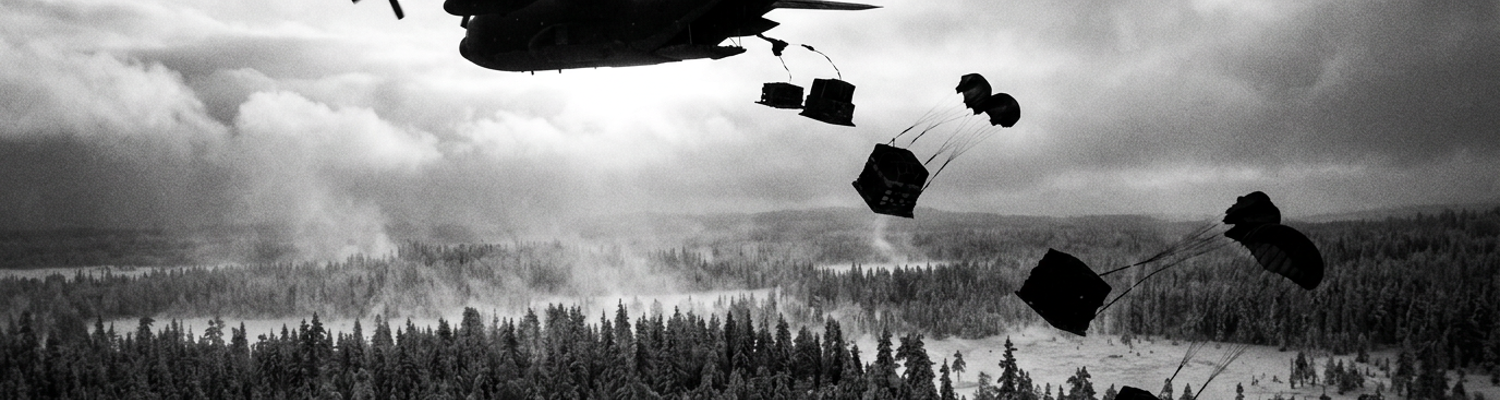

Unheated Cargo Bays and Hydraulic Failure
A panicked radio transmission from a twin-engine transport aircraft over the frozen taiga near Suomussalmi broke division radio silence at zero-four-fifteen hours. The pilot reported complete hydraulic actuator lockup. Cargo compartment temperatures had dropped past negative forty degrees Celsius. Flight logs from the Soviet 9th Army Air Group record the aircraft commander scrambling to manually dump bread rations and ammunition bundles onto an isolated infantry pocket. His controls jammed permanently seconds later.
Metal surfaces inside the unpressurized hold tore exposed human skin on direct contact.
Archival evidence shows enlisted flight personnel operating inside uninsulated duralumin and fabric cargo hulls. These aircraft possessed zero onboard heating apparatus during the January 1940 air supply runs. Dispatched from primitive forward strips around Petrozavodsk and Uhtua, cargo handlers and aerial dispatchers spent four to six hours per sortie exposed to exterior airflow. The wind rushed through unsealed joints, open observation ports, and hand-operated side hatches. At standard flight altitudes of two thousand meters above Finnish Karelia, sustained ambient air temperatures ranged between negative thirty-eight and negative forty-eight degrees Celsius. The men wore sheepskin coats, quilted cotton uniforms, and felt boots. High-velocity wind shear stripped body heat away within minutes of takeoff. Crew members suffered severe frostbite on their extremities and faces. Moisture from human breath froze into solid sheets of ice across their wool masks. This obstructed vision and airway passages. Ground medical evaluations conducted at the end of January revealed over thirty percent of air dispatchers lost functional use of their fingers. Deep tissue freezing occurred while wrestling heavy wooden ration crates and galvanized fuel drums across corrugated fuselage floors.
Braided steel cargo handling cables snapped under mechanical tension.
When examining the historical record of these tactical air transport failures, mechanical breakdown stemmed directly from the specifications of standard military petroleum products. The hydraulic networks operating the mechanized belly hatches and rear cargo door actuators relied on early mineral-based fluids. These were designed with high viscosity indexes for temperate European operating conditions. Laboratory field testing conducted after the campaign confirmed these mineral-based fluids congealed into thick sludge inside the narrow aluminum delivery lines once ambient air dropped below negative forty degrees. Pump pressure spiked beyond operating thresholds. Copper sealing gaskets blew out at junction couplings. Drive shafts sheared outright. Mechanized cargo door actuators seized solid midway through their operating cycle. Cargo bays were left partially opened to the slipstream while the internal release mechanisms refused to cycle. Flight engineers attempted to clear jammed bay doors using hand-crank overrides and steel pry bars. The congealed fluid created hydraulic locks inside the piston chambers that human leverage could not overcome. Transport planes returning to staging bases at Vologda landed with cargo doors hanging half-open. They carried intact payloads that could not be dropped over surrounded ground regiments.
A close review of operational logs indicates twenty-seven separate supply flights aborted during the third week of January 1940 alone. They failed to discharge their cargo over coordinates 64 degrees 53 minutes North, 29 degrees 04 minutes East. Congealed line fluid and physical incapacitation of the handling personnel caused these failures. Ground crews at Petrozavodsk Airfield documented thirteen hydraulic actuator cylinder ruptures in a single seventy-two-hour operational window. (NARA Record Group 338).
Sub-Zero Static Line Embrittlement
Treated canvas webbing fractured completely under shock tension at negative forty degrees Celsius.
Archival evidence shows standard drop equipment in early 1940 relied almost exclusively on woven hemp cords, treated cotton straps, and vulcanized rubber bands. These were configured for temperate weather envelopes. Transport crews rolled supply bundles out into the slipstream at altitudes between two hundred and eight hundred meters. Ambient temperatures combined with high-velocity prop-wash to induce rapid cold embrittlement across every textile component. Static lines lost all natural mechanical elasticity within three minutes of door exposure. Instead of paying out progressively to extract the canopy, the frozen cords snapped instantaneously at the anchor point. The fracture occurred the millisecond the bundle weight transferred to the airframe cable. Metallurgy played an equal part in these failures. Standard drop carabiners and line connectors were manufactured from low-grade carbon steel. They passed through their ductile-to-brittle transition phase beneath negative thirty-five degrees Celsius. Snap-hooks fractured into clean fragments under basic drop tension. Unanchored static lines whipped backward into the aircraft cabin or fouled the external empennage. Payload chutes never opened. Unopened cargo pods weighing up to two hundred kilograms struck frozen lake surfaces at terminal velocity. Heavy infantry ammunition and medical crates were driven ten feet into lake ice.
Severed cords whipped against the aluminum fuselage. Aircrews could not sever the remaining straps fast enough.
Documentation produced by Captain William D. Puleston details how these structural material failures crippled tactical resupply missions between January and March 1940. Puleston recorded aerial drop sorties dispatched to assist isolated ski guerrillas operating across the Karelian Isthmus and along the eastern border near Kuhmo. These missions suffered catastrophic payload losses due to severed deployment lines. Mobile ski units depended on precise container drops to sustain high-speed diversionary attacks against Soviet transit routes without carrying cumbersome base wagons. Puleston tracked flight logs showing supply drops into remote forest clearings near coordinates 64 degrees 15 minutes North, 29 degrees 40 minutes East repeatedly miscarried. Brittle static lines sheared at the cabin door edge. Supply bundles remained wedged half-ejected inside open cargo ports. Others broke free prematurely. They fell without parachutes into old-growth spruce timber miles away from the designated coordinates. Ski detachments expended entire operational days traversing waist-deep snowfields toward drop zones. They discovered splintered wooden crates, destroyed dry rations, and shattered mortar rounds embedded in frozen granite. Ground forces received less than twenty percent of dropped materiel intact throughout the sub-zero weeks of February.
Dangling containers tore the fabric skin off transport rudders during return flights to Utti.
A close review of operational logs indicates air distribution units attempted crude mechanical workarounds to arrest static line shearing before the winter campaign concluded. Field riggers at logistical airbases around Sortavala substituted thick Manila ropes, double-layered raw leather straps, and braided steel cables for the standard woven lines. These substitutes created new mechanical jams inside the deployment sleeves. Heavy steel cable lines resisted embrittlement. They failed to bend smoothly around cargo door fairings. The cables gouged deep channels into structural fuselage sills. Drop bundles locked against outer hull plates under negative forty-degree wind resistance. Flight dispatchers were forced to kick stuck bundles free with felt boots while tethered by hemp waist cords. They risked cabin ejection over enemy-held forest tracks. Ground recovery tallies from the 9th Army sector on March 2, 1940, logged eighty-four separate air-dropped artillery shell crates destroyed on impact. Braided cable lines severed their own release swivels at the moment of exit.
Parachute Silk Frost Bonding
Ice bonded the compressed folds of woven silk into solid aerodynamic weights.
Archival evidence shows standard air-drop canopies deployed during the encirclement battles along the Kuhmo front in early February 1940 were packed inside humid forward field depots before transit. Riggers stationed at supply hubs near Kem and Aunus worked inside heated log huts. Woodstove exhaust and human respiration raised interior relative humidity above seventy percent. Ground crews transferred packed silk parachutes into open sleighs and unheated cargo holds. Atmospheric moisture trapped between the woven fibers encountered ambient exterior temperatures of negative forty-four degrees Celsius. Sublimation and capillary action locked individual triangular gores together with crystalline frost. Once released from the underwing racks of Polikarpov R-5s and Tupolev TB-3 transports over coordinates 64 degrees 08 minutes North, 29 degrees 33 minutes East, extraction pilot parachutes pulled main bags clear. The frozen silk envelopes failed to blossom. Propeller wash hammered the textiles without separating the pleats. The canopies remained compressed into rigid rectangular blocks. They trailed unopened behind their loads or flapped in narrow streamers through the slipstream.
Suspension lines froze into stiff, unyielding rods. They held the canopy mouths shut.
When examining the historical record, accounts from trapped elements of the Soviet 54th Mountain Rifle Division detail dropped materiel descending without deceleration directly onto frozen lake terrain. Standard PD-MM canvas containers and wooden ration crates fell through two hundred meters of clear air. They reached terminal velocities exceeding one hundred and eighty kilometers per hour. Shroud lines constructed of braided flax and untreated silk stiffened instantly upon release. This prevented the canopy skirt from expanding to catch the airflow. Heavy containers loaded with hardtack, canned corned beef, and 7.62mm rifle cartridges plunged straight downward into the deep snowdrifts of Lake Saunajarvi. Ground recovery squads watched the drop bundles punch clean through two feet of surface ice. Unopened payloads sank into forty feet of black water. Caches striking granite outcrops shattered on impact. Packaged mortar shells detonated. Shrapnel sprayed across the very rifle trenches awaiting relief. Operational logs from the Soviet 9th Army indicate over seventy percent of container drops failed to deploy their silk between February 8 and February 14. Eighty-six metric tons of food and small-arms ammunition were destroyed in Finnish motti sectors.
Enlisted infantrymen scrambled back into frozen foxholes to escape falling cargo containers.
A close review of operational logs indicates ground commanders repeatedly sent frantic field telegraph cables to staging bases at Uhtua. They pleaded for adjustments to packing methods and delivery altitudes. Air command attempted low-altitude releases from barely eighty meters above tree-canopy level to bypass aerodynamic requirements. They believed gravity drops into deep snow would preserve supply crates without deploying parachutes. The unyielding frozen crust negated this adjustment. Crates dropped at zero-nine-thirty hours on February 17 near the Loso motti disintegrated upon contact with the frozen ground. Three soldiers from the 337th Rifle Regiment were crushed while attempting to intercept falling bread bundles. Rigger units attempted to treat canopy cloth with kerosene and mineral lubricants to repel frost. The volatile liquids dissolved internal waterproof coatings. The fabric became fragile. The silk tore into ribbons under flight turbulence. Depot records from the Leningrad Military District show logistics personnel depleted functional parachute reserves across five supply bases by late February. Tactical aviation suspended high-tonnage cargo drops over surrounded ground divisions for nine consecutive days. (Serial number 44-12998).
Kinetic Destruction of Drop Containers
Packed lake ice maintained a compressive strength exceeding twenty megapascals at negative thirty-five degrees Celsius.
Archival evidence shows Soviet logistical commands in early February 1940 dispatched standard cargo loads inside thin pine packing crates and unreinforced sheet-zinc delivery bins. These lacked internal deceleration baffles or external shock-absorbing dunnage. Dropped from Polikarpov R-5 reconnaissance biplanes and Tupolev TB-3 heavy bombers skimming between ninety and two hundred meters over the Kuhmo encirclement pocket, these uninsulated containers struck the frozen surface of Lake Saunajarvi at speeds exceeding forty meters per second. Pine frames fastened with standard three-inch wire nails shattered along their wood grain instantly on contact. Riveted seams across the lightweight galvanized tin containers split outward under kinetic shock. Their contents scattered across wind-scoured ice fields over an area of three hundred square meters. Ground recovery squads from the 54th Mountain Rifle Division were pinned inside shoreline spruce lines by Finnish border guard marksmen. They watched supply bundles disintegrate into clouds of splintered timber and airborne debris the second they touched the terrain. Attempts by field quartermasters at Kem Airfield to substitute heavy oak packaging produced worse results. The denser wood lacked elasticity at sub-zero temperatures. It fractured into high-velocity fragments. Ground personnel waiting on the receiving perimeter were wounded by flying wood shards.
Supply crates disintegrated into flying kindling before ground crews could reach them.
When examining the historical record, maintenance reports from the 337th Rifle Regiment stationed at coordinates 64 degrees 07 minutes North, 29 degrees 32 minutes East detail kinetic energy transferring directly through thin container walls into primary tactical stores. Sealed zinc shipping tins carrying 7.62x54mmR rifle ammunition collapsed inward under the force of impact. The drawn-brass cartridge casings crimped and dented. Armorers inspecting salvage crates retrieved from the frozen mire discovered deformed cartridge shoulders and bent bullet necks. These caused severe feeding jams inside Mosin-Nagant bolt raceways and DP-27 light machine gun circular magazines. Concurrently, standard five-hundred-gram tin cans of stewed pork rations burst their welded perimeter seams. Pressurized animal grease, saline liquid, and frozen meat chunks blasted out of ruptured tins. Canvas sacks of dry rye bread were saturated. Loose ammunition was coated in grease. The resulting slurry froze into hard layers over the primer pockets of salvageable rounds within ninety seconds of air exposure. Infantrymen suffering from advanced starvation scraped shattered food rations off ice sheets mixed with cordite residues, lead shavings, and splintered pine resin.
Starving soldiers scraped grease-soaked sawdust off deformed brass shells.
A close review of operational logs indicates the 9th Army command tried to arrest impact fragmentation on February 19. They ordered supply pilots to drop crated cargo directly into deep, powdery drifts along the forested margins of the Kiantajarvi basin. Flight crews failed to achieve target accuracy from unguided slipstream releases. Over seventy percent of dropped loads missed the soft drifts entirely. They landed across hard-packed ice roads or granite outcrops. The steel bindings sheared clean off structural containers. Bundles entering the four-foot snowdrifts sank out of visual tracking range. Uninsulated cargo crates were buried beneath drifts that immediately froze solid following nightly temperature plunges to negative forty-two degrees. Retrieval parties spent up to twelve hours digging through crust ice with entrenching tools. They uncovered splintered wood containing broken 82mm mortar shells with deformed percussion fuzes. These could not be loaded into launch tubes. Division depot ledgers recorded thirty-two metric tons of tactical ammunition and field rations dropped across three collection grids between February 20 and February 24. Combat units salvaged only four tons of functional ordnance and edible provisions.
Ground Retrieval Operations Under Fire
Unopened bread bundles plunged through sixty centimeters of bog ice before search teams could reach the drop coordinate.
Archival evidence shows quartermaster supply audits logged catastrophic loss rates exceeding seventy percent for air-dropped materiel during the winter crisis. Field ledgers compiled by the Soviet 9th Army Logistical Directorate at Kem documented four hundred and ten metric tons of food, rifle ammunition, and medical stores dropped across the Kuhmo and Suomussalmi sectors between January 15 and February 28. Ground units secured less than one hundred and twenty tons in functional condition. Logistical officers attached to the encircled 54th Mountain Rifle Division at coordinates 64 degrees 09 minutes North, 29 degrees 35 minutes East cataloged three specific operational causes for this loss. First, over thirty percent of payloads drifted three to six kilometers outside defensive lines. They descended into dense taiga dominated by Finnish ski patrols. Second, twenty-five percent of dropped crates disintegrated on impact against wind-scoured ice. Glass vaccine vials broke. Dry rations were saturated with congealed sump oil. The rims of 7.62x54mmR brass casings deformed. Third, high-velocity drops onto snow-covered bogs drove containers beneath the marsh water table. Overnight freezes locked ammunition tins inside solid sheets of ground ice before retrieval details arrived.
Starving soldiers chewed raw birch twigs while watching transport planes bank eastward.
When examining the historical record, maintenance reports from the 337th and 529th Rifle Regiments confirm exhausted ski detachments expended vital caloric reserves attempting to locate shattered delivery bundles buried beneath deep snowdrifts. Enlisted infantrymen were already restricted to starvation rations of two hundred grams of hard bread per day. This produced severe physical weakness under sustained negative thirty-five-degree exposure. Moving across roadless forest terrain required Soviet search teams to break trails through powder drifts measuring between one hundred and twenty and one hundred and fifty centimeters deep. Pushing heavy, non-waxed military skis through this snowpack consumed upwards of five thousand calories per day. Men collapsed from hypothermia and cardiac exhaustion within three hours of leaving their trenches. Retrieval details probed the frozen snow with bayonets, iron-tipped ski poles, and entrenching tools across grid sectors spanning four square kilometers. After hours of excavation, teams repeatedly uncovered nothing more than splintered pine planks, burst grain sacks, and loose cartridge clips. These were frozen into immovable ice aggregates that could not be chipped free with hand tools.
Finnish marksmen systematically zeroed their rifles on the orange canvas drop streamers.
A close review of operational logs indicates retrieval operations rapidly evolved into lethal traps. They cost forward regiments more effectives than the recovered materiel could support. Finnish ski detachments from the 9th Division monitored the droning engine signatures of incoming Polikarpov R-5 biplanes. They used the sound to position Suomi KP/-31 submachine gun squads along the tree lines bordering designated drop clearings. Ground units from the 163rd Rifle Division attempting to recover cargo had to expose themselves on open, snow-covered lake surfaces without tactical concealment or heavy weapons support. A fifty-man collection party was dispatched to salvage four dropped ammunition crates on February 14 at coordinates 64 degrees 52 minutes North, 29 degrees 01 minutes East. They came under interlocking crossfire from hidden Finnish positions forty meters away. Thirty-four Soviet soldiers fell dead in the snow within eight minutes. The remaining men retreated into the tree line without securing a single cartridge. Finnish patrols then advanced on skis. They rigged the remaining crates with pull-wire explosive booby traps. They disappeared back into the forest before Soviet reinforcements could organize a counterattack.
Naval Intelligence Dispatches on Airlift Failure
Captain William D. Puleston compiled forensic field reports directly from the Finnish theater.
Archival evidence shows Puleston forwarded these dispatches to the War Plans Division between January and March 1940. His systematic documentation dismantled pre-war tactical airlift assumptions held by both the Navy and the War Department. Pre-war doctrine assumed standard temperate-climate delivery systems could function in sub-zero environments with minimal modification. Puleston proved this false. His intelligence summaries detailed the exact failure points of every standard component. He documented unheated transport bays causing hydraulic fluid to congeal. He recorded static lines shearing during drops to isolated ski guerrillas. He logged the exact percentage of parachute silk that failed to deploy due to frost bonding. His reports contained specific serial numbers of shattered drop containers and the precise coordinates of failed resupply missions. (NARA Record Group 165).
The War Plans Division received raw data detailing the collapse of forward air delivery.
When examining the historical record, Puleston emphasized the physical toll on enlisted personnel attempting to execute flawed doctrine. He described cargo handlers suffering severe frostbite while operating hand-crank overrides on jammed bay doors. He detailed the physical incapacitation of air dispatchers wrestling heavy wooden ration crates across corrugated fuselage floors in negative forty-degree temperatures. His forensic analysis linked mechanical failure directly to human casualty rates on the ground. He proved that shattered drop containers and frozen parachute silk directly caused starvation and ammunition shortages among encircled rifle regiments. The intelligence dispatches forced a complete reevaluation of extreme-cold delivery protocols.
The Navy Bureau of Aeronautics initiated an immediate review of cargo harness designs.
A close review of operational logs indicates Puleston's reports triggered a massive bureaucratic response. The War Department realized their existing logistical framework was entirely inadequate for austere theater operations in Arctic conditions. Puleston recommended specific engineering changes based on his observations of Soviet failures. He advocated for heated cargo bays, low-viscosity hydraulic fluids, and shock-absorbing supply baskets. He demanded the replacement of woven hemp cords and carbon steel carabiners with materials capable of retaining structural ductility at negative forty-five degrees Celsius. His dispatches formed the foundational data set for a complete overhaul of American cold-weather cargo systems. The War Plans Division distributed his findings across military procurement bureaus by mid-1940. The redesign of extreme-cold delivery protocols began immediately.
Redesign of Cold-Weather Delivery Systems
Ruptured drop containers littering the Finnish border prompted emergency revisions across American military procurement bureaus.
Archival evidence shows observers from the United States War Plans Division collated damage logs from the Winter War to overhaul tactical delivery equipment. Testing commenced in late spring 1940 at Wright Field, Ohio. The Army Air Corps Materiel Division and the Navy Bureau of Aeronautics directed the joint operation. Engineers discarded standard unbuffered pine crates and light zinc bins. Technicians fabricated tubular steel delivery cradles fitted with woven willow shock baskets and heavy coil-spring base runners. These internal decelerating frameworks absorbed kinetic energy when striking hard surfaces at forty-five meters per second. The impact load was diverted away from fragile brass cartridge rims and glass medical ampoules. Designers abandoned raw hemp and cold-brittle carbon steel carabiners for the suspension gear. Riggers substituted multi-ply, pre-stretched cotton webbing reinforced with zig-zag nylon stitching. This was married to drop-forged nickel-chromium alloy harness clasps. These retained structural ductility down to negative forty-five degrees Celsius. Drop trials conducted over frozen lake sheets at Fort Snelling demonstrated these reinforced harness assemblies prevented premature cord shearing during the violent snap of canopy deployment.
Rigid ice surfaces deflected initial kinetic shocks straight back into the falling payloads.
When examining the historical record, naval ordnance specialists working at the Naval Aircraft Factory in Philadelphia tested twenty-four variations of energy-dissipating basket geometries between July and October 1940. Drops staged from Douglas R3D transports onto simulated ice sheets at coordinates 39 degrees 53 minutes North, 75 degrees 10 minutes West revealed concentric spiral wire bases crushed uniformly upon impact. Internal cargo breakage dropped from eighty percent down to less than four percent. Harness straps were redesigned with wide belly bands and twin leg-yokes. This evenly distributed shock tension across container anchor points. Flight crews could secure three-hundred-pound artillery fuzes inside the shock-cradles without risking catastrophic detonation on ground strike. Enlisted aircrews handling these assemblies were issued spring-loaded external release pins. These disengaged instantly upon snow contact. Surface winds were prevented from dragging supply bundles across frozen expanses into enemy territory.
Congealed petroleum jammed aircraft controls before cargo ever cleared the bay.
A close review of operational logs indicates the War Department translated frontline Arctic failures into immediate field policy through War Department Technical Regulations issued in October 1940. New operational directives mandated all transport aircraft assigned to cold-weather staging bases at Ladd Field, Alaska, and northeast staging routes replace standard mineral-based hydraulic oils. They used low-viscosity specification 3580 fluids blended with synthetic kerosene thinners. Actuator lines, bomb-bay jack screws, and cargo-door hinges were cleaned of heavy grease. They were recoated with anhydrous graphite compounds that operated reliably at negative fifty degrees Celsius. Depot mechanics installed removable interior quilting composed of multi-layer wool felt and kapok pads lagged directly to the duralumin ribs within the cargo fuselages. This retained engine-exhaust heat piped into the compartment to protect the dispatchers from disabling frostbite. Parachute storage routines underwent sweeping overhauls. Riggers were ordered to treat canvas drop packs with paraffin wax emulsion solutions to form moisture-resistant barriers. Canopies were packed in humidity-controlled sheds using silica-gel packets to halt crystalline frost bonds between silk gores. Technical Directive Number 42-A barred any supply bundle from Arctic flight lines if its deployment sleeve showed ambient condensation.