
Eastern Sea Frontier Command and Supply Chain Deficits
Long before an aircraft engine turned over above the Delaware Capes in early 1942, sleep deprivation broke down the physical capacity of the ground personnel. Ground mechanics and flight crews stationed across Cape May and Delaware Bay pulled nineteen-hour work rotations on three hours of rest. They slept in unheated coastal barracks. Ocean frost caked the interior floorboards. Food supplies failed to arrive over snowed-in roads. Flight crews subsisted on cold tinned lard and weak coffee. Men marched several miles each morning over frozen salt-marsh tracks between scattered dispersal areas. Sub-zero North Atlantic gales split their skin open. Physical exhaustion settled into their joints before anyone climbed into a flight suit.
Hunger and winter cold weakened coastal personnel before the first combat sorties launched.
When examining the historical record of Eastern Sea Frontier headquarters at 90 Church Street in New York, the breakdown of command planning appears extensive. Vice Admiral Adolphus Andrews and his staff officers enforced rigid theoretical sailing schedules for commercial oil tankers without providing naval escorts. Headquarters directed merchant tankers to follow narrow geographic lines past Five Fathom Bank and the mouth of Delaware Bay on strict calendar intervals. This created predictable corridors. German Type IX submarines exploited these routes daily. Tanker masters received orders to proceed without deviation across waters that Andrews knew lacked protection. Frontier command withheld supply releases from the frontline air squadrons assigned to sweep those same waters. Archival evidence shows coastal units submitted urgent requests for basic supplies. Headquarters denied distribution authorizations for 100-octane aviation fuel and pure isopropyl de-icing alcohol. Depots stored the supplies inland. Ground crews at Naval Air Station Cape May watched their Grumman J4F-1 Widgeons and Vought OS2U Kingfishers sit disabled under winter storms. Carburetor air intakes clogged with slush. Ice accretions on the wings remained uncleaned. Early morning coastal sweeps grounded before the planes could leave the apron.
The naval high command prioritized bureaucratic paper reserves over combat readiness on the flight line.
A close review of operational logs indicates that coastal air detachments suffered severe failures within their ordnance supply chains. Units operating near the Delaware Capes faced shortages of functional air-dropped depth charges. They relied on backlogged rail shipments of Mark 17 and Mark 6 munitions. These arrived with missing components. Depots dispatched depth charges fitted with defective Mark 6 hydrostatic pistols. The internal brass bellow springs rusted or seized during storage. This prevented water pressure from depressing the firing pin at shallow twenty-five-foot settings. In drop tests and documented patrol runs, these weapons struck the water and sank straight to the bottom without detonating. Ammunition boxes regularly arrived without the required brass Mark 1 arming wires and safety release pins. Ground armorers scoured local civilian supply sheds for baling wire and uninsulated copper scraps. They rigged makeshift manual lanyards onto external bomb shackles. They attempted to stop armed 325-pound TNT cylinders from tearing free prematurely during rough water landings.
Operation Drumbeat and Cape Henlopen Vulnerabilities
When examining the historical record of Atlantic coastal defense in early 1942, the exposure of merchant shipping off the Delaware Capes originated directly on the mainland. Civil leaders across Rehoboth Beach, Lewes, and Bethany Beach refused to impose mandatory light extinguishments along their shorelines. They argued that darkening boardwalk illumination and seaside hotel facades would destroy spring resort commerce. Unshielded vehicular traffic moved along Delaware Route 14. High-beam headlights threw illumination across the sand bars. Municipal streetlamps and brightly lit beachfront properties spilled electric glare directly into the ocean mist. This unshielded terrestrial glow created strong atmospheric backscatter. It extended up to twenty miles east of the Cape Henlopen spit at 38 degrees 48 minutes North, 75 degrees 06 minutes West. Watch officers standing on the bridge casings of surfaced Kriegsmarine Type VII and Type IX submarines converted this civic lighting into a firing aid. Lookouts peering landward through 7x50 Zeiss Doppelfernrohr binocular sets registered vessels caught between the submarine and the coast. Commercial tankers moving through the offshore shipping lanes appeared in hard silhouette. They presented black profiles against the bright western horizon.
Civic power grids aimed the German torpedo tubes.
Archival evidence shows how Type VII and Type IX ocean-going submarines exploited this backscatter to sink merchant tonnage without needing star shells or surface search radar. Between 0214 and 0219 hours on February 14, a single five-minute window defined the destruction of unescorted traffic passing Five Fathom Bank. Running on surface diesel power four miles east of Hen and Chickens Shoal, a German watch officer tracked a solitary steam tanker. The ship carried sixty thousand barrels of crude fuel toward the Delaware River refineries. The merchant master operated under peacetime procedures. He burned white masthead navigation lamps and ran in a straight line at ten knots. Below the conning tower hatch, the submarine firing officer entered the visual bearing, target speed, and estimated angle of deflection into the electromechanical Vorhaltrechner calculator. This unit automatically aligned the gyro steering systems inside two forward G7a steam-gas torpedoes. At 0218, high-pressure air expelled both weapons from the bow tubes. Traveling at forty knots at a preset depth of fourteen feet, the torpedoes struck the unarmored hull plates alongside the main propulsion space.
Detonating warheads breached the vessel from keel to superstructure.
A close review of operational logs indicates that these sinkings occurred in full view of local Delaware residents and harbor defense detachments. Soldiers manning the concrete fire-control towers of Fort Miles on Cape Henlopen recorded the shockwaves rattling their optical sighting gear. Sound-ranging equipment confirmed the hits seconds later. Ruptured petroleum compartments ignited instantly. Flames reached hundreds of feet into the night air and illuminated the barrier dunes in bright orange light. Along the beach bluffs of Lewes and Rehoboth Beach, civilians gathered on the sand to watch loaded tankers founder four miles offshore. The hulls cracked under fires exceeding one thousand degrees Celsius. Merchant crewmen abandoned ship without naval escort support. They struggled to launch wooden lifeboats into burning fuel slicks drifting directly toward the breakers. Surviving tankers scattered into the shallow shoals of Delaware Bay. German commanders held their surface positions to recharge battery banks on auxiliary diesel compressors.
Patrol records from the Fourth Naval District confirm that dozens of commercial hulls went down between Cape May and the Virginia Capes during the height of Operation Drumbeat. U-boats operated with near total tactical freedom across these shallow coastal transit lanes. Naval authorities lacked escort vessels to screen the channel. Salvage tugs and small Coast Guard cutters retrieved burned survivors and recovered corpses washed up along the Lewes shoreline. German submarine commanders expended their full torpedo allocations against these unescorted tankers before using their deck guns on remaining hulks. They fired 88-millimeter and 105-millimeter high-explosive shells until cargo holds flooded and the keels settled into thirty fathoms of coastal water.
Frontline Maintenance at Delaware Breakwater
When examining the historical record of coastal patrol operations at Delaware Breakwater, maintenance logs show how quickly North Atlantic seawater dismantled naval airframes. Moored along the inner stone barrier off Lewes at 38 degrees 47 minutes North, 75 degrees 09 minutes West, Vought OS2U-3 Kingfishers and Grumman J4F Widgeons of the Fourth Naval District took direct ocean spray. This corroded external electrical assemblies within forty-eight hours. Salt crust destroyed terminal junction boxes. It cracked the neoprene ignition lead jackets on the 450-horsepower Pratt and Whitney R-985 radial engines. Factory-specified replacement harnesses from naval supply depots in Philadelphia sat backlogged on rail sidings sixty miles away. Faced with grounded aircraft during active U-boat patrols, squadron engineering officers authorized mechanics to forage through rural Sussex County. Enlisted flight mechanics took stake-bed trucks across the gravel routes connecting Milton, Harbeson, and Georgetown. They systematically scoured barn workshops for salvageable civilian hardware.
Standard military supply lines did not exist on the breakwater.
Archival evidence shows that ground personnel dismantled commercial farm trucks, stationary irrigation engines, and combine harvesters to source conductive components. Aviation Machinist Mates extracted heavy-gauge copper grounding wire, Delco-Remy six-volt automotive relays, and porcelain-jacketed terminal blocks from retired tractors. Returning to the drafty seaplane hangars at the Lewes naval section base, technicians cut the salvaged wire to measure. They stripped farm-grade insulation with pocketknives before dipping copper strands into molten lead-tin solder. Mechanics modified automotive brass flare nuts and threaded fuel fittings using hand files. This allowed the parts to seat flush against aeronautical fuel feed lines. Ground crews sealed modified distributor caps with layers of melted farm paraffin and black friction tape. They wrapped exposed spark plug leads to block ocean brine from shorting magneto circuits during rough open-water takeoffs.
Cold weather crippled the fixed fueling infrastructure and electrical service across the harbor pier. Sub-zero gale winds froze condensation inside underground aviation fuel distribution pipes. Mechanical rotary wobble pumps locked in solid ice. Aircraft storage batteries lost chemical charge under temperatures dropping to ten degrees Fahrenheit. Starter coils lacked enough electrical current to trip the Eclipse inertia flywheels. Flight crews scheduled for dawn submarine sweeps faced a dead flight line. Engines had to turn over before the patrol departure window closed.
Dead batteries grounded armed patrol planes at the ramp.
A close review of operational logs indicates ground personnel solved this paralysis by commandeering civilian Farmall Model M and John Deere Model A agricultural tractors from neighboring Lewes dairy farms. Naval mechanics backed the tractors directly up to Kingfisher floatplanes on the timber haul-out slipways. Enlisted personnel welded custom steel brackets onto the tractor chassis. They mounted salvaged commercial high-output vehicle generators connected by flat canvas drive belts to the rear power take-off shafts. Mechanics threw the tractor hand clutches to spin the take-off splines at five hundred revolutions per minute. This fed direct electrical current through heavy jumper leads straight into the Kingfisher starter motors. Ground teams coupled secondary tractor belt drives to rotary centrifugal water pumps stripped from irrigation rigs. Running heavy rubber suction hoses into fifty-five-gallon drums of 100-octane fuel, the tractor-driven pumps forced aviation gasoline up into overhead wing fuel tanks at forty gallons per minute. This bypassed the frozen shoreline pipelines entirely.
Between 0412 and 0417 hours on February 14, this tractor assembly spun the frozen inertia flywheel of Kingfisher BuNo 5384 to operational cranking speed.
Five-Minute Turnaround and Flight Line Hazards
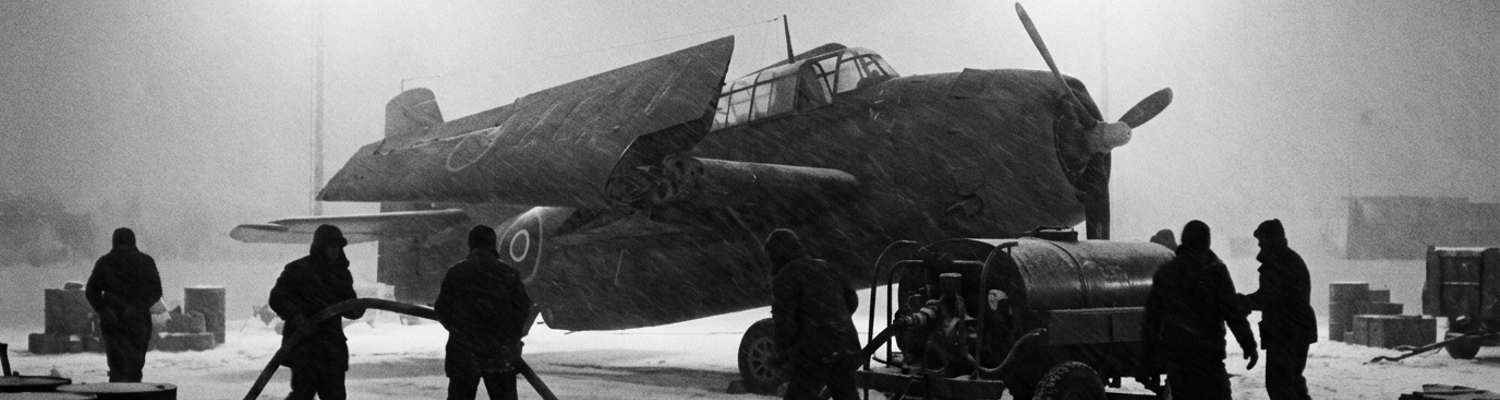
Archival evidence shows that at 0541 hours on February 18, 1942, an incoming emergency contact report from an offshore observation blimp forced an immediate scramble at Naval Air Station Cape May. The facility sat at 38 degrees 56 minutes North, 74 degrees 54 minutes West. A gale-force squall drove ocean sleet horizontally across the concrete apron at forty knots. Ambient air temperatures dropped to eight degrees Fahrenheit. Ground technicians assigned to the coastal patrol detachment had to prepare an armed Douglas TBD-1 Devastator torpedo bomber. The aircraft had just touched down on empty reserve tanks. Glaze ice two inches thick caked the aircraft wing roots, fuselage skins, and the exposed gravity-feed fuel lines running from external storage drums. Mechanics from the station maintenance pool used bronze scrapers and blunt wooden mallets to chip ice chunks away from frozen brass shutoff valves mounted on the auxiliary fuel carts. Under the sub-zero windchill, vulcanized synthetic rubber hoses grew rigid and brittle. They split along their seams when ground personnel bent them toward the aircraft wing fill necks. Flight crews wrapped burlap sacking soaked in warm engine oil over the cracked hose jackets. They secured the leaks with twisted wire to stop aviation gasoline from spraying across the freezing airframe.
Sleet froze human skin directly to bare metal within seconds of contact.
When examining the historical record of Atlantic coastal operations, naval safety protocols strictly prohibited servicing any aircraft while an engine was turning over. Servicing an airframe loaded with live ordnance carried even stricter bans. Lieutenant Commander operational directives from Eastern Sea Frontier headquarters superseded those safety rules that morning. With a surfaced German submarine reported four miles east of Hereford Inlet, the flight crew kept the bomber Wright R-1820-02 radial engine running at idle speed. This prevented the carburetor butterfly valves and cylinder banks from freezing solid. Slung beneath the aircraft belly on an external Mark 5 release rack hung an armed Mark 13 aerial torpedo packed with four hundred pounds of Torpex high explosive. The spinning two-blade propeller whipped freezing prop-wash, sleet, and raw exhaust sparks directly across the work area. Four enlisted mechanics climbed onto the slick metal wings. They operated hand-cranked rotary barrel pumps mounted on fifty-five-gallon drums rolled up on wooden dollies.
Ground mechanics bypassed standard naval fire precautions to keep the radial engine turning.
A close review of operational logs indicates the entire manual hot-refueling sequence took place in a window of 288 seconds. Between 0541 and 0546 hours, ground crewmen pumped one hundred and twenty gallons of 100-octane aviation fuel directly into the main fuselage and wing center-section tanks by hand. Two Aviation Machinist Mates cranked the manual pump levers at eighty strokes per minute. Their gloves soaked with leaking high-octane gasoline that blistered their hands in the freezing wind. Another technician stood on the icy port wing root. He used an uninsulated iron screwdriver to hold down the internal tank baffle flap while securing a braided copper grounding wire against the unpainted wing spar. This prevented static discharge sparks. Down on the slush-covered concrete, the lead petty officer checked the torpedo nose pistol and visual arming bracket with a shielded flashlight. He wiped away frozen sleet that threatened to jam the propeller-driven arming vane. At 0545 and forty-eight seconds, the crew pulled the suction nozzles. They slammed the spring-loaded brass caps flush against the wing plating and dragged the fuel carts clear across the snow drifts. Chief Machinist Mate Joseph V. Miller signaled the pilot with two crossed light wands. The armed Devastator opened its throttle and tracked through runway slush toward the coastal patrol corridor at 0546.
Low-Altitude Interception of Kriegsmarine Submarines
Archival evidence shows that at 0548 hours, the patrol aircraft cleared the snow-slicked boundary of Cape May. The bomber climbed directly into dense freezing sea mist over the Atlantic shelf. Ocean fog held visibility under three hundred yards. The pilot leveled off barely eighty feet above the whitecaps to keep visual contact with the surface. Salt-water spray hit the forward glass canopy and crystallized into opaque rime. This blinded direct forward observation and froze the cockpit sliding track shut. The aircraft suffered a failing pitot-static heater. The airspeed indicator needle oscillated erratically between sixty and one hundred and ten knots. The pilot relied on raw engine manifold pressure gauges and the physical resistance of the elevator trim tab to avoid ditching into the troughs. Below the mist layer, incoming radio direction-finder bearings from the Cape May naval signal tower placed a surfaced German submarine directly across the eastern approach lane of Delaware Bay.
Blind flight at wave-top height left zero room for aerodynamic stall recovery.
When examining the historical record of Fourth Naval District patrol tracks, the target materialized five miles southeast of Overfalls Lightship at coordinates 38 degrees 49 minutes North, 74 degrees 52 minutes West. Three unescorted commercial tankers laden with high-grade aviation gasoline steamed in a line-ahead column toward the mouth of the bay. They remained unaware of the Kriegsmarine Type IX submarine running parallel on their seaward beam. The submarine ran on its twin MAN four-stroke diesel engines at fourteen knots. It maintained surface trim to hold its position across the merchant column projected firing track. German watch personnel on the conning tower bridge casing trained the optical Target Bearing Transmitter on the leading thirty-thousand-barrel tanker. They fed live compass angles below deck to prepare forward tubes one and two for an angled surface shot. Freezing ocean spray washed across the bridge coaming. The submarine commander steadied his course and held a broadside targeting solution within two thousand yards of the lead tanker boiler room.
Torpedo mechanics in the forward compartment pulled the manual safety pins from the G7a warheads.
A close review of operational logs indicates that the five-minute tactical window broke open at 0552 hours. The patrol bomber tore out of the low cloud base five hundred yards astern of the U-boat. The naval pilot dove from one hundred feet down to forty feet above the ocean swells. He aligned the aircraft belly directly along the submarine deck axis. Aviation ordnance switches clicked across the cockpit console. The pilot toggled the mechanical stick release. The bomber dropped four 325-pound Mark 17 depth bombs in a rapid stick spaced seventy-five feet apart. The munitions featured Mark 6 hydrostatic pistols set for twenty-five-foot depths. The charges entered the water along both sides of the submarine casing. They detonated in rapid underwater concussions that hoisted thousands of tons of sea brine into the air. Shockwaves hammered through the submarine pressure hull. The blasts shattered internal lighting circuits, cracked the diesel exhaust flapper valves, and sheared the high-pressure manifold piping in the forward torpedo room.
Emergency negative ballast valves opened immediately inside the control room.
Between 0554 and 0556 hours, the submarine took a steep twenty-degree down-bubble. Its twin bronze screws churned the water. The stern slipped beneath the surface thirty seconds before the torpedo gyroscopes could establish a stable intercept solution. Concussive water displacement from the final depth bomb ruptured the external fuel ballast tank on the starboard saddle. Dark bunker oil vented into the surface foam. Disrupted by the sudden attack, the submerged boat plunged blindly toward the muddy seabed at forty fathoms. It lost acoustic bearing on the merchant column entirely. All three unescorted tankers maintained their course unmolested. They crossed the stone breakwater into the protected anchorage of Lewes Roads at 0614.
Operational Revisions in Anti-Submarine Doctrine
Archival evidence shows that the narrow escape of three laden oil tankers off Overfalls Lightship forced an immediate tactical reappraisal inside Eastern Sea Frontier headquarters at 90 Church Street. Vice Admiral Adolphus Andrews insisted for months that solitary merchant voyages kept commercial traffic moving without the assembly delays of massed shipping. The near-disaster off Delaware Bay dismantled that assumption. The incident accelerated the implementation of coastal interlocking convoys. Command logs from March 1942 reveal that Admiral Ernest J. King directly intervened from the Navy Department. He stripped local commanders of discretionary routing authority. Planners designed the interlocking system around tightly scheduled coastal legs. They designated KS for southbound runs between New York and Key West, and KN for the reverse transit. Merchant freighters lost permission to steam alone past Hen and Chickens Shoal or Five Fathom Bank. Navy planners mandated that every merchant hull anchor inside protected roadsteads at dusk. Ships had to integrate into armed flotillas screened by 173-foot steel PC-class patrol craft and requisitioned Coast Guard cutters.
Unescorted commercial movements along the eastern seaboard ceased by direct order of the high command.
When examining the historical record of Fourth Naval District operations, this procedural shift altered day-to-day flight operations out of Cape May and Lewes. Patrol aircraft ceased flying solitary, uncoordinated search patterns across thousands of square miles of empty ocean shelf. Tactical doctrine bound airborne assets directly to the movement of the coastal convoys. OS2U-3 Kingfishers from Inshore Patrol Squadron VS-1D4 and twin-engine amphibians flew pre-arranged screening boxes five to ten miles ahead of the convoy vanguard. They searched the 30-fathom curve along the Delaware coast where German commanders preferred to lie in wait on the sea floor. Flight crews maintained direct visual contact with surface escort commanders. They passed target coordinates through directed signal lamps rather than breakable radio transmissions. Coordinated air-sea sweeps forced surfaced U-boats to remain submerged during daylight hours. This drained their battery reserves and held their submerged speed to less than four knots while the convoys passed outside torpedo range.
Coordinated air escorts systematically stripped German submarines of daylight tactical mobility.
Maintenance breakdowns along the Delaware coast prompted a reorganization of base supply pipelines. Naval leadership reformed auxiliary logistics to guarantee high-octane aviation fuel and winterization stores directly to forward operating patrol detachments. A close review of operational logs indicates that Fourth Naval District supply officers broke through distribution bottlenecks at the Mechanicsburg and Philadelphia naval supply depots. Dedicated tanker trucks carrying 100-octane aviation fuel bypassed intermediate regional railheads. They rolled directly over snow-cleared state highways into Naval Air Station Cape May and the seaplane ramps at Lewes Breakwater. Depot commanders established forward cold-weather maintenance reserves on site. Ground personnel stocked the flight lines with pure isopropyl de-icing alcohol. They insulated vulcanized rubber fueling hoses with internal grounding wires. They deployed portable gasoline-powered pre-heaters designed to blast dry heat across radial engine cylinder banks prior to morning ignitions.
Armories at Fort Miles and Cape May received overhauled ordnance stores that eliminated makeshift mechanical field improvisations. Ordnance distribution centers delivered factory-sealed wooden crates containing Mark 17 depth bombs equipped with newly calibrated Mark 6 Mod 1 hydrostatic pistols. Technicians fitted these mechanisms with corrosion-resistant beryllium copper bellows. This ensured positive detonation at fifteen-foot and twenty-five-foot depth settings. Armorers no longer needed scrap civilian baling wire from Sussex County farms. They received standardized Mark 1 arming wire assemblies and stainless-steel release lanyards directly from Navy production lines by April 1942.