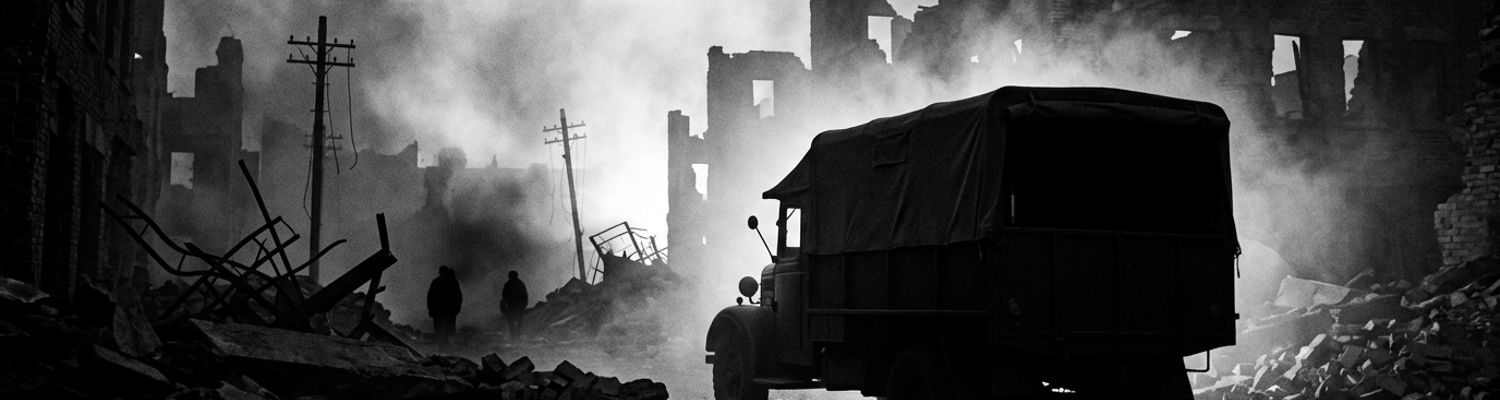

Development of the Dodge WC54 Ambulance Chassis
The hypoid bevel drive gear inside the rear differential housing stripped its hardened splines. Scorched mineral gear oil sprayed across the axle tubes. Under torque on an unpaved gradient, the dog clutches inside the four-speed non-synchronized transmission jammed between second and third gear. This bound the countershaft until the main casing cracked. Hydraulic line pressure collapsed instantly. An overstressed copper-alloy brake tube sheared against the frame rail and vented fluid into the mud. When examining the historical record from the 1941 Louisiana Maneuvers, medical transport detachments repeatedly documented these mechanical breakdowns across the Dodge WC-27 fleet. The civilian-derived half-ton underpinnings could not bear the continuous strain of loaded clinical field service.
The light-duty commercial chassis disintegrated under combat loads.
Archival evidence shows that the Army Medical Department and the Quartermaster Corps demanded an immediate technical departure from the half-ton platform. Chrysler Corporation addressed the structural deficiencies of the WC-27. Engineers developed the T214 truck platform. This chassis was rated for three-quarter-ton military payloads. It featured heavy-gauge steel channel frame rails. Power came from a 230.2-cubic-inch Chrysler flathead inline-six engine. This powerplant delivered 92 brake horsepower at 3,200 revolutions per minute. The engine mated to a heavy-duty four-speed transmission and a single-speed transfer case. Drive went through a Borg and Beck single-plate dry clutch. This operated alongside a front-axle disconnect. The disconnect allowed operators to conserve mechanical wear on paved transit roads. Dodge extended the standard three-quarter-ton truck wheelbase from 98 inches to 121 inches specifically for the ambulance designation. This created the WC-54. The front and rear axle tracks widened to 64.75 inches. This modification reduced the dangerous rollover angle that plagued the narrower WC-27. Semi-elliptic multi-leaf springs stabilized the chassis over pulverized roadbeds and deep cross-country ruts. Heavy double-acting hydraulic shock absorbers reinforced these springs.
By the spring of 1942, the War Department canceled further half-ton medical procurement.
A close review of operational logs indicates that survivability inside earlier soft-skinned vehicles was unacceptably poor. The military awarded the ambulance body contract to the Wayne Works coachbuilding firm in Richmond, Indiana. Wayne Works discarded the canvas tarpaulins and composite wooden frames of previous designs. Engineers developed a monolithic all-steel body shell. This shell bolted directly onto the elongated Dodge T214 chassis. The interior cabin layout maximized volume. It featured two levels of spring-loaded folding litter racks along the interior walls. These racks transported four prone patients on standard military stretchers. When folded flat against the steel hull, these brackets converted into padded longitudinal benches. The benches carried eight seated casualties. Factory draftsmen resolved northern European cold-weather requirements by installing a high-capacity hot-water heating core. This core plumbed directly to the engine block cooling system. It circulated warm air forward to the windshield defrosters and rearward through the patient bay. Dual louvered cowls and an electric blower fan sat high in the rear roof structure. This system pulled stagnant air, blood stench, and carbon monoxide exhaust out of the enclosed compartment.
Richmond assembly lines manufactured 22,857 of these all-steel ambulance enclosures before factory production halted in 1944.
Operational records from the European Theater of Operations confirmed that the unladen vehicle weighed 5,920 pounds. This mass placed severe stress on its 9.00-16 military tires. Field mechanics frequently adjusted the leaf spring hangers. They swapped clogged fuel filters as low-octane military gasoline fouled the single-barrel Carter carburetor during prolonged low-gear idles outside forward casualty stations.
Urban Deployment with the First Medical Battalion
When examining the historical record from October 11, 1944, the tactical role of the Dodge WC54 shifted from rear-echelon shuttle to close-quarters extraction tool. At 1015 hours that morning, the twenty-four-hour unconditional surrender ultimatum issued by Major General Clarence R. Huebner to the German garrison commander expired without compliance. Colonel Gerhard Wilck refused the terms. Within minutes, twelve artillery battalions and fighter-bombers from IX Tactical Air Command saturated the urban perimeter with high explosive ordnance. The bombardment flattened outer masonry walls. It blew deep craters across main approach arteries. Company C of the 1st Medical Battalion received orders to push its ambulance sections directly across the municipal boundary. They advanced along the damaged rail line east of the central station. Motor pool mechanics disengaged the front-axle highway lockouts. They shifted the transfer cases into four-wheel drive. This allowed the three-ton steel vehicles to cross pulverized curbstones, downed power cables, and deep layers of shattered brick. Drivers operated in forward low gear with blackout marker lamps extinguished. They relied on tire sidewalls to grind against debris rather than risk exposure to German snipers concealed in upper-story apartments. Engines strained under first-gear loads. Engine oil temperatures surged as cooling air failed to penetrate the debris-packed front radiator grilles.
Artillery concussions fractured the front safety-glass panes.
Archival evidence shows that forward medical detachments assigned the vehicles to direct support of the 26th Infantry Regiment. The 2nd and 3rd Battalions launched house-to-house assaults toward the city center. Rubble choked every primary thoroughfare. This forced medical drivers onto narrow residential lanes such as Julicher Strasse and the side alleys surrounding Saint Elisabeth Church. Street clearings were blocked by collapsed multistory tenements. Dodge ambulances climbed mounds of jagged limestone and pulverized masonry that stood four feet high. These steep ascents repeatedly broke leaf-spring center bolts. The impacts twisted the steel steering tie rods out of alignment. Heavy cross-ply 9.00-16 tires suffered punctures from jagged structural rebar and razor-sharp slate roof tiles. Drivers changed fifty-pound wheel assemblies under active mortar fire. Standard evacuation protocols dissolved in the tight urban footprint. Drivers could not turn around inside fifteen-foot-wide alleys. They reversed out of fire sectors for hundreds of yards with only side-mounted rearview mirrors to guide them. Transfer case selector levers jammed under the violent torque required to back uphill over collapsed brick chimneys.
Drivers reversed down blind corridors using only the sound of grinding wheel rims against brick walls for directional reference.
A close review of operational logs indicates that the 1st Medical Battalion established decentralized casualty collection points inside subterranean domestic wine cellars. They used reinforced bank basements and the damaged municipal slaughterhouse to protect incoming wounded from continuous 88-millimeter airbursts. WC54 teams backed directly into partially cleared entryways. This shielded the rear loading doors from shrapnel. Litter bearers lifted wounded infantrymen out of damp basements into the four internal folding rack bays within two minutes of arrival. The vehicles frequently idled for an hour in stationary defensive positions. Flathead inline-six engine blocks overheated rapidly. Cooling fluid boiled out through the radiator overflow tubes. Exhaust blowers mounted in the rear roof frames ran continuously on battery power. This expelled lethal carbon monoxide pockets that built up when the rear doors stayed shut tight against exterior sniper fire. Transmission gears sheared when drivers dropped clutches at maximum throttle to drive through heavy stone barriers. This stranded loaded chassis in the middle of active kill zones along Kaiserplatz.
Ad Hoc Ballistic Protection and Hull Modifications
Archival evidence shows that forward maintenance units attached to the 1st Infantry Division faced an immediate defensive crisis. German snipers and machine-gun teams in the factory districts of northern Aachen targeted the unarmored Wayne Works ambulance bodies. The 18-gauge stamped steel cab panels offered zero ballistic resistance against German 7.92x57mm heavy ball ammunition. MG 42 machine guns concealed in brick basements fired these rounds. Mechanics from the 701st Ordnance Light Maintenance Battalion set up oxyacetylene cutting rigs in captured machine shops near Rothe Erde. They stripped quarter-inch rolled homogeneous armor plate from knocked-out German Sd.Kfz. 251 half-tracks and burned M4 Shermans. Welders cut custom slabs to cover the flat vertical faces of the Dodge T214 driver and assistant-driver doors. They drilled through the door skins to mount the salvaged steel using half-inch carriage bolts backed by timber spacers. Across the front end, technicians fashioned hinged steel plates over the vulnerable radiator cowl and engine side aprons. This shielded the cast-iron 230.2-cubic-inch engine block, fuel lines, and single-barrel Carter carburetor from deflection shots. The added frontal weight compressed the front twelve-leaf spring packs by two inches. Mechanics fabricated auxiliary spring retainers. This kept the front axle from slamming against the rubber bump stops whenever the chassis dropped into shell holes along Julicher Strasse.
Rifle fire shattered against the bolted plates.
The extra four hundred pounds of steel stripped third gear of its climbing power.
A close review of operational logs indicates that German defensive doctrine in the Aachen sector relied heavily on the Schu-mine 42. This weapon neutralized cleared transit routes without alerting American patrols. The wooden box mine contained a 200-gram block of pressed trotyl explosive fitted with a ZZ 42 percussion fuse. A simple pine or plywood frame encased the charge. This non-metallic construction defeated Allied SCR-625 mine detectors. German combat engineers buried these devices underneath pulverized brick debris and cobblestones along the evacuation corridors around Theaterplatz and the main train depot. When a Dodge WC54 rolled over the pressure lid, the detonating charge ripped through the thin sheet-metal floor pan. The blast turned floorboard splinters, transmission tunnel covers, and pedal linkages into high-velocity projectiles directed into the driver compartment. Company C mechanics countered this upward blast trajectory by stacking fifty-pound burlap sandbags across the driver and assistant-driver floor wells. They packed them two layers deep beneath the pedals and around the base of the steering column. Medical detachments laid additional tiers of sandbags flat across the entire wooden subfloor of the rear patient compartment. They slid the sand-filled canvas directly beneath the lower folding litter racks. The dense mineral fill absorbed explosive concussion. It trapped wood splinters that would have penetrated litter canvases and entered the bodies of resting casualties.
Blast waves pulverized the sandbags into fine dust.
The wooden mine fragments failed to penetrate the canvas barrier.
When examining the historical record from the third week of the battle, the physical toll of these ad hoc field conversions accumulated inside the mechanical linkages of the Dodge chassis. Gross vehicle weight climbed beyond 6,800 pounds. This crushed the lower plies of the standard 9.00-16 tires. Drivers inflated the tubes to forty-five pounds per square inch to prevent the sidewalls from rolling off the rims in debris-choked turns. The steering drag links and sector shafts inside the worm-and-roller steering gearboxes wore down to dangerous tolerances within seventy-two hours of sustained driving. This bound the front wheels when drivers attempted tight maneuvers inside narrow courtyards. Sandbag weight positioned directly over the rear axle diminished ground clearance by nearly three inches. The differential carrier casting dragged across broken granite curbstones and unexploded artillery shells. Motor maintenance logs from the 26th Infantry Regiment show that mechanics replaced front wheel hub bearings twice a week. They found the roller races pitted and dry as stone dust ground past the seals.
Interior Rigging and Expanded Triage Logistics
Archival evidence shows that Wayne Works designed the interior litter retention system exclusively around the standardized U.S. Army Model 1942 folding canvas litter. Dual-tier tubular steel support arms swung downward from the interior hull ribbing. These locked into place with spring-actuated detent pins calibrated for the 90-inch hardwood poles and forged steel stirrups of standard military issue. By October 15, the 26th Infantry Regiment drove toward the Kurhaus and the municipal theater. Company C medical teams encountered hundreds of mangled German non-combatants trapped in collapsed cellar shelters alongside wounded riflemen. Forward triage officers refused to turn away wounded civilians. German civil-defense stretchers collected from basement aid shelters possessed wider wooden rails and zero standard stirrup feet. They featured varying widths that could not engage the Wayne Works retention channels. When drivers attempted to force these irregular civilian frames into the upper mounts, the brackets bound against the sidewalls. They popped loose over bomb craters. This dropped injured patients onto the steel floor.
Standardization disappeared in the basements beneath Kaiserplatz.
A close review of operational logs indicates that motor pool welders improvised field modifications directly at the Company C staging area behind Saint Elisabeth Church. Mechanics gathered perforated angle iron from ruined railway maintenance sheds near the central depot. They cut the steel into nine-inch auxiliary offset brackets with hand hacksaws. These ad hoc brackets clamped over the factory tubular litter arms using threaded U-bolts stripped from damaged civilian delivery carts. Field medics looped surplus heavy canvas cargo straps and spliced telephone wire through the floor tie-downs. This created adjustable lower cradles that suspended the mismatched German Red Cross litters two inches below the primary upper tiers. The altered geometry allowed medical orderlies to slide a German wooden-frame litter into the upper rack. An American canvas stretcher rested directly beneath it. This locked both frames against the ambulance hull ribs with turnbuckle tensioners.
Five tons of steel and human cargo strained the rear axle stops.
When examining the historical record from the fighting along Pontstrasse on October 18, evacuation requests rapidly outpaced transport volume. This forced drivers to double the rated casualty payload of the Dodge chassis. Factory specifications limited the rear compartment to four recumbent patients or eight seated casualties. Drivers routinely loaded six prone litters and four ambulatory casualties into the ninety-three-inch interior space. Two wounded infantrymen lay on the upper improvised iron brackets. Two more occupied the factory lower bunks. Orderlies placed two additional stretchers side by side directly across the sandbagged wooden floorboards. German civilians suffering from severe crush trauma and burns lay wedged between American soldiers with penetrating thoracic wounds. Their limbs overlapped in the forty-eight-inch gap separating the hull walls. Orderlies pushed ambulatory casualties onto the narrow rear step. They forced them to crouch between the lower stretchers. Their knees pressed hard against the canvas of the lower patients.
Operating orders mandated total vehicle blackout along the pulverized two-mile corridor connecting the forward battalion aid stations near Farwick Park to the clearing station at Brand. Drivers guided the vehicles through pitch darkness with the external slit-lens blackout marker lamps switched off. They felt for stone curbs with the outer sidewalls of the front tires. Inside the sealed cargo bay, thick felt curtains covered the rear oval window glass to block light leakage. This plunged the confined patient space into total obscurity. The roof-mounted electric exhaust blower was deactivated to prevent electrical drain on the six-volt battery system while the engine idled. This trapped fuel vapors, blood stench, and heavy dust inside the unventilated cabin. The overloaded chassis pitched across forty-degree shell crater slopes along Julicher Strasse. Unrestrained medical equipment boxes slid across the floor. They struck casualties who could neither move nor see in the darkness. Transmission gears ground loudly in low range. Drivers kept the clutch half-engaged to prevent stalling on steep debris banks. This shook the ambulance body until the improvised ceiling brackets scraped against the bare steel roof ribs.
Evacuation Bottlenecks at Kaiserplatz
Archival evidence shows that the vehicular transit system entering Kaiserplatz halted completely on the morning of October 16. Four-story limestone and red-brick apartment blocks along Wilhelmstrasse and Adalbertstrasse collapsed outward under direct 75mm and 105mm fire from the 745th Tank Battalion. This deposited continuous rubble banks six feet deep directly across the roadway. Municipal tram wires, severed telephone lines, and ungrounded electrical cables lay tangled across this brick field. Dodge WC54 ambulances from Company C entered the square to evacuate casualties from the 2nd Battalion, 26th Infantry. Spinning 9.00-16 tires caught the coiled copper and galvanized steel cables. The rotation wound the high-tensile wire directly around front axle yokes and rear brake drums. This mechanical entanglement locked drive flanges and severed rubber hydraulic brake hoses. It immobilized vehicles directly in the center of the intersection. Forward triage setups operating out of the cellars near Saint Adalbert Church buckled within ninety minutes. Stretcher-bearers emerged from basement bulkheads carrying litter cases. They found four loaded ambulances stalled bumper-to-bumper with zero lateral clearance to pull forward or retreat.
High-voltage tram line cables wrapped four inches deep around the front universal joints.
This locked the steering knuckles completely.
A close review of operational logs indicates that the square was ringed by impact craters from five-hundred-pound bombs dropped days earlier by P-47 Thunderbolts. These left depressions eight feet deep and twenty feet across in the granite paving stones. Drivers attempting to detour around stalled lead vehicles dropped their right wheels into the shelving edges of these pits. This shifted the two-and-a-half-ton trucks onto precarious thirty-degree side angles. The factory 121-inch wheelbase worked against the operators in these narrow bypass attempts. A driver attempted to ride the rim of a crater. The low-hanging cast-iron casing of the Dodge rear differential carrier dragged hard on jagged masonry slabs. This lifted the rear tires off the ground. It neutralized the traction of the single-speed transfer case. Company C drivers climbed out of the cabs under fire with folding trench shovels. They dug stone fragments out from beneath the undercarriage. Assistant drivers jammed scrap floor timbers under the spinning tread to regain forward momentum.
The rigid steel frame rails offered zero flex when high-centered across broken curbs.
The rear driving axle suspended in free air.
When examining the historical record from the afternoon fighting on October 16, German forward observers positioned in the water tower on the Kaiserberg directed continuous battery fire onto these stranded vehicles. German 81mm Granatwerfer 34 mortar crews stationed in the northeastern industrial fringe dropped high-explosive shells into the open square at three-minute intervals. Indirect 105mm rounds from the 246th Volksgrenadier Division supplemented this barrage. Jagged steel fragments ripped through the unarmored Wayne Works body panels. They pierced the 18-gauge sheet steel without losing ballistic velocity. Mortar airbursts struck the exterior cowls of the WC54 units. They punctured thin brass radiator tubes and sprayed scalding ethylene glycol across windshields. Inside the patient bays, blast concussions repeatedly threw the spring-loaded litter racks off their wall pins. This dropped wounded soldiers onto the sandbagged floor. Hot shell casing splinters tore through canvas stretchers. Assistant drivers used field dressings to plug leaking engine oil pans. They wrapped friction tape around destroyed fuel lines. They attempted to preserve manifold pressure long enough to drive out of the target grid.
Shrapnel from a single 81mm mortar airburst pierced the unshielded Carter carburetor of ambulance number 17.
This cut off fuel flow and trapped eight recumbent casualties under direct observation until dusk.
Vulnerabilities Captured by Signal Corps Photographers
Archival evidence shows that cameramen from the 165th Signal Photographic Company documented the systematic physical destruction of the Dodge WC54 fleet during the final house-to-house clearing of central Aachen. Operating alongside lead rifle platoons from the 26th Infantry Regiment, technical photographers exposed hundreds of feet of 35-millimeter black-and-white film. They shot dozens of four-by-five Speed Graphic sheet negatives around the ruined intersection of Theaterplatz and Promenadenstrasse. Their lenses focused directly on the unarmored Wayne Works ambulance bodies. They captured how high-explosive ordnance perforated the factory steel shells. Shell fragments from German 81-millimeter mortar airbursts and 105-millimeter howitzer rounds tore effortlessly through the 18-gauge cold-rolled sheet steel. Jagged metal shards destroyed the exterior skin without losing forward velocity. They sliced clean through the interior timber framing. The fragments severed primary brake fluid lines, battery cables, and main wiring harnesses.
Fragment impacts opened clean entry slits and torn jagged exit funnels.
When examining the historical record from mid-October 1944, photographic contact prints reveal how artillery splinters pierced the vehicle patient bays from front to rear. One detailed sequence taken near Saint Elisabeth Church shows a stationary ambulance struck by indirect artillery fire while idling outside an emergency cellar station (NARA Record Group 111, Box 42). Flying shrapnel pierced the thin steel driver door. It continued through the unshielded instrument cluster. It tore through the heavy wooden cab partition before embedding deep inside the patient compartments. The hot iron splinters sheared off the steel detent pins of the upper litter brackets. This dropped patient frames onto the floorboards and punctured the lower canvas stretchers. Signal Corps footage recorded the exact trajectory of 88-millimeter casing fragments. These entered the right engine apron. They cleaved straight through the cast-iron cylinder head of the flathead inline-six engine. They punched out the opposite side of the radiator shell. This dumped twenty-two quarts of boiling coolant onto the cobblestones in five seconds.
White circular backdrops created distinct aiming points across smoke-filled avenues.
A close review of operational logs indicates that the Geneva Convention emblems displayed on the Dodge ambulances attracted intense small-arms fire from concealed German positions. Under international evacuation protocols, Wayne Works applied thirty-two-inch bright red crosses set within thirty-six-inch round white fields on the ambulance roof, the rear dual-leaf doors, and both cargo side panels. In the enclosed corridors of Sandkaulstrasse and around the municipal theater, these stark symbols stood out sharply against gray limestone debris, pulverized brick, and heavy soot. Signal Corps motion picture film recorded tight bullet groupings perforated directly into the red cross emblems on the rear doors of Company C vehicles. Clusters of 7.92x57mm machine-gun holes centered precisely on the red vertical and horizontal bars. German defenders from the 246th Volksgrenadier Division fought from barricaded upper-floor apartments. They directed MG 42 bursts straight through the center markings. They correctly deduced that the red paint sat level with the heads and torsos of patients inside the cabin.
Rifle fire repeatedly struck the ambulances as they backed blind toward basement cellar doors.
Photographers with the 1st Medical Battalion recorded identical ballistic patterns along the approach lanes leading to Farwick Park. German snipers operated from intact chimneys and church spires. They exploited the wide profile of the three-quarter-ton chassis as it navigated rubble mounds. The four-by-five film negatives record multiple entry points through the white roof rounds. Riflemen positioned high above the streets placed their sights directly over the red Geneva emblems while drivers attempted to turn tight corners. These high-angle armor-piercing rounds penetrated the stamped metal roof cap. They ripped through the thin acoustic headliner. They entered the upper tier of loaded litters before terminating in the transmission case below. Signal Corps photographers documented six separate Dodge WC54 chassis abandoned along Wilhelmstrasse. They featured shattered windshields, deflated front tires, and fuel tanks drained by rifle rounds. These rounds had struck dead-center through the red cross painted across the spare tire cover.
Obsolescence and Transition to Armored Medical Carriers
Archival evidence shows that Army Medical Department evaluators attached to the First Army concluded by November 1944 that civilian-derived vehicle chassis possessed no operational future in close-quarters urban combat. Field reports forwarded from Aachen to the Office of the Chief Surgeon in Paris documented thirty-seven separate Dodge WC54 hulls disabled or destroyed across the sector within a fourteen-day window. Evaluators noted that 18-gauge cold-rolled Wayne Works body panels offered zero resistance against 7.92mm machine-gun bursts, shell fragments, and falling masonry along assault corridors like Julicher Strasse and Theaterplatz. Blast overpressures from 105mm artillery routinely blew out side windows. They warped cabin door frames and severed unprotected copper brake conduits. Pulverized stone rubble continuously snapped steering knuckles and broke rear spring hanger pins. Medical officers recognized that the low-slung 121-inch wheelbase three-quarter-ton platform could not maneuver over two-meter brick piles without high-centering the differential housing. This turned loaded evacuation runs into stationary targets for German mortar crews. Unshielded radiator grilles invited catastrophic coolant drainage from glancing shrapnel. This seized engine pistons before drivers could clear forward aid stations.
Commercial sheet steel could not withstand military high explosives.
A close review of operational logs indicates that combat units initiated rapid late-war replacements directly at the regimental level. They converted M3 half-tracks into improvised frontline armored ambulances to retrieve casualties under fire. Technicians from the 701st Ordnance Light Maintenance Battalion stripped the Browning machine-gun ring mounts, internal stowage bins, and ammunition racks from damaged half-tracks. They installed field-welded angle-iron brackets to secure three tiers of standard folding litters along each armored interior wall. Quarter-inch face-hardened armor plate deflected direct 7.92mm rifle fire. It resisted 81mm mortar splinters that previously destroyed soft-skin cabs. Driven by a 147-horsepower White 160AX gasoline engine, the tracked rear bogie assembly rolled straight over collapsed brick facades, unexploded artillery duds, and coiled municipal tram wire. This debris had immobilized standard 9.00-16 pneumatic tires. During house-to-house clearing actions along the northern edge of the Hurtgen Forest and into the Roer plain, armored infantry companies dispatched these medical half-tracks directly into open kill zones. They drove them up to basement windows to load wounded personnel under the direct protection of heavy steel armor.
Rubber tracks climbed rubble banks that snapped solid commercial axles.
When examining the historical record from the final months of the European conflict and immediate postwar evaluations, ordnance authorities requisitioned M8 armored utility carriers and M20 scout cars to operate as low-silhouette extraction platforms. Motor pool mechanics removed the open ring turrets. They installed custom steel deck brackets across the rear engine decks. They retrofitted internal hull compartments to transport two recumbent casualties alongside a medic and an emergency plasma supply. With six-wheel drive powered by a Hercules JXD 320-cubic-inch inline-six engine, the sloped quarter-inch hull armor provided complete splinter protection across open fields and debris-covered intersections. Army Medical Department trials conducted at Fort Sam Houston in 1946 finalized the doctrinal shift. They formally barred unarmored civilian-pattern truck chassis from frontline medical evacuation duties. Postwar military planners transferred future front-echelon patient extraction entirely to fully enclosed tracked armored personnel carriers. The M75 and M59 platforms assumed all frontline duties. The three-quarter-ton Dodge chassis spent its remaining operational life relegated to paved roads behind division clearing stations. Mechanics stripped the remaining Wayne Works bodies for scrap metal at the ordnance depot in Cherbourg.