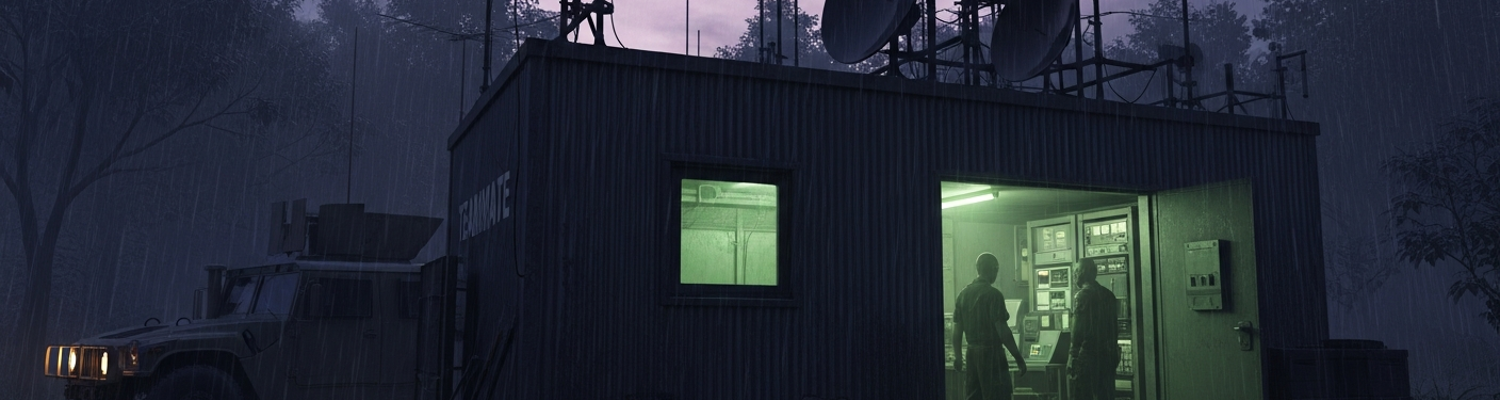

The Honduras SIGINT Node Establishment
Declassified records from the mid-1980s document a sharp pivot in U.S. Army signals intelligence. Central America became the new focus. The expansion was a direct counter to escalating Cold War proxy conflicts in the region, and Honduras was chosen as the central node for this new electronic warfare network. The U.S. Army Intelligence and Security Command (INSCOM) spearheaded the effort, expanding its existing footprint in the Western Hemisphere, which already included the 470th Military Intelligence Brigade in Panama. Between 1984 and 1985, the United States rapidly built up the military installation at Palmerola, a facility later designated Soto Cano Air Base. This base, approximately 75 kilometers from the capital of Tegucigalpa, became the primary staging ground for U.S. operations. It supported Contra forces fighting the Sandinista government in neighboring Nicaragua. From this strategic location, INSCOM deployed specialized SIGINT units. Detachments from the 313th Military Intelligence Battalion, for instance, participated in exercises like Project DRAGONFISH in late 1984. These teams brought with them advanced mobile interception systems, introducing a new phase of technological warfare to the jungles of Central America.
The mission was direct.
These newly deployed SIGINT detachments were tasked with the systematic interception and analysis of communications from two primary sources: Soviet-bloc military advisors and the local insurgent forces they supported. Archival evidence shows Cuban and Soviet advisors were deeply embedded within the Sandinista military structure in Nicaragua. They provided everything from tactical training to strategic communications support. A similar dynamic existed in El Salvador with the Farabundo Martí National Liberation Front (FMLN). To counter this, Army SIGINT teams employed mobile, ground-based platforms like the AN/TRQ-32 Teammate and the AN/TSQ-138 Trailblazer. These systems, often mounted in shelters on M998 HMMWVs or larger cargo trucks, were designed for tactical signals interception across HF, VHF, and UHF frequencies. Operational logs (NARA Record Group 472) detail how teams would deploy these systems five to ten kilometers from the forward line of troops. This required clear lines of sight to enemy transmitters for direction-finding operations. By netting multiple Teammate or Trailblazer systems together, operators could triangulate the precise location of a radio transmitter. This provided actionable intelligence on enemy command posts and troop movements. The objective was to construct a comprehensive electronic picture of the battlefield, tracking both high-level command chatter from Soviet officers and the low-level tactical communications of guerrilla units moving through the countryside.
Adaptive Guerrilla Cipher Challenges
While U.S. SIGINT technology was engineered to defeat complex, state-level encryption, operators immediately ran into a frustrating obstacle from the field-expedient methods of their adversaries. Insurgent forces, particularly the FMLN and Sandinista-supported groups, relied on rudimentary but highly adaptive cipher systems. A close review of operational logs indicates these were not complex cryptographic algorithms that could be broken by computational power. They were simple, manually-operated systems that changed frequently. Guerrilla units used low-power radios, making their signals difficult to detect and intercept from a distance. Their encryption often consisted of simple substitution ciphers or coded phrases altered on a daily or even hourly basis, based on pre-memorized keys or common, easily-distributed documents. This created a high volume of low-grade, encrypted traffic that was difficult to process. The constant adaptation meant that by the time analysts could identify a pattern and begin to crack a code, the insurgents would have already switched to a new system. This forced a heavy reliance on the four-person linguist crews of systems like the Teammate. These crews had to manually sort through endless hours of broadcasts, listening for the slightest mistake or deviation that might offer a key to decryption.
One incident from late 1984 illustrates the dilemma posed by partial decryption. An AN/TSQ-138 Trailblazer system, positioned in the rugged terrain near the Honduran-Nicaraguan border, intercepted a high-frequency burst transmission from a known Sandinista signals node. The signal was protected by a more complex cipher, believed to have been supplied by Soviet advisors. The intercept was relayed to the main U.S. processing center at Palmerola Air Base, where analysts worked for nearly 72 hours to break it. They succeeded, but only in part. The decrypted fragments were a breakthrough, but they also caused extreme alarm. They contained the phrases CARGA TULA, BULGARIA, PUERTO CORINTO, and MAREA NOCTURNA. Intelligence analysts immediately recognized Tula as a key Soviet arms manufacturing city and Bulgaria as a common transit point for Eastern Bloc arms shipments to Nicaragua. Puerto Corinto was the nation's primary deep-water port on the Pacific. The intelligence pointed to a significant delivery of Soviet-made weaponry. Yet, the most important details remained locked in the undeciphered portions of the message. The specific date, the name of the cargo vessel, the exact contents of the shipment, and the meaning of MAREA NOCTURNA, or night tide, were all missing.
This ambiguity paralyzed any direct response. The phrase MAREA NOCTURNA could be a literal instruction to unload the vessel under the cover of darkness during a specific tidal phase to evade satellite or aerial reconnaissance. It could also have been a code word for a specific date on the Sandinista operational calendar. Declassified reports from U.S. Southern Command reveal the intense debate that followed. The garbled sections of the transmission could have contained information on advanced anti-aircraft systems, such as ZSU-23-4 mobile guns or even SA-3 missiles. Such weapons would pose a serious threat to any U.S. aircraft sent to surveil the port. Acting on the partial decrypt by attempting a naval interdiction carried a large geopolitical risk. Stopping and searching a Bulgarian freighter on the high seas based on fragmented intelligence could provoke a serious diplomatic incident with the Soviet Union. The lack of complete, actionable intelligence forced a compromise. Instead of a targeted interception, extensive and costly surveillance assets were diverted to blanket the sea lanes approaching Corinto for several weeks, hoping to visually identify the vessel described in the tantalizing but incomplete message.
Flawed Intelligence and the Chalatenango Operation
A U.S. Army signals intelligence team, operating a mobile AN/TRQ-32 Teammate system from a concealed position in the hills of northern Chalatenango department, intercepted a series of low-power, high-frequency radio transmissions. The target was a command cell of the Farabundo Martí National Liberation Front. After days of work, analysts at the U.S. military mission headquarters in San Salvador partially decrypted the messages. The intelligence fragments painted an urgent but incomplete picture. A concentration of forces was to occur in a specific valley, identified by a grid coordinate, for the distribution of new arms. The message suggested a significant guerrilla formation, a prime target for a decisive blow. Acting on this intelligence, U.S. military advisors from the 7th Special Forces Group strongly recommended a rapid counter-insurgency sweep. A review of the operational planning documents shows they helped devise a classic hammer and anvil maneuver to be executed by their partner force, the Salvadoran Army’s elite Atlacatl Battalion. This unit, trained and equipped by the United States, was designed specifically for such rapid-reaction missions.
The critical failure was one of interpretation. A gap existed between the sterile world of signals analysis and the complex human terrain of the conflict. The concentration of forces was not a purely military gathering. The decrypted grid coordinate pointed to a small, remote village that, on the day of the planned operation, was holding its weekly market. FMLN militia members, who were also local farmers and villagers, were indeed present and scheduled to receive supplies. They were not, however, formed up in a distinct combat unit. They were dispersed among hundreds of civilians, their own families and neighbors. The American advisors and their Salvadoran counterparts, fixated on the promise of a high-value target, interpreted the ambiguous phrase through a conventional military lens. They envisioned a guerrilla battalion mustering in the jungle. The reality was a community gathering, salted with part-time combatants. This fundamental misreading of the intelligence set in motion a disastrous chain of events. The operational plan, built on this flawed premise, made no provision for the presence of a large civilian population.
Execution of the plan triggered a wave of human displacement. UH-1H Huey helicopters, supplied by the U.S., inserted companies of the Atlacatl Battalion to form the anvil force and block potential escape routes. The main hammer element began its push into the valley on foot. The sound of approaching helicopters and the sight of heavily armed soldiers advancing through the fields sent a shockwave of panic through the market. Civilians, caught completely by surprise, abandoned their homes and stalls. They grabbed what little they could carry and fled. The geography of the valley, with its steep, jungled ridges and limited paths, funneled the fleeing population into a single, chaotic stream. Within hours, a significant portion of the region’s inhabitants were turned into internally displaced people. A panicked column of men, women, and children moved through the rugged terrain. They were not running from a battle. They were fleeing the very operation meant to secure the region.
The anvil element of the Atlacatl Battalion was positioned exactly where the operational plan predicted the insurgent force would be driven. The soldiers were briefed to expect a large body of armed enemy fighters attempting to break through their lines. Due to a combination of radio discipline and the chaotic terrain, communications with the advancing hammer force were intermittent. The anvil had no updated information about the civilian tide being pushed toward them. When the large column of displaced villagers, intermingled with a small number of retreating FMLN militia, burst from the tree line, the commander on the ground made a fatal decision. Believing this to be the guerrilla force described in his briefing, he gave the order to open fire. The M60 machine guns and M16 rifles of the battalion, weapons provided to professionalize the Salvadoran military, were turned on the crowd. The result was not a battle, but a slaughter. Unintended civilian casualties were extensive, a direct outcome of intelligence misinterpreted and an operational plan that failed to account for the human dimension of the war.
Inter-Agency Rivalry and Intelligence Failures
The backlash was immediate. A review of declassified hearing summaries (SSCIA-RPT-85-14) shows that within weeks of the disastrous Atlacatl Battalion operation, a closed-door inquiry was chartered by the Senate Select Committee on Intelligence. Its mandate was to dissect the intelligence lifecycle, from the initial intercept by the Army’s AN/TRQ-32 Teammate crew to the final, catastrophic order given by the Salvadoran commander. Investigators from the committee descended on Palmerola Air Base in Honduras and the U.S. Southern Command headquarters in Panama. They impounded every relevant piece of data: the raw, partially decrypted radio traffic, the operational logs from the INSCOM detachment, the after-action reports filed by the 7th Special Forces Group advisors, and the secure teletype messages exchanged with the U.S. military mission in San Salvador. The paper trail was an anatomy of a failure, and the committee’s focus was absolute. They demanded a second-by-second reconstruction of who saw the intelligence, who analyzed it, and why its lethal ambiguity was never challenged.
The investigation became a tribunal on inter-agency dysfunction. Archival records from the inquiry lay bare the deep, systemic fractures between the Department of Defense’s intelligence arms and the Central Intelligence Agency. The core of the conflict was a dispute over ownership and interpretation. INSCOM and the Defense Intelligence Agency (DIA) presented a defense rooted in tactical function. Their position was that the SIGINT unit had performed its function correctly. It detected enemy communications, identified a key phrase, concentration of forces, and pinpointed a geographic location. This raw intelligence was, by their doctrine, perishable and meant for immediate action by military commanders on the ground. They argued that their job was to provide the what and where, not the why. They had provided a target, and the intelligence was technically accurate.
The CIA’s post-mortem presented a sharply different narrative. Agency representatives argued that the disaster was a direct result of the military’s intelligence stovepipe. Had the raw SIGINT from the Teammate system been concurrently shared with the local CIA station, their analysts, armed with human intelligence (HUMINT) sources and a deeper understanding of the local socio-political landscape, would have immediately flagged the grid coordinate as a village known for its weekly market. They would have understood that concentration of forces in this context did not mean a formal military muster but a routine gathering that included part-time FMLN militia members who were also local farmers. The CIA framed the event not as an intelligence failure, but as a failure of imagination. It was a consequence of the Army’s rigid, target-focused worldview colliding with a complex human environment it was not equipped to understand.
This bureaucratic war forced a complete overhaul of information sharing protocols. The inquiry revealed a structural gap. There was no formal, mandated requirement for tactical signals intelligence collected by a DoD unit to be automatically cross-referenced with the CIA's regional assets before being used in an operational plan. The Army’s SIGINT flowed up its own chain of command, from the field unit to SOUTHCOM’s J2 intelligence directorate, using military-specific networks designed for speed. The CIA operated on separate, secure channels, and collaboration often depended on informal relationships rather than established procedure. The committee’s final report, though heavily redacted, led to a direct recommendation: the establishment of joint, theater-level intelligence fusion cells. These were not merely liaison offices but integrated analysis centers where Army SIGINT technicians, DIA analysts, and CIA case officers would be forced to look at the same raw data, on the same screen, at the same time. The goal was to break down the firewalls and ensure that a piece of electronic intelligence could never again be divorced from its human context.
Geopolitical Fallout and Policy Overhaul
The political shockwave from the Chalatenango operation hit Washington with punishing force. A review of congressional records from the period reveals that the House Foreign Affairs Committee immediately convened a series of explosive, closed-door hearings. News of the civilian deaths, initially leaked to the press through anonymous sources within the State Department, created a political firestorm for the Reagan administration. The administration had justified its Central American policy as a necessary stand against Soviet expansion. The fact that the massacre was carried out by the Atlacatl Battalion, an elite unit created, trained, and armed by the United States to be a professional fighting force, became the central, damning detail. Opponents of the administration’s policy in Congress seized on the incident as definitive proof that U.S. military aid was directly enabling war crimes. The narrative was simple and potent. American intelligence, passed through American advisors to an American-trained unit, had resulted in the slaughter of civilians with American-supplied M16 rifles. The administration found itself on the defensive, its complex geopolitical arguments about countering Cuban and Soviet influence drowned out by the visceral details of the massacre.
It was a diplomatic catastrophe.
The government of El Salvador, publicly humiliated and facing an enraged populace, was thrown into a perilous balancing act. Archival evidence shows that the Salvadoran president issued a formal diplomatic protest to the U.S. State Department within 72 hours, condemning the flawed intelligence and demanding a full investigation. The U.S. Ambassador was summoned to the presidential palace in San Salvador. He was met with a list of demands, including the immediate removal of the 7th Special Forces Group advisors who had planned the operation. Behind this public fury, however, was a quiet desperation. Declassified cables from the U.S. embassy reveal frantic back-channel communications. Salvadoran officials sought assurances that the incident would not jeopardize the flow of military and economic aid upon which their government depended. The relationship, once a close partnership against a common enemy, was now poisoned by suspicion. Salvadoran military commanders, fearing both the unreliability of U.S. intelligence and the political consequences of another disaster, became hesitant to act on American-provided targeting data. This created an operational paralysis, severely degrading the effectiveness of the counter-insurgency campaign the U.S. was there to support.
The incident forced a painful re-evaluation of the entire U.S. overt military assistance strategy in Central America. The core assumption of the policy, that U.S. training and equipment could professionalize allied militaries and instill a respect for human rights, was shattered. Within the Pentagon and the State Department, a policy debate erupted. One faction, primarily within the Defense Department, argued that the failure was not one of policy but of control. Their proposed solution was to embed more U.S. personnel within partner units, giving American advisors the authority to veto operations based on questionable intelligence. A counter-argument, championed by a significant bloc within the State Department and on Capitol Hill, held that the Chalatenango massacre demonstrated the inherent flaw in using proxy forces for counter-insurgency. They contended that no amount of training could override the brutalizing nature of the conflict or prevent U.S. culpability when atrocities occurred. This debate resulted in a series of new, restrictive protocols attached to security assistance packages. A declassified National Security Decision Directive mandated that all actionable intelligence intended for offensive operations by a partner force undergo a mandatory review by an intelligence fusion cell. This cell would combine military SIGINT with CIA human intelligence analysis before the intelligence could be shared. It also established stricter rules of engagement for any operation involving U.S. advisors, explicitly prohibiting their participation in planning that relied on a single, uncorroborated intelligence source.