
The year 1982 was a period of pronounced hostility in Central Europe. Diplomatic and military archives show the relationship between the superpowers had deteriorated from the détente of the previous decade. In the United States, the Reagan administration pursued direct ideological and military confrontation with the Soviet Union, a policy matched by an aging, hardline Soviet leadership under Leonid Brezhnev. The central front in Europe became the focus of a massive conventional and nuclear arms buildup. NATO’s 1979 Dual-Track Decision authorized the deployment of Pershing II ballistic missiles and Gryphon cruise missiles, weapons capable of striking deep into Soviet territory with high precision. The Soviet response was the continued deployment of their SS-20 Saber mobile missile systems, holding every major city in Western Europe at risk. This created a hair-trigger atmosphere.
This was the Second Cold War.
Military planners on both sides operated with a low tolerance for ambiguity. For NATO, the primary concern was the conventional superiority of the Group of Soviet Forces in Germany (GSFG). Warsaw Pact doctrine emphasized surprise, speed, and overwhelming mass, designed to shatter NATO’s forward defenses before American reinforcements could arrive. Declassified Soviet planning documents assumed an advance rate of up to 100 kilometers per day. This speed was intended to overrun West Germany and reach the Rhine river in under a week, forcing a political settlement or a desperate escalation to tactical nuclear weapons.
At the heart of this strategic problem lay the Fulda Gap. Geographically, this corridor of land represented the most direct, high-speed avenue for a Soviet armored invasion. The terrain east of Fulda offered two primary axes for an armored thrust, converging on the road and rail networks leading to Frankfurt am Main, the financial center of West Germany and home to U.S. V Corps headquarters. A seizure of Frankfurt would sever the main north-south lines of communication for NATO’s Central Army Group. From there, the Rhine River was only a short distance away.
Defending this sector was the responsibility of the American V Corps, with the 11th Armored Cavalry Regiment (ACR), the “Blackhorse Regiment,” serving as the forward-deployed screening force on the inter-German border. Their mission was not to defeat an invasion but to be a tripwire. Operational plans called for the 11th ACR to fight a delaying action, trading space for time to allow the 3rd Armored Division and 8th Infantry Division to move into their General Defense Plan (GDP) positions. The entire NATO strategy rested on the ability to detect an assault, deploy forces correctly, and slow the initial Soviet armored spearheads. Every bridge and road in the Fulda Gap was cataloged and integrated into a complex plan of defensive obstacles and kill zones.
In late summer 1982, the GSFG initiated large-scale, unannounced military exercises along the Thuringian border, opposite the Fulda Gap. These maneuvers, designated by NATO as Zapad-82, were of a scale not seen since 1968. Intelligence summaries from the period indicate the exercises involved major elements of the Soviet 8th Guards Army, a premier shock formation equipped with T-64 and T-72 tanks. Unlike typical training, these formations moved from their garrisons with full combat loads. Radio traffic analysis showed an unprecedented level of encrypted command communication, and aerial reconnaissance observed the forward deployment of mobile bridging equipment and electronic warfare battalions. This activity mirrored doctrinal preparations for a surprise offensive.
Operational logs from V Corps electronic warfare (EW) assets in 1982 reveal a system stretched to its breaking point. The responsibility for intercepting and disrupting Warsaw Pact communications fell to US Army Intelligence and Security Command (INSCOM) units. One such unit, the 303rd SIGINT Battalion (Provisional), was covertly positioned in the high ground overlooking the Fulda and Werra river valleys. Operating from kasernes disguised as communications relay stations, their mission was to provide the initial warning of a Soviet offensive by monitoring the 8th Guards Army and, if ordered, execute jamming operations against their command nets. A successful jamming campaign could sow enough confusion to slow the initial armored thrust.
The 303rd’s primary offensive tool was the AN/MLQ-32, a truck-mounted communications jamming system. By 1982, the AN/MLQ-32 was an aging piece of equipment rooted in late 1960s technology. Army logisticians had repeatedly filed requests for the newer AN/MLQ-34 TACJAM system, but these were denied at the theater level due to budget battles and a prioritization of funds for the Pershing II missile program. The AN/MLQ-32’s architecture was a maintenance nightmare, reliant on temperamental vacuum tube technology prone to frequency drift. After-action reports from V Corps exercise REFORGER '81 detail numerous instances where the jammers failed to lock onto the frequency-hopping radios used by Soviet tank regiments. The system's power-hungry magnetrons generated immense heat, leading to frequent burnouts of power supply capacitors and cooling fans. Operators from the 303rd reported that to keep a single AN/MLQ-32 active for more than 12 hours, a second system often had to be cannibalized for spare parts.
The generators were worse.
This electronic decay was compounded by mechanical degradation. The S-280 shelters containing the AN/MLQ-32 electronics were mounted on M35A2 multi-fuel trucks. These vehicles were run hard in constant field training exercises. Maintenance records for the 303rd’s motor pool (NARA Record Group 338, Entry 54) show a fleet plagued by systemic failures. The air-over-hydraulic brake systems were notoriously unreliable; a single-point failure in a hydraulic line could render a truck without stopping power on the steep, narrow roads of the Hessian highlands. During the Zapad-82 crisis, one of the 303rd’s four AN/MLQ-32 platforms suffered a complete transmission failure while attempting to reposition to a forward jamming site near Rasdorf. The breakdown blocked a secondary road for four hours, illustrating that V Corps' electronic warfare capability was balanced on a knife’s edge of mechanical attrition.
Operational logs from V Corps in 1982 reveal a communications architecture fractured by inter-service procurement. The US Army was widely fielding the VINSON family of cryptographic devices, most notably the KY-57 tactical voice encryption unit. This system provided secure communications for ground elements. US Air Force assets, particularly the A-10 Thunderbolt II aircraft tasked with blunting any Soviet armored spearhead, utilized an entirely different and incompatible system. The A-10’s AN/ARC-164 UHF radios were equipped with the Have Quick frequency-hopping system, designed to defeat enemy jamming in an air-to-air environment. The core problem was a fundamental incompatibility in cryptographic algorithms and key management. The digital encryption standard used by the Army’s KY-57 could not be deciphered by the Air Force’s Have Quick suite.
This electronic divide was a known issue, documented in numerous after-action reports.
The standard procedure for passing secure targeting data from an Army forward air controller to an A-10 pilot was a dangerously slow workaround. The Army ground unit would relay the message up its own secure command net to a battalion or brigade-level command post. There, an operator would manually decrypt the message, physically walk it to a separate Air Force liaison officer’s terminal, where it would be re-encrypted using Air Force keys and transmitted onward. This process could take five to fifteen minutes. In the context of a Soviet armored assault moving at 30 kilometers per hour, a fifteen-minute delay meant the target could be more than seven kilometers away from its last reported position.
The Zapad-82 exercises transformed this bureaucratic inconvenience into an operational crisis. On August 28th, 1982, observation posts of the 11th ACR detected an unanticipated movement from the Soviet 8th Guards Army. A regimental-sized element of T-72M tanks, belonging to the 21st Motor Rifle Division, broke from its planned exercise route near Vacha and began a rapid advance through a secondary valley pass not covered by pre-sighted artillery. This was a textbook flanking maneuver. The intelligence was time-critical. V Corps command requested a flight of four A-10s from Sembach Air Base for an immediate armed reconnaissance. The request was approved within minutes. The A-10s were airborne, but they were flying towards a target they could not be securely guided to.
This failure of communication was compounded by the breakdown of the Army’s own electronic warfare capabilities. The inability of the AN/MLQ-32 systems to suppress Soviet command-and-control nets meant V Corps could not disrupt the enemy’s coordination. With the ground-based electronic attack failing, the burden shifted to airpower. The A-10s represented the only tool left. Yet, as the lead pilot attempted to establish a secure link with the V Corps air support operations center, the effort collapsed into unintelligible digital noise. The Army’s KY-57 transmissions were garbage to the A-10’s Have Quick radio. The only option was to pass targeting coordinates in the clear, an act that would have broadcast the A-10 flight's precise location and intent. This was deemed an unacceptable risk. The A-10s were forced to circle in a holding pattern, burning fuel while commanders attempted the multi-step manual relay. By the time a garbled, partial set of coordinates reached the pilots nearly twenty minutes later, the Soviet T-72 column had passed through the choke point and disappeared. The post-flight debrief (document USAFE-AAR-82-11B) concluded that in a real combat scenario, the window of opportunity would have been missed.
Command structures in the Fulda Gap sector during the Zapad-82 crisis were not designed for cohesive intelligence fusion. The operational area was saturated with reconnaissance assets, yet the information they gathered flowed through separate, non-communicating, and rigid channels. V Corps planners did not suffer from a lack of incoming data; they suffered from a systemic inability to process it. Intelligence from an Army combat engineer unit followed a completely different path than intelligence from a Central Intelligence Agency observation team operating a few kilometers away.
Information moved up, not across.
This dysfunction is evident when examining the role of U.S. Army engineer reconnaissance teams. While the 11th ACR screened the border, engineer units like the 130th Engineer Brigade were tasked with preparing the network of pre-chambered bridges for demolition. This mission required small teams to operate far forward to physically verify the readiness of explosive charges. On the second day of the Zapad-82 alert, an engineer reconnaissance team from the 130th, patrolling near the border town of Tann, observed figures in mismatched uniforms methodically photographing culverts on the western side of the demarcation line. This activity was a textbook indicator of a pre-assault infiltration by Warsaw Pact Spetsnaz commandos. The team leader immediately reported the sighting over his vehicle’s KY-57 encrypted radio. That report was sent to his company headquarters, then relayed to the brigade’s tactical operations center, where it was logged and passed to the brigade S-2 (intelligence) officer. Before it could be transmitted to V Corps, it had to be evaluated and cross-referenced with other engineer-related reports. The process consumed nearly three hours.
Simultaneously, a separate intelligence drama was unfolding. Archival records suggest the CIA’s Special Activities Division maintained several covert observation posts in German villages overlooking invasion corridors. One such team, operating from a farmhouse with a view of the E40 highway, was using high-magnification optics to monitor Soviet formations. They registered a major development: the unique command-and-control antenna array of a Soviet divisional headquarters vehicle, part of the 8th Guards Army, was spotted moving to a concealed forward position in a forest patch, far from its designated exercise area. This was a definitive indicator of an imminent offensive operation. The CIA team did not use military radio. Their report was encoded into a digital burst and transmitted via a covert satellite link to their controlling station in Frankfurt, then to CIA headquarters in Langley, Virginia. Within Langley’s analytical divisions, the information was verified and incorporated into a broader intelligence summary. Only after this high-level analysis was a sanitized report passed to the Defense Intelligence Agency, which then broadcast a general warning to United States Army Europe. By the time the V Corps G-2 received a vague notification of “unusual command element displacement,” the specific grid coordinate had been scrubbed, and more than six hours had elapsed.
The V Corps intelligence staff now held two disconnected pieces of a puzzle. One was a three-hour-old report about suspicious activity near some culverts. The other was a six-hour-old, non-specific warning about command vehicle movements. Because the reports arrived through different systems, at different times, and with different classifications, they were not immediately correlated. The picture of a coordinated Spetsnaz infiltration to clear a path for a surprise armored thrust was never formed.
Intelligence fusion doctrine within V Corps circa 1982 was fractured by design. The core problem was an incompatibility in how information was structured, classified, and transmitted. An Army engineer unit spotting suspicious activity would generate a SALUTE report: Size, Activity, Location, Unit, Time, and Equipment. This report was highly structured, designed for rapid digital transmission, and rendered in alphanumeric code. A typical report might appear on a V Corps G-2 analyst’s screen as a single line of teletype text.
That same activity, if observed by a West German Bundesgrenzschutz patrol, would be documented in a narrative-based, German-language log, then physically transported to a liaison office for translation. The CIA used a third format. Their reports were prose-heavy narratives transmitted via encrypted bursts to a controlling station, then relayed to Langley for analysis before a sanitized summary was passed back to the military. An analyst at the V Corps G-2 operations center could have three reports describing the same event. One would be a coded data line from the Army, one a translated paragraph from the Germans, and one a heavily caveated summary from the CIA. None would share a common time stamp, coordinate system, or unit identifier. Manually collating these formats consumed hours.
This format conflict was magnified by the rules governing security clearances. Information was a commodity whose value was defined by its exclusivity. Intelligence received from National Technical Means, such as KH-11 KENNEN reconnaissance satellites, carried a TOP SECRET/CODEWORD classification. This meant the raw imagery of Soviet tank formations massing near the border could only be viewed by a handful of specially cleared officers in Sensitive Compartmented Information Facilities (SCIFs). A V Corps G-2 colonel with the requisite clearances might see a satellite photograph showing a full regiment of T-72s conducting pre-combat fueling, an unambiguous indicator of an imminent attack. He was legally forbidden from describing what he saw to the V Corps G-3 operations officer in the adjacent room. To share the information, he had to submit a formal request to the originating agency for a sanitized “tear-line” report. This process involved redacting any detail that might hint at the satellite’s capabilities.
The systems were not designed to inform soldiers; they were designed to protect sources.
As a result, the time-critical intelligence would be stripped of its most vital elements. The specific location would be broadened to a 100-square-kilometer area. The unit identification would be changed from “21st Motor Rifle Division” to “unidentified armored element.” The activity would be described not as “pre-combat loading,” but as “unusual logistical activity.” This vague report would then be cleared for dissemination at the SECRET level, arriving on the G-3 operations officer’s desk six to eight hours after the initial observation. The operations officer, seeing no specific threat, would file it accordingly. The critical gap in the threat assessment was not a failure of collection, but of deliberate, systemic obstruction. The connections were never made.
V Corps operational planning documents from 1982 show a defensive scheme for the Fulda Gap predicated on a specific set of assumptions about Warsaw Pact engineering capabilities. NATO intelligence assessments focused heavily on established Soviet equipment like the PMP heavy pontoon bridge park. These systems, carried on KrAZ-255 trucks, were known quantities. V Corps engineers calculated that a full PMP battalion would require a significant, observable staging period to assemble the bridge sections and maneuver them into place, providing a clear window for artillery or air strikes. The entire General Defense Plan hinged on this timetable. Pre-planned demolition targets and minefields were all calibrated to exploit this perceived delay at key water obstacles like the Fulda and Haune rivers.
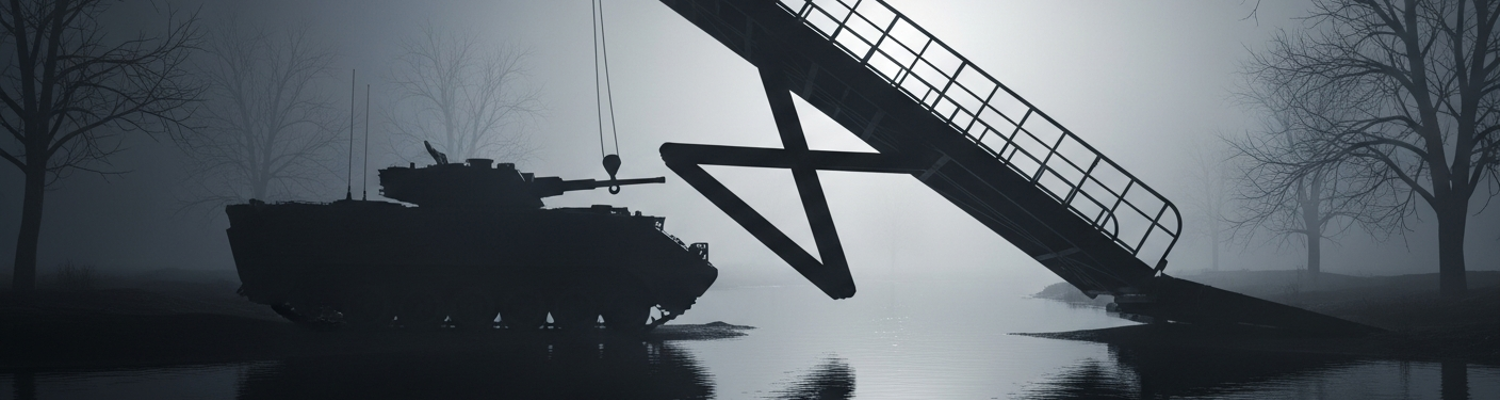
This deployment was based on dangerously obsolete intelligence. Since the 1970s, Soviet forces had been quietly fielding the TMM-3 heavy mechanized bridge system. Unlike the cumbersome pontoon parks, the TMM-3 was a truck-mounted, self-deploying scissor bridge. A set of four TMM-3 vehicles could span a gap of up to 40 meters in as little as 45 to 72 minutes. The system was designed to support vehicles up to 60 tons, fully capable of handling the T-64 and T-72 tanks that formed the core of the Soviet armored spearhead. NATO intelligence had cataloged the existence of the TMM system, but failed to appreciate its operational speed and the numbers in which it had been fielded. The system was miscategorized as a tactical gap-crossing asset, not a strategic tool for maintaining the tempo of a main force advance.
The flaw in NATO’s assessment became clear during the Zapad-82 exercise. On the fourth day of the maneuvers, reconnaissance elements of the 11th ACR observed a column of what were identified as Soviet engineering support vehicles moving west from their assembly areas near Vacha. The column’s vector did not point towards the wide, obvious crossing points on the Fulda River. Instead, it moved towards a series of smaller, faster-flowing tributaries that V Corps plans had marked as impassable for armored formations without extensive engineer support. U.S. analysts at the V Corps G-2 section initially assessed the movement as a simple logistical repositioning.
It was a profound misjudgment. The column was not repositioning; it was executing an assault crossing. Upon reaching a 35-meter-wide tributary, four TMM-3M vehicles rapidly deployed. Within an hour, a 60-ton capacity bridge was in place, allowing an attached company of T-72 tanks to cross and secure a theoretical bridgehead on the western bank. The speed was shocking. There was no prolonged halt, no extensive site preparation, and no large concentration of vulnerable engineering assets for NATO to target. The Soviets did not stop to build a bridge; the bridge itself was a weapon, an integral part of the armored advance. The exercise demonstrated that the 8th Guards Army could bypass the primary, heavily-defended river crossing sites. They could create their own avenues of advance. The TMM-3 was a key that could unlock the entire Fulda Gap.
V Corps fragmentary orders from the Zapad-82 crisis reveal a desperate attempt to regain tactical initiative. The unexpected speed of the simulated Soviet advance necessitated a rapid repositioning of NATO armor. The mission fell to Company C, 54th Engineer Battalion, a V Corps asset. Their orders were direct: advance to a pre-selected crossing site on the Haune River, designated Checkpoint 74A near Burghaun, and emplace a single 60-ton capacity Armored Vehicle Launched Bridge (AVLB). This bridge was the designated lifeline for a planned counter-thrust by a company of M60A3 tanks from the 3rd Armored Division. The operation depended on the engineers’ ability to deploy their bridge in less than an hour. The AVLB, a turretless M60 tank chassis fitted with a hydraulic launching mechanism, was the only asset capable of the task.
The deployment was a failure before it even reached the river.
The order to move, filtered through the slow intelligence channels, arrived with a significant delay. The lead AVLB from Company C, a vehicle plagued by maintenance issues, suffered a complete hydraulic pump failure in its final drive system while navigating the narrow streets of Hünfeld. A fine spray of hydraulic fluid coated the road as the 57-ton vehicle ground to a halt, blocking the primary route to the Haune river. V Corps maintenance logs show that the specific O-rings and pressure seals required for this repair were on backorder. The platoon leader made the decision to reroute his backup AVLB. This forced the massive vehicle onto secondary agricultural roads not rated for its weight, a low-gear crawl that shredded asphalt. The ten-minute journey ballooned to nearly fifty minutes.
Upon finally arriving at the river crossing, the tactical situation had deteriorated. The site was not secure. The backup AVLB lumbered into position only to be met by accurate, pre-sighted 82mm mortar fire. After-action reports indicate the fire was directed by a Spetsnaz reconnaissance team, the same type of unit whose presence had been reported hours earlier. Under this incoming fire, the AVLB crew attempted a hasty deployment. As the scissors bridge began to unfold, a mortar round impacted less than ten meters from the vehicle’s right side. The concussion wave and shrapnel shredded the exposed, unarmored hydraulic lines of the launching mechanism. The bridge, now halfway through its launch sequence, shuddered and jammed, frozen at a 45-degree angle. It was an impassable steel sculpture. The mission had failed, the counter-attack route was closed, and the call for a medical evacuation for the wounded crew went out over the command net.
The order for Company C to withdraw from the failed bridging site was a chaotic affair. Signal logs show their retreat coincided with the first operational use of a previously unknown Warsaw Pact electronic warfare system. American signals intelligence had cataloged the R-330P Piramida jammer, but had assessed its capabilities as limited to wide-band barrage jamming. The effects experienced by Company C were more sophisticated. Instead of static overwhelming their AN/PRC-77 radio sets, the operators heard coherent, repeating fragments of their own encrypted voice traffic. The KY-57 VINSON encryption units began to lose synchronization for minutes at a time, a failure mode outside of their operational parameters. The system injected false data packets into the frequency-hopping sequence, causing the American crypto units to endlessly hunt for a stable sync, effectively isolating the platoon.
They were electronically blind and deaf.
This communications blackout forced the platoon leader to order a fallback along a tertiary route, a narrow logging trail. It was here they ran directly into the armored threat intelligence had failed to locate. Cresting a low ridge, the lead M113 armored personnel carrier came to an abrupt halt, faced with a platoon of three T-72M tanks in a hull-down fire support position less than 800 meters distant. These were elements of the same 21st Motor Rifle Division, but V Corps intelligence had placed them nearly fifteen kilometers to the east. The engineers’ M113s, with their thin aluminum armor, offered protection only against small arms fire, not 125mm cannon shells. Their only anti-armor capability consisted of a handful of M72 LAW rockets, inadequate against the frontal armor of a main battle tank. The platoon sergeant’s M113, bogged down in soft soil, was abandoned by its crew. The retreat became a frantic reversal, with the remaining vehicles pushing their tracked suspension to its limits.
The final stage of the retreat devolved into a study of mechanical attrition. A large, fallen oak tree blocked the trail. The platoon’s pioneer tool kit, stored in an external rack on an M113, was opened to reveal a collection of useless artifacts. Long-term exposure to the damp European climate had seized the tools with rust. The head of a splitting maul was loose on its rotted handle, and the teeth of a two-man crosscut saw were pitted and dull. After ten minutes of fruitless effort, the platoon leader ordered an M113 to ram the obstacle. The vehicle cleared the path but sustained a cracked final drive housing, causing it to shed gear oil for the remainder of the journey. As they finally limped towards friendly lines, the platoon’s last functional radio battery died. The communications blackout was now total, a combination of sophisticated enemy action and simple neglect.