
Northern Persian Gulf Combat Logistics Disruptions
Standard naval replenishment manuals guaranteed uninterrupted fuel transfers on stable fifteen-knot tracks in conditions up to sea state four. Strike planners relied on these mathematical models. On February 24, 1991, the shallow waters off the Kuwaiti coast exposed the flaw in that doctrine. Combat Logistics Force oilers struggled to sustain their assigned stationing boxes across the northern Persian Gulf. The fast combat support ship USS Sacramento (AOE-1) operated north of latitude 27 degrees 30 minutes North. Sacramento drew over thirty-nine feet of water. The basins in this sector rarely exceeded one hundred and twenty feet in depth. Newly cleared mine channels bounded the operating area tightly following the mine strikes on USS Tripoli and USS Princeton six days earlier. Archival evidence shows that commanding officers faced immediate tactical dilemmas. Drifting outside designated swept corridors risked unexploded Italian-made Manta mines. Holding course meant running the twin-screw steam turbine plant into churning sand bars. Engineering logs (NARA Record Group 338) record circulating water pumps ingesting high volumes of suspended seabed silt. This degraded condenser vacuum levels. The boiler rooms had to throttle down propeller shaft revolutions.
The ship lost the room required to maneuver.
A heavy offshore shamal swept off the southern Iraqi desert on February 25. Sustained forty-five-knot northwesterly gales blew directly into the northern operating areas. Visibility plunged below one hundred yards. Airborne dust collided with heavy carbon plumes from over six hundred sabotaged oil wells blazing across the Al Burqan fields. Surface-search radars experienced complete clutter saturation from wave backscatter and dense suspended particulates. The AN/SPS-55 systems on escort cruisers failed to paint accurate surface tracks. Flight decks on USS Midway, USS Ranger, and USS America were launching sorties around the clock. These air wings burned thousands of gallons of JP-5 every hour. Scheduled Underway Replenishment runs were repeatedly scrubbed. A close review of operational logs indicates that three separate refueling rendezvous between Sacramento and Carrier Battle Group Zulu escorts were canceled within a twelve-hour window. The oiler could not broadcast its position through secure visual signals. Infrared navigation systems could not cut through the mixture of desert grit and crude petroleum soot.
Flight deck fuel gauges across Battle Group Zulu plummeted toward reserve levels.
Short, steep, six-to-eight-foot waves characteristic of the shallow Gulf basin generated violent roll angles. These angles exceeded fifteen degrees. Steady alongside positioning for Carrier Battle Group Zulu support vessels became impossible. Standard Tensioned Replenishment Alongside Method rigs require an escort or carrier to hold station between one hundred and forty and one hundred and eighty feet off the supply ship beam at twelve knots. Extreme particulate density blinded bridge watchstanders through their safety goggles. Visual alignment points on the oiler superstructure vanished. Sand penetrated the open bearings of deck machinery. High-pressure fueling hoses and steel span wires whipped through the air under fluctuating hydraulic tension. Nylon shot-lines snapped. Phone-and-distance cables severed before fuel probes could seat into recipient ship bellmouth fittings. Lubricating grease on cargo winch brake assemblies combined with airborne silica to form a destructive abrasive paste. This paste stripped friction linings and froze the sliding blocks on the port-side stations of Sacramento. Pumping operations had to be aborted five minutes into the initial hookup with the destroyer USS Paul F. Foster. The vessels surged within eighty feet of each other.
By midnight on February 26, the carrier group had consumed sixty-two percent of its onboard aviation fuel without receiving a single gallon from the supply train.
Emergency Probe Breakaways on the High Seas
When examining the historical record of deck operations on February 27, deck logs from USS Sacramento register violent roll amplitudes. These rolls exceeded twenty-two degrees every eight seconds in the shallow trough of the northern Persian Gulf. Dense clouds of airborne sand and pulverized soot from burning Kuwaiti oil wells blanketed the bridge wings. Visual range dropped to less than fifty feet. The optical alignment markers on approaching combatants disappeared entirely. Helmsmen on Sacramento fought severe hydrodynamic hull suction. Escorting destroyers drifted dangerously close along the supply ship beam. The guided-missile cruiser USS Mobile Bay slid inward past the minimum eighty-foot safety threshold toward the port quarter of Sacramento. The conning officer ordered an immediate emergency breakaway. Bridge personnel sounded the collision alarm. Deck operators slammed manual overrides on the high-pressure pneumatic releases at stations five and seven.
This action tripped the probe latch mechanisms.
The fueling nozzles ejected from the recipient ship bellmouth fittings before the hulls slammed together. Conning officers rang up emergency flank speed on the engine order telegraph. They applied twenty-five degrees of right rudder to swing the four-hundred-foot stern away from the encroaching cruiser.
The ocean sheared across the exposed main decks.
A close review of operational logs indicates that the physical rigging connecting the vessels suffered catastrophic damage during these violent separations. Dynamic wave action caused severe tension spikes across the Standard Tensioned Replenishment Alongside Method lines. The hydraulic ram tensioners rapidly bottomed out beyond their mechanical stroke capacity. High-tensile steel span wires snapped with explosive force. These cables were three-quarters of an inch thick and held twenty thousand pounds of static working load. They whipped across the cargo decks of Sacramento and stripped structural stanchions down to bare metal. Reinforced seven-inch rubber fueling hoses could not handle the rapid lateral expansion. Multiple hose assemblies tore apart at the swaged metal couplings before the automatic dry-break poppet valves could seat. Rig crews wearing heavy cranial helmets dropped to the nonskid deck. They dodged the recoil of severed steel cables. Pressurized JP-5 jet fuel sprayed across the forward sponsons. Damage control teams immediately deployed purple-K dry chemical extinguishers. They suppressed volatile fuel vapors washing across hot auxiliary boiler exhaust ports.
Winch gears seized under the impact of desert grit.
Archival evidence shows that fuel transfer rates collapsed. The standard requirement of three hundred thousand gallons per hour dropped to sporadic bursts of less than eighteen thousand gallons. Escort cruisers and Spruance-class destroyers assigned to protect Carrier Battle Group Zulu burned hundreds of gallons of distillate fuel an hour. They were merely running their General Electric LM2500 gas turbines against the forty-five-knot gale. USS Paul F. Foster logged its fuel bunkers down to eleven percent of usable capacity. This placed the destroyer within three hours of engine flameout if bottom sediment contaminated the low-level service tanks during a roll. Commander, Carrier Group Zulu received urgent flash traffic from surface screening units. Three separate escorts had crossed below their absolute minimum operational reserve lines. Tactical commanders faced the choice of stripping air-defense ships from the carrier defensive perimeter. The alternative was sending them four hundred miles south to commercial terminals at Sitra, Bahrain. By the morning of February 28, Sacramento had offloaded only nine percent of its scheduled fuel tonnage. Five combatants were running on residual fuel reserves.
BARCAP Tasking and Iraqi Aircraft Interceptions
Archival evidence shows that Carrier Air Wing Two operated under standing tasking orders. Embarked aboard USS Ranger, the wing maintained continuous twenty-four-hour Barrier Combat Air Patrol stations along the northern periphery of the Persian Gulf. Beginning in late January and accelerating through the final week of February 1991, Iraqi Air Force pilots attempted to salvage their remaining combat assets. They fled en masse toward western Iranian air installations at Bushehr, Dezful, and Shiraz. Naval strike planners plotted patrol orbits fixed directly north of Bubiyan Island and east of the Al-Faw Peninsula. This prevented swept-wing Su-24 Fencers, MiG-29 Fulcrums, and Mirage F1EQs from establishing an unmonitored sanctuary across the border. Flight crews drawn from fighter squadrons VF-1 and VF-2 kept two to four aircraft airborne over these northern corridors at all hours. They flew holding patterns through thick layers of burning crude smoke. Crews relied strictly on their AN/AWG-9 weapon control radars to paint tracks breaking east from Iraqi airfields at Jalibah and Safwan.
Intercept stations were pushed sixty miles north of the fleet defensive umbrella.
When examining the historical record of these intercept profiles, the twin Pratt and Whitney TF30-P-414A turbofan engines powering the F-14A Tomcat generated operational constraints. These constraints compounded the fleet fuel shortage. An F-14A launched from Ranger carrying a full load of approximately 16,200 pounds of internal JP-5 and two 267-gallon external drop tanks. This provided roughly 20,000 pounds of usable fuel on takeoff. Heavy headwinds from the Shamal exceeded forty knots at low altitude. Flight crews were forced into high power settings merely to maintain ground track over assigned orbits. Tactical controllers scrambled Tomcats to chase low-level Iraqi bogeys dashing eastward. Pilots ignited their afterburners to clear the sound barrier and close the target range.
In zone-five afterburner, each TF30 engine consumed more than one thousand pounds of fuel per minute.
External tanks were emptied within forty-five minutes of departure. Total fuel states dropped below six thousand pounds after less than seventy minutes in the air. This was the emergency minimum required to execute a carrier instrument approach in heavy sandstorms. Engines drained fuel tanks faster than flight crews could acquire positive radar locks.
A close review of operational logs indicates that these high loiter requirements created severe boundaries for tactical air control personnel managing Persian Gulf airspace. Watch officers operated the AN/UYQ-21 combat consoles aboard the Aegis cruiser USS Bunker Hill. Functioning as Anti-Air Warfare Commander, they coordinated with airborne early warning controllers aboard E-2C Hawkeyes from VAW-116 to oversee the northern Gulf sectors. Controllers had to balance the requirement of keeping combat-ready Tomcats on barrier stations against the rapidly shrinking fuel states of aircraft returning on bingo fuel. Airborne refueling assets were scarce. KA-6D organic tankers and land-based Air Force KC-135Rs were restricted by weather diversions and mechanical failures caused by airborne sand scouring turbine blades. A Tomcat pilot might arrive at an assigned tanker track with only fifteen hundred pounds above recovery minimums. If that pilot experienced a sheared refueling probe or an unseated drogue basket, the air controller had no safe recovery options. Inland divert fields like Shaikh Isa in Bahrain were over three hundred miles away into a forty-five-knot headwind. This flight path was impossible for an aircraft whose fuel gauges sat at emergency reserves.
Deck logs from Ranger confirm that on the evening of February 26, three separate F-14A sections returned to the carrier landing pattern with remaining fuel states below two thousand pounds. They had broken off intercepts against fleeing MiG-23s. Recovery teams arrested the first section with four hundred pounds of usable fuel remaining in the sumps.
Twenty seconds before flameout.
Air Intercept Coordination and Fuel Starvation
When examining the historical record of joint air-defense coordination during the late-February storm, serious interoperability failures paralyzed tactical vector handoffs across the northern Gulf. An orbiting United States Air Force E-3A Sentry assigned to the 552nd Airborne Warning and Control Wing operated along the Saudi-Kuwaiti frontier. The aircraft picked up raw radar contacts originating from airfields near Basra. Combat information center personnel aboard the guided-missile cruiser USS Philippine Sea (CG-58) tracked identical airspace. Serving as the regional anti-air warfare coordinator, the cruiser used the AN/SPY-1B phased-array radar. Technical failure severed data transfer between the two platforms. Severe atmospheric ionization and airborne dust caused catastrophic Link 11 high-frequency radio packet dropouts. This broke the geodetic lock between the airborne grid of the E-3 and the naval tactical data system of the cruiser. On secure Have Quick voice circuits, controllers on Philippine Sea received target vectors from the Sentry. Operators read coordinates across conflicting cartographic reference datums. Discrepancies between system grids threw bearing-and-range vectors off by up to fifteen nautical miles. Intercept officers passed erroneous steering azimuths to airborne fighter sections.
Link 11 track numbers fractured into duplicate false contacts across the tactical display consoles.
Archival evidence shows that carrier fighter crews executed fruitless intercept vectors inside blinding dust and smoke layers. This rapidly degraded their fuel states. Vectoring north on headings provided by Philippine Sea, F-14A crews from Fighter Squadron 1 and Fighter Squadron 2 leveled off between eight and fifteen thousand feet. They flew directly inside the convergence zone of the forty-knot Shamal and the soot plume from the burning Burqan oil fields. Visual flight references vanished entirely. Radar intercept officers attempted to isolate low-flying Iraqi aircraft. They repeatedly switched their AN/AWG-9 weapon control radars between pulse-Doppler search and track-while-scan modes. Dense airborne silica and carbon black produced intense microwave clutter. This generated false velocity gates on cockpit tactical displays. Pilots pushed throttle quadrants forward to military thrust and lit their afterburners to clear the opaque airspace. They accelerated above four hundred and fifty knots.
This sustained high-power search profile inside particulate clouds spiked exhaust gas temperatures on the Pratt and Whitney TF30 turbofans by twenty degrees Celsius. Fuel burn accelerated to eight hundred pounds per minute per engine.
Crews spent twenty minutes burning half their internal fuel capacity chasing phantom contacts through airborne particulate clouds.
A close review of operational logs indicates that multiple F-14A Tomcats dropped through five thousand pounds of remaining fuel. They entered emergency bingo status while eighty miles north of the fleet. Standard naval flight doctrine dictates that aircraft reaching bingo fuel must immediately break off station and route to an alternate land base. No viable diversion runways existed within safe operational radius for Carrier Battle Group Zulu on February 26. Kuwaiti air installations at Ali Al Salem and Ahmed Al Jaber were cratered by allied bombs. They were laden with unexploded cluster munitions and surrounded by entrenched Iraqi ground units. Southern diversion fields sat over three hundred nautical miles away into forty-five-knot shamal headwinds. These included Shaikh Isa Air Base in Bahrain and King Abdulaziz Naval Base in Saudi Arabia. With fuel reserves sitting under four thousand pounds, twin TF30 engines burned JP-5 at rates that ensured dry fuel tanks and compressor flameouts sixty miles short of the Saudi coastline. Aircrews had no alternate runway options. They were forced to attempt emergency recovery traps on carrier flight decks pitching through twelve-foot vertical heave cycles.
Silicate Ingestion and Turbine Blade Wear
Archival evidence shows that the mechanical threat to Carrier Battle Group Zulu extended straight into the fuel storage trunks deep inside the hull of USS Ranger (CV-61). Suspended desert silicates whipped up by the Shamal measured between one and ten microns. This dust breached external louvers, ventilation trunks, and gravity-fed fuel tank vents along the catwalks of the carrier. Standard nylon pre-filters and pleated coalescer filter-separator elements stationed along the JP-5 fuel distribution lines were engineered for standard oceanic sea salt aerosols. They were not designed for crystalline Arabian quartz dust. Particles cut through the filter media. The dust flowed unchecked into the fuel processing rooms where centrifugal fuel purifiers operated twenty-four hours a day. Rotating separator bowls inside the purifiers spun at thousands of revolutions per minute to strip water and sediment from jet fuel before it reached flight deck fueling stations. These bowls rapidly loaded with a dense gray mineral paste. This sludge caked the inter-disc clearances and blinded the self-cleaning discharge ports. The heavy rotor assemblies were thrown violently out of dynamic balance. High-vibration sensors automatically tripped the drive motors. This knocked purifiers offline across auxiliary machine spaces and cut clean JP-5 delivery rates to flight deck manifolds by half.
Machinists tore down clogged centrifuge units by hand every four hours in forty-degree heat.
When examining the historical record of Carrier Air Wing Two operations, the quartz dust proved lethal to the Pratt and Whitney TF30-P-414A turbofans. These engines powered the F-14A Tomcats of Fighter Squadrons 1 and 2. Operating from Ranger in the northern Gulf, these twin-spool engines ingested tens of thousands of cubic feet of particulate-laden air during catapult launches and low-altitude patrols. Abrasive grains stripped the protective coatings off the variable stator vanes. The dust ground down the leading edges of the titanium low-pressure compressor blades. Metal loss along the blade tips increased operational clearances. This bled aerodynamic compression efficiency and narrowed the already razor-thin stall margins of the engine. Worse destruction occurred further aft inside the hot section. Ingested silicates entered the combustion chambers. Gas temperatures exceeding one thousand degrees Celsius melted the quartz dust into molten glass. This liquefied substance solidified instantly upon contacting the cooler surfaces of the first-stage turbine nozzle guide vanes. It blocked the microscopic internal cooling air bleed holes. Deprived of convective cooling air, nickel-alloy turbine blades suffered severe thermal fatigue. This led to chordwise cracking, trailing-edge delamination, and sudden blade tip shedding during high-power barrier patrol climbs.
Silica glazing turned internal cooling passages into solid ceramic plugs.
A close review of operational logs indicates that squadron maintenance divisions and Aircraft Intermediate Maintenance Department technicians aboard Ranger worked thirty-six-hour shifts to arrest the failure rate. Choking flight deck winds drove soot from the burning Al Burqan oil fields straight across open maintenance bays. Aviation machinist mates were forced to wear rubber goggles and MCU-2/P chemical protective masks while servicing exposed engine compartments. Mechanics constantly removed and flushed fouled external fuel manifolds and clogged fuel injection spray nozzles. They used pressurized solvent to dislodge packed silt from microscopic spray tips. Mineral grit penetrated the internal seals of the Hamilton Standard fuel control units. This jammed the hydromechanical pilot valves and caused severe fuel scheduling errors that triggered unpredictable compressor stalls on approach. Maintenance control accelerated complete engine inspection intervals from one hundred flight hours down to twenty-five hours. This created an acute shortfall of serviceable TF30 powerplants. Replacement engines were delayed aboard supply ships unable to navigate the minefields. Maintenance crews stripped hot-section modules and turbine disks from grounded airframes parked on the hangar deck to keep eight flyable Tomcats on the launch schedule.
On February 27, Fighter Squadron 2 reported five of its twelve F-14As deadlined in the hangar bay with damaged turbine stages.
Blind Carrier Recoveries Under EMCON Alpha
Archival evidence shows that on the night of February 27, 1991, the command staff aboard USS Ranger (CV-61) locked the vessel into Emission Control Condition Alpha. The ship was churning through the northern Persian Gulf at latitude 28 degrees 45 minutes North. Standing fleet directives required absolute electromagnetic silence across the battle group. This denied Iraqi signals intelligence units and coastal HY-2 Silkworm anti-ship missile batteries along the Al-Faw Peninsula any electronic signature to target. Engineers threw breakers on the primary AN/SPS-48E three-dimensional air-search radar. They silenced the AN/SPS-49 long-range surface arrays and completely deactivated the AN/SPN-46 precision approach and landing system of the carrier. Standard carrier recovery doctrine depended on these microwave beams to lock onto incoming aircraft and feed automated glide-slope azimuths directly into the autopilots of Carrier Air Wing Two. Without radar transponders or tactical air navigation transmitters radiating from the mast, the five-thousand-man carrier vanished from Allied electronic displays. It sliced through forty-five-knot shamal gusts and twenty-foot swell oscillations. Strike aircraft returning from missions over southern Iraq drifted across an unlit ocean surface. They calculated positions purely by dead reckoning and internal inertial navigation gyros that degraded with every passing minute of flight.
The carrier ran blind through the gale.
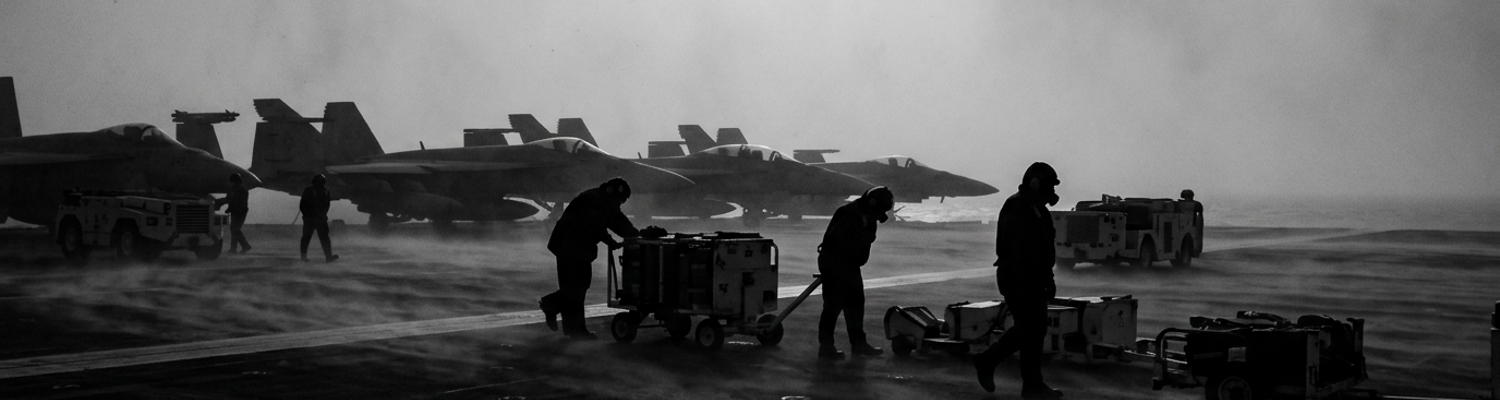
When examining the historical record of deck operations, flight deck directors faced an operating environment stripped of standard illuminated flight gear. Dense clouds of airborne particulate matter and soot from burning oil wells cut ambient optical visibility down to less than thirty yards. The 1,040-foot flight deck was reduced to complete darkness. Deck floodlighting was extinguished to preserve blacked-out security. To direct incoming aircraft clearing the arresting gear wires, yellow-shirted taxi directors relied strictly on pairs of handheld cyalume chemical light sticks. They waved green and red chem-lights inside clear plastic wands to signal turns, brake holds, and wing-sweep commands. Flight deck crews clamped flashing amber wave-off arrays to the port catwalk stanchions. These were wired to emergency dry-cell batteries to provide an emergency optical cue if an aircraft drifted dangerously off alignment. Aircraft chocks and tie-down chains had to be located and secured by feel against deck non-skid coated in slick mixtures of unburned jet fuel, salt spray, and abrasive desert silica. Tractor drivers moved forty-thousand-pound aircraft across the pitching flight deck without headlights. They followed the faint chemical glow of a director walking three paces ahead of the nosewheel.
A slip of ten inches meant tumbling into the dark waters of the Persian Gulf.
A close review of operational logs indicates that the survival of inbound strike flights rested entirely on the Landing Signal Officers stationed on the exposed port platform. Strike aircraft entered the landing pattern with remaining fuel readouts hovering below eight hundred pounds. This included fuel-starved F-14A Tomcats and A-6E Intruders from Attack Squadron 155. Eight hundred pounds was barely sufficient for a single go-around. Extreme Shamal wind shear generated heavy mechanical turbulence off the blunt island superstructure of Ranger. This created downdrafts that pushed approaching aircraft into three-hundred-foot-per-minute sink-rate spikes directly behind the round-down. The AN/SPN-41 instrument carrier landing system was powered down. Blowing soot completely obscured the Fresnel Lens Optical Landing System. Aviators were deprived of visual glidepath cues until two seconds before touchdown. Standing braced against forty-five-knot gusts, the LSOs tracked the faint engine exhaust signatures of inbound jets solely by sound and momentary silhouettes against the blowing dust. Over ultra-high-frequency radio channels, officers issued rapid continuous voice corrections. They ordered immediate throttle advances, nose-attitude adjustments, and rudder corrections to bring approaching aircraft down without visual line-of-sight alignment references.
Between 2200 and 0200 hours, eighteen aircraft trapped successfully aboard Ranger.
The final A-6E snagged the number three arresting cable with ninety pounds of fuel left in its collector tanks.