
Taszar Intermediate Staging Base Activation
Parkas and canvas tool rolls clattered against frozen ground as advance parties checked hydraulic jacks, tow bars, and tire chains along the perimeter of an austere airfield. The 21st Theater Army Area Command established the primary Intermediate Staging Base at Taszar Air Base in southern Hungary to support Operation Joint Endeavor in December 1995. Logistics planners chose the former Warsaw Pact installation because its rail spurs and concrete runways could support a massive buildup of forces bound for Bosnia. Survey teams inspected the cracked pavement and waterlogged drainage ditches, finding an installation that lacked basic billeting, reliable electrical power, and heavy vehicle staging aprons. Cold winter winds cut across the flat farmland, freezing standing pools of slush and coating vehicle recovery gear in brittle frost as mechanics waited for the first troop transports to touch down. Crews calibrated their battery testers and diesel generators under battery-powered lanterns, knowing that thousands of soldiers and combat vehicles from Germany were already moving south toward their perimeter.
Flatcars loaded with M1A1 Abrams tanks and M2 Bradley fighting vehicles rolled into railhead hubs at Kaposvar and Taszar after long journeys across Central Europe. Railhead hubs processed heavy tracked armor offloaded from Germany while operating in subzero winter conditions. Hydraulic ramps and steel tie-down chains froze solid during transit, forcing tank crews and mechanics to strike locking pins with sledgehammers and blast frozen linkage assemblies with portable heat blowers. Thick layers of road salt, ice, and slush covered the flatcar decks, turning the offloading ramps into slippery corridors where sixty-ton tanks risked sliding sideways off the narrow wooden timbers. Soldiers worked through the night in freezing sleet, draining fuel water separators and applying torch heat to frozen track shoes that had bonded directly to the steel railway cars. Ground guides walked inches from spinning steel tracks with flashlights, guiding each armored vehicle down onto the bare station sidings before the engines could stall in the bitter cold.
Clay soil collapsed under the massive weight of the freshly unloaded armor, churning into a thick paste that trapped vehicle tires and pulled boots off soldiers. Engineers emplaced thousands of tons of crushed rock aggregate and geotextile ground fabric to prevent maintenance yards and living areas from sinking into Hungarian clay. Commercial dump trucks hauled limestone gravel from local quarries day and night, dumping heavy loads directly onto rolls of woven synthetic cloth that work crews unrolled across the saturated dirt by hand. Bulldozers spread the crushed rock across hundreds of acres, packing the stones into a solid matrix that supported forty-ton supply trailers and tracked recovery vehicles. Work details pinned down the frayed edges of the fabric with rebar stakes, creating dry, stable islands of gravel where tent cities and maintenance facilities could stay level.
Mechanics moved tool chests and air compressors into these newly stabilized maintenance bays, working inside drafty shelter tents to revive engines crippled by frozen condensation and cracked fuel lines. Soldiers spliced brittle heater hoses, swapped out dead starter batteries, and wrapped fuel filters in insulation blankets to keep transport convoys running around the clock. Motor pool sergeants scavenged extra gaskets and warm engine oil from rear echelon pallets, troubleshooting electrical short circuits caused by moisture seeping into exposed wiring harnesses. Supply clerks and technical inspectors cleared each newly serviced tank and armored carrier for road movement as soon as recovery crews topped off the fluids and adjusted the track tension. Convoy commanders staged the verified armor in organized serials along the gravel bypass roads, preparing the staging base to push fuel, ammunition, and fighting vehicles southward toward the border.
Sava River Pontoon Deployment at Zupanja
Tractor trailers hauled bridge erection boats and aluminum bay sections directly to the water edge, where the 130th Engineer Brigade and the 502nd Engineer Company commenced assault ribbon bridge construction between Zupanja, Croatia, and Orasje, Bosnia. Unprecedented winter snowmelt surged the Sava River four meters above flood stage, widening the crossing site to roughly six hundred meters of violent, turbid water. Engineers found standard river crossing calculations completely inadequate as the swollen river swallowed low-lying Croatian approach roads and submerged both muddy banks beneath several feet of brown runoff. Combat engineers backed heavy bridge trucks through axle-deep mire along the northern bank, releasing folding aluminum interior bays into the rushing current with loud metallic clangs. Boat operators in twin-engine Bridge Erection Boats immediately maneuvered against the roaring torrent, revving their water jets to pin each drifting pontoon section against the shoreline before the floodwaters could wash the equipment downstream.
Steel cables groaned under extreme tension as boat operators fought the nine-knot river current, aligning the floating aluminum bays so deck crews could hammer hinge pins into place. Rapid river currents and heavy drifting ice floes repeatedly struck deployed ribbon bridge bays, shearing connector pins and threatening structural detachment across the central spans. Large chunks of river ice slammed into the pontoon hulls with heavy thuds, bending alignment lugs and snapping the high-strength steel locking clamps that bound adjacent bays together. Mechanics lay flat across the pitching aluminum decks in freezing wind, using crowbars, drift pins, and heavy sledgehammers to force distorted joints back into alignment. Soldiers worked without safety harnesses over the churning brown water, driving oversized replacement pins through battered hinge sleeves while flood spray coated their hands and coveralls in ice.
Engineers blasted the ice-encrusted anchor winches with portable blowtorches along the muddy Croatian bank to keep the main tensioning lines from snapping under the frozen load. Heavy bulldozers buried massive logs and concrete blocks deep into the saturated levee soil to serve as deadman anchors when standard ground pickets pulled free from the mud under the immense hydraulic load. Winch crews rigged thick steel wire ropes from these improvised deadman anchors directly to the upstream bridge spans, counteracting the brutal lateral drag generated by the six-hundred-meter expanse of floating aluminum. Bridge erection boats remained pinned nose-first against the pontoon flanks with their diesels screaming at maximum throttle, running their engines continuously to counter the drift pressure. Mechanics shuttled five-gallon fuel cans across slippery catwalks directly to the boat cockpits, refueling the engines while the craft bounced violently in the icy chop.
Mechanics poured the fresh diesel into vibrating fuel tanks while bridge crews muscled the final floating ribbon sections toward the flooded Bosnian embankment. Combat engineers on the Orasje shore waded chest-deep into freezing backwaters to guide the heavy aluminum ramp bay into a makeshift landing abutment. Bulldozers dumped tons of crushed stone into the soft marshland along the Bosnian approach, packing the loose rock down to create a stable ramp capable of bearing the weight of armored vehicles. Welders cut through buckled ramp braces with cutting torches and fabricated reinforced steel plates on site, repairing the structural wear caused by days of continuous river battering. Riggers locked the final cross-deck turnbuckles and torqued the structural connecting bolts along the entire six-hundred-meter span, securing the pontoon roadway in place across the raging Sava River.
Deadman Anchorages and Structural Rigging
Floodwaters slammed against the newly bolted pontoon bays with violent force, threatening to tear the aluminum roadway away from its temporary shoreline moorings. Standard steel ground pickets pulled clean out of the liquefied clay almost immediately as the river surged past flood stage. Combat engineers excavated deep deadman anchoring installations along both saturated riverbanks using buried timber baulks and structural steel pilings. Tracked excavators dug massive trenches parallel to the water, carving through meters of waterlogged silt to reach firmer ground. Work details lowered heavy timber baulks horizontally into the trenches and drove structural steel piles deep into the subsoil before chaining the assemblies together with heavy tow chains. Bulldozers compacted thick layers of heavy clay and crushed limestone aggregate over the buried beams, locking the deadman structures into the shorelines to create unyielding foundation points.
Engineers retrofitted high-tensile steel guy cables and supplemental winch lines directly across bridge joints to counter lateral hydrodynamic water drag, securing the floating spans to the fresh shoreline anchors. Riggers spliced thick wire ropes through the structural lifting eyes of each pontoon bay, bridging the flexible hinges where water pressure tried to twist the aluminum sections out of line. Soldiers clamped industrial turnbuckles and mechanical winches across the joints, adjusting each fitting by hand to distribute the pulling load evenly across the entire span. Frost coated the steel cables as crews worked in freezing river spray, using heavy torque wrenches and drift pins to lock down slipping brackets. Deck crews watched the cable strands groan and stretch under the river drag, checking every bolt for signs of metal fatigue. Winch operators tightened each supplemental line until the bridge stopped flexing downstream, but the relentless nine-knot current still placed dangerous stress on the shore fittings.
Crews in Bridge Erection Boats conducted around-the-clock power-holding maneuvers directly into the current to deflect floating ice and relieve tension on shore anchorages. Boat pilots steered their twin waterjet nozzles against the upstream flow, pressing their reinforced bows directly into the pontoon sponsons to absorb the river lateral thrust. Drifting ice floes struck the aluminum hulls with heavy thuds, threatening to wedge under the ribbon bridge bays and lift the roadway off its water line. Pilots throttled their diesel engines to full power, steering into incoming ice sheets to break up the frozen chunks and herd them safely past the crossing site. Cold river water washed over the open cockpits while the jet drives churned at maximum revolutions, fighting the floodwater inch by inch. Exhaust plumes drifted over the churning brown water as relief crews rotated through the wheelhouses every few hours to keep the boats running without pause.
Mechanics refueled the vibrating boat engines directly from five-gallon cans while bridge inspectors checked the tension on every retrofitted cable. Technicians walked the pitching aluminum deck with flashlights and torque wrenches, tapping cable clamps to verify that the deadman rigging held tight against the river pull. Welders reinforced damaged deck brackets with portable arc torches, fusing cracked steel plates back onto the bay hinges while freezing wind whipped across the river corridor. Surveyors on the Croatian levee sighted through optical transits, confirming that the combination of buried timber baulks, steel pilings, and working boats halted all lateral drift across the six-hundred-meter span. Work crews cleared the last debris from the bridge entrance ramps, opening the reinforced pontoon roadway for the first armored vehicle test crossing into Bosnia.
Posavina Corridor Mechanical Attrition
Tanks churned down the newly cleared ramp into the soft marshland, leading long supply columns south toward the front lines. Convoys navigating Main Supply Route Arizona through the Posavina Corridor encountered dense alluvial mud that penetrated wheel hubs and jammed brake assemblies. Liquefied clay and coarse river silt worked past the rubber grease seals on heavy transport axles, packing tightly around drum assemblies and brake shoes. Friction surfaces wore down within miles, generating scorching heat that cooked wheel bearing grease into carbon and stopped wheel sets from turning. Drivers smelled burning friction pads through their floorboards as tires dragged uselessly through the mire, slewing five-ton trucks sideways across the single-lane road. Mechanics crawled under the stalled axles with pry bars, cold chisels, and cans of penetrating lubricant, hammering against stuck linkages to break the wheels free before rear supply serials piled up behind them.
Trucks forced their way through narrow bypasses around the stalled wheel-locked vehicles, gouging deep parallel troughs into the saturated subgrade. Drive shafts and universal joints on heavy cargo trucks suffered premature structural failures from continuous churning through axle-deep road ruts. Extreme rotational torque twisted the hollow steel drivelines until the metal sheared apart, leaving drive axles dead while engines screamed at maximum revolutions. Heavy steel cross bearings snapped under the shock loads whenever spinning wheels suddenly bit into buried rocks, throwing fractured yokes into the mud. Recovery crews in tracked wreckers wallowed through knee-deep muck to hook heavy tow chains directly to dead axle housings. Mechanics lay flat on frozen wooden planks in the slush beneath the chassis, unbolting bent shaft sections and bolting on spare universal joints to clear the road for following fuel tankers.
Abrams tanks and Bradley fighting vehicles rumbled past the disabled wheeled transports, their wide metal track pads churning the roadbed into a thick gray paste. Cooling radiators and engine fan compartments on these heavy armored vehicles repeatedly clogged with frozen mud slurry, triggering severe overheating. High-speed cooling fans sucked the thick liquid clay directly through rear intake grilles, where blistering engine heat quickly baked the mud into hardened crusts across delicate cooling fins. Blocked airflow trapped heat inside engine bays, sending temperature gauges past the red line and setting off warning alarms in crew compartments. Drivers slammed on their brakes and shut down their throttles in the middle of active lanes before engine blocks warped or turbine seals disintegrated. Tank crews climbed out into the freezing sleet with entrenching tools and wooden survey stakes, chiseling caked earth out of fan shrouds while support teams rushed forward with pressure washers.
Mechanics hauled diesel-powered hot-water pressure washers onto the muddy roadway, aiming high-velocity spray directly into the packed radiator grates. Scalding runoff and melted clay cascaded off the armor plates into the roadside ditches as crews worked their way down the line of stalled fighting vehicles. Technicians scavenged replacement drive belts, water hoses, and hub seals from cannibalized parts trucks stationed at forward recovery points, working with bare, numbed hands in the subzero air. Soldiers torqued fresh mounting bolts into stripped bell housings and bled air out of scorched hydraulic lines while convoy commanders paced the shoulder with handheld radios. Drivers climbed back into cleaned cabs as soon as temperature gauges dropped to safe operating limits, revving their engines to test the restored airflow. Armored columns engaged their transmissions and lurched back into the rutted roadway, rolling deeper into the Posavina Corridor toward forward assembly areas.
Route Clearance and Minefield Mitigation
Road craters blocked the narrow supply route ahead of the advancing armor, forcing convoy commanders to halt their vehicles on the muddy asphalt. Unmapped bounding fragmentation mines and blast antipersonnel mines densely lined the saturated berms of the Posavina supply axis. Demolition charges detonated during earlier fighting had collapsed drainage culverts beneath the roadway, leaving gaping chasms several meters deep that severed the only hard-surfaced route into northern Bosnia. Freezing rainwater and persistent runoff flooded the ditches, washing away surface dirt and shifting the plastic-bodied mines into unpredictable positions beneath the muck. Drivers could not swerve their heavy vehicles off the asphalt shoulders without detonating hidden explosives against their tires and tracks. Convoy leaders radioed back for specialized clearance assets, knowing that stranded trucks could not be towed until sappers cleared the saturated banks.
Sapper teams paired metal detectors with mechanical tripwire grappling hooks to clear shoulders before recovery vehicles could position. Soldiers tossed weighted grappling hooks on nylon cords across the weeds to snag hidden tripwires attached to the pronged fuses of bounding mines. Teams pulled each line back from behind protective armor shields so any triggered bounding mine would detonate harmlessly in the open air. Subzero temperatures drained the metal detector battery packs rapidly, forcing sappers to rotate spare dry cells inside their field jackets to keep the audio signals clear. Technicians followed behind the cleared paths, sweeping the soaked ground with detectors set to maximum sensitivity to find the tiny metal firing pins buried inside plastic mines. Sappers drove non-magnetic brass probes into the stiff mud by hand, marking confirmed mines with red flags and laying strips of white engineer tape to designate clear work zones along the road shoulders.
Engineers welded improvised belly armor and standoff plating onto Armored Combat Earthmovers to cut bypasses around impassable road craters. Mechanics in forward repair tents salvaged thick sheets of structural steel from abandoned factories and cut them to size with oxyacetylene torches. Welders bolted and fused these heavy plates directly beneath the earthmover hulls to shield hydraulic pumps, transmission cases, and operator compartments from upward blast pressure if a blade struck a buried charge. Mechanics worked under drafty canvas fly sheets with portable generators, drilling mounting holes through hardened chassis frames and torquing high-strength bolts until the supplemental armor held firm against severe vibration. Soldiers attached steel mesh screens along the engine access covers and cab sides to detonate secondary fragmentation before it struck thin exterior body panels. Operators strapped on heavy protective vests and steered the modified earthmovers into the marked shoulder lanes, lowering their front dozer blades into the thick clay to excavate bypass routes.
Earthmovers pushed tons of wet clay away from the crater edges, creating wide detour ramps that circumvented the damaged pavement. Dump trucks backed down the marked lanes to unload crushed limestone and gravel directly into the soft detour trenches. Operators drove their steel tracks repeatedly across the rock piles to compact the stone into a firm roadbed that supported heavy transport axles without sinking. Survey teams checked the subgrade firmness with steel sounding rods, verifying that the compacted limestone aggregate would not shift under the weight of fifty-ton transports. Engineers pounded wooden boundary stakes into the stabilized shoulders, stringing reflective tape to keep following drivers within the proven safe lanes. Recovery vehicles positioned their winches on the newly reinforced ground, ready to guide the waiting supply serials through the bypass and onward down the corridor.
Recovery Operations and Field Modifications
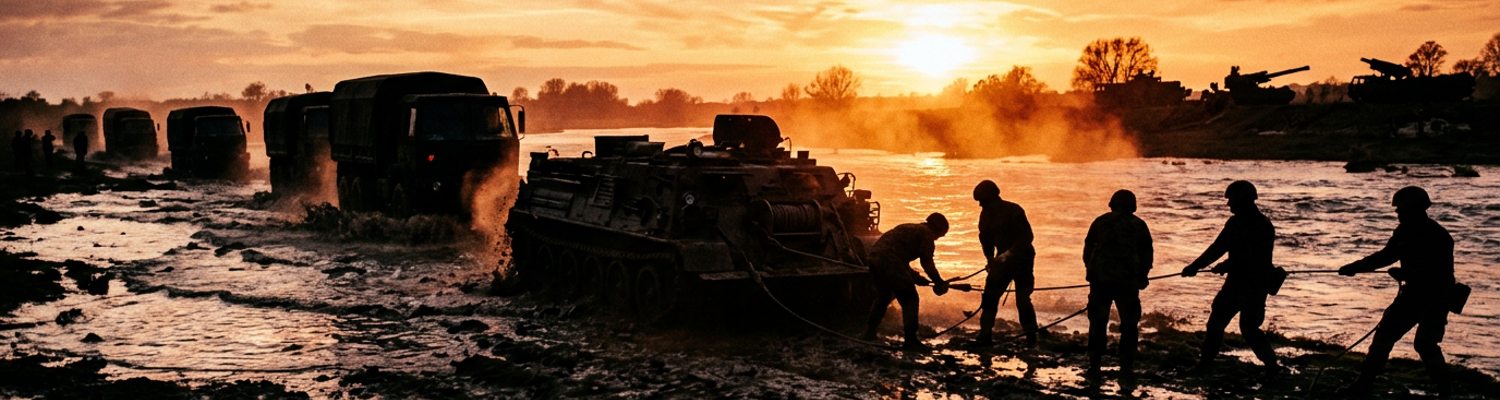
Steel winch cables groaned under extreme tension as tracked recovery crews dragged bogged supply trucks and armored personnel carriers through the bypass trenches. Medium Recovery Vehicles churned through knee-deep slurry to reach immobilized five-ton trucks, forcing their heavy steel tracks through frozen sludge that packed tightly beneath their lower hull plates. This dense crust pressed directly against exterior plumbing and ruptured critical fittings during heavy winching operations, dumping red hydraulic fluid into the snow and paralyzing recovery booms. Maintenance teams welded protective deflector shields onto recovery vehicle hulls to safeguard exposed hydraulic lines, cutting curved steel plates from scrap piles and fusing them over the vulnerable underbody piping with portable stick welders. Mechanics worked in freezing sleet with angle grinders to bevel the plate edges, ensuring the heavy steel deflectors could take the repeated impact of submerged boulders and frozen ruts without shearing off. These improvised deflectors channeled frozen mud away from hydraulic fittings, allowing recovery crews to snatch stuck armor from the shoulders and pull the last stranded cargo trucks onto the gravel approaches.
Soldiers in maintenance support battalions constructed makeshift high-pressure steam wash racks along bridge approaches to flush abrasive river grit and road clay from vehicle undercarriages. Logistics crews assembled these washing points out of industrial water heaters, diesel pumps, and perforated steel pipes laid over timber drainage grates. High-pressure steam blasts stripped hardened limestone mud from brake calipers, steering knuckles, and drive hubs that would otherwise seize up during road marches. Cold Balkan winds blew thick clouds of vapor across the road shoulders as wash details worked twelve-hour shifts in wet rubber overalls, directing each incoming vehicle onto the timber ramps where washing teams sprayed scalding water through wheel wells until clean metal reappeared. Technicians checked wheel hubs by hand immediately after washing, feeling for unusual heat that signaled bearing failure before releasing trucks onto the pontoon ramps. Melted runoff carried tons of gritty sludge into roadside drainage pits, allowing washed transports and fighting vehicles to rumble off the spray platforms with clean suspensions and roll forward into staging areas.
Silt particles kicked up by the armored columns coated engine intake screens, threatening to choke the high-revving engines as convoys pushed south. Mechanics accelerated track tensioning cycles and shortened air filter cleaning rotations to prevent fine silt from ruining gas turbine air induction systems. Turbine maintenance crews pulled the massive air filters from rear engine decks twice every day, using compressed air nozzles to blow out dense plugs of baked sediment before fine grit could pit the spinning turbine blades. Technicians inspected the rubber filter gaskets under portable floodlights, replacing dried seals immediately so unfiltered air could not bypass the intake housings. Tank mechanics also checked track shoe tension at every refueling halt, pumping heavy grease into track adjuster cylinders to compensate for slack caused by slurry grinding away steel track pins and rubber bushings. Soldiers tapped track pins with sledgehammers to verify pin retention and adjusted tension nuts until the track sag met strict technical manual limits, signaling drivers to engage their transmissions and lead the resupplied columns down the corridor.
Sava River Supply Lifeline Stabilization
Exhaust smoke rolled across the frozen marsh as the resupplied armor reached the northern riverbank where bridging crews fought high floodwaters to align the crossing. Engineers locked the final bridge pontoon bays into place on December 31, 1995, allowing the lead armored elements of the 1st Armored Division to transit into Bosnia. Soldiers drove heavy steel locking pins through the aluminum bay hinges with sledgehammers, securing the floating roadway while icy river spray broke over their boots. Boat operators in twin-engine craft held the swaying sections steady against the four-knot current by running their water jets at full power during the final hookup. Lead tanks rumbled onto the flexing metal surface one by one, keeping wide spacing to prevent shock loads from snapping the fresh connection joints.
Steel pontoon hulls groaned under the passing weight of sixty-ton armor columns, causing river water to force its way through tiny seal leaks. Engineer work parties sustained continuous pumping shifts inside submerged pontoon compartments to expel seepage water and prevent catastrophic buoyancy loss. Soldiers lowered electric submersible pumps and gasoline-powered suction hoses through cramped deck hatches, working waist-deep in freezing bilge water. Mechanics cleared river grit and floating debris from pump intake screens every hour to stop the small motors from overheating. Hand crews manned manual diaphragm pumps whenever electrical breakers tripped from moisture, keeping water levels inside the hollow aluminum pontoons well below danger limits. Inspection teams crawled through the dark interior bays with flashlights and chalk, marking seepage points along structural seams so repair squads could patch the metal between convoy runs.
Welders sealed the chalked seams under protective canvas tarps while vehicle traffic rumbled across the deck overhead. The finalized ribbon span established an uninterrupted ground supply corridor linking Taszar to forward operating bases in Tuzla. Heavy transport trucks carrying bulk diesel bladders, artillery rounds, and field rations rolled across the river day and night without stopping. Highway controllers at intermediate staging areas timed each convoy departure to match bridge crossing limits, keeping vehicle spacing consistent and preventing dangerous traffic jams on the saturated river ramps. Combat engineers walked the bridge deck around the clock with torque wrenches, tightening loose connection bolts that backed out under the relentless vibration of tracked armor. Forward depots across northern Bosnia received their first steady shipments of winter clothing, tent heaters, and tank repair parts within hours of the bridge opening.
Forklifts unloaded the incoming supply crates onto gravel pads in Tuzla while maintenance teams back on the Sava adjusted cable turnbuckles to absorb the bridge swaying motion. Sapper squads tightened high-tensile steel winches on the Croatian and Bosnian shorelines every four hours, counteracting the natural slack caused by shifting river mud around the buried timber deadmen. Bridge crews stationed safety boats upstream to intercept large tree trunks and sheets of river ice, nudging the floating debris clear of the aluminum bays with reinforced boat hulls. Mechanics set up heated tool shelters on both riverbanks to service boat engines and replace frayed winch cables without taking the crossing out of service. Sentry teams stood guard on the approach ramps with signal lanterns, guiding long rows of fuel tankers onto the pontoon roadway to keep fuel moving directly to forward combat units.