
Chinese Numerical Superiority 1950
A close review of operational logs from late 1950 reveals the impossibility of the task facing the United Nations Command. The scale of the new enemy was difficult to comprehend. By late November 1950, the Chinese People’s Volunteer Army (PVA) had secretly moved approximately 380,000 combat personnel into North Korea. This force was organized into multiple army groups. The 13th Army Group, itself comprising over 250,000 soldiers from elite units like the 38th, 39th, and 40th Corps, was poised directly against the US Eighth Army.
The PVA was a light infantry army, hardened by years of civil war. Its soldiers traveled with minimal logistical tails, marching at night through terrain considered impassable by road-bound Western armies. They carried their own ammunition and rations. This mobility allowed them to repeatedly infiltrate and encircle UN positions. Against this force, the Eighth Army and attached Republic of Korea (ROK) units were outnumbered by a factor of more than three to one. The entire UN command was on the verge of what it thought was a final victory, unprepared for the scale of the new war that had just begun.
Intelligence had failed catastrophically.
The Chinese Second Phase Offensive, launched on November 25, 1950, was a brutal awakening. The PVA 13th Army Group slammed into the US Eighth Army’s front along the Ch’ongch’on River, while other PVA forces simultaneously savaged the US X Corps in the east. The decisive blow fell on the Eighth Army’s right flank, held by the ROK II Corps. The unit disintegrated under the assault, exposing the entire flank of the American divisions. With their right flank completely in the air, the US 2nd and 25th Infantry Divisions were ordered into a fighting withdrawal. The retreat funneled through a narrow, frozen mountain road south of Kunu-ri, a route that became known as the Gauntlet. Chinese divisions, having marched cross-country, set up formidable blocking positions and ambushes along the high ground overlooking this single escape route. For units like the US 2nd Infantry Division and the attached Turkish Brigade, the retreat became a chaotic race for survival. A close examination of archival records (NARA Record Group 407) shows that the 503rd Artillery Battalion lost all of its guns in the pass. Vehicles were abandoned as they ran out of fuel or were destroyed, clogging the road and forcing men to take to the hills in a disorganized rout that became known as the Big Bug Out. The withdrawal from the Ch’ongch’on resulted in the longest retreat in US military history, a desperate 120-mile scramble south.
The psychological impact on the frontline soldier was profound. Troops who had been told they would be home by Christmas were suddenly fighting for their lives against an enemy whose existence their own command had denied just weeks prior. The PVA’s tactics were psychologically devastating. Night attacks were preceded by the unnerving sound of bugles, whistles, and horns, used for command and control but perceived by terrified GIs as a tool to induce panic. The sheer number of Chinese infantry, often appearing in successive formations, gave rise to the term human wave attacks. This perception, combined with the collapse of entire friendly units and the constant threat of encirclement, shattered the morale of many veteran American troops. A phenomenon dubbed bug-out fever swept through the ranks, an uncontrollable urge to flee south. The confidence and offensive spirit that had characterized the UN drive north from the Inchon landings evaporated in the freezing air of the North Korean mountains, replaced by a deep-seated fear of the seemingly inexhaustible Chinese armies.
General Ridgway's Command Assumption
The command of the Eighth Army changed hands at the moment of its deepest crisis. On December 23, 1950, Lieutenant General Walton Walker was killed when his command jeep collided with a ROK Army weapons carrier north of Seoul. Walker, who had commanded the Eighth Army since its deployment to Korea, died instantly in the accident near Uijeongbu. The man selected to replace him was Lieutenant General Matthew B. Ridgway, then serving as the Army’s Deputy Chief of Staff for Operations and Administration in the Pentagon. Notified on Christmas Eve, Ridgway flew to Tokyo alone, arriving on Christmas Day for a briefing with General Douglas MacArthur. MacArthur painted a grim picture of the situation but granted Ridgway complete operational latitude, telling him the Eighth Army was his to do with as he saw best. When Ridgway arrived in Korea on December 26, he found an army that was not just in tactical retreat but was psychologically shattered, gripped by a defeatist attitude and a pervasive fear of the Chinese forces.
His first actions were immediate.
Ridgway immediately focused on the complete restoration of the army’s will to fight. He found an organization consumed by defensive thinking and open talk of evacuating the peninsula entirely. During one of his first briefings at I Corps, after sitting through a long presentation on defensive contingencies, he asked to see the staff’s plans for an attack. The operations officer admitted there were none. That officer was replaced within days. This act set the tone for his command. Archival evidence shows Ridgway spent his initial days constantly at the front, visiting every corps and division headquarters. His physical appearance became iconic: a hand grenade and a first-aid kit strapped to his paratrooper harness, a visible declaration that the army’s commander was prepared for direct combat. He made it clear to all subordinate leaders that they were expected to be at the front, not in rear command posts. He listened to soldiers’ complaints, ordering hot meals moved closer to the lines and ensuring deliveries of winter clothing and even basic supplies like writing paper. This was a direct, personal style of leadership that stood in stark contrast to the recent past, rebuilding shattered confidence from the individual soldier upwards.
With morale beginning to turn, Ridgway fundamentally altered the Eighth Army’s entire operational philosophy. The era of panicked retreat was over. He replaced it with a doctrine of aggressive, forward-moving defense and attrition. He demanded that commanders stop marking enemy positions on maps unless they had been verified by a patrol in recent contact, forcing units to actively engage the enemy to develop intelligence. The first major application of this new approach was Operation Thunderbolt, launched on January 25, 1951. It was not a drive for territory but a large-scale reconnaissance-in-force designed to reestablish contact with Chinese forces and inflict maximum casualties. This concept, which came to be known as the meat grinder, leveraged the UN’s overwhelming superiority in artillery and airpower to bleed the numerically superior PVA. Formations were ordered to advance deliberately, securing flanks and using firepower to destroy enemy formations dislodged by the assault. This was followed by operations with names that broadcast the new offensive spirit: Killer, Ripper, and Rugged. Operation Killer, launched in February, had the explicit goal of destroying enemy forces south of a designated line, using massive artillery concentrations to annihilate withdrawing PVA units. The objective was no longer to hold ground at all costs, but to use ground as a means to facilitate the destruction of the enemy.
Han River Aggressive Patrol Directive
By January 1951, the Eighth Army had been pushed south of the Han River, abandoning Seoul and establishing a new defensive line near Pyeongtaek. A dangerous void had opened between the retreating UN forces and the advancing Chinese, leaving commanders blind and susceptible to surprise attacks. In response, Lieutenant General Matthew B. Ridgway issued a directive that fundamentally inverted the army’s psychology of retreat. He demanded a shift to aggressive, constant patrolling and the execution of limited objective offensives. This was not a call for a general advance but a granular, violent re-engagement with the enemy on his own terms. A close review of operational logs shows that commanders were ordered to send out reconnaissance patrols to forcibly reestablish contact. Hesitation was met with replacement. Ridgway made it clear that maps showing enemy positions were to be erased unless that position had been confirmed by a patrol in recent, direct contact. This forced units to push forward and fight for information.
An early expression of this new doctrine was Operation Wolfhound.
Ordered on January 15, 1951, the operation was a reconnaissance-in-force centered on the US 27th Infantry Regiment, the Wolfhounds, of the 25th Infantry Division. This was not a tentative probe; it was a powerful combined-arms team of infantry, tanks, and artillery tasked with attacking toward the Suwon-Osan area to test enemy strength. Ridgway’s instructions to I Corps commander General Frank W. Milburn were explicit: do not allow the force to become decisively engaged or require rescue, and do not exploit any opportunity for a larger advance without direct orders. The operation was a tightly controlled act of violence, designed to gather intelligence and bleed the enemy, a preview of the attrition strategy that would come to define Ridgway’s tenure.
The immediate tactical focus for these operations was the Han River line. The river, a formidable natural obstacle, was frozen thick in the winter cold, creating a vast, flat killing field and a potential highway for either army. Chinese People’s Volunteer Army (PVA) and North Korean People’s Army (NKPA) forces held the north bank, including the rubble of Seoul. Ridgway’s directive aimed to dominate the south bank and project power across the ice. Patrols from I Corps and IX Corps began systematically pushing toward the river, clearing any screening forces left behind by the main Chinese armies. Archival evidence shows that these were not quiet reconnaissance missions. Tank-infantry teams from the 25th Infantry Division advanced with armor, firing on suspected enemy positions on the opposite bank to provoke a response. The intent was to force the PVA to reveal their dispositions and concentrations. These aggressive probes culminated in Operation Thunderbolt, launched on January 25, which was a much larger, corps-level reconnaissance-in-force designed to push all the way to the Han. As units like the US I Corps neared the river, resistance stiffened, but the UN’s overwhelming advantage in artillery and airpower was used to systematically pulverize any enemy formation the patrols located. By early February, UN forces had secured Inchon and Kimpo Airfield and established a strong presence along the south bank of the Han.
This was a calculated gamble.
The Eighth Army was still psychologically fragile and acutely aware of its numerical inferiority and the enemy’s proven ability to infiltrate and encircle its units. Sending patrols forward into the void risked having them cut off and annihilated, which could have sent shockwaves through the already brittle morale of the frontline troops. Ridgway, however, was betting that the projection of strength was more important than the risk of tactical losses. The patrols served two purposes. For the enemy, they were a clear signal that the Eighth Army was not a broken force on the verge of evacuation but was instead preparing to resume the offensive. For his own men, seeing their comrades move forward and attack, and return, was the most effective antidote to the defeatism that had plagued the command. This was a war of will, and Ridgway used these limited offensives to seize the psychological initiative. He ensured the gamble paid off by refusing to let patrols go unsupported. Every reconnaissance mission was backed by meticulously planned fire support; the goal was for the patrol to find and fix the enemy, allowing the army’s massive advantage in firepower to handle the killing. This developing operational method, finding the enemy with infantry and destroying them with artillery and airpower, was the essence of the new American way of war in Korea.
Extreme Korean Winter Operations
The Siberian anticyclone descended upon the Korean peninsula in the winter of 1950-51, transforming the mountainous terrain into a frozen battlespace for which the Eighth Army was unprepared. Arctic winds swept down from Manchuria, routinely pushing temperatures to more than 30 degrees below zero Fahrenheit, with wind chill making conditions even more severe. The ground froze to the consistency of iron, making the simple act of digging a foxhole a monumental task requiring hours of labor with pickaxes. Snowfall was heavy and persistent, blanketing a landscape already defined by sharp-edged hills and narrow, winding dirt roads. For artillery units, the cold became a direct adversary in complex ways. A close review of operational logs from the 31st Field Artillery Battalion indicates that the extreme cold altered the propellant properties of their gunpowder, causing initial rounds to fall short until frantic recalculations were made. Rivers like the Han, which should have been formidable barriers, froze solid, creating broad highways for troop movement but also vast, featureless killing zones devoid of cover.
The cold was a weapon.
For the individual soldier, this environment was a relentless assault on the body. During the first winter of the war, over 5,000 U.S. casualties required evacuation not because of enemy action, but due to cold injuries alone. This figure accounted for 16% of all non-battle injuries requiring hospital admission. Frostbite was rampant, with the Battle of the Chosin Reservoir producing some 8,000 frostbite casualties among U.S. forces. Medical records show that ninety percent of these cases involved feet. The standard-issue leather combat boot, when wet, would freeze solid, constricting blood flow and accelerating tissue death. Soldiers wounded in action who lay too long on the frozen ground often suffered severe frostbite before they could be evacuated. The physical toll went beyond frostbite; constant shivering burned calories that could not be easily replaced, leading to exhaustion and weight loss. Weapons, the soldier’s last line of defense, failed. Lubricating oils congealed, rendering machine guns and rifles inoperable until they could be warmed. The simple act of pulling back the bolt on an M1 Garand became a struggle for hands numbed and weakened by the cold.
This direct assault on men and machines was matched by a systemic paralysis of the Eighth Army’s logistical nervous system. The unpaved supply routes became sheets of ice, drastically slowing convoys. Vehicle batteries lost their charge in the sub-zero temperatures, and engine lubricants thickened into sludge, making it impossible to start trucks and jeeps without lengthy thawing procedures. Rubber tires became brittle and cracked. Fuel lines frequently froze solid. The task of keeping the army supplied devolved into a series of desperate, small-scale battles against the elements. Every can of C-rations was frozen solid, requiring thawing before consumption. Medical supplies like plasma and liquid procaine, used to treat frostbite by improving circulation, were at constant risk of freezing and becoming useless. The cumulative effect of these failures created a state of extreme vulnerability where the army’s mechanical and material superiority was largely negated by the weather itself.
US Military Hardware Degradation
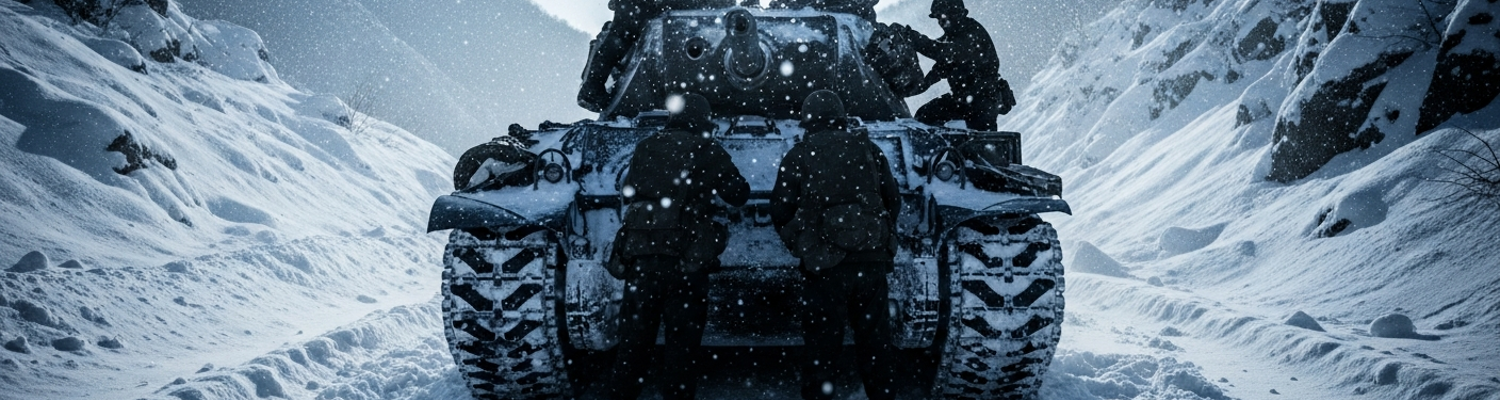
The Eighth Army’s mechanical strength, its arsenal of armor, was not designed for the Siberian conditions it faced. A close review of operational logs and maintenance reports from the winter of 1950-51 shows a systemic failure across armored units. For the crews of M4A3E8 Sherman and the heavier M26 Pershing tanks, the cold was a relentless enemy that attacked the machines from within. Standard lubricants for engines and transmissions thickened into a viscous sludge, making morning starts an exercise in futility. Batteries lost their electrical charge almost instantly in the sub-zero temperatures. Maintenance crews resorted to desperate measures, sometimes building fires directly beneath the engine blocks of their tanks simply to warm the oil enough to turn the engine over. In many units, the standing order became to leave tank engines running all night, consuming enormous quantities of scarce fuel to prevent them from freezing solid. The metal of the vehicles themselves became dangerously brittle. Tracks and suspension components, already stressed by the rugged terrain, could snap without warning. Ice and frozen mud would pack into the road wheels and bogies, immobilizing the tank as effectively as an enemy mine. Ordnance reports from the period (specifically, Ordnance Technical Intelligence Report No. 17) show M26 Pershing tanks suffering a mechanical loss rate as high as 35% during some operations, a figure far exceeding combat losses.
The army’s artillery, the foundation of its attrition strategy, suffered its own crisis of physics. The cold attacked the core function of the M2A1 105mm howitzer, the primary field piece for infantry divisions. A detailed examination of after-action reports reveals that the hydro-pneumatic recoil mechanisms, which relied on hydraulic fluid to absorb the shock of firing, began to fail. As temperatures plummeted, the fluid congealed, preventing the barrel from returning to battery and turning rapid-fire support missions into a slow, frustrating struggle. Firing pins, their springs weakened by the cold, would fail to strike primers with enough force to detonate a round. More insidiously, the cold altered the very nature of the weapon’s ammunition. Archival evidence from B Battery of the 31st Field Artillery Battalion documents a specific engagement where registered rounds began falling drastically short of their targets. A frantic recalculation by the battery’s officers revealed that temperatures approaching 32 degrees below zero had changed the burn rate and propellant properties of the gunpowder itself, forcing gun crews to relearn their craft in the middle of a firefight. To combat the freeze, artillerymen took to urinating on the frozen breeches and mechanisms of their guns to thaw them out in the heat of battle.
This degradation extended to the logistical fleet that was the army’s lifeblood. The iconic 2.5-ton CCKW truck, the deuce and a half, and the ubiquitous jeep were the vehicles tasked with moving every bullet, ration, and man to the front, but they were systematically defeated by the cold. Veteran accounts from motor pools describe how the standard 6-volt electrical systems of the CCKW trucks were wholly inadequate for the temperatures. Even specially issued cold-weather kits, which added a second battery in parallel, were not enough to turn over engines filled with thickened oil. Fuel lines froze, rubber hoses and seals became brittle and cracked, and tires lost pressure and traction on the icy roads. A single stalled truck on one of Korea’s narrow mountain supply routes could halt an entire convoy for hours, creating a cascade of delays that rippled all the way to the front line. The failure of these simple vehicles had a direct tactical impact, starving tanks of fuel and artillery batteries of ammunition.
Command Control Breakdowns
The aggressive patrol actions mandated by General Ridgway along the Han River were predicated on the Eighth Army’s ability to coordinate its units and leverage its firepower, yet the entire effort was plagued by systemic breakdowns in command and control. At the most fundamental level, the technology of communication failed. A close examination of operational logs reveals persistent and debilitating issues with the primary radio sets available to frontline infantry. The backpack-mounted SCR-300 walkie-talkie, the main link between companies and battalions, was a vacuum-tube apparatus designed in World War II that was notoriously fragile and battery-dependent. Its effective range of roughly three miles was drastically reduced by the severe, mountainous Korean terrain. More critically, the BA-70 and BA-80 dry-cell batteries that powered the units were chemically crippled by the sub-zero temperatures. A battery rated for 20 hours of life in temperate conditions might last only a few hours, if it worked at all. For platoon-level actions, soldiers carried the smaller AN/PRC-6 handie-talkie, a single-channel radio whose quarter-watt output gave it a maximum range of about one mile, a distance that was often wishful thinking. Patrols moving across the frozen Han or probing enemy positions near Suwon during Operation Thunderbolt found their links to supporting artillery and adjacent units severed as batteries died and low-power signals failed to penetrate the hills.
These technological failures cascaded into tactical chaos, making the coordination of disparate units an exercise in frustration. The UN command was a coalition force, and while American units formed the core, they fought alongside Republic of Korea (ROK) Army divisions and contingents from nations like Turkey and France. True interoperability was a fiction. American and ROK units often operated on different radio frequencies with incompatible equipment, rendering direct communication impossible. A US tank platoon from the 25th Infantry Division assigned to support a ROK infantry assault during the advance on Inchon had no reliable method to talk to the troops they were protecting. Coordination relied on visual signals, which were easily lost in the smoke and confusion of battle, or on liaison officers who had to physically move between command posts. The problem was so pronounced that after-action reports document instances where British naval vessels providing gunfire support had to relay fire commands to US Marine Corsair aircraft because the ship and the planes could not communicate directly. This left commanders attempting to orchestrate complex combined-arms maneuvers like Operation Thunderbolt with the equivalent of a dangerously broken telephone line. Seams between advancing corps and divisions became points of extreme vulnerability, as units moving on parallel tracks were often blind to the status of their neighbors.
Severe weather was the final, decisive factor that shattered the already fragile command infrastructure. The extreme cold that deadened batteries and froze weapons also grounded the airborne assets that might have compensated for the failure of ground-based radios. Small, single-engine L-5 and L-19 liaison aircraft were the eyes of the army, tasked with spotting for artillery, performing reconnaissance, and providing a communication link for commanders. When blizzards and low-hanging fog rolled in, these planes could not fly. This left ground commanders completely blind beyond their immediate line of sight. A patrol dispatched to probe PVA positions north of the Han could be swallowed by a sudden snowstorm, their radio rendered useless by the cold, with no possibility of air observation to find them or direct fire support. The ground itself, frozen to the consistency of rock, made laying new telephone wire, the most reliable form of communication, a slow, arduous process. Runners, the most ancient form of military communication, were the last resort, but in deep snow and arctic temperatures, they were slow, exhausted, and easily lost. The combination of failing electronics, incompatible systems, and blinding weather meant that Ridgway’s directive for aggressive, coordinated action was often executed by isolated units fighting for survival, fundamentally deaf, dumb, and blind.
Ridgway's Han River Gamble Assessment
The immediate tactical results of the Eighth Army’s renewed offensives in late January 1951 were swift and decisive, fundamentally altering the battlefield geometry south of the Han River. Operation Thunderbolt, a corps-level reconnaissance-in-force launched on January 25, was the main expression of this new strategy. A review of operational logs shows that US I and IX Corps advanced methodically, with formations ordered to maintain contact with adjacent units and not to advance beyond designated phase lines until ordered. This was a deliberate, controlled aggression. Resistance from Chinese People’s Volunteer Army (PVA) screening forces stiffened as the UN columns neared the river, but it was systematically shattered by overwhelming artillery and air support. By February 10, the attack had achieved its primary objectives. UN forces had secured the port of Inchon and the vital Kimpo Airfield, and had established a strong, continuous defensive line along the south bank of the Han. The advance confirmed that the main body of the PVA had pulled back to regroup, leaving a tactical void that Ridgway’s forces had successfully and violently reclaimed.
This was a gamble founded on a cold psychological and strategic calculation. Lieutenant General Matthew B. Ridgway was acutely aware that the Eighth Army was still suffering from the psychological shock of the previous months. Sending forces forward risked having them isolated and destroyed, an event that could have shattered the army’s fragile morale for good. Ridgway, however, assessed that inaction was the greater danger. He reasoned that allowing the PVA to rest and refit without pressure would invite another overwhelming offensive against a static, fearful defender. The aggressive patrols and limited attacks served a dual purpose. For the enemy, they were an unmistakable signal that the Eighth Army was not a broken force preparing to evacuate but was instead regaining the initiative. For his own men, the operations were the most effective antidote to their defeatism. Seeing American units move forward, engage the enemy, and successfully return was a powerful demonstration of renewed strength and competence. Ridgway heavily mitigated the risk by wedding his infantry to the army’s immense firepower; the patrols were not meant to win ground but to find and fix the enemy, allowing massed artillery and air strikes to inflict maximum casualties.
The long-term impact on the Eighth Army’s operational confidence was profound. The success of Operation Thunderbolt and its precursor, Operation Wolfhound, proved that the Chinese soldier was not invincible and could be defeated by a combination of sound tactics and superior firepower. This rebuilt the confidence of the frontline soldier and, critically, of the unit commanders who Ridgway had tasked with leading from the front. The Eighth Army began to transform from a force that feared encirclement into an army that understood how to use its mobility and firepower to attrite a numerically superior foe. This newfound confidence was not arrogance; it was a professional belief in a new, sustainable way of fighting that prized the destruction of enemy forces over the holding of terrain. This shift was not lost on the PVA command. They no longer faced a panicked army prone to disorganized retreat. Instead, they confronted a methodical and aggressive opponent that was willing to trade space to set the terms of battle, an enemy that relentlessly probed their lines and punished any exposed formation with devastating fire. The era of easy victories for the PVA was over, replaced by a brutal war of attrition.