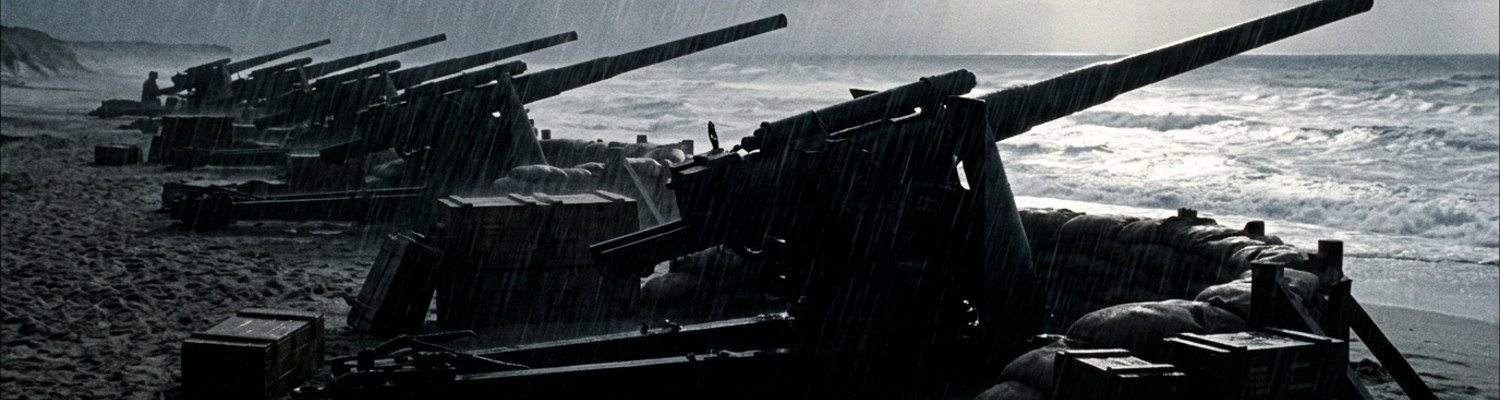

Coastal Defense Emplacements and Early Preparations
The wind died down completely just before dawn on June 4, 1942. A heavy quiet settled over the flat expanse of Midway Atoll. Men stationed along the southern perimeter gripped their steel helmets in the dark. A close review of operational logs indicates that the gunners stared into an empty horizon. They waited for the Japanese bombardment to break the silence. Not a single engine roared in the distance. The ocean slapped gently against the coral reef.
Every second of quiet amplified the mechanical dread building inside the reinforced sandbag emplacements.
Archival evidence shows the United States Marine Corps 6th Defense Battalion held the responsibility for repelling a direct surface assault on this coral atoll. Under the command of Lieutenant Colonel Harold D. Shannon, the unit deployed a specific array of heavy ordnance across the southern shoreline of Sand Island. The primary battery positioned precisely at coordinates 28 12 N 177 21 W bore the designation Battery F. This unit operated the heaviest weapons in the sector under severe physical conditions. Four 7-inch 45 caliber coastal defense guns sat in open-ring revetments facing the likely approach vectors of enemy cruisers. Naval engineers originally designed these massive artillery pieces in the early 1900s as the secondary batteries for pre-dreadnought battleships. Stripped from obsolete vessels and shipped across the Pacific from Pearl Harbor, each gun barrel weighed over 28,000 pounds.
Moving these massive assemblies across the soft beaches of Sand Island required extreme manual exertion.
Work details laid temporary wooden plank roads over the shifting dunes. Specialized tracked tractors ran their engines to the point of overheating just to pull the steel carriages a few yards at a time. Gun crews mixed and poured hundreds of tons of concrete by hand to form the deep foundation pads required to anchor the base rings. Infantrymen filled ten thousand canvas sandbags to build protective parapets around each gun pit. Once bolted down to their platforms, the Mark 2 pedestal mounts provided a 15-degree elevation limit. This mechanical restriction capped their maximum firing range at approximately 14,000 yards. The Marines stacked hundreds of 165-pound armor-piercing projectiles in adjacent subterranean magazines. These storage bunkers consisted of corrugated steel buried under three feet of sand.
When examining the historical record regarding the maintenance of these aging weapons, a severe mechanical failure point emerges long before the first Japanese ship approached. Relentless trade winds drove corrosive Pacific salt spray directly into the open gun pits day and night. This constant exposure caused the rapid decay of the natural rubber and leather recoil seals on the primary battery mounts. The 7-inch guns relied on a complex hydro-pneumatic recoil system filled with a specific mixture of glycerin and water. This pressurized fluid absorbed the massive rearward force generated by firing. Salt crystals accumulated on the polished steel recoil cylinders. The abrasive particles physically scratched the metal surfaces every time the handwheels elevated or depressed the gun. The intense tropical sun baked the exposed rubber components, accelerating the degradation process.
Once the salt compromised the exterior packing glands, the system began to leak pressure and fluid into the sand below.
If a gun fired without sufficient recoil fluid, the 28,000-pound barrel would slam backward. The kinetic energy would tear the steel trunnions from the mount and crush the gun crew. Battery commanders submitted urgent requisition forms for replacement gaskets to the 14th Naval District headquarters in early May (NARA Record Group 127). Cargo vessels arrived at the Midway lagoon carrying aviation fuel, anti-aircraft ammunition, and barbed wire. The specific dimensional seals required for the obsolete Mark 2 mounts never materialized on the loading docks. The distribution network prioritized aviation assets over coastal defense maintenance. Battery F had to solve the engineering crisis locally. Facing a complete loss of recoil control, gunners resorted to packing the leaking cylinders with heavy axle grease salvaged from motor pool tractors. They wrapped the decaying seals in canvas soaked in waste engine oil to repel the incoming moisture. Firing practice had to be completely suspended to preserve the fragile, deteriorating gaskets for the actual invasion.
The improvised patching reduced the recoil slide clearance to a fraction of a millimeter.
Hydraulic Gasket Deficiencies and Mechanical Seizing
A close review of operational logs indicates that a severe shortage of spare hydraulic gaskets plagued Sand Island prior to June 1942. This deficit directly degraded the combat readiness of the Marine 6th Defense Battalion. Supply manifests from the 14th Naval District at Pearl Harbor show that rear-echelon quartermasters repeatedly bypassed the emergency requisitions submitted by Battery F. The obsolete 7-inch 45 caliber coastal defense guns required highly specific, large-diameter neoprene and leather composite seals. These components maintained pressure within the hydro-pneumatic recoil cylinders. The cylinders relied on a precise mixture of glycerin and distilled water to absorb the violent rearward kinetic energy generated by firing 165-pound armor-piercing projectiles. Without intact gaskets, the pressurized fluid seeped out of the packing glands and drained down the carriage.
Naval engineers calculated that firing the weapon with compromised recoil pressure would cause the 28,000-pound barrel to bottom out against the rear stops.
This physical impact would instantly shear the heavy steel trunnion pins and collapse the entire gun assembly onto the concrete pad. Battery commanders submitted detailed supply requests throughout March, April, and May (Bureau of Ordnance File 44-A). They logged the rapid deterioration of their existing seals under the intense tropical sun. Cargo transports arrived at the Midway lagoon daily. They unloaded thousands of barrels of high-octane aviation fuel, crates of .50 caliber ammunition, and coils of barbed wire. The specific dimensional seals required for the World War I era Mark 2 pedestal mounts never materialized on the loading docks.
Archival evidence shows this specific supply failure triggered a cascading mechanical breakdown. The breakdown directly impaired the battery's ability to track moving surface targets. Elevation gears jammed continuously due to accumulated salt crust and degraded hydraulic seals leaking fluid directly onto the lower mount assemblies. The Mark 2 carriage utilized a heavy, exposed series of brass and steel worm gears to raise and lower the 28,000-pound gun barrel through its 15-degree vertical arc. As the deteriorated leather packing glands split open, the viscous glycerin and water mixture dripped steadily onto the traversing and elevating mechanisms located directly beneath the recoil slide. Relentless trade winds blowing across the southern reef carried high concentrations of atomized seawater directly into the open concrete gun pits of Battery F. The airborne salt spray mixed with the leaking hydraulic fluid and the heavy axle grease the Marines had applied to the gears. This chemical combination baked under the midday heat to form a hardened, abrasive paste that coated the deep grooves of the elevation arcs.
Turning the manual elevation handwheels required two artillerymen straining against the cast-iron handles just to crack the hardened crust.
The abrasive salt compound physically ground away the softer brass gear teeth every time the crew attempted to adjust the barrel angle. Gun captains recorded that the handwheels frequently seized completely during standard tracking drills. The artillery pieces locked at fixed elevations. They became completely useless against moving ships. Freeing the jammed mechanisms required the gunners to halt their firing drills and completely dismantle the protective steel gear housings. Men scrubbed the caked salt from the worm gears using stiff wire brushes. They applied highly flammable petroleum solvents requisitioned from the motor pool. Waste engine oil scavenged from tractor crankcases provided temporary lubrication. The temporary fix lasted only until the next wave of airborne saltwater blew over the sandbag parapets and mixed with the fresh oil. By late May, the continuous jamming forced gun crews to schedule mandatory teardowns of the elevation mechanisms every forty-eight hours.
They discarded the ruined brass filings directly into the sand at the base of the concrete foundation pads.
Commanding officers faced a rigid engineering bottleneck with no external support. Lieutenant Colonel Harold D. Shannon ordered the gun crews to cease all live-fire practice. The directive aimed to preserve the few remaining intact gaskets for the anticipated Japanese assault. The lack of live-fire training meant the gunners had to rely entirely on dry-fire tracking drills. These drills were constantly interrupted by the seizing elevation gears. When a gear jammed during a simulated surface engagement, the crew physically struck the brass housings with wooden mallets. The impacts dislodged the larger salt crystals. Metal fatigued quickly. The 6th Defense Battalion maintenance logs list dozens of sheared cotter pins and bent handwheel shafts (Maintenance Log Entry 114). This mechanical damage resulted from the sheer brute force applied by the Marines trying to force the barrels upward. Every hour spent breaking down the gear assemblies was an hour subtracted from reinforcing the sandbag parapets. The physical degradation of the Mark 2 mounts dictated the daily schedule of Battery F. The men remained trapped in a cycle of cleaning and re-greasing obsolete machinery.
The maintenance crews documented over forty instances of stripped elevation worm gears before the end of May.
Combat Camera Detachment Reassignment and Fatigue Details
When examining the historical record of the Midway atoll defenses, a severe manpower shortage forced immediate changes to specialized assignments during the final weeks of May 1942. Personnel from the Naval Combat Camera Detachment arrived on Sand Island via PBY Catalina flying boats. They carried explicit orders from Pearl Harbor to document the fortification efforts. Commanded by Hollywood director John Ford, this specialized unit initially deployed with lightweight 16mm Eyemo cameras, heavy wooden tripods, and sensitive sound recording gear. Their mission involved capturing the defensive preparations of the Marine 6th Defense Battalion. The unit operated under strict directives to produce visual intelligence for the Navy Department. Base commander Captain Cyril T. Simard and Lieutenant Colonel Harold D. Shannon recognized that the physical demands of maintaining the heavy coastal artillery far exceeded the capacity of the assigned gunners. Command directives immediately reassigned these highly trained photographers from their primary visual documentation duties directly into standard manual labor pools.
The optical lenses and spare film magazines sat locked inside their watertight transport crates.
Archival evidence shows that the Hollywood technicians found themselves integrated into fatigue details operating directly at coordinates 28 12 N 177 21 W. The continuous accumulation of wind-blown coral sand inside the open-ring revetments of Battery F required constant physical excavation to prevent the gun carriages from seizing. Men who previously spent their careers framing cinematic shots now wielded standard-issue entrenching tools and heavy iron spades. They spent ten-hour shifts digging out the concrete base rings of the four 7-inch 45 caliber coastal defense guns. Blisters formed instantly. The intense Pacific sun baked the unprotected gun pits, driving ambient temperatures well above one hundred degrees Fahrenheit. Salt spray from the adjacent southern reef coated their skin and uniform shirts. This caused severe friction abrasions as they hauled burlap sacks filled with wet sand away from the foundation pads.
Every available pair of hands was required to halt the rapid mechanical degradation of the primary batteries.
A close review of operational logs indicates that the fatigue crews manually hauled grease to keep the aging artillery functional. The chronic shortage of proper hydro-pneumatic recoil seals caused the World War I era Mark 2 pedestal mounts to leak pressurized glycerin fluid continuously into the dirt. To compensate for this specific mechanical failure, the Marines and the reassigned camera operators transported fifty-pound steel buckets of thick, salvaged axle grease from the motor pool directly to the gun emplacements. The trek spanned over a quarter-mile of shifting dunes. They carried these heavy loads by hand across temporary wooden plank roads that constantly sank into the soft beach sand under their boots. Upon reaching the artillery pieces, the fatigue details applied the viscous paste directly onto the exposed brass worm gears of the elevation arcs. Working entirely without specialized applicator tools, the men used wooden paddles and their bare hands to pack the thick grease deep into the grooves of the traversing mechanisms. Airborne salt crystals immediately bound to the fresh lubricant. The mechanisms locked. This chemical reaction required the crews to scrape the hardened, abrasive crust off the metal surfaces with stiff wire brushes before applying a fresh layer of grease every forty-eight hours.
The abrasive paste physically ground away the softer brass teeth on the manual elevation handwheels.
Beyond the constant lubrication requirements, the physical preservation of the primary gun barrels demanded extreme manual exertion from the newly formed work details. Fatigue crews hauled heavy clearing rods from the subterranean corrugated steel magazines out to the open firing pits. These specialized artillery maintenance tools consisted of dense, solid ash wood poles tipped with heavy brass bore brushes and thick cotton swabs. Naval engineers originally designed the 7-inch 45 caliber weapons with barrels exceeding twenty-six feet in length. This necessitated multi-section clearing rods that weighed over eighty pounds when fully assembled. Moving these massive poles required coordinated teamwork in extremely tight quarters. The constant exposure to atomized seawater threatened to rapidly pit the internal steel rifling of the 28,000-pound assemblies. To prevent corrosive decay from destroying the ballistic trajectory of the armor-piercing projectiles, the integrated teams of artillerymen and camera personnel had to swab the entire length of the bore daily. The crews soaked the cotton swab heads in highly flammable petroleum solvents to break down the salt deposits accumulating inside the steel tubes.
Four men strained simultaneously against a single wooden shaft to force the tight-fitting brass brush past the breech block.
Logistical Bottlenecks at Northern Lagoon Offloading Zones
Archival evidence shows the primary offloading point for the Midway garrison consisted of a single, narrow wooden pier extending into the northern lagoon. Cargo ships arriving from the 14th Naval District at Pearl Harbor dumped incoming material haphazardly onto the cramped wooden decking. The offloading process lacked heavy mechanized cranes or dedicated rolling stock. Dockworkers manually dragged thousands of heavy wooden crates across the splintered planks. Piles of high-octane aviation fuel drums and boxes of .50 caliber anti-aircraft munitions quickly overwhelmed the limited square footage of the landing zone. The Marine 6th Defense Battalion supply officers submitted daily emergency requests for the specific maintenance supplies needed to keep Battery F operational on the opposite side of the island. These requisitions included heavy wire brushes, highly flammable petroleum solvents, and replacement hydro-pneumatic fluid for the obsolete 7-inch 45 caliber guns. The severe bottlenecks at the Sand Island docks meant these specific crates sat buried under tons of barbed wire and canvas sandbags. The physical dimension of the pier restricted movement to a single lane of foot traffic. Work details prioritized frontline ammunition over rear-echelon maintenance gear.
The backlog delayed the delivery of the specialized artillery maintenance tools by over seventy-two hours.
A close review of operational logs indicates that the communication infrastructure required immediate physical reinforcement while the heavy maintenance supplies sat trapped on the northern shoreline. Battery F relied on direct electrical links to the central command bunker to coordinate surface target tracking and receive firing coordinates. The existing wiring suffered severe corrosion from constant exposure to atomized seawater. Command decisions from Lieutenant Colonel Harold D. Shannon directed emergency engineering crews to lay new, lead-sheathed copper fire control cables along the southern perimeter. These heavy transmission lines weighed over four pounds per foot. Moving the large wooden spools out to the gun emplacements proved impossible across the soft inland sand dunes. The heavy tracked tractors assigned to the motor pool immediately sank to their axles when attempting to haul the weight over the shifting terrain. The engineers opted to route the cables through the shallow water running parallel to the southern reef.
The selected path directly exposed the work details to the violent kinetic energy of the incoming Pacific swells.
Flat-bottomed Higgins boats transported the heavy wooden spools into the coastal waters near coordinates 28 12 N 177 21 W. The shallow draft of the landing craft prevented them from approaching closer than fifty yards to the shoreline. Marine engineers and naval personnel jumped into chest-deep water to manually haul the thick copper cables toward the beach. Sharp coral heads hidden beneath the surface sliced through their canvas boots and utility trousers. The heavy surf battered the work details, repeatedly knocking men off their feet as they hoisted the lead-sheathed lines onto their shoulders. Saltwater immediately infiltrated the exposed copper wiring whenever a wave submerged the spliced connections. The crews dragged the heavy lines yard by yard through the turbulent water, fighting the undertow pulling back toward the open ocean. Small, improvised wooden jetties built to service patrol boats blocked the direct path to the gun pits. The men had to physically dive under these choked surf zone piers to thread the heavy cables through the barnacle-encrusted wooden pilings.
The friction from the hauling process stripped away sections of the protective outer rubber insulation.
When examining the historical record, the physical exhaustion of the cable details directly compounded the maintenance crisis at the gun pits. The same men hauling heavy copper wire through the surf were scheduled to overhaul the jammed elevation gears on the primary batteries. They returned to the open-ring revetments covered in dried salt and bleeding from deep coral abrasions. The crates containing their required wire brushes and solvents remained stranded on the congested northern docks. The gunners resorted to using their combat knives to scrape hardened salt crusts off the brass worm gears.
They lubricated the cleaned gear teeth with the remaining dregs of contaminated axle grease.
Intelligence Intercepts and Hydraulic Fluid Conservation
Archival evidence shows that encrypted radio intercepts from the United States Pacific Command fundamentally altered the daily consumption rates on Sand Island during the final week of May 1942. Cryptanalysts operating out of Station HYPO at Pearl Harbor successfully decoded the Japanese JN-25b naval cipher. They identified the Midway atoll as the target designated AF by the Imperial Japanese Navy. Fleet Admiral Chester W. Nimitz dispatched a highly classified intelligence summary directly to Captain Cyril T. Simard and Lieutenant Colonel Harold D. Shannon via secure underwater telegraph cables. This dispatch detailed the expected date of attack, the specific approach vectors from the northwest, and the heavy cruiser escorts accompanying the incoming First Air Fleet. The confirmed threat of an imminent, large-scale carrier strike triggered an immediate halt to all standard material distributions across the Marine 6th Defense Battalion. Quartermasters physically padlocked the subterranean storage bunkers located near the central command post at coordinates 28 12 N 177 21 W. The heavy steel doors stayed shut. Shannon issued a base-wide directive freezing the issuance of all petroleum solvents, aviation-grade lubricants, and specialized chemical mixtures to frontline units. Supply officers required direct written authorization from the battalion executive officer to release even a single quart of standard motor oil to the motor pool tractors.
The newly enforced conservation protocols cut off Battery F from their remaining reserves of uncontaminated maintenance supplies.
A close review of operational logs indicates that the battery commanders faced an immediate crisis regarding the specific glycerin and distilled water mixture required to operate the hydro-pneumatic recoil cylinders on the 7-inch 45 caliber guns. The relentless leaking of the degraded leather packing glands had already drained the majority of the working fluid into the dirt beneath the Mark 2 pedestal mounts. Officers commanding the heavy artillery positions inventoried their remaining sealed drums of pure hydraulic fluid. They found less than fifteen gallons. This limited supply had to service the entire four-gun battery. To prevent a complete mechanical failure of the recoil slides during the anticipated surface bombardment, the commanders instituted a strict, localized fluid rationing system. Maintenance crews received authorization to dispense the clean glycerin mixture in increments of exactly four fluid ounces per gun every forty-eight hours. Artillerymen used calibrated glass beakers scavenged from the base medical dispensary to measure the exact volume of liquid before pouring it into the brass filler valves. The men had to filter the liquid through clean cotton rags to ensure no wind-blown sand entered the highly sensitive pressurized chambers during the transfer process.
Spilling a single drop of the clear liquid onto the concrete foundation pads constituted a direct violation of command orders.
When examining the historical record, this extreme rationing of hydraulic fluid directly dictated the physical positioning of the 28,000-pound gun barrels. Naval engineering specifications for the Mark 2 mounts required fully pressurized cylinders to safely absorb the kinetic energy generated by firing at the maximum 15-degree elevation angle. Gravity compounded the rearward force of the blast when the heavy barrels pointed upward. Firing a 165-pound armor-piercing projectile at high angles with partially filled recoil slides would cause the massive steel tubes to bottom out against the rear stops, instantly snapping the heavy steel trunnions. Battery commanders ordered the gun captains to lock the manual elevation handwheels at a maximum angle of four degrees. This specific mechanical restriction reduced the rearward gravitational pressure on the compromised leather seals and conserved the tiny volume of clean fluid inside the chambers. The forced reduction in barrel elevation simultaneously slashed the effective firing range of the coastal defense guns from 14,000 yards down to barely 7,500 yards. Gunners lost the ability to engage Japanese heavy cruisers at maximum visual range. They had to wait for enemy surface vessels to cross the shallow outer reef boundary before initiating a firing sequence.
The manual locking mechanisms on the brass worm gears were physically bolted into place using half-inch steel wrenches.
Nitrocellulose Degradation and Artillery Fire Readiness
Archival evidence shows that the distribution of high-explosive powder charges across the southern perimeter followed an increasingly rigid schedule during the final weeks of May 1942. The 7-inch 45 caliber coastal defense guns operated by the Marine 6th Defense Battalion required separate ammunition components to function. Gunners had to load a 165-pound armor-piercing projectile followed by a heavy silk bag containing smokeless nitrocellulose powder. Quartermasters stored these highly volatile charges inside subterranean corrugated steel magazines buried under three feet of sand at coordinates 28 12 N 177 21 W. The intense ambient heat of the Pacific atoll caused the temperature inside these unventilated bunkers to exceed one hundred and ten degrees Fahrenheit by midday. Chemical degradation of the nitrocellulose accelerated rapidly under these thermal conditions. Lieutenant Colonel Harold D. Shannon instituted a strict allocation protocol to prevent accidental detonations and conserve the most stable explosives for the anticipated Japanese surface assault. Supply officers physically locked the heavy steel doors of the primary magazines, releasing only a fraction of the required powder to the open-ring revetments of Battery F.
Gun captains received an exact allotment of four silk powder bags per artillery piece to store in the ready-boxes.
A close review of operational logs indicates that this strict allocation directly correlated with the rapid mechanical degradation of the primary battery mounts. The obsolete Mark 2 pedestal assemblies suffered from completely compromised hydro-pneumatic recoil cylinders and heavily scored brass elevation gears. Firing a standard sixty-pound powder charge generated violent rearward kinetic energy that the damaged leather packing glands could no longer absorb safely. Artillery engineers calculated that a full-pressure blast would drive the 28,000-pound steel barrel backward with enough force to shear the heavy trunnion pins and collapse the entire carriage. Command directives forced the gun crews to separate their allocated powder bags into smaller, reduced-weight increments. Men sat in the dirt beside the concrete foundation pads and manually unlaced the heavy silk sacks. They scooped out handfuls of the raw nitrocellulose grains, reducing the total charge weight down to thirty-five pounds. This specific chemical reduction lowered the internal chamber pressure upon detonation, theoretically protecting the fragile recoil slides from a catastrophic blowout. The physical modification of the explosives simultaneously slashed the muzzle velocity of the armor-piercing shells.
The modified charges reduced the maximum effective range of the coastal defense guns to less than seven thousand yards.
When examining the historical record, the artillerymen of Battery F faced a constant tactical dilemma regarding their immediate fire readiness. Standard coastal defense doctrine required guns to be fully loaded and elevated when enemy surface vessels were reported operating within a fifty-mile radius. Executing this protocol meant ramming the heavy steel projectile and the silk powder bag directly into the breech of the 7-inch barrel. Leaving the weapon in this loaded state exposed the sensitive nitrocellulose to the highly corrosive, salt-laden trade winds blowing across the southern reef. Atomized seawater easily bypassed the closed breech block threads. Moisture saturated the silk fabric within hours, chemically neutralizing the firing primers and guaranteeing a misfire. The abrasive salt crystals also accumulated directly on the internal steel rifling. If a crew fired the weapon with salt deposits inside the tube, the 165-pound projectile would physically scrape against the debris, scoring deep gouges into the barrel walls. This internal damage permanently degraded the ballistic accuracy of the gun. The Marines had to balance the requirement for instant reaction times against the severe long-term material wear caused by environmental exposure.
Commanders ordered the gun crews to ram the armor-piercing shells into the chambers but keep the powder charges sealed inside watertight brass transport canisters.
This operational compromise demanded extreme physical exertion from the fatigue details assigned to the gun pits. Keeping the heavy steel projectiles seated in the breech without firing them required the crews to manually extract the shells at the end of every twelve-hour watch to inspect the internal rifling for rust. Artillerymen utilized heavy mechanical hand winches and solid ash wood clearing rods to push the 165-pound rounds backward out of the chamber. The continuous friction generated by repeatedly loading and unloading the unfired munitions physically ground down the soft copper driving bands wrapped around the base of each shell. Microscopic copper shavings mixed with the heavy axle grease applied to the breech block threads. This abrasive compound hardened under the intense tropical sun, causing the heavy steel breech mechanisms to seize. Freeing the jammed blocks required four men straining against heavy iron pry bars. The men scrubbed the contaminated threads with stiff wire brushes and highly flammable petroleum solvents before attempting to reload the weapon. They discarded the damaged copper filings directly into the wet sand at the base of the concrete foundation pads.