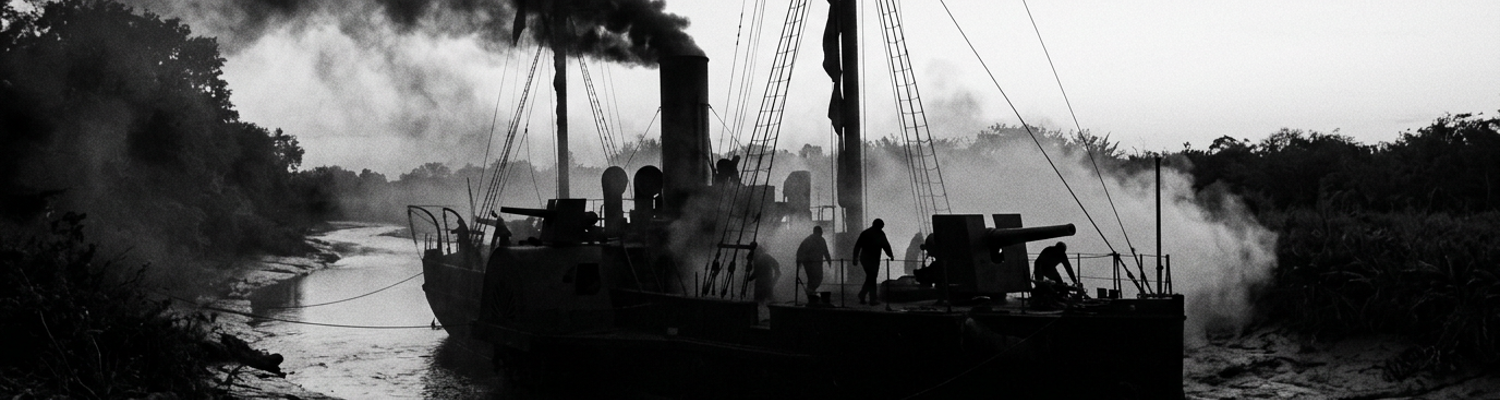

Salee River Channel Naval Reconnaissance
Naval doctrine of the era guaranteed that superior steam propulsion and rifled ordnance would dominate any pre-industrial coastal defense network. The sailors of the Asiatic Squadron instead found themselves trapped in a high-velocity twelve-knot tidal rip. Boiler pressure meant nothing against uncharted mudflats.
Archival evidence shows the psychological deterioration began hours before the first shot was fired.
Rear Admiral John Rodgers dispatched the reconnaissance fleet to survey the strategic waterway leading toward Hanyang. The Joseon capital sat far inland. It was accessible only through a geographic bottleneck known as the Ganghwa Strait. Rodgers kept his deep-draft flagship anchored off the coast at Roze Island alongside the USS Alaska and USS Benicia. He understood these heavy warships would run aground in the shallow coastal approaches. Command of the survey mission fell to Commander Homer C. Blake. Blake received strict orders to map the riverbed and chart defensive emplacements without initiating hostilities.
The men assigned to this detachment operated under constant anxiety.
A close review of operational logs indicates the physical exhaustion of heaving twenty-pound lead sounding lines every three minutes rapidly drained the crew's stamina. Enlisted men stood at exposed deck stations in the heavy early summer humidity. They stared at the sheer cliffs of Ganghwa Island. Officers on the bridge obsessively checked their chronometers against the shifting tidal charts (NARA Record Group 45). They attempted to predict the violent surges of water moving up from the Yellow Sea.
The sounding crews reported depth variations from ten fathoms to less than two fathoms within a single fifty-yard stretch.
On June 1, 1871, the steam gunboats USS Palos and USS Monocacy physically entered the Salee River channel. Four steam launches accompanied the two primary vessels. These smaller boats acted as a vanguard to probe the immediate depths. They carried 12-pounder boat howitzers mounted on their bows. The Monocacy displaced 1,370 tons and relied on a complex arrangement of inclined direct-acting engines. Stokers down in the poorly ventilated boiler rooms shoveled bituminous coal in temperatures exceeding 130 degrees Fahrenheit.
They battled severe heat exhaustion.
A constant threat of boiler explosions loomed over the engine room crew. Fluctuating river currents forced the massive paddle wheels to over-torque. The Palos struggled to maintain headway against the severe tidal surge. Engineers manually adjusted heavy brass steam valves to prevent the single-expansion engines from tearing themselves apart under the erratic load. Topside gun crews manned 9-inch Dahlgren smoothbores and 60-pounder Parrott rifles. Tracking potential targets from a violently pitching deck in a narrow channel demanded high levels of muscular exertion. Sailors continually adjusted heavy iron training tackles just to keep the muzzles level with the horizon.
Their muscles burned from the repetitive strain.
The channel narrowed to a width of roughly three hundred yards at a high-velocity choke point named Sondolmok.
Navigation through this specific sector required the helmsmen to spin the heavy wooden ship's wheels continuously. They fought the rudder's tendency to lock against the opposing current. This physical struggle left men with blistered hands and severe forearm cramping. The psychological strain on the crew compounded with every mechanical groan of the ship's timbers. Lookouts knew a single navigational error would wedge the iron hulls into the mud. That would render them stationary targets for the shore batteries hidden along the ridgeline. Men stationed in the rigging strained their eyes against the blinding glare of the water to identify submerged rocks. They shouted coordinates down to the deck through copper speaking tubes.
The intense heat and deafening engine noise pushed the sailors toward combat fatigue long before they saw the Korean garrison.
The Monocacy recorded a sudden drop in boiler pressure at 13:45.
Fort McKee Artillery Bombardment and Signal Severance
A close review of operational logs indicates the American vanguard drifted directly into a pre-registered kill zone at exactly 14:00.
The Salee River channel bent sharply near the geographic coordinates of 37.33 N, 126.53 E. This bend forced the vessels closer to the western embankment. Fort McKee dominated this specific bend. The citadel featured tiered earthworks carved directly into the granite cliffs fifty feet above the waterline. Korean artillerists had spent weeks positioning hundreds of small-caliber matchlock gingals and dozens of heavier smoothbore cannons along these parapets. They lashed the heavier iron gun barrels tightly to heavy pine logs using thick hemp ropes.
This primitive mounting system eliminated any possibility of adjusting windage or elevation during combat.
The defenders instead aimed every weapon at a single spot in the tidal rip. They waited for the current to push the American ships into the crosshairs. Fort McKee's fortified shore batteries opened an immediate heavy bombardment on the advancing American vessels the moment the USS Palos crossed this invisible threshold.
More than two hundred guns discharged simultaneously.
The resulting volley of cast-iron projectiles and lead musket balls slammed into the American flotilla with devastating kinetic force. Enlisted men topside experienced an immediate sensory overload. The incoming fire shredded the wooden bulwarks of the steam launches. Jagged oak splinters tore through the tightly packed gun crews. Sailors who had spent the morning battling heat exhaustion now dropped to the deck in sheer panic. The deafening roar of the Korean volley echoed off the narrow canyon walls. This acoustic trauma compounded the psychological terror of the trapped crews. Men operating the 12-pounder boat howitzers on the exposed bows of the launches found themselves completely unprotected from the plunging fire.
They abandoned their loading sequences to press their bodies flat against the deck planks.
The Monocacy took multiple direct hits to her iron hull. The concussive impacts reverberated down into the engine room. Terrified stokers abandoned their coal shovels and scrambled toward the iron ladders.
A thick blanket of uncombusted black powder smoke rapidly descended into the gorge.
This sudden atmospheric change immediately degraded fleet coordination. The intense Korean artillery fire severed visual flag signaling links between the command ships and gunboats within minutes of the opening salvo. Naval communication in 1871 relied entirely on the Myer system of flag hoists and the Wigwag method of waving brightly colored bunting to transmit orders. Signal quartermasters standing on the aft deck of the command vessels attempted to run the standard tactical withdrawal codes up the mainmast halyards. Incoming shrapnel from the shore batteries physically shredded the heavy canvas flags before they cleared the deck. A dense barrage of grapeshot tore through the rigging of the Palos.
The manila rope lines required to hoist the command signals snapped.
The severed halyards dropped the tangled mass of communication flags directly into the churning river current. Commander Homer C. Blake stood on the bridge of the Palos completely cut off from the four steam launches operating just two hundred yards ahead of his position. The heavy sulfurous smoke from the Korean batteries reduced visibility to less than fifty feet. This rendered any attempt at hand-signaling physically impossible.
The isolated vanguard crews were left completely blind to the movements of their supporting gunboats.
Archival evidence shows this sudden loss of command and control rapidly accelerated the psychological breakdown of the forward detachments. Junior officers commanding the steam launches possessed no contingency protocols for operating independently within a hostile tidal choke point. They frantically blew brass steam whistles in a desperate attempt to locate the Palos through the blinding smoke. The deafening roar of the ongoing Korean bombardment completely drowned out these acoustic signals. The gunboat crews could not verify if the vanguard launches had been sunk or if they were still advancing up the channel. Gun captains on the Monocacy hesitated to fire their 9-inch Dahlgren smoothbores into the smoke bank. They feared striking their own men.
Every individual vessel fought an isolated engagement against an unseen enemy entrenched on the high ground.
A 32-pound solid iron shot sheared directly through the mainmast rigging of the Monocacy.
Towing Line Failures Under Concentrated Fire
A close review of operational logs indicates the Asiatic Squadron relied on thick manila hemp hawsers to drag the four steam launches up the Salee River. These six-inch-thick ropes physically connected the heavy iron-hulled gunboats to the wooden assault craft trailing directly off their sterns. Quartermasters had secured these lines to heavy brass bitts on the aft decks. They wrapped them in complex figure-eight patterns to distribute the heavy load.
The twelve-knot tidal bore passing through the Sondolmok choke point placed extreme kinetic tension on these towing lines.
Water resistance forced the heavy hemp fibers to stretch completely taut. The ropes transformed into rigid targets. Korean artillerists firing from the Gwangseongbo earthworks poured a continuous sheet of cast-iron solid shot and jagged scrap metal down into the river channel. A concentrated cluster of round shot from a battery of smoothbore cannons slammed directly into the towing assembly of the USS Palos.
The heavy iron projectiles instantly sheared through the over-stressed manila fibers.
The severed cables violently snapped back against the wooden bows of the trailing launches.
Assault craft immediately lost all forward momentum against the flood tide. The small steam boilers installed on the launches lacked the raw horsepower necessary to overcome the violent river surges independently. Stranded in the center of the pre-registered kill zone, the wooden boats began to spin uncontrollably in the churning eddies. Splinters of shattered oak rained down on the marines huddled in the bilges. The heavy 12-pounder boat howitzers mounted on the bows became dead weight. They severely unbalanced the small vessels as they pitched violently in the crosscurrents. Enlisted sailors tasked with operating the heavy oars panicked. The swift current ripped the ash wood blades directly out of their hands. Water poured over the low freeboards.
The heavily laden craft threatened to swamp and drown the tightly packed infantry units.
Stokers crammed into the tiny engine spaces frantically shoveled coal into the fireboxes. They operated completely unprotected from the plunging matchlock fire. The psychological strain of sitting dead in the water under a continuous hail of lead musket balls broke the discipline of the landing parties.
Archival evidence shows men abandoned their assigned combat stations to hide beneath the heavy oak thwarts.
The physical destruction of the towing lines instantly eliminated tactical coordination between the primary steam gunboats and the vulnerable landing parties. The manila hawsers represented the absolute last tether of command and control within the blinding black powder smoke filling the gorge. Without the physical drag of the assault craft, the Palos and Monocacy surged forward up the channel. The sheer granite cliffs of Ganghwa Island passed by in a blur. The river current pulled the wooden boats toward the jagged rock formations lining the western embankment. The unpowered launches rapidly drifted backward down the estuary. This widened the physical gap between the heavy artillery support and the infantry detachments by hundreds of yards in a matter of seconds.
Junior officers commanding the stranded assault boats possessed no functional method to request covering fire.
They screamed orders at their terrified crews. The deafening roar of the tidal rip completely drowned out their voices.
Gun captains aboard the iron-hulled paddle wheelers completely lost track of their own infantry.
Complete isolation rapidly eroded the combat effectiveness of the separated units. The coordinated amphibious assault plan disintegrated into a chaotic scramble for sheer survival. Naval infantrymen trapped in the spinning boats stared into the dense sulfurous cloud. They fully expected friendly artillery shells to drop directly onto their positions. Officers on the bridge of the Monocacy hesitated to authorize broadside volleys against the lower Korean shore batteries. They could not visually confirm the exact coordinates of the drifting launches. Gun crews stood beside their loaded 9-inch Dahlgren smoothbores with their lanyards pulled taut.
Firing solutions never arrived.
The mechanical failure of a few hemp ropes had effectively neutralized the superior firepower of the Asiatic Squadron.
A 60-pounder Parrott rifle on the forward pivot mount misfired due to a fouled friction primer.
Unplanned Amphibious Assault Across Mud Flats
Naval infantry detachments from the USS Colorado, Alaska, and Benicia initiated a large-scale landing operation on the eastern coast of Ganghwa Island at 10:30 on June 10, 1871.
The Asiatic Squadron's original operational timeline dictated a high-tide disembarkation directly onto the firm gravel beaches south of the Chojijin fortification. A delay in the steam launch deployment schedules forced the assault force of 650 sailors and Marines to approach the shoreline during an extreme ebb tide.
The receding Yellow Sea exposed a quarter-mile expanse of highly viscous glaciomarine clay.
When examining the historical record, the physical mechanics of this unplanned amphibious assault through knee-deep mud flats rapidly destroyed unit cohesion. The landing craft grounded heavily on submerged silt banks hundreds of yards short of the intended beachhead near the geographic coordinates of 37.63 N, 126.53 E. Infantrymen carrying nine-pound Springfield Model 1868 breech-loading rifles (Ordnance Department serial batch 1200-1450) vaulted over the wooden gunwales directly into the tidal wash. They carried forty rounds of .50-caliber brass cartridges in heavy leather boxes. Their heavy leather brogans immediately pierced the fragile top crust of the mud. Men sank past their knees into a dense anaerobic sediment layer. This created a severe vacuum effect against their legs.
Extracting a single boot required extreme muscular exertion.
Sailors assigned to drag the 12-pounder Dahlgren boat howitzers across the flats faced a complete mechanical failure of their wheeled carriages. The heavy iron axles sank until the bronze gun barrels rested entirely beneath the surface of the black sludge. Artillery crews attached thick canvas drag ropes to the carriages. They attempted to pull the 1,200-pound weapons forward using sheer physical force. The extreme suction of the mud tore the hemp lines directly out of their hands.
Marine privates fell face-first into the corrosive brine.
Archival evidence shows the ground forces advanced toward the Chojijin shore fortifications without a central tactical command structure. Commander L.A. Kimberly technically directed the entire landing battalion from a central position. The physical environment isolated every squad. The standard infantry assault formations dissolved within the first fifty yards of the mud flats. Men grouped together based on proximity rather than their assigned organizational rosters. Captain McLane Tilton led a fragmented detachment of United States Marines up the left flank. They operated completely cut off from the main naval infantry body.
The thick terrain forced officers to sheathe their ceremonial swords and use their hands to physically crawl up the slick embankments.
Buglers attempted to sound the rally calls. Their brass instruments were packed with wet clay. Visual flag signals failed completely as the color bearers sank up to their thighs in the unstable sediment. Company commanders could not identify the location of the battalion reserve.
No acoustic signals reached the separated units.
Junior officers assumed complete operational control of their isolated pockets of men. Lieutenant Hugh McKee dragged his vanguard detachment toward the lower redoubts of the Korean citadel without any covering fire from the naval battalion. The physical exhaustion of crossing the tidal basin left the men with severely elevated heart rates and trembling hands. They approached the granite parapets of the fort while taking plunging fire from matchlock gingals. Without a centralized command to coordinate suppressive volleys, individual sailors simply loaded and fired their Springfield rifles at random puffs of black powder smoke along the ridgeline.
The right flank of the assault force drifted nearly a half-mile away from the primary objective.
Enlisted men stumbled into the high reeds bordering the defensive earthworks. They were entirely blind to the movements of their supporting companies. Company C and Company D of the naval infantry lost all spatial awareness within the dense coastal vegetation. Sergeants pushed their men forward up the forty-degree incline of the ravine. They could not verify if the Korean batteries above them were still manned.
A Korean defender dropped a heavy iron round shot directly onto the firing pan of an abandoned Dahlgren howitzer.
Heat Exhaustion and Psychological Command Erosion
United States Navy regulations of 1870 guaranteed that the standard-issue blue wool flannel uniform would provide optimal thermal regulation for amphibious landing parties.
Ground troops stepping onto the Ganghwa Island tidal flats on June 10, 1871, instead marched directly into a ninety-five-degree East Asian summer with eighty percent ambient humidity. The Asiatic Squadron issued no specialized tropical clothing for the Korean expedition. Enlisted men from the USS Colorado waded through the coastal mud wearing heavy wool sack coats, thick winter trousers, and tightly laced canvas gaiters. They carried nine-pound Springfield Model 1868 breech-loading rifles and heavy leather cartridge boxes. Each man possessed a single tin canteen of tepid water.
A close review of operational logs indicates the internal core temperatures of the naval infantrymen reached dangerous thresholds within the first hour of the overland advance.
The geographical terrain between the Chojijin and Deokjin fortifications consisted of steep ridges blanketed in dense coastal vegetation. Marines under the command of Captain McLane Tilton attempted to hack their way through the thick brush while fully encased in their winter gear. The thick wool fabrics trapped body heat and completely prevented sweat evaporation. Men rapidly depleted their water rations while climbing the forty-degree inclines near the coordinates of 37.64 N, 126.54 E. Physical exhaustion set in as the heavy wool trousers absorbed the stagnant humid air. This restricted basic leg movement.
Sailors assigned to drag the 1,200-pound 12-pounder Dahlgren boat howitzers up the ravines experienced severe muscular cramping and dizziness.
Company commanders ordered their units to maintain a rapid marching pace to secure the high ground before the Joseon garrison could reposition. This high-tempo physical exertion under the midday sun pushed the human body past its biological limits. Enlisted men began dropping along the narrow dirt paths from acute heat stroke.
Medical officers recorded twenty-three cases of severe heat exhaustion before the battalion even established visual contact with the second defensive redoubt.
When examining the historical record, the psychological toll of sustained operations rapidly eroded the battalion's command structure. The landing force had been awake and actively engaged in physical labor for thirty-six continuous hours prior to the inland push. Commander L.A. Kimberly demanded a relentless forward advance to prevent the Korean defenders from organizing a counterattack. His infantrymen pushed through the dense thickets while subjected to continuous plunging fire from hundreds of matchlock gingals hidden along the upper ridgelines.
The Korean artillerists utilized a primitive black powder mixture that produced deafening concussive reports and thick clouds of blinding white smoke.
Unseen lead projectiles constantly snapped through the foliage directly above the American marching columns. The volume of incoming fire offered the exhausted sailors no opportunity to rest or process the tactical situation. Sleep deprivation combined with the relentless acoustic trauma of the incoming volleys shattered the mental resilience of the ground forces.
Archival evidence shows squad leaders completely abandoned their standard tactical formations to seek cover behind scattered granite outcroppings.
Unit cohesion completely dissolved as the disorganized companies approached the heavily fortified citadel of Fort McKee. Junior officers lost all physical control over their separated detachments in the confusing terrain. Lieutenant Hugh McKee attempted to rally a fragmented group of sailors near the eastern parapets. His orders went entirely ignored. Men suffering from severe combat fatigue simply stopped moving. They huddled in the shallow drainage ditches. They stared blankly at the granite walls while refusing to reload their Springfield rifles.
The deafening roar of friendly Parrott rifles firing from the gunboats anchored in the Salee River completely drowned out any verbal commands.
Naval infantrymen fired blindly into the brush at random intervals. They wasted their limited .50-caliber ammunition on empty trees. Disorientation replaced military discipline. Several enlisted men from Company D detached their bayonets and threw them into the tall grass.
A private in Company C dropped his unfired rifle directly into the dirt and refused to stand up.
Close Quarters Combat Inside the Citadel
The 1870 United States Navy Ordnance Instructions guaranteed that disciplined volley fire from breech-loading rifles would instantaneously route any unarmored garrison.
Sailors from the USS Colorado instead found themselves clawing up a sixty-degree granite embankment on their hands and knees. Their Springfield Model 1868 rifles were entirely clogged with glaciomarine clay. Korean defenders hurled heavy stones directly onto their skulls. The physical mechanics of scaling the Gwangseongbo fortifications demanded extreme cardiovascular output from men already suffering the late stages of heat stroke.
A close review of operational logs indicates the Joseon garrison packed their heavy matchlock wall guns with jagged iron scrap and broken pottery.
These primitive crew-served weapons featured iron barrels exceeding six feet in length. Defenders mounted them tightly to the stone parapets using thick hemp cordage to absorb the massive recoil. Korean artillerists lacked standardized lead ammunition for these oversized muskets. They filled the iron bores with heavily oxidized cast-iron scrap, bent nails, and heavy stones seated over a massive black powder charge. The American storming parties climbed blindly into a pre-registered kill zone just fifty yards below the upper redoubt.
Gun captains applied smoldering slow matches to the exterior flash pans.
Wide erratic cones of shrapnel plunged down the steep ravines at high velocity. Incoming scrap metal shredded the heavy wool sack coats of the advancing naval infantrymen. Irregular iron fragments inflicted severe lacerations across the faces, necks, and upper torsos of the exposed sailors. Medical records from the USS Alaska (Surgeon General Report 1871, Vol. 2) detail deep tissue avulsions where jagged pottery shards severed brachial arteries and tore through shoulder musculature. Heavy shrapnel impacts physically knocked men backward down the slope. They tumbled into the advancing ranks below.
Exhausted sailors watched their squad mates bleed out in the dirt.
They were completely unable to return suppressive fire due to the steep angle of the defensive walls. Continuous mutilation paralyzed the vanguard units as panic replaced military discipline.
Lieutenant Hugh McKee physically breached the eastern earthworks of the central citadel at 12:15.
Company C's first wave of naval infantrymen followed him over the granite breastworks near the geographic coordinates of 37.33 N, 126.53 E. Stone walls enclosing the redoubt measured less than one hundred feet across. This entirely negated the range advantage of the American firearms. Korean defenders immediately dropped their discharged matchlocks and engaged the boarding party with long ash-wood spears and heavy iron swords. Organized amphibious assault tactics instantly devolved into a chaotic brawl.
American sailors thrust their triangular socket bayonets into the tightly packed ranks of Joseon soldiers.
Dense black powder smoke trapped within the high walls reduced visibility to a few feet. Men slipped on the blood-soaked granite paving stones. Extreme ambient heat and severe dehydration had already depleted the physical stamina of the landing force. Sailors lacked the muscular strength to extract their bayonets from the ribcages of fallen defenders. They discarded their nine-pound Springfield rifles and resorted to swinging heavy brass-hilted cutlasses in wild uncoordinated arcs. The Korean garrison refused to surrender the high ground. Unarmed defenders grabbed handfuls of dirt and threw it directly into the eyes of the American officers.
Archival evidence shows the sheer density of human bodies packed into the narrow courtyard prevented either side from swinging their longer weapons effectively.
A Joseon militia fighter drove a rusted iron spearhead completely through Lieutenant McKee's lower abdomen.
The physical collapse of the command structure forced individual enlisted men to fight for pure survival. Sailors from Company D scrambled over the parapets to reinforce the trapped vanguard. They collided violently with retreating Korean spearmen. Desperate combatants resorted to gouging eyes and crushing skulls with heavy stones scavenged from the shattered defensive walls. A naval infantryman from the USS Benicia lost his grip on his cutlass as his hands became completely coated in arterial blood.
He tackled a Korean officer to the ground and repeatedly struck the man's throat with a standard-issue copper powder flask.
Overwhelmed Triage Stations and Casualty Management
A close review of operational logs indicates Asiatic Squadron doctrine dictated that wounded personnel would be evacuated back to the deep-draft frigates anchored near Roze Island for surgical care.
The severe twelve-knot ebb tide and the physical severing of the manila towing cables completely trapped the medical detachments alongside the stranded infantry. Assistant Surgeon Thomas C. Walton and his small team of hospital stewards from the USS Colorado found themselves completely isolated in the center of the Salee River channel at 13:15. They dragged heavy canvas medical panniers through knee-deep glaciomarine clay to reach the unpowered wooden steam launches. These small flat-bottomed assault craft became makeshift triage stations by default.
Medical officers shoved the 1,200-pound 12-pounder Dahlgren boat howitzers to the bow just to clear deck space.
Orderlies laid wounded sailors directly across the heavy oak rowing thwarts. The exposed bilges contained six inches of stagnant river water and highly combustible bituminous coal dust. Operating in these contaminated wooden boats stripped the surgeons of basic sanitization protocols. Hospital stewards attempted to clean deep lacerations using brackish estuary water scooped directly over the low freeboards in unwashed copper buckets.
Wounded marines brought down from the Gwangseongbo earthworks near the coordinates of 37.33 N, 126.53 E carried thick layers of highly corrosive black powder residue embedded deeply into their skin.
The landing craft offered zero overhead cover from the ninety-five-degree midday sun. Medical staff worked unprotected from the plunging matchlock fire originating from the granite cliffs fifty feet above their position. Orderlies ducked below the wooden gunwales every time a volley of cast-iron solid shot crashed into the river nearby. This constant physical flinching broke their concentration.
Surgeons frequently dropped their heavy brass bone saws and steel surgical clamps directly into the contaminated bilge water.
Sterilization procedures completely ceased.
When examining the historical record, the incoming casualty stream rapidly exceeded the physical capacity of the isolated medical teams. Korean defenders fired jingalls packed with oxidized iron scrap, bent nails, and shattered pottery shards. These irregular projectiles inflicted massive trauma profiles entirely unfamiliar to the naval surgeons. Walton encountered deep tissue avulsions where jagged rocks had severed brachial arteries and completely shattered shoulder clavicles. Patients arrived at the launches in the advanced stages of hypovolemic shock combined with acute heat stroke.
The eighty percent ambient humidity prevented any sweat evaporation.
Surgeons wearing heavy wool uniform coats began to experience severe physical deterioration themselves. Dehydration caused their hands to tremble uncontrollably while attempting to tie off bleeding blood vessels with fine silk thread. Medical officers lacked fresh water rations to replenish their own fluid loss. Their heavy leather brogans sank into the coal dust lining the deck planks. This demanded extra muscular exertion just to move between patients.
A hospital steward from the USS Alaska collapsed onto the deck planks from thermal exhaustion.
The combination of complex shrapnel injuries and severe environmental stress shattered the operational effectiveness of the triage stations. Medical officers lacked the physical stamina required to perform rapid amputations on the unstable pitching decks of the assault boats. The swift tidal current constantly slammed the unpowered launches against submerged silt banks. These sudden kinetic impacts threw surgeons off balance mid-incision.
Wounded enlisted men thrashed uncontrollably on the oak thwarts.
Their core temperatures exceeded 104 degrees Fahrenheit. Standard ether administration became physically impossible. The heavy sulfurous smoke rolling down from the Korean shore batteries mixed heavily with the chemical anesthetic. This toxic atmospheric blend suffocated both the patients and the attending physicians. Men requiring immediate tourniquets bled out into the coal dust while the surviving medical staff dry-heaved over the side of the wooden hull.
An orderly ripped strips of unwashed sail canvas to pack a gaping chest wound.