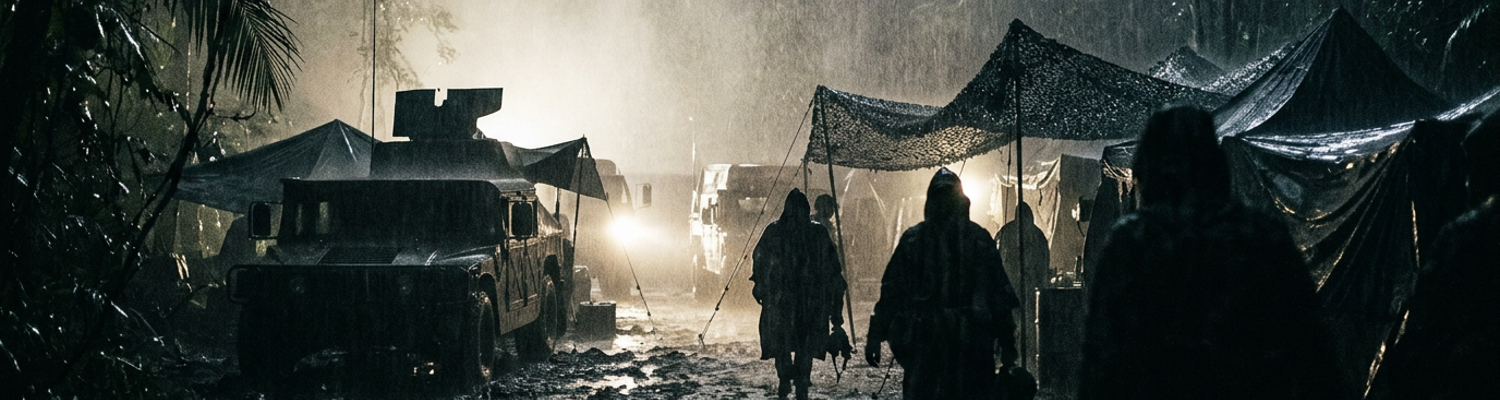

Assault Landings at Yellow Beaches
26 December 1943. 0746 hours. Coordinates 05 31 00 S, 148 31 00 E.
Archival evidence shows that Task Force 76 initiated Operation Backhander against the northwest perimeter of New Britain under an overcast sky. The air smelled heavily of sulfur and cordite. Off Silimati Point, assault transports unloaded combat teams of the First Marine Division into landing craft. The flat-bottomed boats circled in heavy Pacific swells. Naval gunfire from the cruisers Nashville and Phoenix had just finished blasting the tree line into shattered timber. The bombardment blanketed the target area in dense white phosphorus smoke. Major General William H. Rupertus watched the initial waves churn westward toward two narrow coastal gaps. Planners designated these gaps Yellow Beach 1 and Yellow Beach 2. Planners allocated just five hundred yards of sand per landing zone. They expected a straightforward approach directly into the coastal strip.
The sea floor defied aerial reconnaissance estimates.
A close review of operational logs indicates that Allied hydrographic charts completely missed the presence of jagged fringing reefs. These coral formations sat two hundred to three hundred yards offshore. When the flat-bottomed LCIs and wooden-hulled LCVPs of the initial assault groups drove shoreward, the lead craft ground violently atop submerged coral heads. Steel hulls screeched against volcanic limestone shelf formations. Skegs snapped. Propellers tore away. Several craft wedged fast in three to five feet of surging ocean water. Coxswains gunned twin Detroit diesels in futile attempts to reverse. They burned out transmission clutch plates. They swung broadside into incoming breakers. Lowered bow ramps dropped infantrymen directly into submerged coral drop-offs. Combat packs weighing seventy pounds dragged men beneath the waves. Company officers made split-second decisions to jettison essential ammunition crates and SCR-300 field radios directly into the sea. This prevented troops from drowning outright. Marine engineer detachments scrambled onto the coral with sledgehammers and towlines. They attempted to wrench stranded Higgins boats off the shallows. Waves swamped open engine compartments.
Mechanized equipment stalled permanently on the reef heads.
When examining the historical record of Colonel Julian N. Frisbie and the Seventh Marines, the shoreline offered no relief from the trauma of the surf. Men wading inland discovered that the narrow sand shelf abruptly vanished. It turned into a maze of submerged littoral sinkholes and anaerobic mud pits. Troops stepped off submerged coral ledges directly into six-foot-deep fissures of black swamp water. The Third Battalion attempted to establish contact with the First Battalion advancing on their left. Japanese machine guns from the Matsuda Force opened fire from concealed log bunkers embedded along the jungle woodline. Type 92 heavy machine guns rattled through the smoke. Their 7.7mm rounds shredded mangrove roots. The gunfire sent plumes of saltwater around wading troops. Infantrymen struggled to raise their salt-caked M1 Garands and Browning Automatic Rifles above the muck. They tried to haul submerged companions out of underwater sinkholes. Fear of drowning while trapped under equipment produced acute panic among young replacements. These men had never faced sustained fire.
Scores of Marines vanished below the water line without warning.
Field dispatches from First Marine Regiment combat teams confirm that several dozen men discarded their helmets and combat webbing. They did this simply to keep their heads above the brackish swamp surface. Japanese small-arms fire and mortar bursts from inland positions near Target Hill tore through the disorganized lines of riflemen. The men struggled to clear the waterline. Company commanders lost direct line-of-sight control in the black mangrove roots. Radios flooded. Visual signaling became obscured by smoke and rain. Searing heat, diesel fumes, and sudden drownings pushed frontline Marines toward immediate sensory overload. Physical exhaustion set in within sixty minutes of H-Hour.
By 0830 hours, twelve landing craft sat permanently abandoned across the coral barricade outside Yellow Beach 1.
Northwest Monsoon and Coastal Quagmire
A close review of operational logs indicates that the Northwest Monsoon struck the beachhead with full force within five hours of the initial landing. Gale-force winds blowing across the Vitiaz Strait drove torrential squalls directly into the northern coast of New Britain. The storm dumped over ten inches of rain across the division zone within a single twenty-four-hour cycle. Aerial photographic interpretations had identified the belt directly behind Yellow Beaches 1 and 2 as solid soil covered by light kunai grass. The downpour peeled back the thin root mat. This exposed an anaerobic coastal shelf saturated with centuries of volcanic silt. Runoff cascading down the ridgeline of Target Hill pooled immediately behind the fifty-yard sand strip. The water backed up against the coral barrier and created an inland lagoon. Stagnant brackish water surged to depths of four to six feet throughout the mangrove fringes. Marines of the Seventh Regiment attempting to push three hundred yards inland sank past their waists into semi-liquid peat. They could not establish dry foxhole perimeters or firm defensive anchor points.
Rotting swamp water filled every trench within seconds of digging.
When examining the historical record of the Seventeenth Marine Regiment and the First Pioneer Battalion, doctrinal offloading concepts collapsed completely under the weight of the mud. Standard doctrine dictated that heavy mechanized plant equipment would clear corduroy log roads off the sand. This would allow six-by-six GMC trucks and M3A1 light tanks to haul dry cargo straight to inland ammunition dumps. Cape Gloucester swallowed the equipment. Caterpillar D7 and D8 bulldozers sank to their radiator cowlings within fifteen yards of leaving the coral apron. Wet volcanic clay forced its way into final-drive seals. The clay mixed with lubricants to form a grinding paste. This paste stripped planetary gears within two hours of continuous throttle. Track pins on thirty-ton M4A1 Sherman tanks sheared off. Steel tracks churned hopelessly through liquid mud. The hulls dropped until their belly plates rested flush on the swamp floor. Marine mechanics rigged double-pulley winches to broad mangrove trunks to haul out swamped Alligator amphibians. The root systems ripped out from the saturated soil. Heavy vehicles sat submerged to their turret rings. They blocked the few natural gaps leading out of the landing zones.
Standard field equipment drowned before firing a single round.
Archival evidence shows that the mechanical breakdown paralyzed shore-party dispersal operations across the entire width of Yellow Beach 1. Landing craft continuously dropped ramps to offload hundreds of tons of rations, five-gallon water cans, and wooden artillery crates directly into the surf. Shore party personnel had no operable vehicles to move the supplies inland. Stacks of high-explosive 75mm artillery shells and cardboard mortar rounds rapidly piled eight feet high directly in the surf wash. Churning saltwater dissolved protective packaging and saturated delay fuses. Over four thousand men became bunched onto a narrow strip of sand measuring less than forty yards wide between the water and the swamp. Japanese Type 97 81mm mortar teams positioned on the reverse slope of Target Hill exploited the congestion. They lobbed sustained spreads of fragmentation shells into the stationary human crush. Exhausted pioneers and combat engineers worked thirty-six hours without pause. They stood up to their armpits in sulfur-tainted mud while carrying mortar shells overhead. Their feet rotted rapidly from immersion foot.
Screaming men clawed through the slurry to escape incoming airbursts.
Field reports from the First Pioneer Battalion recorded thirty-eight individual cases of acute combat neurosis by the evening of 27 December. This condition was brought on entirely by the sensory trauma of continuous drowning hazards, unrelenting rain, and physical entrapment beneath heavy tree falls. Giant hardwood banyans, their anchor roots softened by the perpetual deluge, toppled without warning onto dugouts and supply caches. These trees crushed five Marines in their sleep near the Seventh Marines command post. By midnight, division maintenance records listed forty-one mechanized vehicles completely submerged or abandoned along the coastal shelf.
Banyan Corduroy Road Construction
Archival evidence shows that by the morning of 28 December, Lieutenant Colonel Harold E. Rosecrans ordered the First Battalion, Seventeenth Marines to clear an inland causeway toward Japanese positions near Target Hill. Every piece of heavy diesel earthmoving machinery had failed. With Caterpillar D7 bulldozers submerged past their engine hoods, engineer companies relied on two-man crosscut hand saws, broadaxes, and machetes. They aimed to drop hundred-foot banyan trees along the perimeter of Yellow Beach 2. Banyan root structures resisted standard cutting patterns. Saturated wood bound the saw blades. Squads had to drive steel wedges into wet cuts every three inches while balancing on submerged roots. Combat engineers stripped the limbs, bucked trunks into twelve-foot sections, and rolled green timber weighing several tons each directly into the morass. Falling banyans triggered immediate ground tremors. These tremors collapsed nearby foxholes and sent pressurized black sludge showering over work parties.
Chain saws seized within minutes from water contamination.
A close review of operational logs indicates that Company A and Company B of the Seventeenth Marines drove four-inch wooden stakes along the margins of the trail. This pinned the logs against the lateral pressure of the swamp. Sinking log mats into the peat required teams to stand submerged to their hips in sulfuric water. They threaded heavy hemp cordage and salvaged telephone wire around submerged banyan trunks. Heavy tracked vehicles fractured the green timber instantly. An M4A1 Sherman attempted to cross the newly laid track at map coordinate 05 32 15 S, 148 32 40 E. The banyan surface shifted sideways under thirty tons of steel. The retaining stakes snapped. The tank plunged into five feet of liquefied volcanic ash. Engineers spent six continuous hours hacking replacement timber by hand to bridge the resulting gap. Working without dry clothing or shelter, over two dozen engineers collapsed from muscle spasms and heat exhaustion before midday.
The swamp swallowed whole layers of timber overnight.
When examining the historical record of Colonel Julian N. Frisbie and the Seventh Marines, supply lines to frontline infantry companies broke down completely once rifle platoons advanced eight hundred yards past the beachhead. Mechanized trailers could not move. Shore party personnel, weapons company clerks, and walking wounded organized human pack trains. They hauled ammunition and food forward on foot. Men loaded ninety-pound wooden crates of .30-06 ball ammunition, metal boxes of 60mm mortar shells, and water-damaged cartons of K-rations directly onto their bare shoulders. Footing disappeared beneath three feet of foul-smelling swamp runoff. Every forward step through the tangled mangrove roots required a violent wrenching motion. This strained knee ligaments and tore combat boots cleanly off men. Carrying parties had to keep weapons crates elevated above the brackish water. This turned a four-hundred-yard supply run into a two-hour ordeal under sniper fire from concealed Japanese tree platforms.
Men drowned beneath the weight of mortar crates.
Archival evidence shows that frontline supply carriers experienced acute mental breakdown as physical exhaustion intersected with continuous artillery bombardment. Shell fragments regularly punctured five-gallon water cans lashed to packboards. This emptied drinking supplies into the mud before carriers reached frontline foxholes. Riflemen of the Third Battalion went twenty-four hours on a single wet chocolate bar while clinging to rotting log parapets. Company medics reported soldiers sobbing uncontrollably in the swamp water. Their hands shook so violently from peripheral nerve exhaustion that they could not open ration tins or load Garand en-bloc clips. The skin on their legs turned white and sloughed off in strips from continuous submersion in anaerobic decay. Division field hospital records for 29 December documented that forty-seven men from carrying details were admitted for severe psychological shock, muscle atrophy, and immersion foot without having sustained a single gunshot wound.
Tactical Assault on Target Hill
Archival evidence shows that Colonel Julian N. Frisbie ordered the Third Battalion, Seventh Marines to assault Target Hill. This steep volcanic elevation dominated the eastern flank of the beachhead. The terrain formed a razorback ridge where loose volcanic ash slipped away under torrential rain. Assault squads clambered upward through waist-high kunai grass and bamboo tangles under direct fire from the Japanese 53rd Infantry Regiment. Defensive positions consisted of mutually supporting trench lines and log pillboxes dug into the crest. Marine riflemen discarded their heavy field packs. They pulled themselves up forty-five-degree muddy slopes by grabbing exposed banyan roots with one hand while holding M1 rifles with the other. Japanese defenders rolled Type 97 fragmentation grenades down the gullies. These exploded at chest height against the wet volcanic shale. Blind corners along the razorback forced combat down to five-yard engagements using M1911 pistols, trench knives, and Ka-Bar blades.
Sustained point-blank fire severed company telephone wires within minutes of the opening assault.
A close review of operational logs indicates that the physical and mental stamina of the Third Battalion deteriorated rapidly under thirty-six hours of non-stop counterattacks on the ridgeline. Japanese mortar crews lobbed Type 97 81mm projectiles directly into shallow rifle pits cut into the rock. Men occupied waterlogged slit trenches alongside decaying enemy casualties. The narrow spine of the ridge offered no space to evacuate the dead. Sleep became impossible. Continuous concussive blasts against the confined crest produced severe sensory disorientation and localized deafness across entire rifle platoons. Battalion medical aid logs recorded instances of riflemen experiencing uncontrolled tremors, hysterical weeping, and total catatonic stupor while clutching empty weapons. By the time Company K consolidated the high ground, stretcher bearers had to carry forty-two Marines down the slope. These men exhibited no physical wounds but could not speak or track movement with their eyes.
Volcanic mud stripped the bluing from rifle barrels and clogged Garand gas ports.
When examining the historical record of Colonel William J. Whaling and the First Marines, the westward push toward the primary Japanese airfields confronted an organized labyrinth of defensive bunker complexes. Major General Iwao Matsuda had reinforced the airfield approaches with dozens of mutually supporting pillboxes. These were constructed from double-tiered coconut logs, volcanic gravel, and crushed coral. These earthworks sat flush with the jungle floor. They were camouflaged under living ferns that concealed their firing apertures from aerial observation. Assault platoons of the First and Third Battalions advanced through the swamp corridors bordering the runway clearings. Japanese Type 92 heavy machine guns opened fire from interlocking grazing angles. Marine M4A1 Sherman tanks attempting to deliver direct 75mm high-explosive fire repeatedly threw tracks in hidden mud gullies. They sank to their hull sponsons. Demolition details crawled directly into the fields of fire. They wriggled through putrid surface water to shove ten-pound composition-C satchel charges and M1A1 flamethrower nozzles directly into bunker firing embrasures.
Burning diesel and scorched timber hung over the kunai flats for days.
Archival evidence shows that clearing these fortifications exacted a heavy psychological toll on the attacking infantry as the advance reached the edge of Airfield No. 1 on 29 December. Japanese garrison troops launched nighttime infiltration raids out of undiscovered secondary tunnels. They crept between Marine foxholes in torrential downpours. Riflemen fired at indistinct sounds in the pitch black. They expended thousands of rounds at shadows and falling branches. The inability to distinguish between actual counterattacks and monsoon debris triggered acute paranoia throughout the foxhole lines. Division psychiatric teams reported that forty percent of operational casualties arriving at the First Medical Battalion clearing station between 28 and 30 December suffered from acute combat fatigue syndrome. Marines exhibited severe autonomic dysfunction, muscle spasms, and complete emotional detachment from their surroundings. By 31 December, elements of the Fifth Marines pushed across the shattered tarmac of Airfield No. 2. They found eighty-five destroyed Japanese aircraft and empty revetments filled with stagnant water.
The division recorded 219 dead and over 700 wounded before securing the coastal airfield perimeter.
Psychological Breakdown and Canopy Hazards
Archival evidence shows that prolonged confinement within submerged foxholes triggered a wave of acute combat neurosis across the First Marine Division within seventy-two hours of the beachhead breakout. Riflemen from Lieutenant Colonel Odell M. Conoley and the Second Battalion, Seventh Marines occupied frontline slit trenches dug into volcanic silt. These pits rapidly filled with four feet of black runoff water. Troops stood or crouched in these pits for days at a time. Their lower bodies were completely submerged in rotting vegetation and human excrement. Continuous downpours deadened all ambient sound. This produced an acute auditory isolation where men could not hear movement more than five feet away. The dense, triple-canopy jungle overhead blocked daylight almost entirely. Perimeter squads were trapped in a perpetual twilight that destroyed their spatial awareness. Cut off from visual contact with adjacent fighting holes, riflemen suffered from tactile hallucinations. They reported unseen hands pulling at their equipment beneath the waterline.
Mud eroded human endurance down to pure autonomic reflex.
A close review of operational logs indicates that the division medical clearing stations on the coast were swamped with psychiatric casualties who exhibited zero physical trauma. Medical officers of the First Medical Battalion recorded dozens of frontline infantrymen arriving in states of severe catatonia. Their jaws locked. Their eyes were unresponsive to light. Battalion surgeons administered heavy doses of sodium amytal and paraldehyde via intramuscular injection. They attempted to induce forty-eight hours of drug-assisted sleep to reset shattered nervous systems. Field aid stations established near Yellow Beach 2 lacked dry cots. Corpsmen placed sedated psychiatric patients onto sodden canvas litters suspended above three inches of standing mud. Division command attempted to cycle shattered rifle companies to the rear. Transport shortages across the corduroy tracks meant men stayed pinned under continuous Japanese mortar harassment while awaiting evacuation. By 2 January 1944, psychological casualties accounted for nearly twenty percent of all non-fatal medical evacuations processed through division clearing stations.
Nightfall removed any lingering visual orientation.
When examining the historical record of the Fifth Marines pushing toward the Borgen Bay perimeter, an unexpected mechanical danger killed dozens of men in their fighting positions. Gale-force monsoon squalls blowing across the Bismarck Sea pushed gusts exceeding fifty miles per hour through the upper forest canopy. The saturated volcanic soil completely lost its mechanical shear strength. The shallow root plates of hundred-foot hardwood trees tore loose without warning. Massive ironwood and mahogany trunks, weighing several tons each, snapped violently at their root bases. They dropped vertically through the dense undergrowth. Artillery rounds produced an audible whistling descent. Falling canopy trees generated only a brief crack of splintering timber before smashing into the ground. These impacts flattened reinforced log dugouts. They shattered weapons emplacements. They buried Marine rifle squads beneath tons of wood and fibrous vines.
Falling timber killed more men in certain bivouacs than enemy counter-battery fire.
Archival evidence shows that the constant threat of tree collapse generated profound sleep deprivation. This exacerbated the mental disintegration of the rifle companies. Men of the Third Battalion, Fifth Marines endured four consecutive nights without closing their eyes. They sat upright in flooded trenches while staring straight up into the black canopy. Every gust of wind triggered panic along the perimeter. Soldiers strained to hear the sharp sound of snapping trunk fibers over the roar of the downpour. Riflemen abandoned covered bunkers out of fear of being crushed alive. They chose to sit exposed to Japanese sniper fire rather than risk being flattened under a falling trunk. Medical aid logs for 3 January 1944 recorded five Marines crushed to death and eleven others permanently crippled by falling timber in a single six-hour storm cycle near the base of Hill 660.