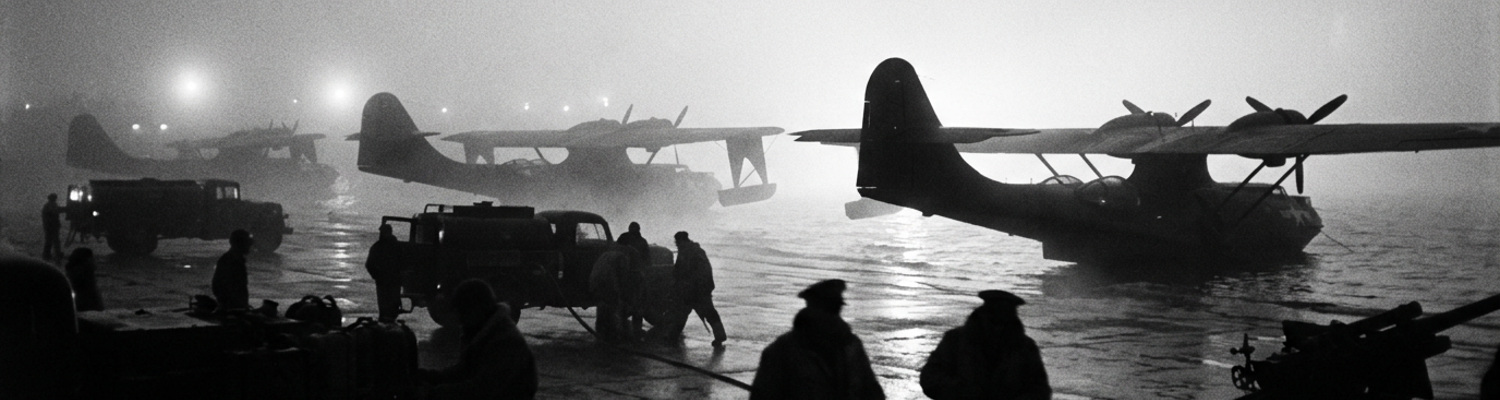

Coastal Patrol Infrastructure at Montauk Point
At 0418 hours in dense coastal fog in early 1942, a garbled high-frequency transmission crackled into the communications shanty at Montauk Point. An offshore patrol vessel reported an unidentifiable diesel wake three miles south of the lighthouse. Static abruptly cut the carrier wave. The Third Naval District scrambled its sector watch. A chaotic scramble across unpaved access roads followed. Maintenance crews at the Montauk detachment fought seawater seepage in their electrical generators. Sand fouled the field telephones. Mechanics worked with flashlights shielded by grease-stained rags. They struggled to ready aircraft before the contact could submerge and slip westward toward the Ambrose Channel.
Salt water corroded everything it touched.
Archival evidence shows that aviation support for the eastern tip of Long Island depended on an improvised coastal patrol system. This network was split between Coast Guard Air Station Brooklyn at Floyd Bennett Field and the forward seaplane slipway at Fort Pond Bay. Flight crews operated Grumman J4F-1 Widgeons and Vought OS2U Kingfishers. These light utility platforms were pressed into service as makeshift submarine hunters. The machines were never designed for prolonged offshore combat endurance. The twin-engine Widgeons utilized inverted inline Ranger L-440 engines. These powerplants suffered constant carburetor icing in sub-freezing coastal air. Their thin aluminum hulls wrinkled under the shock of rough Atlantic swells.
Kingfishers fared no better.
Ground crews at Montauk frequently had to hand-crank the Pratt and Whitney R-985 radials in forty-knot winds. Electric inertia starters burned out their solenoids after repeated use. Fuel delivery broke down almost immediately. High-octane aviation fuel arrived at Montauk in rusty fifty-five-gallon drums by rail via the Long Island Rail Road. Enlisted mechanics had to hand-pump each gallon through chamois-skin filters. This stripped out condensate before an aircraft could launch with a single Mark XI depth charge slung under its wing.
No spare parts arrived for three weeks.
When examining the historical record, the patrol patterns mapped out by coastal planners reveal an exhausting low-altitude grind across the southern approaches of Long Island. Eastern Sea Frontier directives mandated continuous daylight and twilight sweeps along fixed corridors. These corridors extended seventy miles south-southeast from Montauk Point. They intersected the outward shipping lanes near coordinates 40 degrees 30 minutes North, 71 degrees 50 minutes West. Pilots flew square-search and ladder-search patterns at altitudes below five hundred feet to pierce low-hanging marine stratus clouds. Observers scanned the gray water with handheld binoculars. They searched for periscope trails, oil slicks, or the distinct twin wakes of a Type IX U-boat running on electric motors.
Flying at eighty-five knots into headwinds drained fuel reserves twice as fast as operational charts predicted.
Pilots were left with barely twenty minutes of fuel as they turned back toward the Montauk bluffs. Flight logs from May 1942 note that over sixty percent of scheduled patrol hours were scrubbed or cut short. Salt crust coated cockpit windscreens and corroded distributor caps mid-flight. A close review of operational logs indicates that the communication loop between the aircraft and the coastal lookout towers was fundamentally fractured. Spotters stationed at Montauk Lighthouse and Napeague Beach relied on high-frequency voice radios. These units routinely lost signal synchronization whenever patrol Kingfishers dipped below coastal radar horizons.
Reporting a contact required climbing to fifteen hundred feet to transmit a coded position over the 3105-kilocycle band.
This altitude exposure pushed the lumbering observation craft into offshore winds that blew it off course. Often the shore-based direction-finding station at Shinnecock received only broken Morse fragments through the heavy atmospheric interference. Ground officers cross-referenced the coordinates and telephoned the seaplane apron at Fort Pond Bay. By that time, the target was long gone. Mechanics were left wiping engine cowlings with kerosene. They waited for the next freight delivery of spark plugs from the naval depot in Bayonne.
Aviation Maintenance and Component Shortages
Every flight hour consumed three pounds of replacement metal that never showed up on the supply manifests.
When examining the historical record, the root cause of the Atlantic patrol blackout at Fort Pond Bay came down to an absence of eighteen-millimeter Champion ceramic spark plugs. Each Pratt and Whitney R-985 radial mounted to a Vought OS2U Kingfisher required eighteen aviation-grade plugs. The twin Ranger L-440-5 engines on the Grumman Widgeons demanded a dozen each. Salt air mixed with low-grade 73-octane aviation gasoline. This mixture quickly fouled the electrode gaps with lead bromide and gray brine scale. Engine performance dropped within twenty-five flight hours. Misfires occurred during low-altitude maritime sweeps along the offshore shipping corridors at coordinates 40 degrees 45 minutes North, 71 degrees 40 minutes West.
Naval Supply Depot Bayonne in New Jersey faced a national nickel-alloy distribution logjam.
They failed to ship designated crates to the Montauk railhead throughout late spring. Station logs from June 1942 document that the detachment commander at Fort Pond Bay repeatedly scrubbed dawn anti-submarine patrols. Four out of six Kingfishers sat immobilized on the asphalt apron with empty cylinder heads. Aviation machinists soaked lead-caked plugs in benzene baths. They scraped carbon off the electrode cores with hand-filed hacksaw blades. This unauthorized field cleaning altered the factory firing gaps from 0.015 inches to unpredictable widths. The modified gaps triggered backfires that blew out exhaust manifolds during rough water takeoffs.
Engines died on the water.
Archival evidence shows that local shop foremen resolved the complete lack of factory spares by gutting damaged airframes dragged off the sandbars. Coast Guard flight facilities across the Long Island shoreline transformed the back corner of the Fort Pond Bay seaplane hangar into an ad-hoc salvage yard. Mechanics stripped structural framing, control cable turnbuckles, and oil scavenge pumps directly out of a wrecked J4F-1 hull. That specific aircraft had ground-looped in the surf off Montauk Point weeks earlier. A Kingfisher sustained wing-spar cracks during an emergency landing in four-foot Atlantic swells near the Shagwong Reef buoy. Ground personnel pulled its intact magnetos and pushrod tubes before the tide could submerge the fuselage.
Maintenance officers bypassed formal Bureau of Aeronautics requisition protocols entirely.
They issued informal inventory tags to install salvaged cylinder barrels onto operational R-985 engines. Enlisted aviation metalsmiths hammered twisted aluminum cowlings flat over wooden bench blocks. They shaped makeshift engine baffles to replace rusted heat shields on operational aircraft. Two operational patrol planes were maintained entirely through the systematic destruction of three decommissioned hulks sitting outside the hangar fence. Salvaged parts kept the sector operational.
A close review of operational logs indicates that this predatory scavenging spread directly to the secondary flight station at Floyd Bennett Field. Brooklyn supply chiefs secretly trucked worn generator brushes, re-soldered copper wiring harnesses, and pitted exhaust collector rings eastward along Route 27 under the cover of blackout orders. Warrant officers traded five-gallon tins of high-grade marine paint to local commercial mechanics in East Hampton. They received automotive feeler gauges and abrasive emery cloth in exchange.
Air crews had to test-fire cannibalized Wright and Pratt and Whitney engines tied down to concrete apron cleats with manila hemp hawser ropes.
They watched cylinder head temperature gauges climb past two hundred degrees Celsius as mechanics searched for compression leaks. On June 18, 1942, an inventory ledger at Fort Pond Bay verified a severe parts deficit. Seventy-two percent of all functional spark plugs on the line were third-generation re-gap salvage taken from written-off trainer hulls.
Medical Supply Deficits in Littoral Air Support
A close review of operational logs indicates that during the height of the offshore U-boat offensive against merchant shipping in July 1942, Coast Guard aircraft based at Fort Pond Bay launched on search-and-rescue sweeps without a single standard package of reconstituted dried blood plasma. Eastern Sea Frontier triage plans instructed pilots responding to burning tankers thirty miles south of Montauk Point to administer plasma immediately upon hauling shock-trauma casualties out of water rafts. Medical dispensaries across the Third Naval District had placed requisition orders for the standard American Red Cross dried plasma kits. These kits contained four-hundred-cubic-centimeter vacuum bottles of dried human citrated plasma, distilled water, and rubber intravenous tubing.
Naval Medical Supply Depot Brooklyn held zero units for Coast Guard littoral air units.
Supply officers diverted nearly all processed stocks straight into deep-water Atlantic convoy escorts and Mediterranean staging depots. Flight crews scrambled to the coordinates of a torpedoed Panamanian-flagged vessel. They found their onboard medical kits severely lacking. The boxes contained little more than paper bandages, morphine Syrettes, and petroleum jelly gauze.
Glass saline ampoules cracked inside their transit crates.
Archival evidence shows that even basic five-hundred-milliliter flasks of sterile isotonic sodium chloride solution failed to reach the Montauk flight detachment before flight crews launched into littoral rescue zones. Road deliveries eastward along Long Island routinely rattled cargo boxes over unpaved washboard sections of the Montauk Highway. The thin-walled glass vials shattered before trucks reached Fort Pond Bay. The primitive cargo spaces of Grumman J4F-1 Widgeons lacked climate controls. Any intact saline bottles stowed in aft access bays either froze during five-thousand-foot cloud transits or overheated beside uninsulated exhaust pipes during wave-skimming low searches.
Flight mechanics improvised saline drips using rubber fuel line tubing and siphon needles.
They discovered that particulate sediment from broken packaging had contaminated the fluid. Station surgeons at the Montauk Point naval section base recorded severe medical deficits. Seventy percent of recovered merchant mariners suffering from deep blast shock and acute hypothermia arrived without having received a single drop of intravenous fluid. Aviation machinists had to flush chemical burns using untreated tap water pumped from the station fire house.
There were no Stokes litters left on the shelf.
When examining the historical record, the shortage of standard tubular-steel Stokes wire basket litters across the eastern Long Island air stations forced flight personnel into dangerous field improvisations. The Third Naval District supply pool in Bayonne allocated only two complete wire litters to Fort Pond Bay. Both were destroyed on July 3 when a surface swell snapped a hoist cable during a sea extraction off Shagwong Reef. Factory replacements from the manufacturer were backordered by four months due to sheet-steel and wire-mesh rationing.
Aircrews operating the Grumman J4F-1 and twin-float Kingfishers had to muscle sodden, oil-covered survivors directly through narrow fuselage hatches by hand.
Crewmen laid injured sailors directly onto the unpadded corrugated aluminum floorboards of the passenger cabins. They used standard canvas engine-cowling tie-down straps and half-inch manila cargo lashing to bind their chests and legs directly against the structural ribs. The metal floorboards sat three inches above the hull bilge. Casualties were left exposed to sloshing seawater, aviation fuel vapors, and engine grease throughout the thirty-minute return flight to the seaplane ramp.
Engine vibration transferred directly into crushed bone.
A close review of operational logs indicates that flights back from coordinates 40 degrees 32 minutes North, 71 degrees 48 minutes West regularly worsened traumatic injuries. Casualties were strapped directly to bare airframe stringers. Pratt and Whitney R-985 radials turning at two thousand revolutions per minute sent severe harmonics through the unlined hull skin of the Kingfishers. This vibration dislodged field tourniquets and tore open closed compound fractures. Flight crews had to kneel in the bilge water. They leaned their body weight against lashed casualties to stop them from sliding into the rudder control cables routed along the floorboard margins. The seaplane base at Fort Pond Bay logged five separate cases in August 1942 where mariners arrived at the dock with secondary rib fractures. Unpadded lashing straps bit into their chests during rough water landings.
Operation Pastorius and Coastal Security Protocols
Dense sea fog covered Atlantic Avenue Beach at midnight on June 13, 1942.
When examining the historical record, coastal defense protocols along the eastern seaboard collapsed the moment German submarine U-202 surfaced eight hundred yards off the dunes of Amagansett at coordinates 40 degrees 59 minutes North, 72 degrees 07 minutes West. Under Operation Pastorius, four Abwehr operatives led by George John Dasch rowed an inflatable rubber raft through the surf. They hauled wooden cases packed with hexogen, pen-type delay detonators, and acid timing pencils into the sand. The saboteur unit had departed the submarine base at Brest aboard U-202 two weeks earlier. They carried twenty-five thousand dollars in American currency and explosive blocks disguised as lump coal.
Unarmed Coast Guard Seaman Second Class John C. Cullen encountered the four men in dense sea mist near the water line.
He was on a routine foot patrol out of Station 112. Dasch attempted an immediate cash bribe of two hundred and sixty dollars to prevent an alarm. Cullen accepted the money to avoid being shot on the spot. He sprinted two miles through soft beach sand back to the station shanty to notify Chief Boatswain Mate Carl R. Jenrich. By 0130 hours, shore guardsmen armed with bolt-action M1903 Springfield rifles were excavating four buried crates soaked in fuel oil. They uncovered sixty pounds of explosive charges, brass blasting caps, dry cell batteries, and German naval fatigues.
Vice Admiral Adolphus Andrews at Eastern Sea Frontier headquarters ordered immediate Level-One alert protocols across the Third Naval District.
He mobilized the 113th Infantry Regiment and deployed armed patrols across forty miles of beach terrain from Montauk Point to Moriches Inlet. Every coastal rifle post expected an amphibious assault before dawn. Archival evidence shows that the defensive alarm triggered an immediate radio communications blackout that disrupted tactical coordination across Long Island. Within ninety minutes of the telephone report to the Greenport section base, the First Air Force and the Eastern Sea Frontier restricted coastal airspace. They banned all non-military flight activity within twenty miles of the Atlantic shoreline.
Civilian airfields across Long Island received emergency grounding orders that suspended commercial operations instantly.
The Third Naval District shut down radio transmission authorizations for all regional littoral air stations. This grounded routine observation flights at Fort Pond Bay and Floyd Bennett Field. Patrol pilots were strictly forbidden from using high-frequency voice channels. OS2U Kingfisher crews were required to fly low-level search grids under absolute electromagnetic silence. Ground mechanics at Fort Pond Bay removed transmitter vacuum tubes from radio chassis. They wired safety seals across push-to-talk microphone triggers to eliminate the possibility of stray carrier signals reaching offshore U-boat direction finders.
Radio silence reduced coastal air reconnaissance to isolated guesswork.
A close review of operational logs indicates that shifting all defense communications onto civilian wire circuits triggered an immediate mechanical breakdown. Command posts at Montauk Point, Amagansett, and Shinnecock were forced to route emergency military traffic through commercial Western Union copper lines and civilian switchboards in East Hampton. Salt fog seeped into junction boxes mounted to exposed wooden utility poles along Route 27. This dropped line voltages and corrupted teletype data between littoral guard stations and naval intelligence officers in New York City.
Civilian switchboards became overloaded with incoming military calls.
Base commanders dispatched enlisted runners riding Indian 741 motorcycles through the dark without headlamps. Station logs from June 14 record that three urgent intelligence dispatches detailing the purchase of rail tickets to Jamaica Station sat stranded in the Amagansett telegraph shanty for four hours. Wet junction boxes had severed contact with the Third Naval District command center.
Offshore Casualty Evacuation Delays
Inbound rescue boats returned from sea without sending a single radio signal.
When examining the historical record, the communications blackout enforced across the Eastern Sea Frontier during the summer of 1942 paralyzed medical dispatching along the Long Island coastline. Directives issued by Third Naval District intelligence prohibited Coast Guard 83-foot patrol boats and converted civilian pickets from keying their 2670-kilocycle voice transmitters within thirty miles of the shoreline. Command staff feared offshore Type IX U-boats were operating high-frequency direction-finding equipment. This equipment could track incoming patrol traffic straight back to Fort Pond Bay. Skippers risked court martial if they broke electromagnetic silence without direct written authorization from the sector commander.
Patrol vessels could not broadcast casualty numbers or triage categories while inbound from recovery zones near coordinates 40 degrees 20 minutes North, 71 degrees 42 minutes West.
Shore dispensaries remained completely blind. Medical personnel at Montauk Point received no advance manifests detailing burn severity, shrapnel lacerations, or crushed limbs. Emergency ambulances assigned to the Montauk detachment sat parked five miles west inside an unheated garage in Montauk village. They did not stand by on the docks. Boat crews pulled into harbor to discover cold piers with zero medical personnel waiting.
Nobody on the beach knew the wounded had arrived until lookout towers spotted shuttered Aldis lamps blinking through the fog.
Archival evidence shows that multi-hour delays in transferring burned merchant mariners from offshore picket boats to designated beach evacuation corridors cost critical treatment time. Survivors pulled from flaming crude slicks after torpedo strikes in the outbound shipping lanes arrived with extensive second-degree and third-degree thermal injuries. Their skin peeled from exposure to boiling Bunker C fuel oil. Rough surf conditions along the Atlantic coastline prevented deep-draft picket craft from approaching within four hundred yards of the sand shoals near Ditch Plains.
Station 112 surfmen had to launch wooden thirty-six-foot pulling surfboats through heavy six-foot ocean breakers to shuttle casualties off the rolling patrol boats.
Hoisting an incapacitated, oil-coated mariner wrapped in wet wool blankets across open water required three men to balance on slippery gunwales while handling rough manila guide lines. Heavy ocean swells repeatedly battered the two hulls together. This action crushed patient limbs against wooden rub rails. Shifting sandbars repeatedly grounded the wooden surfboat keels during the approach. Basic boat-to-shore transfers stretched past four continuous hours for a single group of twelve casualties.
Hypothermia took hold long before the surfboats grounded in the wet shingle.
A close review of operational logs indicates that coastal terrain bottlenecks compounded the delay once casualties finally cleared the water line. Picket craft CG-44315 spent nearly three hours idling against heavy south-southeast tidal rips off Shagwong Point on July 14, 1942. The vessel waited for beach clearance while its twin Kermath gasoline engines blew carbon monoxide across casualties huddled on the open aft deck. Beach recovery teams lacked tracked evacuation vehicles. Enlisted men pulled canvas-and-wood sledges through deep quartz sand up thirty-foot dune inclines by hand.
Saline drips could not be administered on the exposed beach.
Gale-force winds blew abrasive beach grit into open wounds and needle hubs. Station corpsmen transferred the final burned sailor to the Montauk Point lighthouse medical station at 0615 hours. His core body temperature had plummeted to eighty-nine degrees Fahrenheit.
Dune Triage Stations and Equipment Shortfalls
Atlantic winds drove fine beach sand through every seam of the canvas shelter halves.
Archival evidence shows that surfmen from Coast Guard Station 112 established ad-hoc shoreline triage posts in the lee of the secondary dune lines between Ditch Plains and the Montauk Lighthouse. These posts were pinned at coordinates 41 degrees 04 minutes North, 71 degrees 52 minutes West. Medical units assigned to the Fourth Naval District had stripped regional depots of portable steam autoclaves. They used these units to furnish outgoing troop transports in New York Harbor. Littoral aid stations were left with zero pressurized sterilization equipment.
Frontline corpsmen dug four-foot trenches into the shifting dunes.
This shielded open-flame Coleman gasoline stoves from forty-mile-per-hour gusts. Enlisted handlers boiled surgical instruments inside galvanized steel mess kits over unstable kerosene burners. This exposed scalpel blades and hemostats to airborne quartz dust the moment tools left the water. Driftwood stakes driven into the sandy soil served as mounting posts for blood-plasma bottles. Shifting sands repeatedly pulled the stakes loose. Inverted glass containers toppled directly into the scrub brush.
Corpsmen could not generate dry heat at two hundred and fifty degrees Fahrenheit without enclosed shelters or field autoclaves.
They could not eliminate spore-forming bacteria from surgical steel. Soot from kerosene burners coated every pair of forceps before an incision could be made. A close review of operational logs indicates that the Third Naval District medical liaison in Brooklyn denied three consecutive requisitions for trailer-mounted field sterilizers throughout June 1942. District officers directed Montauk personnel to haul boiling water directly from the boiler room of the Montauk Point Lighthouse station two miles to the east. They used open ten-quart galvanized pails carried across unpaved beach tracks on foot.
Cooling water lost thermal lethality within eight minutes of exposure to ocean winds.
Temperatures dropped below the one-hundred-degree-Celsius threshold required to neutralize clostridial pathogens. Corpsmen working under Chief Pharmacist Mate Raymond Vance resorted to wiping bone saws and suture needles with raw industrial alcohol drawn from aviation maintenance drums. This fluid failed to strip persistent grease and sand particles from the metal hinges.
The station exhausted its entire supply of sterile muslin dressings in twelve hours.
When examining the historical record, a sudden influx of twenty-eight survivors from a torpedoed British freighter on July 8 completely drained the emergency dressing lockers across the eastern Long Island coastline. Coast Guard surfmen had consumed their last four-inch sterile gauze compresses on crewmen suffering from extensive Bunker C fuel oil burns and shrapnel trauma. Requisition trains out of Naval Medical Supply Depot Brooklyn were delayed along the Long Island Rail Road branch at Ronkonkoma. Replacement medical crates sat stranded eighty miles away.
Frontline surfmen received orders from local station commands to collect blood-caked, petroleum-soaked bandages directly from discarded casualty litters.
They soaked the compromised cotton strips in buckets of brackish water pulled from coastal marsh wells. Enlisted personnel scraped dried crust and heavy crude oil out of the fabric weave using coarse wire brushes. They hung the damp strips across dune fence wires to dry in the salt spray. Sand grains embedded deep within the frayed cotton fibers turned the recycled dressings into abrasive scouring pads when applied to fresh open tissue. By late July, surfmen at Ditch Plains were binding severe blast lacerations with unsterilized canvas strips cut directly from wet weather oilskin coats.
Overland Transport Failures Along Sand Routes
Standard military vehicles choked on the fine quartz sand of eastern Long Island.
When examining the historical record, the motor pool assigned to Coast Guard Station 112 and the Montauk Point naval section base was wholly inadequate for coastal patient transport. The Third Naval District command diverted every factory-new Dodge WC-54 four-by-four ambulance to major naval hospitals in Brooklyn and St. Albans. Montauk operated with zero enclosed, four-wheel-drive medical vehicles throughout 1942. Station personnel relied on an unarmored civilian fleet of 1940 Ford 1.5-ton stake-bed trucks and Chevrolet G-7100 series utility pickups. These were confiscated from commercial depots or drafted from civilian highway crews.
These civilian-pattern vehicles lacked low-pressure flotation tires.
Drivers had to bleed down standard dual rear tires to fifteen pounds of pressure to gain traction. The fine, windblown coastal grit penetrated open brake drums. It chewed through asbestos linings within twenty miles of continuous operation along beach approach corridors. Engine cooling systems suffered continuous failures. Radiator fins packed solid with quartz dust thrown up by spinning front wheels. Water temperatures in the flathead V-8 engines exceeded two hundred and thirty degrees Fahrenheit.
Mechanics at the Montauk garage spent their night shifts pulling sand-scored cylinder heads.
They replaced charred clutch pressure plates that had burned out after thirty minutes of low-gear grinding through dune cuts. Drive axles cracked under the torque of deep sand. Archival evidence shows that mechanical transport collapsed completely along the secondary trail system north of Ditch Plains at coordinates 41 degrees 03 minutes North, 71 degrees 54 minutes West. The transition zones between the coastal dunes and the interior scrub oak woods consisted of uncompacted, wind-drifted quartz sand up to three feet deep.
Drivers attempted to force 1.5-ton utility trucks through these dune notches to reach casualty collection points.
The high-centered differentials grounded hard against the underlying gravel ridges. The resistance sheared the splines off semi-floating rear axle shafts as drivers shifted between reverse and first gear trying to rock the heavy chassis free. Station logs from July 1942 record that three out of five operational transport trucks suffered catastrophic differential gear stripping or snapped leaf spring shackles in a single seventy-two-hour period. Replacement axle assemblies sat eighty miles to the west at the motor depot in Holtsville. There was no rail clearance to move them forward.
Enlisted drivers carried wooden planks, shovels, and steel tow cables.
Winching an immobilized truck out of a sand bowl frequently burned out the front-mounted power take-off units. Vehicles were left stranded up to their running boards. A close review of operational logs indicates that the breakdown of motorized transport forced surfmen to haul casualties across the dunes entirely on foot. Carry details consisting of four to six Coast Guardsmen carried injured merchant mariners on rigid steel Stokes litters across two miles of unpaved, undulating footpaths. This route stretched between the beach waterline and the paved macadam of Old Montauk Highway.
Litter teams sank past their ankles into loose sand on twenty-degree dune inclines.
This doubled the time required for basic litter relays. Shifting sand regularly broke the stride of the stretcher bearers. It wrenched joints and jolted burn victims who had already suffered hours of sea exposure. Teams rotated carrying stations every one hundred yards to prevent total physical exhaustion among the surfmen. These men were already working twelve-hour coastal defense watches in heavy wool service dress. To evacuate fourteen heavily burned sailors landed near Caswell Bluffs on July 22, the Montauk detachment mobilized thirty-two off-duty surfmen. They spent four hours hand-hauling the wounded through dense bayberry thickets in pitch-black blackout conditions. The final litter team reached the paved roadway at 0440 hours. They transferred the casualties to open flatbed utility trucks with failing water pumps.
Court Martial Case 334178 Findings
When examining the historical record, the classified proceedings of Court Martial Case 334178 opened at the Brooklyn Navy Yard in September 1942. The tribunal investigated systemic material breakdowns along the Long Island shoreline. Naval prosecutors focused their charges on Coast Guard warrant machinists and station commanders across the Montauk sector. They alleged criminal neglect of coastal patrol craft and unauthorized disposal of military inventory.
The defense testimony laid bare an administrative breakdown that left frontline detachments stranded.
Flight engineers at Fort Pond Bay and surf station mechanics from Station 112 presented work orders. These documents showed they had operated auxiliary diesel generators without replacement lube-oil filters for over twelve hundred continuous hours. Frontline coastal units lacked certified gaskets. Enlisted motor machinists cut replacement head seals out of heavy cardboard ammunition boxes soaked in shellac. Worn intake valves burned out on 83-foot patrol cutters operating off Montauk Point. Station personnel manufactured makeshift valve stems on civilian metal lathes in East Hampton using low-grade structural steel rod stock.
Supply ledgers entered into evidence proved the frontline base had received zero factory replacement valves in five months.
Archival evidence shows that Case 334178 exposed a catastrophic divergence in resource allocation between littoral defense units and offshore combat fleets. Third Naval District supply officers in Manhattan had systematically diverted priority material codes away from eastern Long Island. They assigned high-octane aviation fuel, marine ignition wire, and bronze propeller shafts exclusively to newly built destroyer escorts fitting out in New York Harbor. The trial record documented that station commanders at Montauk and Shinnecock filed forty-six priority supply requisitions between May and August 1942. Regional supply bureaucrats rejected or downgraded every single one.
Without factory spares, coastal units survived by operating an illicit bartering ring.
Station chiefs traded government fuel oil to civilian fishing boat operators along Fort Pond Bay. They received scrap copper tubing, industrial grease, and commercial marine spark plugs in exchange. Court officers attempting to establish criminal negligence discovered a different reality. Base officers had ordered every unauthorized mechanical modification directly. They were trying to keep anti-submarine patrol vessels from foundering in open Atlantic swells. The naval tribunal quietly dismissed the primary sabotage charges against the mechanics before the third week of hearings.
A close review of operational logs indicates that the inquiry quickly expanded into the parallel logistical breakdown inside the Third Naval District naval medical procurement system.
Official findings produced by the district medical inspector detailed how procurement officers at the Naval Medical Supply Depot in Brooklyn had completely severed littoral aid stations from the military supply chain. Requisitions for emergency trauma supplies submitted by the Montauk Point dispensary sat unprocessed for ninety days. Regional administrators classified shore triage stations as secondary non-combat installations. Deep-water convoy escorts received complete allotments of dried blood plasma kits and sterile surgical packs. Coastal dispensaries treating merchant marine burn casualties received crates filled with obsolete wooden splints, sulfur ointments, and paper tape.
Delivery schedules broke down along the Long Island Rail Road corridor.
Crates of fragile glass intravenous ampoules sat abandoned on exposed freight platforms at Jamaica Station under direct summer sunlight for weeks. Heat-sensitive pharmaceuticals spoiled before transport trucks ever departed for the eastern bluffs. Depot manifests confirmed that seventy-four cases of morphine Syrettes routed to Fort Pond Bay were lost in transit between Bayonne and Long Island City. The final investigative report revealed that administrative red tape actively blocked emergency medical replenishment even as casualty numbers surged following littoral U-boat attacks.
Third Naval District logistics directors refused to release emergency medical stockpiles stored at the Naval Hospital in St. Albans.
They required signed triplicate authorizations from the district medical officer. This officer was stationed forty miles away in lower Manhattan. Couriers carried authorization slips through coastal blackout checkpoints via Route 27. By the time they arrived, local triage personnel at Ditch Plains had already resorted to boiling discarded cotton rags in ocean water to dress open compound fractures. The official inquiry concluded in late October 1942. The Navy issued an unpublicized order transferring two regional supply commanders to remote administrative posts in the Aleutian Islands.