
Precision Navigation's Genesis
In the decades following the War of 1812, the United States Navy turned its gaze from coastal defense toward the deep blue. A young republic, flush with expansionist ambition, found its maritime reach checked by a fundamental problem: the tyranny of longitude. While a competent ship’s master could determine latitude from the sun’s midday height with relative ease, fixing an east-west position on a featureless ocean was a matter of complex observation and often, frustrating inaccuracy. The prevailing method, known as lunar distances, was a test of a navigator’s skill under the best of conditions and a source of gross error under the worst.
The lunar distance technique demanded a ship's sailing master, the warrant officer responsible for navigation, to measure the angular distance between the moon and a select star or the sun. On the unsteady deck of a vessel, he would brace himself, sextant in hand, trying to bring the reflected image of one celestial body to the limb of the other. This was a delicate operation, performed with a sextant on a moving deck, often in foul weather. Once the angle was captured, a series of laborious calculations followed. The navigator had to correct for parallax, refraction, the dip of the horizon, and the semidiameter of the celestial bodies using logarithmic tables. Any mistake in the multi-step process, or a slight error in the printed almanac tables, could translate into a longitude error of dozens of miles. An error of just one arcminute in the measurement could result in a longitude error of up to 30 arcminutes, or half a degree. This was a method that demanded expertise and time, commodities not always available on a warship clearing for action or clawing off a lee shore.
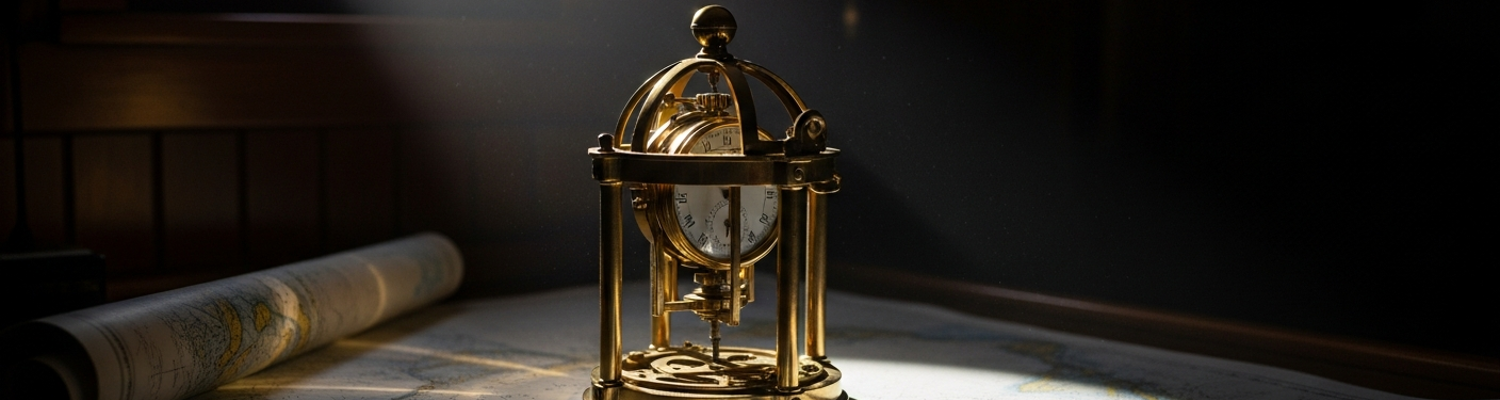
The marine chronometer offered a radical, mechanical alternative. It was not a new invention, with British, French, and American clockmakers like William Cranch Bond producing examples since the late 18th century. However, their extreme expense and fragility initially kept them out of widespread naval service. By the 1830s, manufacturing had improved, costs had decreased, and the U.S. Navy began its first serious acquisitions. A chronometer was a machine of breathtaking precision. Its heart was a fast-beating balance wheel with a helical hairspring, connected to a spring detent escapement. This mechanism gave a precise impulse to the balance with minimal interference. To maintain constant force as the mainspring unwound, a fusée, a conical pulley, and a miniature chain were used. A bimetallic strip built into the balance wheel compensated for temperature changes that would otherwise alter the timing. The entire assembly was mounted in a set of brass gimbals that kept it level with the horizon, no matter how the ship pitched and rolled.
Its function was brutally simple: to keep perfect time. Specifically, it kept Greenwich Mean Time (GMT), the time at the Royal Observatory in Greenwich, London. The operational shift this represented was immense. A sailing master no longer needed to spend hours with his sextant and tables for a single longitude fix. Instead, he determined his local time by observing the moment the sun reached its highest point in the sky, local noon. He would then simply compare his local time to the time on the face of the chronometer. The difference between the two times gave him his longitude. Every hour of difference corresponded to 15 degrees of longitude east or west of the Greenwich meridian. This mechanical solution replaced arcane astronomical calculation, offering a directness that promised to reshape naval operations, though some veteran masters remained skeptical of the delicate machine, preferring their trusted tables.
Charting Global Ambition
The ability to determine longitude accurately and repeatedly was more than a navigational convenience; it was a strategic enabler. It gave American naval commanders the confidence to conduct extended voyages far from charted waters, to make precise landfalls, and to project power with a newfound reliability. This capability found its most potent expression in the United States Exploring Expedition of 1838.
Commanded by the ambitious and difficult Lieutenant Charles Wilkes, the expedition was a clear statement of America’s growing global interests. Wilkes, who had previously headed the Navy’s Depot of Charts and Instruments, understood the power of the new technology. He equipped his squadron of six ships with an unprecedented twenty-eight marine chronometers purchased from the finest English makers like Arnold & Dent, Charles Frodsham, and Molyneaux & Son. This was a significant investment, demonstrating the Navy’s commitment to the instrument. Wilkes did not trust a single timepiece. He used the fleet of chronometers to cross-check one another, establishing a mean time and rate of error that delivered a new level of positional accuracy. This allowed his ships, when separated by storms in the vast Pacific, to have a common time reference, enabling them to calculate their positions independently and rendezvous at predetermined coordinates with confidence.
Over four years, the expedition surveyed and charted vast stretches of the Pacific Ocean, its islands, and, most famously, a 1,500-mile stretch of the Antarctic coast, proving it was a continent. The thousands of charts produced by the expedition were a tangible product of the chronometers’ precision. They allowed the American whaling fleet and merchant marine to follow in the Navy’s wake, exploiting new resources and opening new markets. Accurate charts were a tool of empire, and the chronometer was the key that created them.
The data firehose opened by widespread chronometer use fueled another naval revolution. At the Depot of Charts and Instruments in Washington, Lieutenant Matthew Fontaine Maury began a colossal undertaking. He collected and systematically analyzed the logbooks from thousands of naval and merchant voyages. Each logbook was a repository of chronometer-derived positions, wind observations, and current data. Maury and his staff collated this information, creating the famous Wind and Current Charts. These charts were a form of strategic intelligence, revealing the ocean’s patterns and allowing ship captains to plan routes that took advantage of favorable winds and currents. Maury’s work, built upon a foundation of countless chronometer readings, drastically cut voyage times. For the California-bound clipper ships of the Gold Rush, his sailing directions could shave more than a month off the perilous trip around Cape Horn, saving money for merchants and increasing the operational tempo for the Navy. A vessel that could reliably make a faster passage was a more effective instrument of national policy.
The Observational Imperative
Acquiring chronometers was only the first step. The instruments were delicate, temperamental, and demanded a rigorous support structure to be of any military use. A chronometer was a liability if its daily rate of gain or loss was not known with exacting certainty. This reality forced the U.S. Navy to create a scientific and logistical infrastructure from scratch. The care and feeding of these brass machines became a new, vital component of sea power.
At sea, the chronometer lived a coddled existence. Kept in a padded mahogany box, it was typically stored in a dedicated, secure locker in the captain’s cabin or chart room. The sailing master or a designated midshipman had the solemn duty of winding it at the exact same time each day, usually eight o'clock in the morning, and recording its reading in a log. Its delicate spring detent escapement was vulnerable to shock. A sharp jolt from a storm or the concussion of the ship’s own guns could disturb its rate or stop it entirely. During preparations for battle, the chronometers were often removed from their gimbals and carefully stowed below the waterline in sand-filled barrels to dampen the shock of cannon fire. Temperature fluctuations in a ship’s cabin, from the cold of the North Atlantic to the heat of the tropics, could alter the properties of its metal components and throw off its timekeeping. For this reason, warships on long voyages carried at least three chronometers. If one began to deviate, a comparison of the three would reveal the outlier.
This battlefield reality drove the requirement for a shore establishment. The Navy needed a place to procure, service, store, and most importantly, rate its chronometers. This need led directly to the founding of the Depot of Charts and Instruments in Washington D.C. on December 6, 1830. Initially placed under Lieutenant Louis M. Goldsborough with a meager budget, its primary mission was the repair and rating of navigational instruments. This depot was the humble seed from which American naval timekeeping grew.
Rating a chronometer was a painstaking process. It involved comparing the instrument’s time against the heavens themselves. At the depot, an officer would use a transit circle, a specialized telescope mounted to rotate on a single east-west axis, to observe the precise moment a specific star crossed the celestial meridian. This astronomical observation provided the true local time, which was then compared to the time shown on the chronometer. The process was repeated day after day to establish the chronometer’s daily rate of error. The instruments were also tested in temperature-controlled rooms, subjected to deliberate heating and cooling to determine their performance across a range of climates they would encounter at sea. Only when this rate was stable and known could the instrument be issued to a ship.
The growing importance of this task and the expanding needs of the fleet led to the depot’s evolution. In 1842, propelled by the tireless lobbying of Lieutenant James Melville Gilliss, who had experienced the shortcomings of American navigational tools firsthand, Congress appropriated $25,000 to establish a permanent national observatory. The United States Naval Observatory, established in 1844, became the central nervous system for the Navy’s temporal and navigational enterprise. Gilliss traveled to Europe to procure the finest astronomical instruments, and the new observatory, first located in Foggy Bottom, took on the mission of caring for all the Navy’s chronometers. Under its first superintendent, Matthew Fontaine Maury, the observatory not only rated the timepieces but also became a center for astronomical research and the production of nautical almanacs. The observatory established a new kind of naval officer: a technical specialist, as adept with a transit telescope as with a sextant, whose work was fundamental to the projection of American power across the world’s oceans.