
The Static of Command
The sound was not of failure, but of confusion. A cascade of clicks from the sextuplex receiver at the Eighth Army Corps headquarters in Manila. The operator, a corporal from the Signal Corps, did not hear silence. He heard a torrent of meaningless noise as the delicate balance of the F.W. Jones system collapsed. Polarity reversals, harmonic frequencies, and variable current strengths, all designed to push six messages down a single copper wire, dissolved into an electrical shriek. The intended target of the data stream was a forward garrison of the 28th U.S. Volunteer Infantry near the town of Lipa in Batangas province. The last coherent transmission, logged at 09:17, confirmed the garrison’s request for an emergency shipment of quinine. The next transmission was garbled nonsense. Then, the line registered as open. A complete, unnerving quiet descended on the console.
The system was a technical marvel. It built upon the existing quadruplex framework by adding a third layer of transmission. Two messages traveled via the standard duplex method of polarity reversal. Two more were sent by varying the amplitude of the current, a technique requiring sensitive relays. The final two messages were encoded on alternating or harmonic currents, a concept borrowed from early telephone experiments. This allowed for a theoretical throughput that commanders believed would make the vast archipelago of the Philippines manageable. It would connect disparate garrisons and allow for centralized control over a sprawling, unconventional war.
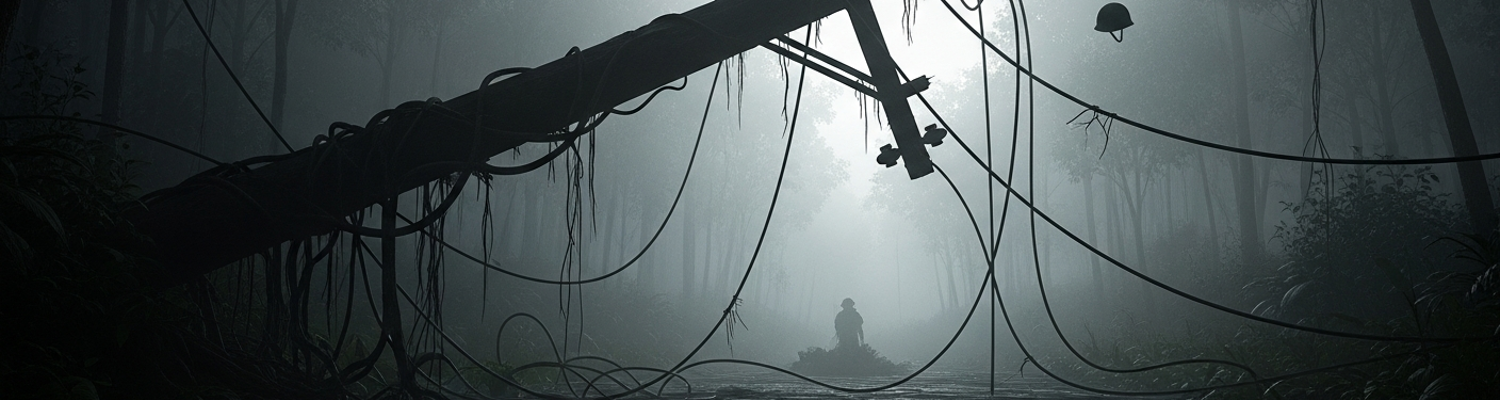
On the operational maps in Manila, the symbol for the 28th’s outpost was now frozen. It was a static icon representing a total information void. The cause was unknown. It could be a simple equipment fault at a repeater station. It could be a tree falling across the line during a monsoon squall. Or it could be the work of Filipino insurgents, known as Insurrectos, who had learned the strategic value of a single pair of wire cutters. For the commander in Manila, the illusion of omniscience had vanished. For the men in Batangas, the silence was a direct threat to their survival.
The Headquarters Bubble
The F.W. Jones Sextuplex Telegraph was the central nervous system of the American command structure in the Philippines. Its installation in major headquarters created a new philosophy of warfare, one predicated on the assumption of continuous, high-volume information. A review of Eighth Army Corps operational logs (Record Group 395, NARA) shows a command staff increasingly reliant on the telegraph for minute-to-minute updates. They tracked patrol movements, supply levels, and enemy contact reports from dozens of isolated outposts, all flowing into a single room in Manila. The sextuplex console, with its six distinct channels, fostered a powerful perception of total situational awareness.
This perception was a vulnerability.
The psychological effect on command was a deep-seated trust in the electronic data over the principles of field command. The operational map, updated with each new telegraphic dispatch, became the reality. This fostered a highly centralized, micromanaged approach to the conflict. Colonels in Manila issued orders dictating the patrol routes for lieutenants in the jungle and the precise contents of supply wagons destined for remote provinces. The system was designed to eliminate the fog of war. Instead, it created a generation of commanders less tolerant of ambiguity and less capable of independent decision-making when the data stream inevitably failed. The headquarters became an information bubble, reinforcing its own version of the conflict, a version that depended entirely on the integrity of a few thousand miles of copper wire.
The failure of the line to the 28th Infantry’s garrison transformed this false confidence into a catalyst for error. In the absence of new information, commanders defaulted to their last known data points. The operational map showed the garrison was secure, albeit in need of medical supplies. Based on this now-obsolete picture, the corps commander made a decision at 10:30. He ordered a small patrol from the 30th U.S. Volunteer Infantry, stationed ten miles to the south, to move north and re-establish contact with the 28th’s outpost. The route selected was based on intelligence that was hours old. It sent the patrol directly toward a river crossing that a local agent had identified as a planned ambush site just an hour prior. That warning, of course, never arrived.
The War on Infrastructure
The American effort to pacify the Philippines was as much an engineering project as a military one. The Army Signal Corps was tasked with stringing thousands of miles of telegraph wire through dense jungle, across mountain ranges, and between islands. A close examination of their records reveals the immense difficulty of the task. The humid, tropical environment was a constant enemy. Wires corroded, wooden poles rotted quickly in the damp soil, and monsoon winds could bring down entire sections of the line. Repairing this network was a slow, laborious process.
It was a process Filipino insurgents learned to exploit with precision.
Their campaign against American infrastructure was not about large-scale destruction. It was a war of attrition against the fragile connections that held the occupation together. Insurgent units, often small, locally-raised groups, developed specific techniques for disrupting the telegraph network. They would not simply cut a wire, which could be easily spliced. Instead, they would remove entire 20- or 30-foot sections of the copper line, forcing Signal Corps repair crews to haul heavy spools of new wire deep into hostile territory. In other instances, they would fell a single pole in a remote, inaccessible ravine, making the break difficult to locate. After-action reports from the Visayas campaign describe insurgents smashing the glass insulators on poles with rocks, causing the line to ground out and degrade the signal without severing it completely. This subtle sabotage was particularly effective against the sextuplex, as it could corrupt the sensitive harmonic channels while leaving the basic polarity channels intermittently functional, injecting corrupted data into the system.
The physical supply lines were just as vulnerable. The limited rail network on Luzon, primarily the Manila-Dagupan Railway, was a frequent target. Insurgents would remove spikes from ties, causing rails to spread under the weight of a train. They would burn trestle bridges and block cuts with debris. This forced American logistics to rely on mule-drawn wagon trains moving along poorly maintained roads and jungle tracks. These convoys were slow, conspicuous, and easily ambushed. The expansion of the war meant supply lines stretched ever further from secure ports, increasing the time and risk involved in every resupply mission. A convoy commander, without reliable telegraphic updates, could not be rerouted around a washed-out bridge or a known ambush site. They were committed to their path, moving blindly through a landscape where the enemy held the initiative.
A Known Vulnerability
The fragility of telegraphic communication was not a new discovery for the U.S. Army. The campaigns against Native American tribes in the American West during the preceding decades had been a harsh education in the vulnerabilities of a wired frontier. During the pursuit of Geronimo’s Apaches in the 1880s, General Nelson A. Miles coordinated the movements of thousands of troops across Arizona and New Mexico almost entirely by heliograph and telegraph. His strategy depended on rapid communication to encircle and trap the highly mobile Apache bands.
The Apaches understood this dependency completely.
They could not win a stand-up fight against the U.S. Army, but they could attack its nervous system. Archival records from the Department of Arizona detail sophisticated Apache tactics. They learned to cut telegraph wires in ways that made repair difficult. A common method was to cut the line and then carefully splice the two ends back together using a strip of rawhide. The rawhide acted as an insulator, breaking the electrical circuit, but was nearly impossible for a Signal Corps lineman to spot from a distance. The repair crew would have to dismount and physically inspect the wire foot by foot, a slow and dangerous process that left them highly exposed to attack while command posts remained isolated.
This form of infrastructure warfare was elevated to a strategic level during the Spanish-American War. One of the first objectives of the U.S. Navy in Cuba was to sever the undersea telegraph cables connecting the island to Spain. On May 11, 1898, American sailors in small boats, under heavy fire from Spanish shore batteries near Cienfuegos, grappled for and cut the cables, isolating the Spanish command in Havana from their government. The lessons were clear. An advanced military force was only as strong as its weakest connection. When the Philippine-American War began months later, the U.S. Army was tasked with building a communications network in a far more difficult environment, and Filipino insurgents were quick to apply the same lessons their Spanish and Apache predecessors had learned. A single cut wire could be more effective than a volley of rifle fire. It could blind a command, halt a supply column, and leave an isolated garrison to its fate.
The Quinine Error
The sextuplex system's promise of efficiency became a direct cause of operational failure. The 28th Infantry garrison's urgent request for quinine was a matter of life and death. Malaria and other tropical diseases were a greater threat than combat in many sectors. The request was transmitted over a line that, unknown to the operators, had been compromised. An insurgent patrol had smashed several glass insulators on a series of poles miles from the garrison. The wire was not severed, but it was now intermittently grounding against the wet wood of the poles. This introduced enough electrical noise to corrupt the delicate harmonic frequencies of the sextuplex system.
The receiving station at the Manila depot registered a valid, but incorrect, order. A close analysis of the transmission logs shows that the code block for “quinine, Class VIII Medical” was distorted. The receiving apparatus misinterpreted the corrupted signal as a request for “3.2-inch artillery shells, Class V Ordnance.” The system, optimized for speed, processed the request automatically. There was no protocol for human verification of unusual requisitions from an infantry outpost. The digital request was valid, so it was filled.
Within hours, a mule train was organized. Quartermaster personnel, following procedure, loaded pack saddles with heavy wooden crates of artillery ammunition and dispatched the convoy on the long trek south toward Batangas. For the men of the 28th, suffering from spiking fevers and with their small supply of medicine exhausted, the eventual arrival of ammunition they could not use was a catastrophic failure of logistics. The system designed to deliver the right supplies with maximum speed had instead delivered the wrong supplies with chilling efficiency.
This error triggered a cascade of secondary problems.
The garrison’s commander sent a second, more frantic message, attempting to correct the mistake. This transmission, sent over the same damaged line, arrived in an even more garbled state. The Manila depot now had two conflicting, digitally signed requisitions from the same unit. Unsure of the source of the error, the depot quartermaster elevated the problem to Eighth Corps headquarters, seeking clarification. This consumed the time of senior staff officers and clogged the primary command channel with a logistical problem while patrols were in the field. It took nearly a full day to sort out the error. By the time a new convoy with the correct medical supplies was dispatched, dozens of men in the garrison were incapacitated by malaria.
Fire Mission by Phantom
The expectation of accuracy was the sextuplex telegraph's most dangerous legacy. At 14:20, the Fire Direction Center for a battery of 3.2-inch field guns belonging to the 6th U.S. Artillery, operating in support of operations in Batangas, received a fire mission. A post-action analysis of the battery’s logs reveals the message originated from a forward observer team attached to a patrol from the 30th Infantry. The transmission was passed through a telegraphic repeater station where the line was suffering from signal degradation. A fluctuation in the current, caused by a damaged wire, altered a single digit in the hand-cranked telegraph transmission.
The target was supposed to be a concentration of Insurrectos spotted moving along a riverbank. The coordinates were rudimentary, based on a compass bearing and an estimated distance from a known landmark. The error changed the compass bearing by a mere ten degrees. The intended target, a position designated as “Hill 204, Bearing 1-9-0,” was instead registered by the artillery battery as “Hill 204, Bearing 2-0-0.”
This was the exact position of another American patrol.
The command to fire came quickly. The pressure to act on fleeting intelligence was immense. The coordinates were checked against the operational map, but the map was hours out of date and did not show the second patrol’s location. The faulty data appeared valid. Within minutes, the battery commander ordered a three-gun volley. The crews worked with practiced speed, laying their guns and setting the time fuses on their shrapnel shells. The physical damage to a wire miles away had now been translated, through a chain of electronic misinterpretation, into an imminent threat for friendly troops.
The shells burst in the air above the trees. The shrapnel rained down on the unsuspecting men of the American patrol. They were caught completely by surprise, taking cover from an enemy they could not see. The patrol’s own signalman tried to raise headquarters on his heliograph to call off the shelling, but the intermittent sun and jungle canopy made it impossible to establish a connection. On the ground, there was no way to stop it. The artillery battery, blind to the damage it was causing, registered the fire mission as complete. They received no correcting information, only the silence of the unreliable network. The incident was a direct result of a system where speed was valued over certainty, and where a single point of failure in the infrastructure could inject fatal errors into the command chain.
The Arbitrary Battlefield
The collapse of the communication network reduced the war to a state of primitive chance. For the individual soldier, survival became arbitrary. The men of the 28th Infantry garrison in Batangas did not face a major assault. They were defeated by malaria because a corrupted signal sent them artillery shells instead of quinine. Their combat effectiveness was destroyed by a damaged insulator on a telegraph pole they would never see. Survival was determined by a clerical error.
This randomness was the defining feature of the technological failure.
For the supply convoy carrying the useless ammunition, survival depended on the skill of their scouts and the random chance of avoiding an ambush on a jungle trail. For the patrol from the 30th Infantry, survival was a matter of ten degrees on a compass. A soldier was killed not by an insurgent’s Mauser rifle, but by an American shrapnel shell fired because of a voltage drop in a wire. His death was the direct result of a headquarters that trusted its map more than the reality on the ground, a map whose data was fatally obsolete.
The chasm between the perceived situation in Manila and the conditions in the field was absolute. The commander who dispatched the patrol saw a logical maneuver on his map. He was moving one blue icon toward another. The decision was clean, logical, and completely detached from the physical world where the route was a kill zone and the destination was already being overrun by disease. The sextuplex system, by promising an infallible view of the battlefield, amplified this dangerous disconnect. The very volume of data it provided when working correctly fostered a deep institutional dependency, making its failure all the more complete. When the line went dead, commanders were left making decisions based on a reality that no longer existed.