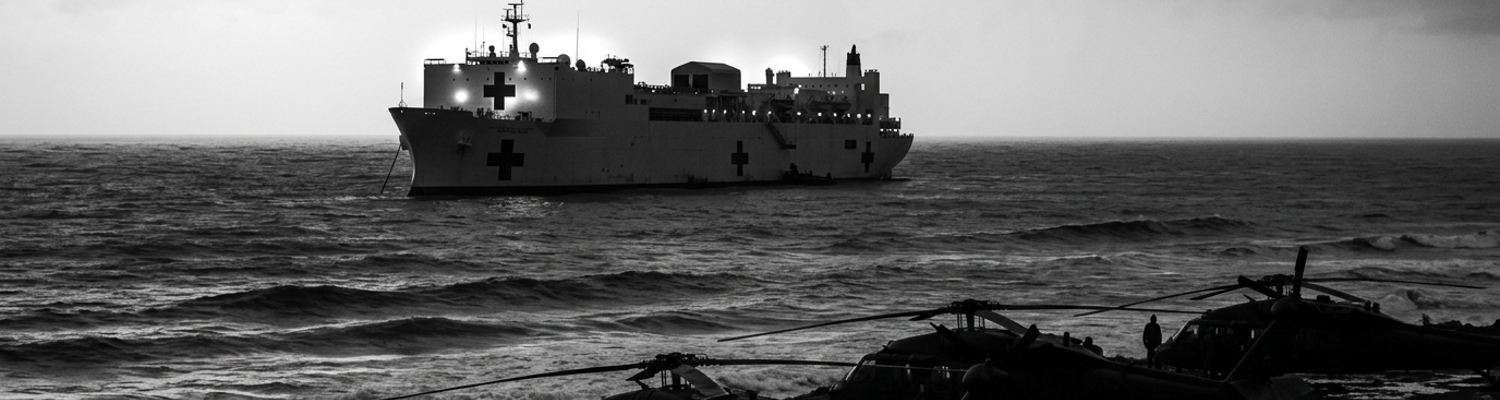

Paralyzed Medical Lifelines at the Cua Viet
The initial manifest unloaded across the ramps at the mouth of the Cua Viet River comprised four hundred thousand rounds of 7.62mm linked ball ammunition. Six thousand 105mm high-explosive artillery shells sat next to eighteen hundred 155mm white phosphorus projectiles. Stacks of five-hundred-pound Mark 82 bombs waited for immediate air delivery. Naval gunfire support added eight-inch armor-piercing shells. Heavy cruisers fired these from the offshore gunline along the Demilitarized Zone. This assembled firepower held enough kinetic blast density to level every trench complex within five square miles.
The payload functioned.
The evacuation corridor failed.
Archival evidence shows cloud ceilings over the Gulf of Tonkin dropping below fifty feet by midday. A driving northeast monsoon front caused this barometric shift. Out at sea, the white-hulled hospital ship USS Sanctuary (AH-17) kept steam on its boilers. Its flight deck pitched across eight-foot swells. The four main surgical suites sat completely empty. Rotary-wing aircraft assigned to Marine Medium Helicopter Squadron 165 attempted to lift off from the shoreline pad at Dong Ha. They tried again from the forward strip at Cua Viet. Low barometric pressure combined with horizontal rain. This blinded the aircrews the second their wheels cleared the ground. Instrument flight rules along the coastline were impossible. Localized radar altimeters failed in the dense sea spray. Pilots could not differentiate between the crests of ocean waves and the gray sky. Two transport helicopters carrying litter cases suffered severe spatial disorientation. They aborted out to sea. The pilots banked hard back into the coastal mud flats to avoid ditching in the surf. Casualty flights sat grounded on dirt berms. Crews tied down the rotor blades. The hospital ship floated just beyond the fog line. It remained entirely unreachable.
Mud and manual field dressings replaced offshore surgical suites.
A close review of operational logs indicates the forward aid station of 3rd Battalion, 3rd Marines received more than eighty casualties within a six-hour span. This station sat near coordinates YD 324665 along the riverbank. Medical personnel worked inside partially flooded sandbag bunkers. River water mixed with blood and debris from incoming artillery barrages. Supplies of clean field dressings vanished before mid-afternoon. Whole blood units and dry litters also ran out. Litter cases were stacked along trench floorboards lined with ponchos. These patients lay directly exposed to intermittent 122mm rocket impacts. North Vietnamese positions north of the Ben Hai River fired these rockets. Triage officers made the call to stop administering intravenous fluids to peripheral cases. Plasma supplies dropped to zero. Sepsis and hypothermia set in. Casualties lay submerged to their waists in mud-thick silt. Their body temperatures dropped in the constant downpour. Battle corpsmen applied tourniquets over water-rotted field uniforms.
Standard combat evacuation doctrine dictated a thirty-minute transit.
A wounded Marine needed to reach a sterile surgical suite aboard Sanctuary within thirty to forty minutes of initial wounding. Documented transit times from this engagement averaged twenty-six hours. Litter bearers hauling wounded through flooded paddies took four hours. They carried single stretchers five hundred yards under continuous sniper fire. This effort only reached intermediate clearing points. Trauma cases with penetrating chest wounds waited out the night on the ground. Severed arteries and blown limbs received no surgical intervention. Attempts to run small landing craft through the sandbars failed. Breaker waves swamped the open hulls. The surf drove them back onto the riverbanks. Advanced gas gangrene infected open fractures inside the bunkers. These patients never saw an operating table.
Monsoon Inundation of Forward Littoral Fortifications
Archival evidence shows meteorologists recording forty-four inches of continuous rainfall across the northern I Corps coastal plain during the first three weeks of November 1967 (NARA Record Group 338). The sandy soil between the Cua Viet estuary and the Demilitarized Zone lost all mechanical shear strength. Saturated by the northeast winter monsoon, ground water tables along coordinates YD 310680 surged to surface level within forty-eight hours of the initial storm front. Low-velocity runoff backed up behind coastal sand dunes. This submerged forward ammunition staging areas in three feet of stagnant water. Heavy tracked vehicles sank past their road wheels into the waterlogged littoral shelf. These included M48A3 Patton tanks and M50 Ontos anti-tank platforms. Engineering survey logs from the 11th Engineer Battalion documented soil bearing capacities dropping from four thousand pounds per square foot to less than three hundred across the amphibious staging flats.
Water liquefied the earth beneath the forward bases.
A close review of operational logs indicates this sudden hydrological shift generated destructive hydrostatic pressure. This pressure built up behind every fortified position dug into the littoral strip. Field units had stabilized tactical trench networks using vertical timber revetments. They used four-by-four dimensional lumber uprights. Marine-grade three-quarter-inch plywood sheets backed by packed sandbags protected personnel against incoming 122mm artillery bursts. Drainage weeps clogged with coastal sand within hours. Subterranean water pressed outward against the retaining structures. Lateral forces exceeded twelve hundred pounds per square foot. Plywood retainers bowed outward under this weight. They splintered along their horizontal grain. Heavy wooden cross-braces snapped. Anchor pickets driven six feet into the dune subsoil pulled free. The saturated sand liquefied into an uncontained slurry. Hundreds of yards of frontline trenches caved inward. Tactical operational centers and subterranean ammunition storage cells collapsed. Tons of wet earth crushed timber supports and buried telephone wire lines. Field switchboards and thousands of mortar rounds disappeared under the mud.
Defensive perimeters dissolved without a shot fired.
Regimental commanders were forced to make immediate tactical compromises. They had to prevent the total loss of the forward supply footprint. Infantry riflemen from Battalion Landing Team 1/3 and Battalion Landing Team 2/4 were systematically pulled off primary listening posts. Company commanders stripped forty percent of their frontline riflemen from fighting holes. They assigned these men to around-the-clock emergency structural rebuilding details. Marines dropped their M16 rifles. They seized entrenching tools and buckets. They bailed freezing mud from collapsed command shelters under constant gray downpours. Perimeter defense deteriorated. Sentry positions along the northern river approaches shrank to skeletal two-man posts. Gaps of over two hundred yards separated these isolated positions.
Work parties hauled green timber beams.
They dragged interlocking AM-2 aluminum airfield matting through waist-deep slurry. They rebuilt the retaining walls before perimeter sectors slipped into the drainage channels. Small gasoline trash pumps brought in to dewater the communication trenches choked on sand. These pumps seized within thirty minutes of continuous operation. Tactical reconnaissance patrols into the surrounding sand flats ceased entirely. By November 24, combat personnel had hand-filled eighty-two thousand replacement sandbags. They stabilized the collapsed revetments surrounding the ammunition supply point of Sub-Unit 1, 1st Amphibian Tractor Battalion at coordinates YD 348682.
Submerged Ammunition Bunkers and Munitions Spoilage
Archival evidence shows water levels inside the subterranean ammunition supply point at coordinates YD 352678 rising twenty-eight inches above floor timbers by November 26. Ammunition technicians from the 9th Marine Amphibious Brigade had excavated these revetments into littoral sand dunes. They dug six feet below grade. Heavy corrugated steel arches and double layers of sandbags covered the pits. Water seeped through the porous dune sand. It inundated wooden pallets holding reserve stocks of 60mm and 81mm mortar rounds. Hundreds of thousands of rounds of 5.56mm rifle ammunition also sat in the water. Rubberized seals on standard steel M2A1 ammunition cans deteriorated. This happened after sixty hours of total submersion under brackish groundwater. Moisture penetrated past the crimped neck seals and primer pockets of 5.56mm M193 ball cartridges. Inside the 81mm mortar stacks, cardboard packing sleeves softened into wet pulp. They jammed inside the steel container tubes and trapped the munitions. Corrosive groundwater flooded the mechanical point-detonating fuzes of M374 high-explosive mortar projectiles. This degraded the spring-loaded firing pins. It saturated the black powder ignition booster charges. Artillery crews inspecting ammunition found damp propellant increments on mortar tails failing to ignite. This reduced weapon ranges by two-thirds. It also produced dangerous hangfires inside gun barrels.
Standing water contaminated forty percent of all small-arms ammunition inside the littoral supply points.
This chemical decay converted the forward ammunition point into an erratic hazard. North Vietnamese forward observers from the 84th Artillery Regiment positioned on the heights north of the Ben Hai River adjusted counter-battery fire. They targeted these compromised dump locations. Enemy batteries firing 130mm M-46 field guns and 122mm rockets hit the waterlogged bunkers at coordinates YD 345681. They used air-burst and point-detonating shells. Incoming fragments pierced the sandbag revetments. They shredded exposed metal shipping boxes. Saturated composition-B filler and damp nitrocellulose propellant charges reacted unpredictably to the shockwaves. These chemicals were unstable after days of leaching. Compromised artillery shell casings fractured. Their degraded main charges detonated sympathetically. A single 122mm rocket hit on Bunker 4 triggered a chain reaction. This obliterated six adjacent earthen revetments. Nine hundred rounds of 105mm high-explosive shells detonated. Fifteen thousand rounds of belted machine gun ammunition cooked off in an unbroken three-hour series. Marine ordnance disposal teams could not enter the burning revetments. Exploding small-arms rounds and white phosphorus canisters threw toxic smoke and fragments across a six-hundred-yard radius.
Secondary explosions blew fragments through the remaining drainage pumps.
All dewatering efforts halted. Replacing these lost stockpiles failed. Ground lines of communication between the port facility and the inland combat outposts were impassable. Supply Support Group Bravo attempted to dispatch emergency dry-stock convoys. These departed from the staging depots at Dong Ha toward the frontline positions of Battalion Landing Team 1/3. The primary resupply artery was a dirt lateral connecting Route 555 to the Cua Viet perimeter. It dissolved into a continuous trench of liquid clay and mud over two feet deep. Standard M35A2 two-and-a-half-ton cargo trucks loaded with replacement ammunition pallets bogged down to their transfer cases. This occurred within two hundred yards of departing the staging hardstand. Winch cables snapped. M543 wreckers attempted to drag five-ton haulers through the saturated silt. Tactical commanders ordered rough-terrain forklifts and tracked M548 cargo carriers into service. These heavy prime movers threw tracks and burned out transmissions in the dense coastal sediment. Resupply convoys scheduled to complete the eight-mile transit in forty minutes suffered documented transit delays averaging seventy-eight hours.
Replacement dry munitions sat immobile on submerged roadbeds.
They remained stuck four miles south of the frontline trenches. By November 28, forward infantry companies along the river line reported their dry-stock reserve levels down to eighteen rifle rounds per Marine. Frontline 81mm mortar sections retained only six operational shells per tube.
Severed Wire Relays and Tactical Blindness
Archival evidence shows defensive coordination across coordinates YD 320690 disintegrating by November 29. Heavy artillery bombardment destroyed physical contact between frontline trenches and fire direction centers. Infantry companies from Battalion Landing Team 1/3 relied on standard WD-1/TT twin-strand wire. They strung this along ditch parapets to maintain contact with the 3rd Battalion, 12th Marines Fire Direction Center. North of the Ben Hai River, North Vietnamese batteries fired salvoes of 130mm M-46 field guns directly into the littoral sand dunes. Steel fragmentation slashed through sandbag retaining walls. It severed unarmored telephone cables every few minutes. This deadened connections to the central SB-22/PT switchboards. Splicing teams from the battalion communications platoon crawled out into waterlogged craters under active barrages. They hunted for shredded line ends with bare fingers in the mud. Flying steel fragments cut down these wiremen. Line maintenance crews suffered eighty percent casualties within thirty-six hours. The unit supply of replacement DR-8 wire spools ran out. Forward observers lost every reliable link to pre-registered artillery defensive plots. Frontline rifle positions lacked indirect fire support during enemy probes.
Trench switchboards fell silent across the entire perimeter.
A close review of operational logs indicates backup high-frequency radio networks breaking down under continuous monsoon weather systems. Battalion communicators attempted to route tactical fire control traffic over to AN/PRC-47 and vehicle-mounted AN/GRC-106 high-frequency single-sideband sets. They needed to bypass the shredded landlines. Persistent atmospheric ionization from sweeping thunderstorm fronts flooded HF frequencies between two and twelve megahertz. Continuous static discharges filled the channels. Torrential downpours dumped four inches of water an hour. This created severe radio-frequency attenuation. It absorbed low-power ground-wave transmissions over distances as short as two miles. Saturated coastal sand disrupted the ground planes of field-expedient long-wire antennas. Dramatic antenna impedance mismatches resulted. This overheated radio power stages and blew internal final amplifier tubes. High humidity penetrated rubberized chassis gaskets. It coated internal circuitry in corrosive copper oxide and shorted out frequency selectors. Company C attempted to transmit emergency fire missions to the 105mm howitzer batteries at Cua Viet. They produced only unintelligible bursts of receiver noise.
Every assigned tactical frequency failed.
Efforts to correct this targeting void using airborne illumination created disastrous optical backscatter for ground forces. Artillery batteries fired 105mm M314A2 illumination projectiles over the perimeter. Air Force C-130 aircraft dropped two-million-candlepower Mk 24 parachute flares over the estuary mouth. The northeast monsoon had clamped a dense stratus cloud ceiling down to one hundred and fifty feet above the sand flats. Parachute flares ignited directly inside this low-altitude cloud deck. The burning magnesium compositions became trapped within thick water vapor layers. Dense cloud droplets reflected the high-intensity burn downward. This produced a blinding white sheet of diffuse glare instead of ground-level illumination. Marine machine gunners looking north across the perimeter wire suffered severe flash blindness. This eliminated their night-adapted vision for minutes at a time. The diffuse overhead glare illuminated the wet trench parapets. It framed Marine rifle positions in sharp relief for North Vietnamese mortar crews. These enemy crews fired 82mm high-explosive rounds from positions north of the river.
Sapper Incursions and Naval Anchorage Defenses
Archival evidence shows North Vietnamese waterborne combat engineers turning the seaward exit of the Cua Viet River into a primary attack vector against offshore shipping by early December 1967. Combat divers of the 126th Naval Sapper Regiment operated from hidden reed beds north of coordinates YD 340695. They deployed floating contact mines into the outward river flow during falling tides. These explosive devices consisted of modified Soviet cast-TNT charges and salvaged 250-pound aircraft bombs. The sappers lashed them to buoyant bamboo frames and empty fifty-five-gallon petroleum drums. They fitted them with crude contact horns and chemical delay fuzes. The drifting ordnance swept past the outer sandbars and entered the open roadstead at speeds up to four knots. Swimmers tracked these floating patterns in total darkness. They breathed through trimmed bamboo canes or closed-circuit oxygen rigs. They guided the explosive charges toward the hulls of anchored supply transports.
Dark water masked every approach.
A close review of operational logs indicates USS Sanctuary and accompanying auxiliary vessels establishing continuous anti-swimmer picket lines. They needed to shield their thin hulls from underwater sabotage. Floating three miles off the estuary, the hospital ship kept two armed 40-foot utility boats running tight oval circuits. These boats patrolled the perimeter fifty yards out from the hull. Boat crews and topside watchstanders carried crates of Mk 3A2 offensive concussion grenades. They threw the cylindrical explosive charges into the black water at irregular five to eight-minute intervals. The eight-ounce TNT fillers generated hydro-acoustic shockwaves exceeding two thousand pounds per square foot within a thirty-foot kill radius. This was designed to rupture internal organs and shatter the middle ears of submerged divers without damaging ship plating. Topside sentries armed with 12-gauge shotguns and hand-held searchlights swept the surrounding swells. They fired into floating logs and tidal detritus. Deck-mounted .50-caliber machine guns stood manned around the clock.
Tears in underwater hull plating would sink thousands of tons of medical equipment within minutes.
This asymmetric threat denied offshore auxiliary ships the safety of dropping anchor in the roadsteads. North Vietnamese sappers carried magnetic limpet mines packed with sixty pounds of Composition B (Bureau of Ships Document 44-12998). These mines clamped against steel hulls below the bilge keels and detonated on clockwork delay mechanisms. Anchored vessels presented static targets. The task group commander ordered Sanctuary, amphibious cargo ships, and tank landing ships into perpetual motion. Engineering crews kept propulsion boilers lit under forced draft. They consumed thousands of gallons of naval distillate fuel simply to keep main turbines turning over. The ships held five knots in heavy swells. Navigators executed constant course corrections between pre-plotted waypoints along the shallow littoral shelf. They disrupted diver swim tracks. They dodged drifting debris fields while avoiding the shifting sand shoals off the river bar. Watch officers on the bridge plotted new drift patterns every ninety minutes. They kept helm controls manned and reversed turbine directions through dense fog banks without radar navigation beacons.
Boiler maintenance logs on Sanctuary recorded ninety-six consecutive hours of continuous low-speed steaming.
They never dropped anchor once during this period.
Post-Operation Autopsies and Doctrine Shifts
Archival evidence shows after-action reviews conducted by the 3rd Marine Amphibious Force and the 11th Engineer Battalion condemning the reliance on local timber and sandbags across the northern coastal plain. Field-cut four-by-four timber uprights and dimensional marine plywood retainers had bowed, split, and collapsed. Lateral hydrostatic pressures exceeded twelve hundred pounds per square foot. Saturated dune sand had turned into uncontained slurry. It wiped out frontline fighting holes and crushed subterranean command bunkers across sixty miles of contested perimeter. Fleet Marine Force Pacific directives issued in early 1968 explicitly banned untreated timber for earth-retaining structures in coastal zones. Engineers mandated pre-engineered revetment systems. They specified interlocking corrugated steel bin walls, slotted pierced-steel airfield planking, and standardized galvanized arch units bolted directly to steel base channels. Blueprints required backfilling revetment cavities with graded pea gravel rather than native silt. Perforated polyvinyl chloride weeping conduits wrapped in fiberglass filter cloth flanked these structures to vent trapped groundwater. Combat engineering doctrine ordered these prefabricated steel components pre-sorted on supply pallets. Forward units could reinforce trench lines before subsoil tables liquefied.
Soil mechanics dictated tactical survival.
When examining the historical record from the Bureau of Medicine and Surgery, the total isolation of offshore hospital ships such as USS Sanctuary during northeast monsoon gales forced an overhaul of frontline evacuation channels. Tactical assumptions that helicopters could guarantee thirty-minute transit to offshore surgical suites disintegrated. Low-pressure storm systems dropped coastal cloud ceilings below fifty feet. Navy planners counteracted this operational breakdown by constructing weather-independent secondary casualty staging facilities directly inside the littoral perimeter at Cua Viet. Engineers built these hardened beachside medical stations out of prefabricated twelve-foot corrugated steel culverts. They sank them into dunes and encased them in reinforced concrete shells covered with three layers of sandbags. Independent diesel generators, sealed neoprene gaskets, and ducted dehumidification equipment preserved a sterile, dry environment below ground level. Staffed by surgical teams from Company B, 3rd Medical Battalion, each facility contained two operating tables and eighty litter racks. Two hundred units of whole blood sat inside kerosene-backed refrigeration units. High-pressure oxygen delivery manifolds lined the walls. Surgeons held, debrided, and stabilized severe penetrating trauma cases for seventy-two hours inside the perimeter. They no longer relied on rotary-wing air corridors.
Sheltered medical bunkers replaced the lost air lifelines.
A close review of operational logs indicates Commander Amphibious Force, U.S. Pacific Fleet, dismantling static offshore anchorage procedures around contested river entries. Hydrographic surveys following the Cua Viet crisis proved that anchoring deep-draft supply transports within five miles of the river mouth positioned ship hulls directly along the drift tracks of sapper-deployed contact mines. Revised operational orders established an eight-nautical-mile minimum standoff perimeter for hospital ships and auxiliary transports operating near contested estuaries. Static roadsteads ceased to exist. Bridge watchstanders maintained continuous steaming patterns. They executed five to seven-knot oval circuits along pre-plotted littoral tracks to throw off underwater swim trajectories. Escort vessels established active hydro-acoustic sanitization barriers across the mouth of the river. They utilized continuous hull-mounted sonar pings and dropped Mk 3A2 concussion grenades at five-minute intervals. Patrol craft formed inner interception screens across estuary shoals. They engaged floating debris with automatic fire before river currents pushed flotsam into the open sea lanes. Naval regulations permanently moved static auxiliary anchorages beyond the twelve-fathom contour line (as of December 12, 1967).