
Operation Aphrodite Origins and Airframe Selection
At four thousand feet above the chalk ridges of northern France, nothing moved inside the stripped flight deck. Only the steady mechanical drone of four Wright R-1820-97 radial engines broke the stillness. The vibration rattled against raw aluminum ribs that no longer carried soundproofing. Two flight crewmen had jumped through the forward escape hatch into the slipstream miles back. They left the aircraft to drift under pneumatic servo pressure. German sound-locator crews in the valley stopped their listening gear. They tracked the approaching engine noise through high-magnification optics. Silence blanketed the limestone plateau around Landrethun-le-Nord. Artillery spotters braced for impact.
Standard bombing doctrine had failed against concrete.
A close review of operational logs indicates that Eighth Air Force planners faced an engineering impasse in the Pas-de-Calais by May 1944. Reconnaissance photographs mapped heavily fortified complexes at Mimoyecques, Siracourt, and Wizernes. German construction units cast reinforced concrete slabs up to five meters thick over subterranean galleries. Allied intelligence cataloged these installations under Operation Crossbow. The five-shaft tunnel system at Mimoyecques housed high-pressure V-3 multi-chamber cannons sighted on London. High-altitude daylight attacks by B-17 and B-24 formations dropped standard one-thousand-pound bombs. The ordnance detonated against the surface cap without compromising the underground shafts. Anti-aircraft batteries defending the targets complicated low-level strikes. German commanders deployed heavy concentrations of radar-directed 88-millimeter and 105-millimeter flak guns across the approach corridors. They shot down bombers and their ten-man crews with steady frequency. Records from Headquarters Eighth Air Force (NARA Record Group 18) show that General Henry H. Arnold instructed staff officers to find a precision standoff capability. The goal was eliminating crew losses over these target sectors.
Burtonwood air depot received the structural castoffs.
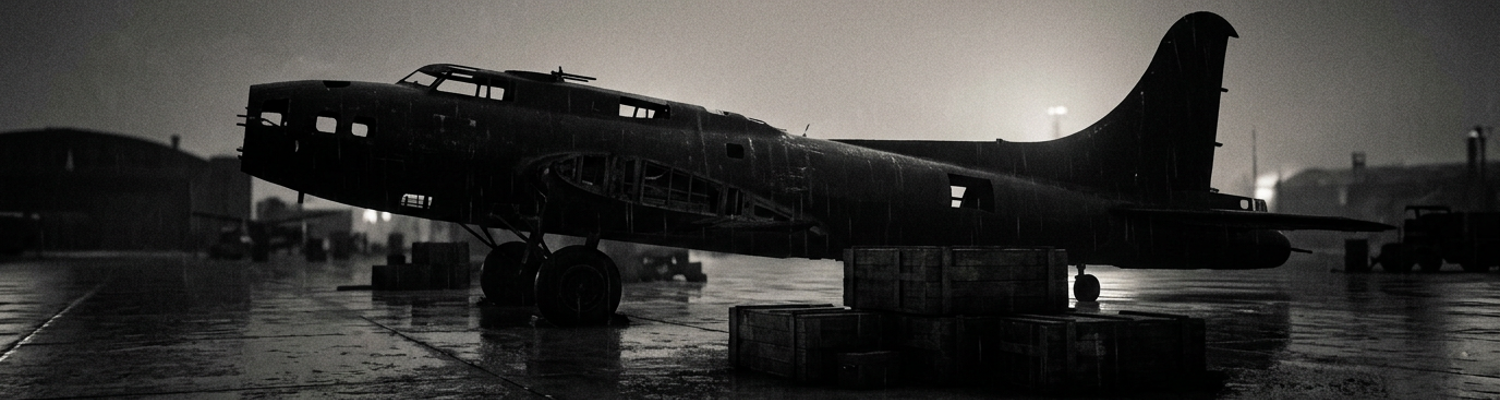
Archival evidence shows that USAAF technical commands solved the requirement by requisitioning airframes that had completed their operational limits. Maintenance inspectors designated structurally damaged Boeing B-17F and B-17G models. These specific airframes possessed twisted stringers, flak-punctured spars, or severe metal fatigue. Known formally as BQ-7 assault drones under Operation Aphrodite, these war-weary aircraft were routed to Base Air Depot 1 at Burtonwood and modification centers at RAF Honington. Depot mechanics gutted the interior spaces to reduce gross weight. Workers unbolted the Sperry ball turrets. They severed the waist guns. They pulled the heavy armor bulkheads and disconnected the oxygen distribution networks. Pneumatic actuators were clamped directly to the control cables governing the elevators and rudders. These tied into an Azon radio receiver unit on the rear bulkhead. Two RCA Block I television cameras were wired into the airframe. One lens pointed at the cockpit instrument panel. The second focused forward through the plexiglass nose. Loading crews packed the vacant bomb bays and forward compartments with up to twenty thousand pounds of Torpex or British Amatol. They ran explosive booster blocks and primer cords through the mass.
Flight test crews at RAF Fersfield took delivery of the first converted batch on June 25, 1944. They logged ten B-17 airframes equipped with sixty-channel radio receivers.
Structural Stripping and Explosive Rigging at Fersfield
Fersfield offered isolation and five thousand feet of concrete runway cut directly through the damp Norfolk scrub.
A close review of operational logs indicates that the 562nd Bomb Squadron turned the perimeter revetments of RAF Fersfield into a salvage and modification yard by early July 1944. The unit was detached from the 388th Bomb Group at nearby Knettishall. Ground mechanics stripped every system deemed non-essential for a terminal one-way flight. Crews sheared off the Sperry chin turrets and the twin .50-caliber machine guns from the nose compartments. They threw the heavy steel mountings onto scrap piles. Torches sliced through internal armored bulkheads, the pilot protection plates, and the structural brackets holding the dorsal Bendix turret. Ground personnel dragged out the belly ball turret assemblies. They plated the open bottom wells with thin sheet alloy. Radios, liaison sets, interphone wiring, crew oxygen bottles, and soundproofing quilts were ripped out through the waist doors. The copilot seat disappeared from the right side of the flight deck. An open crawlway replaced it. This modification gave the pilot immediate access to the nose escape hatch. Stripping more than twelve thousand pounds of defensive weight warped the center of gravity forward. Ground crews recalculated control cable tension across the dorsal pulleys to prevent the tail surfaces from fluttering under high speed.
The stripped heavy bomber had become an empty aluminum shell.
Archival evidence shows that munitions handlers converted this hollowed fuselage into a guided blast weapon using Torpex. This explosive mixture was forty percent more powerful than standard TNT. British ordnance teams delivered the Torpex in hundreds of individual wooden crates stacked across the hardstands. Ground crews manually hauled nine-ton allotments into the interior. This load equaled up to twenty thousand pounds per aircraft. They stacked blocks from the forward bulkhead through the bomb bay and against the forward face of the radio compartment. Layers of Torpex were lashed together with heavy canvas webbing and steel banding. This prevented cargo shifting during rough takeoffs. The dense payload sat concentrated along the center of the main wing spar. Ground engineers braced the bomb bay floor beams with heavy lumber and steel angle iron. This stopped the floor from buckling downward during taxiing over expansion joints. Armament personnel laced loops of Primacord through tetryl booster charges embedded throughout the Torpex stack. They connected the high-explosive core to instantaneous impact fuses, delay fuzes, and nose-mounted contact triggers. A pair of electric detonator switches was routed into the cockpit (specification document AN-11-50). The flight crew could arm the entire twenty-thousand-pound mass only after climbing through two thousand feet.
Accidental detonation would destroy the entire airfield.
When examining the historical record of these modifications, maintenance reports document relentless failures in the primitive control connections grafted onto the airframe. The mechanics of the 562nd clamped Bendix pneumatic actuators onto the primary control cables. They routed rubber air hoses through the empty bomb racks to high-pressure nitrogen flasks. Pressure drops in the nitrogen tanks caused the rudder and elevator servos to drift. This pulled the control surfaces out of trim before the bomber could establish level flight. Solder joints broke along the external radio antennas mounted on the upper fuselage during engine ground runs. Mechanics worked on open, grease-blackened hardstands in persistent rain. They troubleshot radio-control receiver boxes that short-circuited when exposed to damp air. Each modified Fortress sat low on its landing gear struts. Tires compressed against the rim flanges by the dead weight of the high-density explosive charge. Ground crews calibrated the dual television transmitters in the nose. They focused Block I camera lenses on the artificial horizon and compass before buttoning up the stripped cowlings. At gross weights exceeding sixty-three thousand pounds, the modified machines pushed the structural limits of the landing gear assemblies during static engine run-ups at twenty-five hundred revolutions per minute.
Flight orders designated the first loaded airframe for launch on August 4, 1944.
Telemetry and Television Integration Systems
A close review of operational logs indicates that communications specialists at RAF Fersfield retrofitted the stripped BQ-7 bombers with the AN/ARW-1 frequency-modulation radio receiver. Bolted into the rear radio compartment alongside a BC-617 audio selector box, this receiver processed discrete audio-frequency commands broadcast across eight distinct channels. Electric signals traveled from the selector filter into a BC-622 relay unit (drawing number SC-9921). This directly governed the Sperry C-1 automatic flight control system. Solenoid valves activated pneumatic lines clamped to the primary elevator, rudder, and aileron control cables. This forced control surfaces into deflection angles without manual assistance. Throttle pushrods received matching mechanical linkages wired to reversible electric servomotors. Ground technicians spent days balancing the sensitivity of these electromechanical relays on the bench. Loose contact fingers or oxidized breaker points caused immediate control divergence. High-vibration ground tests frequently shook the fragile quartz crystals out of frequency alignment before the bomber even approached the takeoff runway.
Electromechanical relays dictated whether the loaded bomber held level flight or plunged into the ground.
Archival evidence shows that control of this automated apparatus rested entirely with a trailing CQ-4 mother ship. This was typically a modified Boeing B-17G or Consolidated B-24J trailing five miles behind the strike drone. Inside the radio compartment of the CQ-4, a specialized operator manipulated a BC-756 joystick control box wired into an AN/ARW-18 radio transmitter. Deflecting the small stick transmitted specific audio tones across the very-high-frequency carrier wave. This commanded the BQ-7 to bank, pitch, adjust engine revolutions, or arm its detonator circuits. Operational limits restricted effective control distance to eighteen miles under standard transmitter output. Engineers occasionally boosted transmission range using an AM-33 radio frequency amplifier. Line-of-sight propagation vulnerabilities continuously compromised the radio link. Atmospheric ionization, coastal fog banks, and heavy rain over the English Channel degraded signal reception at the dorsal whip antenna. When signal strength dropped below operational thresholds, the BC-617 selector chattered erratically. It released control pressure and allowed the thirty-ton warhead to slip into uncontrolled dives.
Signal dropouts severed the link without warning.
When examining the historical record of remote guidance technology, engineers recognized that directional control required real-time optical feedback. This prompted the integration of early RCA Block 1 television equipment. Depot teams installed two separate iconoscope television camera units into each stripped B-17 airframe. Technicians clamped the first camera directly behind the flight deck. They framed its fixed optical lens tightly around the primary flight cluster to monitor the altimeter, airspeed indicator, directional gyro, and engine tachometers. A second camera occupied the nose compartment. It was positioned behind the transparent plexiglass cone to project a direct panoramic view of the forward horizon and terrain. These cameras processed imagery through a 350-line scanning raster at forty frames per second. They converted light into electrical signals fed directly into an onboard television transmitter. High-voltage dynamotors mounted in the waist supplied power. They drew heavy direct-current amperage from the primary generators.
Transmitted signals appeared on a seven-inch cathode-ray receiver screen mounted in the CQ-4 mother ship. Flight controllers operated a manual switch box to alternate between the instrument display and the forward targeting camera. Engine harmonics and severe air turbulence shook the delicate vacuum tubes in the transmission circuit. This created thick bands of horizontal static that washed out the small phosphor screen. Direct sunlight striking the forward plexiglass nose blinded the sensitive iconoscope target plate. This obscured the chalk ridges and railway cuts surrounding Mimoyecques. Control operators frequently stared at an unreadable white blur as the heavy bomber surged past four hundred miles per hour toward French soil. At fifty yards from the target perimeter, the forward camera delivered its final sweep of blurry chalk earth. Then the transmitter chassis shattered against bedrock.
Telemetry Breakdown and Channel Abort Incidents
A close review of operational logs indicates that the radio link between the BQ-7 and its airborne handlers began disintegrating almost immediately after deployment in August 1944. During the early August combat sorties mounted by the 562nd Bomb Squadron from RAF Fersfield, high-frequency command links suffered systematic electronic interference. The AN/ARW-1 receiver arrays mounted in the drones shared narrow radio spectrum bands with Allied coastal radar installations, British tactical communications networks, and cross-Channel jamming units. This radio frequency spectrum congestion created severe cross-talk across the eight audio-frequency control channels. Uncommanded audio tones bled across discrete receiver filters. This prompted the onboard BC-622 relay chassis to trip contradictory circuit paths simultaneously. Elevators jerked against pneumatic servos while aileron actuators locked in opposite deflections. Signal attenuation compounded the control failures as the CQ-4 mother aircraft attempted to track the explosive-laden bombers across the low-altitude mist of the Suffolk coastline. Dense atmospheric humidity and low-lying coastal cloud layers absorbed the high-frequency line-of-sight carrier waves. Receiver signal strength dropped below the trigger threshold of the BC-617 selector boxes. Mother-ship flight controllers watching their seven-inch television monitors saw remote joystick commands fail completely as the bombers crossed over the North Sea marshlands.
Radio signal dropouts turned twenty thousand pounds of Torpex into an unguided projectile.
Archival evidence shows that these electrical failures triggered violent flight-surface lockups and uncontrollable flat spins across the rural counties of East Anglia. On August 4, 1944, during the maiden combat sortie designated Mission 515 (Eighth Air Force Field Order 419), a war-weary B-17F bearing serial number 42-39835 lifted off from Fersfield. It carried a ten-ton high-explosive payload bound for the V-3 fortress at Mimoyecques. At two thousand feet, primary pilot First Lieutenant John Wesley Fisher (O-735112) and his flight engineer Technical Sergeant Elmer Most (32455611) engaged the remote reception gear. They passed flight authority to the trailing CQ-4 control ship. Autopilot relays responded to the incoming radio carrier by pitching the heavy bomber into an uncommanded vertical climb. This threw the aircraft toward an aerodynamic stall. Fisher fought the mechanical controls to override the runaway servos. He reset the gear twice before ordering Most to bail out through the open nose crawlway. Most became lodged in the emergency hatchway. Fisher kicked him clear into the slipstream before making a final attempt to stabilize the rolling bomber. Cross-talk locked the rudder trim tab into a hard deflection. This spun the uncrewed bomber into a flat autorotation over the coastal parish of Sudbourne. The aircraft impacted inside dense woodland near Orford. It excavated a crater one hundred feet in diameter and set two acres of timber on fire.
Scattered metal wreckage ignited secondary blazes across a half-mile radius of Suffolk farmland.
When examining the historical record of subsequent August sorties, flight controllers repeatedly discovered that signal attenuation over the coast created erratic wandering profiles. Two days after the Orford disaster, on August 6, 1944, the 562nd Bomb Squadron dispatched another flight of BQ-7 drones toward fortified V-weapon installations across northern France. Both two-man checkout crews climbed to their handoff points. They armed the internal Torpex fuzes and successfully parachuted into eastern England. Moments after transfer of command authority, signal degradation severed control from the trailing CQ-4. One drone lost all elevator authority and plunged directly into the English Channel. The second robot bomber experienced a total receiver freeze. Channel cross-talk locked its pneumatic rudder servo into a continuous leftward banking attitude. Instead of continuing east toward the French shoreline, the thirty-ton bomb executed an unguided sweeping turn. It tracked inland over the populated industrial harbor of Ipswich. Control operators inside the mother ship transmitted repeated emergency abort and diving tones. Attenuated radio reception prevented the onboard solenoids from releasing the rudder cable clamps. For several minutes, the drone circled directly above residential neighborhoods and dockyards. Its fuel supply exhausted itself. The airframe glided away from the populated district and splashed into offshore waters.
Maintenance officers at Fersfield grounded the remaining airframes to strip out the double-Azon guidance units.
Kinetic Deficits Against the Mimoyecques Bunker
A close review of operational logs indicates that the physical layout of the Mimoyecques fortress presented an impossible terminal ballistic problem for the 562nd Bomb Squadron. Organisation Todt engineers had cut the V-3 launch shafts into the limestone ridge at Landrethun-le-Nord at an angle of fifty degrees. They pointed toward London. These narrow subterranean apertures measured less than six meters across. Remote flight controllers stationed five miles to the rear in trailing CQ-4 control aircraft tried to guide the modified B-17 bombers onto these targets using the BC-756 joystick. Radio commands transmitted through the AN/ARW-18 antenna experienced a half-second processing delay before the pneumatic Bendix servos pulled the control cables. At dive velocities exceeding three hundred miles per hour, this lag produced terminal positioning errors of several hundred feet. The wallowing, sixty-three-thousand-pound airframe could not execute the violent vertical pitch adjustments required to align with a five-meter slot sunken into a hillside.
The aerodynamics of a stripped heavy bomber forbade vertical diving.
When examining the historical record of the August strikes, guidance failures escalated as the drones entered their final approach runs over the chalk hills of northern France. German gun crews from Flak-Abteilung 245 (Luftwaffe Field Command 11) threw barrages of 88-millimeter explosive shells across the approach corridors. This severed the line-of-sight antenna wires and sprayed the forward nose cone with shrapnel. Inside the CQ-4 control cabins, flight controllers watched the seven-inch television displays flicker and desynchronize. The RCA Block 1 iconoscope tubes succumbed to extreme engine vibration and ground-fire shocks. The camera feed washed out completely in direct midday sunlight. This turned the hillside into an overexposed expanse of white limestone. Operators had no depth perception on the primitive 350-line screens to distinguish the mouth of an inclined shaft from ordinary excavation trenches or bomb craters. Every BQ-7 launched against the site missed the subterranean shaft openings entirely. They struck open ground hundreds of yards off-axis or detonated along the outer perimeter embankments.
Thin sheet aluminum cannot breach solid stone.
Archival evidence shows that the explosive configuration of the BQ-7 was fundamentally incapable of compromising the primary defensive structure. To protect the five underground artillery shafts, German construction battalions had cast a solid reinforced concrete slab known as the Betonplatte. This measured five and a half meters thick and covered thousands of square meters of the Landrethun plateau. The B-17 carried twenty thousand pounds of Torpex packed into its open bays. This charge possessed zero structural casing. Unlike hardened armor-piercing ordnance, the unarmored aluminum fuselage of the bomber crumpled immediately upon impact. It detonated the explosive mass entirely on the surface. Without ground penetration to contain the detonation shockwave, the blast expanded upward and outward into the open atmosphere along the line of least resistance. The atmospheric overpressure shattered trees and excavated shallow chalk depressions across the exterior surface. It left the multi-meter reinforced concrete slab beneath structurally intact.
Post-strike reconnaissance photographs analyzed by Allied intelligence revealed that these large surface detonations achieved negligible penetration into the subterranean works. Impact points located directly adjacent to the concrete apron produced surface spalling. They scorched the upper face of the slab without generating tensile failure in the underlying steel reinforcement rebar. Shockwaves transmitted through the chalk rock dissipated rapidly before reaching the heavy machinery halls and railway tunnels positioned one hundred feet below the surface. Subterranean garrison troops inside the fortified complex reported intense ground vibrations and electrical short-circuits during the detonations. The underground firing galleries and elevation gear for the V-3 cannon tubes suffered no mechanical misalignment. German repair crews cleared surface debris from the shaft mouth caps with shovels and small bulldozers within twenty-four hours of each Aphrodite strike.
Postwar Bunker Surveys and Program Termination
Archival evidence shows that inspection teams from the British Bombing Analysis Unit and the Royal Engineers entered the subterranean galleries of the Mimoyecques installation in September 1944. This followed the retreat of German forces from the Pas-de-Calais. Survey officers mapped the five-shaft underground battery at coordinate 50 degrees 51 minutes North, 01 degrees 45 minutes East. They measured the physical effects of every Allied weapon system delivered against the chalk ridge. Structural engineers checked the five-and-a-half-meter reinforced concrete slab covering the central shafts. They cataloged shallow impact depressions, localized spalling, and surface burn patterns left by detonated Torpex blocks. Not a single BQ-7 assault drone had perforated the concrete cover or broken the underground inclined galleries. Surface detonations from the stripped Boeing airframes only scoured the top layer of earth and fractured unreinforced external retaining walls. Inside the limestone tunnels one hundred feet down, cross-drift passages, reinforced steel gallery linings, and the elevation mechanisms for the V-3 smoothbore cannon tubes held their alignment on heavy mounting beds. Remote flight control gear, compromised by radio interference and sluggish pneumatic pushrods, had scattered thirty-ton airframes across pastureland and woods outside the complex perimeter.
Concrete armor had defeated surface-exploding aluminum.
When examining the historical record of bunker-defeat weaponry, technical evaluations compiled at Landrethun-le-Nord confirmed that subterranean destruction required specialized penetrators rather than converted aircraft. Allied commanders possessed field evidence from the July 6, 1944, strike executed by Royal Air Force No. 617 Squadron. They dispatched nineteen Avro Lancaster bombers armed with twelve-thousand-pound Tallboy bombs designed by Barnes Wallis. Machined from hardened chrome-molybdenum steel with thick forward casings, the aerodynamic Tallboys fell from eighteen thousand feet. They exceeded terminal velocities of seven hundred and fifty miles per hour before burying themselves ninety feet through topsoil and limestone. Detonation of the deep Torpex D1 core sent shockwaves directly into the bedrock. This created a camouflet that collapsed the subterranean railway tunnels, crushed firing shaft number one, and caused thousand-ton rockfalls inside the underground gun chambers. The USAAF concept of using an unarmored, thin-skinned B-17 airframe packed with bulk explosive contradicted these ballistic principles. An empty fuselage disintegrating at surface level dispersed ninety percent of its shockwave energy into open air. A deep-penetrating unguided bomb coupled its explosive force directly to the surrounding geology.
Kinetic mass and drop altitude accomplished what remote-control guidance systems could not.
A close review of operational logs indicates that the physical survey reports prompted Eighth Air Force command to pull funding and airframes from the remote-control assault project. On January 27, 1945, Lieutenant General James H. Doolittle signed the formal operational directive (Directive 77-A, Headquarters Eighth Air Force). This terminated Operation Aphrodite and all related BQ-7 initiatives within the theater. Maintenance crews at RAF Fersfield and RAF Honington halted modification work on war-weary B-17 and B-24 bombers immediately. Ordnance personnel disconnected the AN/ARW-1 receivers. They pulled the BC-617 audio selector boxes and stripped out the dual RCA Block 1 television transmitters from remaining fuselages. Ground units defuzed tons of boxed Torpex. They returned the explosive blocks to central ammunition depots at Bramcote. The surviving stripped bombers, missing defensive armament, turrets, and navigational radios, were towed into storage revetments across East Anglia. Depot scrap cutters dismantled the airframes with oxyacetylene torches to recover raw aircraft-grade aluminum.