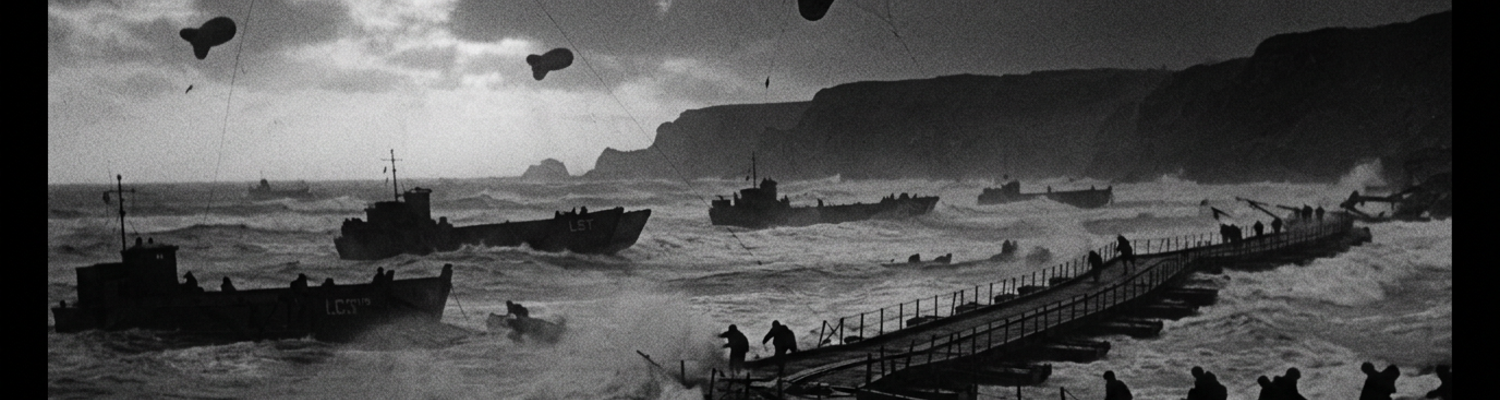

The Great Storm at Saint-Laurent-sur-Mer
Supplying a mechanized invasion force of two million men across a tidal-swept channel without a deep-water port presented a massive engineering problem. Allied planners knew conventional supply lines would fail across the open beaches of Normandy. Cargo ships required heavy cranes to unload tanks and bulk fuel. German forces controlled every major port from Cherbourg to Le Havre. They heavily mined the approaches and destroyed the harbor infrastructure. To bypass this blockade, the War Department designed artificial harbors. Archival evidence (NARA Record Group 338) shows the entire European ground campaign depended on thousands of tons of materiel arriving daily over these unproven floating structures.
A violent four-day gale struck the Normandy beachheads on June 19, 1944.
When examining the historical record, meteorological logs from the English Channel reveal a sudden atmospheric pressure drop beginning late on June 18. Winds rapidly accelerated from a moderate breeze to sustained Force 6. They peaked at Force 8 on the Beaufort scale. This low-pressure system drove high-velocity winds directly into the exposed coastline of the Bay of the Seine. Waves reaching ten feet battered the landing zones continuously for ninety-six hours. Allied meteorologists had no historical precedent for a weather event of this magnitude occurring in late June. Heavy surf halted all amphibious landing craft operations. Thousands of troops sat trapped on transport ships offshore. Over eight hundred flat-bottomed vessels were driven onto the sand. The physical force of the water column slamming against the steel and concrete structures offshore generated stress loads far exceeding the theoretical design limits established by the engineers in London.
The storm completely destroyed the American Mulberry A artificial harbor at Saint-Laurent-sur-Mer.
Positioned directly off Omaha Beach, the installation relied on an outer breakwater of floating steel structures called Bombardons. A close review of operational logs indicates these two-hundred-foot-long steel floats snapped their heavy mooring chains on the second day of the gale. Unmoored Bombardons drifted inward on the heavy swells. They repeatedly struck the inner ring of sunken concrete Phoenix caissons. Structural failure progressed rapidly through the harbor complex. Continuous impacts fractured the reinforced concrete walls of the caissons. Seawater flooded the internal buoyancy chambers. The breakwater disintegrated. Inside the harbor, the ten-mile network of Whale floating roadways twisted under the surging tide. Steel bridging units sheared off their concrete pontoon supports. Men of the 108th Naval Construction Battalion attempted to secure the swinging roadways with thick wire cables. The physical torsion proved too great. The hawsers snapped. Heavy steel sections crashed into the central Spud pierheads.
Entire sections of the harbor sank to the seabed.
Word of the collapse at Saint-Laurent-sur-Mer triggered immediate alarm in London and Washington. Planners recognized the loss of the primary American offloading facility meant daily cargo deliveries would plummet. The projection dropped from ten thousand tons to less than three thousand. General George Marshall received classified cables detailing the structural loss and the resulting supply deficit. Top commanders in the Joint Chiefs of Staff faced the sudden prospect of the American First Army running out of artillery shells and aviation fuel. British and American diplomats exchanged urgent dispatches regarding the potential stalling of the entire western front. Supreme Headquarters Allied Expeditionary Force issued orders to halt all further harbor construction at Omaha Beach. Salvage crews received instructions to strip the surviving mechanical components from the American sector. They transported the salvaged Spud legs and Whale roadways eastward to reinforce the British Mulberry B harbor at Arromanches.
Anchorage Paralysis and Barrage Balloon Failures
Type LZ low-altitude defense balloons hovered at an elevation of two thousand feet above the Bay of the Seine before the gale struck. British and American naval crews had tethered hundreds of these hydrogen-filled envelopes to the decks of transport ships. They used four-millimeter high-tensile steel wire rope. When wind velocities exceeded forty knots on the morning of June 19, the mechanical winches securing these tethers experienced severe stress fractures. Torn barrage balloon cables snapped in high winds. They tangled directly into supply vessel screws.
The heavy steel wires fell into the choppy channel waters.
They rapidly sank into the path of the rotating bronze propeller shafts of the transport fleet. As the ships attempted to maintain their station against the surging tide, the submerged steel cables wrapped tightly around the spinning propeller hubs. This friction seized the drive shafts instantly. Main engine bearings burned out. Internal propulsion failures occurred deep within the engine rooms of over fifty transport vessels.
The sudden loss of engine power turned fully loaded cargo ships into uncontrolled drifting steel hazards.
A close review of operational logs (File Ref ADM 199/164) indicates this mechanical failure triggered an immediate crisis within the British Admiralty. Admiral Bertram Ramsay received urgent dispatches at his underground command bunker in Portsmouth. These reports detailed the destruction of the transport fleet propulsion systems. The reports quickly reached the War Cabinet in London. Planners calculated that the fouling of the screws had neutralized more Allied shipping tonnage in twelve hours than German submarines had achieved in the previous month. Top-level diplomats and naval attaches held emergency briefings regarding the sudden reduction in cross-channel transport capacity. Without functioning engines, the disabled ships required heavy fleet tugs for extraction. Those specialized recovery vessels were currently trapped in port due to the severe weather.
The entire offshore supply chain ceased functioning at 0400 hours on June 20.
Lost mooring lines left the offshore anchorage logistically paralyzed. It became highly vulnerable to low-altitude aerial attacks. Standard bower anchors designed for calm summer conditions dragged violently across the sandy seabed of the English Channel. Transport vessels collided in the heavy surf. They crushed their thin steel hulls against the reinforced concrete caissons of the Mulberry structures. The complete absence of the balloon canopy removed the primary physical deterrent against the Luftwaffe Fliegerkorps IX. German Focke-Wulf 190 and Junkers Ju 88 attack aircraft specialized in dropping below radar coverage. They conducted horizontal strafing runs and skip-bombing attacks against clustered shipping. The balloons had previously forced these squadrons to operate at altitudes above three thousand feet. This exposed them to heavy shore-based anti-aircraft fire.
Allied gunners could not manually track fast-moving aircraft from the violently pitching decks of the unmoored transport vessels.
Archival evidence shows the sudden loss of airspace control generated intense alarm at Supreme Headquarters Allied Expeditionary Force. Air Chief Marshal Arthur Tedder sent classified cables to Washington outlining the extreme danger facing the paralyzed anchorage. Geopolitical concerns shifted from the delayed delivery of rations to the prospect of a coordinated German air assault wiping out the immobilized First Army supply reserve. Intelligence officers at Bletchley Park desperately monitored German radio traffic. They needed to determine if the Luftwaffe had detected the missing balloon barrage. Diplomatic cables between Winston Churchill and Franklin D. Roosevelt reflected an acute fear that the entire invasion foothold was exposed from the air. At 1400 hours on June 21, British radar stations along the southern coast of England detected a formation of thirty unidentified aircraft. They launched from airfields near Amiens and headed directly toward the unshielded American sector.
Beachhead Supply Deficits and Tonnage Disruption
When examining the historical record, the complete structural failure of the Mulberry A artificial harbor at Omaha Beach triggered an immediate collapse in daily troop and supply unloading capacities. Heavy steel Whale roadways and concrete Phoenix caissons lay shattered across the seafloor. Amphibious trucks foundered in the heavy surf. Saltwater flooded their engine compartments. Over four hundred of these utility vehicles sank within forty-eight hours. The War Department had calculated a daily requirement of ten thousand tons of materiel just to maintain parity with the German troop buildup in the region. Following the destruction of the offshore infrastructure, offloaded cargo dropped to barely fifteen hundred tons per day. Fresh infantry regiments scheduled for immediate deployment sat trapped on swaying transport vessels for five days. Combat fatigue degraded the frontline units these trapped soldiers were supposed to relieve. Exhausted riflemen held forward positions without replacement. High-level planners at Supreme Headquarters Allied Expeditionary Force in London tracked this tonnage deficit hourly. They plotted the exact mathematical decline of American combat effectiveness on large wall maps.
The loss of the primary deep-water offloading platforms meant heavy armored reinforcements sat immobilized aboard transport ships in the English Channel.
Archival evidence shows this rapid decline in tonnage forced Allied logistics officers to drastically ration ammunition and fuel. Major General John C.H. Lee and the staff of the Communications Zone watched their forward supply depots drain completely by June 22. The 29th Infantry Division and the 2nd Armored Division were engaged in intense close-quarters combat against German forces in the dense hedgerows surrounding Saint-Lo. These frontline units consumed thousands of 105mm and 155mm artillery shells daily. They needed to suppress enemy machine-gun positions. The delayed installation of the Operation PLUTO underwater fuel pipeline meant all motorized transport relied entirely on packaged petroleum. Without the artificial harbor to process heavy cargo ships, quartermasters could only land small quantities of munitions and five-gallon jerrycans via flat-bottomed Landing Craft Infantry vessels. These ships deliberately beached themselves at high tide. Crews hand-carried individual crates of artillery fuses and powder charges through chest-deep water. They worked under sporadic sniper fire from the bluffs.
Forward artillery batteries received strict orders to limit their firing rates to three rounds per gun per day.
A close review of operational logs indicates this sudden deficit in combustible supplies and high-explosive ordnance sent immediate panic through the highest echelons of the Allied command structure. General Dwight D. Eisenhower sent urgent dispatches to the Combined Chiefs of Staff in Washington. He detailed the complete exhaustion of 80-octane aviation fuel reserves on the continent. Diplomatic cables between the War Cabinet in London and the Pentagon reveal a high-level fear that the entire western front was on the verge of stalling permanently. British intelligence at Bletchley Park intercepted decrypted Enigma messages. These intercepts confirmed the German High Command was moving the Panzer Lehr Division and the 12th SS Panzer Division toward the American sector. Top commanders in Washington mapped out the probability of a coordinated German armored counter-offensive pushing the undersupplied American First Army back into the sea. Secretary of War Henry L. Stimson demanded daily briefings on the specific tonnage of armor-piercing shells reaching the beachhead. Joint Chiefs of Staff meetings shifted entirely from offensive breakout strategies to emergency defensive supply allocations.
Quartermasters at the Omaha Beach dumps recorded an inventory of exactly forty-two individual rounds of 155mm ammunition on the morning of June 23.
Strategic Friction Between Allied Naval Commands
When examining the historical record, the physical disintegration of the Omaha Beach harbor complex instantly transferred the crisis from the Normandy surf to the sealed briefing rooms of London and Washington. War Department clerks at the Pentagon processed frantic damage assessments from the Communications Zone throughout the night of June 20. These decrypted cables detailed the total loss of the American offloading capability. Top officers within the United States Joint Chiefs of Staff directed immediate blame toward the British Admiralty. American Fleet Admiral Ernest J. King reviewed reports indicating British salvage vessels had begun stripping intact Phoenix caissons and floating Whale roadway sections from the ruined American sector. Royal Navy commanders under Admiral Bertram Ramsay at Portsmouth had ordered these components towed eastward. They intended to reinforce the surviving British Mulberry B installation at Arromanches. United States Army Chief of Staff General George Marshall viewed this unilateral transfer of heavy engineering equipment as a direct violation of the pre-invasion resource-sharing agreements. Arguments broke out over the secure transatlantic telephone cable connecting the War Cabinet Rooms in Whitehall to the Munitions Building in Washington. American generals demanded the Admiralty immediately open the Arromanches harbor to United States cargo ships to offset the seven-thousand-ton daily deficit at Omaha. First Sea Lord Admiral Andrew Cunningham flatly refused this request. British supply officers calculated that injecting American Liberty ships into the Arromanches traffic pattern would cause fatal bottlenecks for the British Second Army fighting around Caen.
The British naval staff restricted all deep-water berths at Mulberry B strictly to vessels flying the White Ensign.
Archival evidence shows this strict segregation of port facilities rapidly escalated into a wider conflict regarding emergency shipping allocations across the entire European theater. Without a functioning deep-water pier at Saint-Laurent-sur-Mer, the American supply chain required hundreds of additional flat-bottomed Landing Ship Tanks to beach directly on the Normandy sand. Planners in Washington realized they lacked the required hull numbers in the Atlantic fleet to replace the lost artificial harbor capacity. Marshall drafted a memorandum to the Combined Chiefs of Staff demanding the immediate reassignment of fifty landing ships currently operating in the Mediterranean Sea. British commanders pushed back aggressively against this redistribution plan. Field Marshal Alan Brooke argued that stripping amphibious lift capacity from the Mediterranean would permanently stall the ongoing Allied offensive in Italy just north of Rome. The Admiralty proposed an alternative solution requiring the United States to draw down its domestic merchant marine reserves.
This proposal threatened to disrupt the global supply chain supplying the Soviet Red Army through Murmansk.
A close review of operational logs indicates the debate over these transport vessels nearly fractured the Allied global strategy. Admiral King used the Normandy supply collapse to challenge the established Europe First doctrine. The United States Navy was simultaneously executing Operation Forager in the Pacific. This required heavy amphibious lift to support Marine divisions landing on Saipan in the Marianas. King informed the British delegation that if the Admiralty would not release the Mediterranean landing ships, he would unilaterally divert new ship construction from East Coast shipyards directly to Admiral Chester Nimitz in the Pacific Ocean Areas. British diplomats sent panicked cables to Winston Churchill warning that the American naval command was preparing to abandon the primary supply priority of the European theater. War Department supply officers calculated that diverting just one week of landing ship production to the Pacific would leave the United States First Army without enough 105mm artillery shells to break out of the Normandy bocage. Joint Chiefs of Staff meetings devolved into shouting matches over specific shipyard output schedules at the Norfolk Naval Base. Planners tracked the exact location of every available transport hull on large Atlantic charts. They searched for any redundant cargo capacity to patch the failing supply routes at Omaha Beach.
Naval registry clerks counted exactly fourteen unassigned landing ships sitting at anchor in Chesapeake Bay on the morning of June 24.
Diplomatic Shockwaves in the Combined Chiefs
A close review of operational logs indicates the total loss of the American offloading facility at Saint-Laurent-sur-Mer initiated an immediate structural overhaul of Allied coastal supply doctrines. Supreme Commander General Dwight D. Eisenhower and the Supreme Headquarters Allied Expeditionary Force staff convened emergency meetings on June 22 to address the sudden seven-thousand-ton daily deficit. Planners realized the original Overlord blueprint relying on the Mulberry structures for ninety days of sustained offloading was permanently void. Major General John C.H. Lee of the Communications Zone drafted new directives ordering a complete re-evaluation of Western European cargo delivery systems. Engineers from the 5th and 6th Engineer Special Brigades received instructions to abandon deep-water crane operations and prepare for direct over-the-beach unloading. This emergency measure required flat-bottomed Landing Ship Tanks to intentionally run aground on the tidal flats of Omaha and Utah beaches during high tide. Crews would wait for the water to recede before discharging two-and-a-half-ton cargo trucks directly onto the wet sand.
This brute-force grounding technique subjected the thin steel hulls of the transport vessels to severe structural warping.
Archival evidence shows this sudden reliance on direct beaching triggered a severe shortage of shallow-draft vessels across the European theater. The War Department calculated that maintaining the required fifteen thousand tons of daily supply without the artificial harbor required an immediate injection of eighty additional landing ships. United States Army Chief of Staff General George Marshall sent classified cables to the Combined Chiefs of Staff demanding the urgent reallocation of transport ships from other global zones. British Prime Minister Winston Churchill and the War Cabinet immediately resisted this demand. They feared stripping Mediterranean amphibious assets would permanently stall the British Eighth Army advancing through the Apennine Mountains in Italy. Marshall insisted the Normandy beachhead took absolute priority. He proposed a drawdown of landing craft slated for the upcoming invasion of the French Riviera under Operation Dragoon. Rear Admiral John L. Hall submitted requests for an immediate transfer of landing craft currently stationed in Naples. The resulting diplomatic friction paralyzed the joint planning committees in London for forty-eight hours.
Supply officers at the Pentagon began rationing 105mm artillery shells for the First Army down to individual crates.
When examining the historical record, this demand for replacement hulls rapidly escalated into a highly contentious dispute regarding Pacific theater resources. Admiral Ernest J. King viewed the European supply failure as a direct threat to his ongoing naval operations against the Japanese Empire. The United States Navy was simultaneously executing Operation Forager. They committed hundreds of landing ships to support the V Amphibious Corps landing on the heavily defended beaches of Saipan in the Mariana Islands. King aggressively rejected the request to divert newly constructed landing ships from American shipyards to the English Channel. The Admiral argued that re-routing vessels from the Pacific would leave Marine divisions stranded without ammunition under heavy Japanese mortar fire. Diplomatic cables between the Munitions Building in Washington and the Admiralty in London detailed the threat to unilaterally seize total control of output from the Boston Navy Yard and the Philadelphia Naval Shipyard.
The Combined Chiefs faced the immediate prospect of a two-front supply collapse.
To bypass the paralyzed offshore delivery system, the Allied High Command radically accelerated plans to capture heavily fortified French ports. Directives issued on June 24 ordered Lieutenant General J. Lawton Collins to redirect the entire VII Corps northward. They needed to assault the deep-water harbor at Cherbourg located at the northern tip of the Cotentin Peninsula. Infantry regiments of the 4th, 9th, and 79th Divisions originally slated to push south toward Saint-Lo diverted their march routes up the peninsula through flooded marshlands. German forces anticipated this exact strategic shift. Major General Karl von Schlieben ordered his garrison to systematically detonate the Cherbourg dockyards. They dropped heavy cranes into the approach channels. They scuttled blockships across the primary maritime entrances. They sowed the harbor basin with contact mines. Allied salvage crews estimated it would take three months to clear the twisted steel and concrete debris from the Cherbourg berths.
Naval registry clerks in Washington documented exactly twelve newly constructed landing ships departing the Norfolk Naval Base for the Pacific on the morning of June 25.