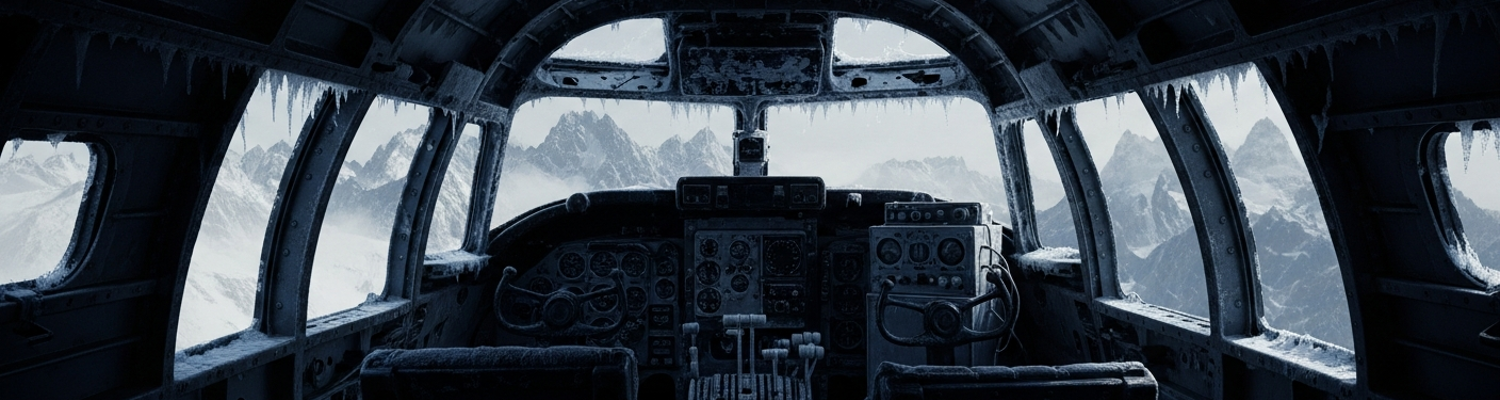

A close review of operational logs for the U.S. Army Air Forces’ Air Transport Command in April 1943 reveals a fundamental disconnect between doctrine and application. The flight manuals for the Douglas C-47 Skytrain and the newly introduced Curtiss C-46 Commando promised predictable performance. The reality for crews in the Assam Valley of India was that the manuals were fiction. The air bridge they were tasked to maintain over the eastern Himalayas, a 550-mile route from India to Kunming, China, known only as “The Hump,” was an environment so hostile it invalidated every engineering assumption.
The terrain was the first antagonist. The flight path crossed a north-south extension of the main Himalayan range, forcing unpressurized aircraft taking off from near sea level to claw their way above 18,000 feet to clear ridges that topped 20,000 feet. The thin air starved engines of power and wings of lift. Downdrafts could slam a fully loaded transport downwards thousands of feet in seconds. Early C-47s, unable to consistently reach safe altitudes, were forced to navigate perilous passes, a lethal gamble in poor visibility. The route became littered with wreckage, creating a grim navigational aid known as the Aluminum Trail.
Then there was the weather.
The pre-monsoon season beginning in April turned hazardous flights into nightmarish ordeals. The region, a convergence zone for massive Eurasian air masses, produced towering cumulonimbus clouds reaching over 39,000 feet, far above the service ceiling of any transport. Flying into one meant disintegration from turbulence, hail, and severe icing. Winds approaching 100 miles per hour, a precursor to the discovery of the jet stream, could throw an aircraft miles off course, rendering dead reckoning, the primary mode of navigation, into pure guesswork. Ice accumulating on wings destroyed lift; on propellers, it created imbalances violent enough to tear an engine from its mounting. Navigational aids were almost nonexistent. The entire China-Burma-India Theater was served by only nine Army Airways Communications System stations in early 1943. The few non-directional homing beacons were often blocked by mountains or overwhelmed by the electrical energy of storms. For most of the journey, crews were flying blind.
The communication systems connecting these aircraft to the ground were a fragile network of 1930s-era technology. The standard equipment, the SCR-274-N command set for high-frequency (HF) communication and the SCR-522 for very high-frequency (VHF), were dependent on vacuum tubes and heavy dynamotor power supplies. The SCR-274-N was a modular system requiring the radio operator to physically swap transmitter and receiver boxes to change frequency bands. These units were highly susceptible to the constant, violent vibration of flight, leading to component failure and frequency drift. The VHF SCR-522, while offering clearer transmission, was strictly line-of-sight. Its low-power 15-watt signal was useless in a landscape defined by massive mountain ranges that created vast radio dead zones.
Transmitting a distress call was an act of faith. A Mayday broadcast on a designated emergency frequency had no guarantee of being heard. Monitoring fell to the thinly stretched AACS ground stations and any other aircraft in range. Search and rescue (SAR) coordination was, until mid-1943, an improvised affair. The high-profile crash of a C-46 carrying correspondent Eric Sevareid in August 1943 would force a more structured approach, but before then, a distress call was often just a fragmented signal. Ground operators struggled to get a directional fix as the mountains caused signals to bounce and scatter. The initial response was often to divert other transport crews from their supply missions to begin a search, multiplying the risk. It was not until early 1944 that a dedicated unit, the 1352nd Army Air Forces Base Unit, was established for Hump SAR operations, a direct result of the hard lessons of 1943.
The physical environment was an active impediment to radio waves. Jagged peaks blocked line-of-sight VHF signals completely. HF signals, which could theoretically bounce off the ionosphere, were absorbed or distorted by the same storm systems that threatened the aircraft. The electrical energy within cumulonimbus clouds generated a crushing level of atmospheric static, a constant roar that could drown out low-power transmitters. For long stretches of the flight, crews were electronically isolated.
A downed aircraft was almost always a silent one. Crash investigation reports from the theater show that onboard communication equipment rarely survived the event that caused the crash. The same violent forces that could tear an airframe apart would shatter the delicate electronics. On the C-46 Commando, in-flight fires were a documented and frequent occurrence, with at least 31 cases recorded between May 1943 and March 1945. Such an event would incinerate the radio operator's station. Even a controlled crash-landing would rip away the long wire antenna and shatter the radio racks upon impact. A surviving crew was left with no way to use the aircraft’s primary equipment.
Survival was a hand-cranked generator. The standard emergency equipment for remote operations was the SCR-578 transmitter, known as the “Gibson Girl” for the hourglass shape that allowed a survivor to hold it between their knees. This device powered a 5-watt transmitter on the 500 kHz international distress frequency. Its application in the Himalayas was a study in futility. A survivor, likely injured, hypoxic, and freezing, had to generate a constant 80 RPM on the crank to produce power. The signal’s advertised 200-mile range was based on transmission over open water; in the mountains, it was absorbed and scattered by rock and ice. The unit came with a box kite and a hydrogen balloon to raise its 300-foot antenna wire, but deploying either in the violent downdrafts of a mountain crash site was nearly impossible.
An unheard plea.
Even if a signal was sent, the rescue operation itself was perilous. Before the limited introduction of helicopters late in the war, rescue meant a ground party, often composed of OSS operatives from Detachment 101 and local Kachin or Naga tribesmen, trekking for weeks through exceptionally difficult terrain. A crew that transmitted a signal from the Aluminum Trail could only tend to their wounded, spread their parachutes as a marker, and wait, hoping a search plane spotted them before the elements claimed them.
On the ground, the men of Army Airways Communications System detachments like the 835th Signal Service Battalion fought a war of attrition against the environment. Their workshops in the Assam Valley were monuments to organized chaos. In the stifling heat and monsoon humidity, sensitive vacuum tube receivers failed constantly. Condensation caused short circuits. The fine red dust of the dry season infiltrated every component. The few navigational beacons ran 24 hours a day, and the constant operation, combined with fluctuating power from overworked generators, led to frequent failures of capacitors and transformers. Technicians at stations like Chabua and Dinjan faced a relentless influx of broken equipment with no steady supply of replacement parts. The CBI theater was last in line for logistical priority.
Scavenging became standard procedure. A grim but necessary symbiosis developed with the Aluminum Trail. Crash sites became a critical source of spare parts. A team dispatched to a wreck would perform electronic salvage, systematically stripping the downed aircraft of its radio gear. An intact SCR-274-N was a treasure trove of vacuum tubes, resistors, and dynamotors. Even a shattered radio could yield usable capacitors. These components were painstakingly cleaned, tested, and cataloged. A single working tuning capacitor from a fire-damaged receiver could get a vital ground station back on the air. This cannibalization was not limited to American equipment; parts from downed Japanese aircraft were integrated into repairs when necessary.
Repair was only half the problem. Amplification was the other. The standard-issue transmitters were too weak to cut through the atmospheric static of Himalayan storms. Ground technicians engaged in constant, unauthorized modifications to boost the power and sensitivity of their equipment. To amplify a transmitter’s output, a technician might bypass safety governors on a power supply or alter voltage regulation, deliberately overdriving the final amplifier tubes. This pushed components far beyond design specifications and risked a complete burnout, but it could provide the few extra watts needed to guide a lost aircraft. For reception, they constructed crude but effective antenna arrays. They would string hundreds of feet of wire in directional “rhombic” or “V” configurations aimed toward the most dangerous sections of the Hump. These ad-hoc antenna farms, held up by bamboo poles, were paired with jury-rigged pre-amplifiers built from scavenged parts to boost faint signals before they entered the main receiver. This was how a fighting chance was manufactured from electronic scraps.
In the air, the dedicated radio operator on a C-46 or C-47 was often an in-flight repairman. The constant vibration could shatter the filaments in vacuum tubes or fracture the mountings of heavy power supplies. An operator, working in an unheated fuselage at negative twenty degrees Fahrenheit, would have to diagnose the failure in near real-time. This meant swapping modular boxes, tracing loose connections, and replacing hot vacuum tubes while wearing thick gloves. The pressure was absolute. A functioning radio was the only link to navigation and rescue. Every repair was performed while the aircraft bucked and shuddered, with the knowledge that a single failed component could be a death sentence.
The hunt for a downed crew required its own electronic innovation. Search aircraft from units like the 1352nd AAF Base Unit could not simply listen; they had to actively hunt for signal fragments buried in overwhelming static. Airborne radio operators became direction-finding specialists, using techniques known as “huff-duff” with directional loop antennas to get a rough bearing on a transmission. Field modification records show crews experimenting with trailing long wire antennas from their aircraft or creating makeshift directional arrays to focus their listening power. The process was painstaking. It required the pilot to fly a series of prescribed patterns while the radio operator, hunched over his receiver, listened for the barest peak in signal strength. They were attempting to triangulate a position based on an intermittent, distorted signal, a technical challenge made lethal by the same conditions that had claimed the first aircraft.
The decision to launch a high-altitude recovery mission was never automatic. It was a cold calculation. The trigger was often just a fragmented transmission or an aircraft failing to arrive. The initial question was not where to look, but if a search was possible. Launching a search was a wager, pitting the high probability of losing a second aircraft against the small chance of locating survivors.
This entire fragile enterprise, the linking of ground to air and air to ground, was what made the Hump airlift viable. It was not a function of superior technology or grand strategy. It was a direct result of the quiet, desperate, and completely improvised technical troubleshooting performed by a handful of radio operators and ground technicians. They used scavenged parts to repair broken radios, modified equipment beyond its limits to amplify weak signals, and flew into the worst weather on earth to listen for whispers in the static. Their work, documented not in grand histories but in mundane maintenance logs and after-action reports, directly determined whether a crew lived or died on the Aluminum Trail.