
A close review of operational logs indicates the advisory mission for US Army personnel in 1980s Central America was built on a fundamental contradiction. The primary unit tasked with this foreign internal defense mission was the 7th Special Forces Group, headquartered for many years at Fort Bragg, North Carolina. Its teams deployed to El Salvador and Honduras to train local armed forces in counter-insurgency. In El Salvador, these mobile training teams (MTTs) were tasked with professionalizing the Salvadoran military against the Farabundo Martí National Liberation Front (FMLN), a well-organized insurgency.
The advisors instructed local battalions in patrol tactics, weapons employment, and small unit leadership.
The problem was political. Washington was the source of the contradiction. The Reagan administration viewed Central America as a key battleground against Soviet influence, which prompted significant military aid to allied governments. This policy, however, operated under intense scrutiny from a divided US Congress, which imposed severe restrictions. The most impactful of these was a hard cap of 55 in-country US military advisors allowed in El Salvador at any one time. This number forced a prioritization of combat-arms trainers over essential support personnel, including medical staff. Archival evidence (NARA Record Group 472) shows this created a dangerous imbalance. A small team of Green Berets might be responsible for training a thousand-man Salvadoran battalion but lacked dedicated US medical evacuation assets or even sufficient numbers of their own medics. The advisors were forbidden from participating in combat operations. They could teach tactics but could not lead or accompany their partner forces into battle, creating a disconnect between the training environment and the conditions of guerrilla warfare.
This politically imposed restriction on force numbers directly influenced operational procedures and resource allocation. The 55-man cap meant every slot was precious. The US military presence in Honduras was larger, serving as a regional logistics hub and a staging ground for supporting the Nicaraguan Contras. Operations like Golden Pheasant in 1988 demonstrated US capacity for rapid force projection, deploying elements of the 82nd Airborne and 7th Infantry Divisions to Honduras. Yet, this show of conventional force did little to alter the daily reality for advisors in the Salvadoran countryside. They relied on Salvadoran military assets for movement and, critically, for casualty evacuation. A US Army medic treating a wounded soldier had to navigate a foreign chain of command and depend on a foreign helicopter pilot, operating a potentially poorly maintained aircraft, to attempt an extraction from a hot landing zone.
US Army combat medical doctrine in the mid-1980s was built around a single physiological absolute: the golden hour. This concept, refined by military surgeon R. Adams Cowley, stipulated that a traumatically injured soldier had approximately 60 minutes to receive definitive surgical intervention to maximize survival. This was not a guideline; it was a countdown around which the entire battlefield medical system was designed to function. A close examination of field manuals and training programs from the era, such as the Combat Casualty Care Course (C4) established in 1980, reveals a system predicated on a race against time. The doctrine taught that catastrophic injuries, particularly those involving massive hemorrhage or compromised airways, initiated an irreversible physiological cascade. If surgical repair was not achieved within that hour, the patient’s odds of survival dropped precipitously.
This unforgiving timeframe dictated every action of the 91B combat medic. Training focused on immediate, life-sustaining interventions at the point of injury, designed only to keep the casualty alive long enough to get to a surgeon. The core skills drilled into every medic were stopping massive bleeding, clearing and maintaining an airway, and treating for shock. Army publications from the period, including Field Manual (FM) 21-11, First Aid For Soldiers, focused on these fundamentals. Medics learned to apply pressure dressings and tourniquets, insert nasopharyngeal airways, and initiate intravenous fluid lines to counteract the effects of blood loss. These actions were not definitive treatment. They were a bridge.
The entire purpose of the medic’s intervention was to stabilize the casualty for the next, most important step: medical evacuation.
The system was a relay. The ideal conditions for this relay, as outlined in publications like FM 8-10-6, Medical Evacuation in a Theater of Operations, envisioned a seamless and rapid handoff. A request for an URGENT MEDEVAC would be transmitted securely from the patrol leader to a controlling headquarters. This would trigger the immediate launch of a dedicated air ambulance, typically a UH-60 Black Hawk helicopter. The doctrine assumed this aircraft would be on standby, fully fueled, and medically stocked. The landing zone would be secured, allowing the helicopter to land, load the casualty, and take off, often in under two minutes. During the flight, the on-board medic would provide continuous en route care. This rapid flight would terminate at a Combat Support Hospital (CSH) or Mobile Army Surgical Hospital (MASH). The entire system was orchestrated to deliver the wounded to an operating table within that 60-minute window. This model depended on a series of perfect conditions: absolute air superiority, secure communication channels, available and mechanically sound aircraft, and a pre-established network of fully staffed field hospitals.
The doctrinal necessity of the golden hour was a physiological absolute, but in the operational environment of 1980s Central America, it was a logistical fantasy. A review of operational logs from the 7th Special Forces Group and after-action reports from mobile training teams in El Salvador reveals a pattern where the 60-minute window for surgical intervention routinely collapsed into multi-day ordeals. The primary cause was a command decision rooted in political compromise. The strict cap of 55 US military advisors in-country meant that dedicated American MEDEVAC assets were non-existent. A wounded US soldier was entirely dependent on the Salvadoran Air Force (FAS) for evacuation. This dependency introduced multiple, often catastrophic, points of failure. A MEDEVAC request from a US advisor on the ground did not go to a US flight operations center; it was routed through a Salvadoran chain of command, adding layers of delay.
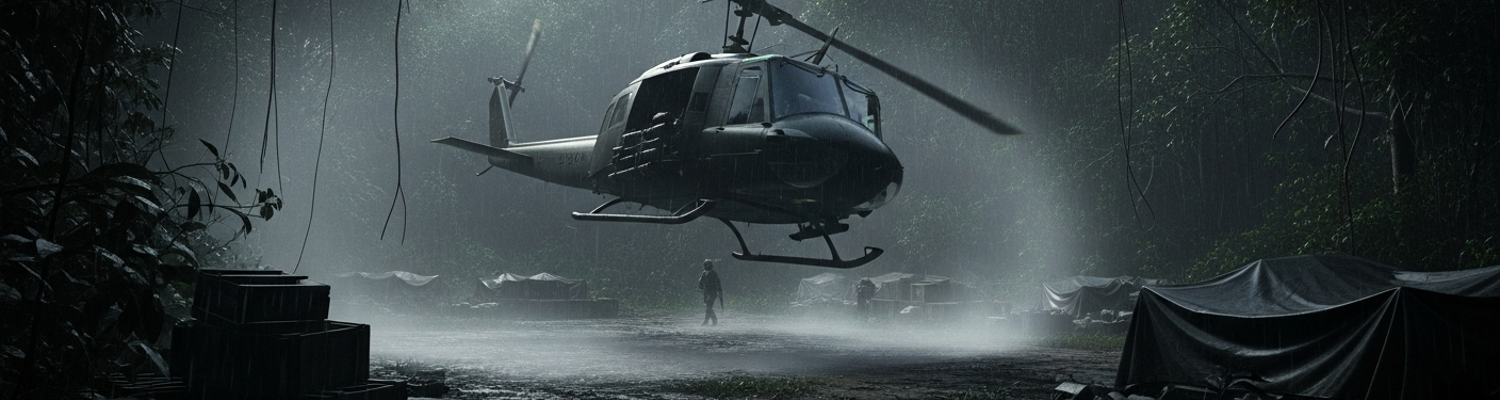
The mechanical backbone of the Salvadoran air fleet was the American-supplied UH-1H Huey helicopter. While the US provided dozens of these aircraft, maintaining them was another matter. Archival evidence shows that FAS helicopter readiness rates were consistently low, often hovering at or below 50 percent due to chronic shortages of spare parts and a lack of qualified maintenance personnel. A request for an air evacuation, even if approved swiftly, was no guarantee that a mission-capable helicopter was available. Salvadoran pilots were often undertrained for the demanding conditions of combat evacuations. They exhibited a documented reluctance to fly into hot landing zones or to operate at night or in the poor weather that frequently enveloped the mountainous terrain. A US medic, having stabilized a casualty against the clock, could only wait. This often resulted in waits that stretched for hours, and in some documented cases, for days, as units were forced to hold their position or attempt a dangerous overland evacuation.
Terrain actively worked to defeat both air and ground extraction methods. The triple-canopy jungle common in regions like Chalatenango and Morazán in El Salvador made visual acquisition of a ground team from the air nearly impossible. A patrol needing extraction first had to locate or create a viable landing zone. In the steep, rugged mountains, finding a naturally clear, flat area large enough for a Huey was rare. This forced teams to spend precious time and energy hacking an LZ out of the dense vegetation with machetes, a loud and physically draining activity that could easily compromise their position. Even with a cleared LZ, a successful landing was not guaranteed. The high humidity and hot temperatures degraded helicopter engine performance, reducing lift capacity.
When air extraction failed, ground evacuation was the only alternative. A soldier being carried on a litter through the jungle became a massive tactical liability. Movement was reduced to a crawl over steep, muddy slopes and across ravines. A journey that a helicopter could make in ten minutes could take a ground team two or three days of exhausting effort. The use of a jungle penetrator, a device lowered by hoist from a hovering helicopter, was a potential solution, but it was a slow process, exposing the aircraft to ground fire for an extended period. Each hoist could take several minutes, and extracting an entire squad one or two men at a time was often deemed too risky by the aircrews.
The operational lifeline for any soldier was the radio. For US advisory teams in Central America, this meant the AN/PRC-77 man-portable transceiver. A review of the radio’s technical specifications against the environmental conditions of the region reveals a fundamental mismatch. The PRC-77 was a VHF/FM radio, operating between 30 and 75.95 MHz, a system predicated on line-of-sight transmission. Its advertised optimal range of approximately eight kilometers was a theoretical maximum achievable only over flat, open terrain. In the steep, jungle-choked mountains of El Salvador, this effective range collapsed. A patrol dropping into a ravine would instantly lose contact. The very terrain that offered concealment also served to sever the link of communication.
This issue of line-of-sight was compounded by the jungle itself. The triple-canopy rainforest formed a literal wall of vegetation that absorbed and scattered VHF radio waves. Studies on radio wave attenuation in jungle environments show that the high moisture content of the dense foliage is the primary culprit, capable of reducing signal strength by up to 60 percent. For the medic and the Radio Telephone Operator on the ground, this meant a transmission that might travel several kilometers in the clear would die out in a few hundred meters. The 1.5 to 2.0-watt output power of the PRC-77 was insufficient. To have any hope of making contact, patrols were forced to seek high ground, a predictable and dangerous tactical choice that FMLN insurgents quickly learned to anticipate. The alternative was to rig a long-wire antenna, a stationary, time-consuming activity that broadcasted their location. For a medic trying to request an urgent MEDEVAC, this signal degradation meant the call might never leave the immediate vicinity of the firefight.
Beyond the physics of signal propagation, the AN/PRC-77 was plagued by the climate’s effect on its power source. The standard non-rechargeable battery for the PRC-77 was the BA-5598/U, a lithium-sulfur dioxide battery. Archival maintenance logs indicate these batteries were highly susceptible to the extreme humidity. Moisture could infiltrate the battery housing, leading to corrosion on the contacts or causing internal chemical degradation that would sap the battery’s life long before its expected 30-hour transmit/receive cycle was complete. A medic on a multi-day patrol would have to carry multiple heavy spare batteries. The failure of a battery was not a gradual event; a radio could work perfectly one moment and be completely dead the next, leaving a patrol utterly isolated without warning. This constant threat of power failure forced a strict radio discipline. Transmissions were kept to a minimum to conserve power, meaning routine check-ins were sometimes skipped, delaying the realization that a patrol was in distress. The moment a medic needed to transmit the nine-line MEDEVAC request could be the exact moment the battery finally gave out.
Beyond the kinetic threats of guerrilla warfare, the environment of Central America was a relentless antagonist. The rainy season, which in key operational areas could last from May to October, defined the physical world. Climatological data shows this period was characterized by oppressive, overcast skies and near-daily torrential downpours. These rains transformed the landscape into a morass of mud and swelled rivers into impassable torrents. For small advisory teams on patrol, staying dry was impossible. The constant dampness added weight to their gear and chafed skin raw.
The water was a vector for disease. Military medical records from the period point to a high incidence of debilitating illnesses directly linked to the wet, unsanitary conditions. Two of the most prevalent were malaria and dysentery. U.S. troops were placed on malaria prophylaxis, typically Chloroquine, a drug that came with its own set of confounding gastrointestinal side effects. By the 1980s, certain strains of the most dangerous malaria parasite, Plasmodium falciparum, had developed resistance to standard drug regimens. Simultaneously, diarrheal diseases were rampant. Data on U.S. military deployments to Latin America between 1981 and 1990 show a median diarrheal incidence rate of 26 percent. Enterotoxigenic E. coli, rotavirus, and Norwalk virus were commonly identified pathogens. For a small Special Forces team, an outbreak of amoebic or bacillary dysentery was a tactical disaster, incapacitating multiple soldiers.
The constant moisture also attacked the body directly, causing a host of agonizing skin ailments known by soldiers as jungle rot. This was not a single diagnosis but a cluster of fungal and bacterial infections that thrived in the perpetually damp conditions inside a soldier’s boots and uniform. Analysis of military dermatology reports from similar environments shows that after just 48 to 72 hours of continuous wet exposure, a unit could see 35% to 50% of its personnel affected by inflammatory skin diseases of the feet. One of the most common conditions was immersion foot, a non-freezing cold injury where the skin becomes waterlogged and highly susceptible to infection. The condition caused tingling and numbness that could progress to severe pain, making walking with a combat load excruciating. Standard-issue full-leather boots were particularly ill-suited, trapping moisture and accelerating the damage. The resulting tropical ulcers and aggressive fungal infections on the feet, groin, and any area where gear chafed could render a soldier completely unable to patrol.
The operational environment of Central America subjected U.S. Army medics to a unique and deeply corrosive form of psychological stress. The counter-insurgency mission in El Salvador meant every moment outside the wire was lived in a state of heightened alert. A review of after-action reports and patrol logs from the era reveals a consistent pattern of psychological degradation rooted in hypervigilance. FMLN insurgents were masters of their terrain, employing sudden, violent, and close-range ambushes. For a small advisory team, the enemy was invisible and ever-present. This reality forced every soldier into a state of exhausting sensory overload. Every rustle of leaves could signal the start of a catastrophic engagement. The toll of this sustained alertness was immense, leading to mental fatigue and a documented erosion of basic decision-making ability. There was no safe zone.
This profound psychological pressure complicated the medic’s ability to perform field triage. The instant a firefight began, doctrinal training collided with a maelstrom of conflicting priorities. Tactical Combat Casualty Care (TCCC) doctrine was clear: the first priority was Care Under Fire, which meant returning fire and gaining superiority was paramount. Only then could the medic move to the wounded. This created an immediate internal conflict. While teammates were engaged in a life-or-death struggle, the medic had to locate and assess casualties, often under direct enemy fire. The fine motor skills required to start an IV or apply a complex dressing would degrade under the effects of adrenaline. Torrential rains turned the ground to mud, and the triple-canopy jungle created a perpetual gloom that made finding a vein or even the source of a bleed a monumental challenge.
In this context, the medic was forced to make life-or-death decisions in seconds, weighing the official triage categories against the tactical situation and the bonds of unit cohesion. The most devastating psychological burden arose in prolonged engagements where MEDEVAC was not forthcoming. After stabilizing a casualty, the medic’s role would shift from acute trauma management to prolonged field care, a discipline for which they were often ill-equipped and undersupplied. As hours stretched into days, IV bags would run dry, stocks of morphine would be depleted, and carefully applied dressings would become soaked with blood and mud. The stabilized patient would begin to deteriorate. This slow, agonizing process had a ruinous effect on troop morale. A wounded soldier, suffering with no hope of extraction, served as a visceral, living reminder of the mission’s broken logistical chain and their isolation. The sight and sounds of a comrade’s preventable decline created feelings of abandonment and rage, transforming a cohesive unit into a group of men just trying to survive.