
The reliance on ground convoys for medical resupply in early 21st-century urban warfare was absolute. A review of operational logs from campaigns in Iraq shows forward-deployed assets like the Battalion Aid Station (BAS) were fundamentally dependent on a constant flow of materiel. These were not shipments of bandages. Convoys transported refrigerated blood products, intravenous fluids, chest tubes, surgical kits, and pharmaceuticals. Without this lifeline, the ability of a BAS to perform its primary function of stabilizing casualties for evacuation would collapse within hours. The system was built around vehicles ill-suited for the threat. The M997, the ambulance variant of the HMMWV, was a frequent component, but its flat-bottomed design and limited armor made it exceptionally vulnerable to underbelly blasts from improvised explosive devices (IEDs). In the initial phases of Operation Iraqi Freedom, a failure to deploy sufficient medical logistics units into the theater created immediate and severe shortfalls. From the outset, the entire chain of casualty care was stretched thin, placing immense pressure on the success of each individual supply run.
Every route was a calculated risk.
Navigating the shattered urban landscapes of cities like Fallujah or Ramadi presented a unique set of tactical problems. Main Supply Routes (MSRs), once clearly defined avenues, became unpredictable gauntlets. A single IED could block a multi-lane road, forcing a convoy of soft-skinned HMMWVs and supply trucks into a maze of unmapped side streets and rubble-strewn alleys. Insurgent forces proved adept at using an initial explosion to channel vehicles into pre-planned kill zones where complex ambushes involving rocket-propelled grenades (RPGs) and small-arms fire could be initiated. The physical toll on the vehicles was enormous. Tires were shredded by debris. Suspensions were destroyed by the constant, violent jolting over broken pavement and wreckage. Operational logs detail frequent mission aborts due to multiple vehicle failures before a convoy even reached its destination. The speed of the convoy was a constant command dilemma. Moving too slowly created a static, easy target, while moving too quickly increased the risk of missing the subtle signs of a buried IED or an impending ambush.
The enemy learned the supply schedules.
The context of the Global War on Terror defined this battlespace as asymmetrical. There was no secure rear area and no conventional front line; the threat was 360 degrees. Insurgent groups in Iraq demonstrated a sophisticated and evolving understanding of U.S. tactics, specifically targeting the vulnerabilities of supply convoys. Analysis of insurgent methods from 2004 and 2005 reveals a pattern of targeting logistics over combat patrols. Ambushes were often complex, using a team to initiate fire from one direction to draw the attention of the convoy’s security element, while a second team attacked from the flank or rear with RPGs or command-detonated explosives. Rolling ambushes, staged car accidents to halt vehicles, and snipers positioned in overlooking buildings were common tactics. For the medics participating in or awaiting these convoys, the psychological weight was heavy. They were acutely aware that their forward aid stations were a primary target of this strategy. A delayed or destroyed convoy did not just mean a logistical inconvenience; it meant that the blood bags, chest seals, and tourniquets needed to save the lives of their fellow soldiers would not arrive. The knowledge that the enemy was actively working to sever their medical lifeline was a constant source of stress.
A review of operational logs from the early 2000s reveals a systemic communications crisis rooted in the physics of urban warfare. The standard tactical radio of the era, the SINCGARS, was a robust system for conventional battlefields. It operated on line-of-sight VHF/UHF frequencies. In the open fields of a European scenario, this was a manageable constraint. In the dense concrete-and-steel canyons of Iraqi cities, it was a weakness. Signals that could travel for kilometers in open terrain were absorbed and scattered by buildings, reducing their effective range to a few city blocks. This forced an immediate and dangerous improvisation: the creation of mobile retransmission points. A designated vehicle, typically a HMMWV equipped with a powerful AN/VRC-92 long-range radio system, would be detached from the main body. This 'retrans' vehicle had to find a location with sufficient elevation and a clear line of sight to both the moving convoy and the command post, acting as an electronic bridge. The entire communications architecture of a convoy mission, the link to fire support, the ability to call for a quick reaction force, the coordination between vehicles, rested entirely on this single node.
The relay became the mission.
This dependency placed the retrans teams in a position of exceptional vulnerability. Insurgent forces demonstrated a rapid and lethal ability to learn American tactics. A lone HMMWV parked on a highway overpass or at a key intersection, bristling with antennas, was an obvious and high-value target. Archival evidence from the 1st Cavalry Division’s operations in Sadr City during the intense fighting of April 2004 shows that maintaining these retrans sites was a constant battle. The teams, often composed of just a few soldiers, had to repeatedly occupy and defend these exposed positions against small arms, RPG, and mortar attacks. As a convoy moved through the city, the retrans team had to conduct a perilous leapfrog maneuver. They would break down their equipment, move at high speed through contested territory, often without the protection of the main convoy body, and then set up in a new, equally dangerous location. Each one of these movements represented a period of total communication blackout for the convoy they were tasked to support. An after-action report from the 2nd Brigade Combat Team, 28th Infantry Division, operating in Ramadi in 2005, documents multiple instances where retrans teams came under direct and sustained fire, forcing mission commanders to choose between pushing forward without reliable communications or halting the convoy in a kill zone to wait for the link to be re-established.
For the medics inside the cramped, jarring confines of an M997 ambulance, this communications instability was a constant presence. The familiar sound of a SINCGARS handset was not one of reassurance, but of intermittent static, clipped transmissions, and unnerving silence. A message confirming the arrival of a critically wounded patient at the BAS could be cut off by a vehicle turning a corner. A convoy commander’s order to divert around a suspected IED might be garbled, with only the first half of the message received before the retrans link was momentarily broken. This created a sense of tactical isolation. Medics knew that their ability to save lives depended on a chain of communication subject to constant disruption. The psychological weight of knowing that a call for help, or a vital update on a patient’s status, might simply vanish into the ether could not be overstated. This was a recurring event during kinetic engagements, leaving individual vehicles and their crews to fight their own battles in a bubble of confusion until the electronic tether could be restored.
Analysis of insurgent electronic warfare (EW) development in Iraq reveals a rapid, lethal evolution in the early 2000s. Initially, radio-controlled improvised explosive devices (RCIEDs) were triggered by simple, commercially available electronics like car-door remotes. U.S. forces responded by deploying the first generation of Counter-RCIED Electronic Warfare (CREW) systems, most notably the Warlock jammer, rushed into service around mid-2003. The Warlock was an adaptation of an existing system, not one designed for the crowded urban signal environment. It functioned by broadcasting a brute-force barrage of electronic noise to overwhelm the frequencies commonly used for detonation. This tactic created an immediate cat-and-mouse game. Insurgent bomb makers, some with formal electronics training, quickly adapted, shifting to different frequency bands, using more complex signals from cell phones or cordless telephones, and exploiting gaps in the jammers’ coverage. This forced a constant, reactive cycle of upgrades from U.S. forces, with engineers sometimes having only weeks to analyze a new threat and develop a counter-technique. The early Warlock systems were bulky, sometimes occupying an entire passenger seat in a HMMWV. A significant failing of these early jammers was their indiscriminate nature; they frequently jammed friendly U.S. radio signals, including SINCGARS voice communications and Blue Force Tracking GPS data, along with those of the enemy.
The electronic battlefield became a zone of mistrust.
True signal spoofing, creating a fake transmission that friendly forces would mistake for a legitimate command, was less a technical reality for insurgent groups in this period and more a psychological fear that shaped tactical behavior. However, archival records point to a more rudimentary but effective form of electronic deception. Insurgent forces demonstrated an ability to use captured U.S. or Iraqi military radios, mimicking call signs and basic communication procedures to sow confusion. While these attempts were often crude and quickly identified by trained operators, even a momentary disruption during a complex convoy operation could be fatal. A garbled or suspicious transmission could force a convoy commander to halt, creating a stationary target. More insidiously, insurgents used electronic means to lure patrols into ambushes. Snipers would initiate an attack to draw soldiers into cover behind specific objects, like a pile of bricks, which had already been rigged with a hidden IED. For a convoy medic, the possibility that a radio call directing their vehicle down a specific street could be a hostile trick, or that a call for help was being monitored by the very forces that had just attacked them, added another layer of stress to every mission.
The most disorienting effect of this electronic battle was the complete and sudden loss of contact. Inside the vibrating hull of an M997 ambulance, the SINCGARS radio was a lifeline, the sole connection to command, fire support, and the receiving hospital. The activation of a convoy’s own CREW systems could instantly sever that link. A constant, high-pitched whine from the jammer would fill the vehicle, followed by an unnerving silence on the radio network as the system overpowered the comparatively weak signal of the SINCGARS handset. Medics found themselves in an electronic black hole, often while in direct contact with the enemy. They could not report their status, receive new orders, call for a Quick Reaction Force, or provide an updated casualty estimate to the waiting surgeons at the Battalion Aid Station. A single vehicle, turning a corner in a dense urban canyon, could lose its line-of-sight signal to the rest of the convoy and, with its own communications simultaneously being jammed by friendly equipment, effectively vanish from the tactical picture. This forced isolation, occurring in the most critical moments of a firefight, left crews to fight their own battles.
A medic’s formal training prepared them for the physiological consequences of combat, but the realities of sustained, high-tempo convoy support in urban Iraq produced psychological casualties that no field manual could adequately detail. On-the-ground observations by medics embedded with these units document the emergence of acute, transient psychotic episodes among soldiers. This was not a slow decline, but a sudden break from reality. Soldiers who had been operationally effective hours earlier would suddenly exhibit profound behavioral disorganization. Medics reported witnessing infantrymen, their faces blank and disconnected in the so-called 'thousand-yard stare,' becoming unable to prioritize basic tasks or follow simple commands. In the back of an M997 ambulance, amidst the chaos of a firefight, a fellow soldier might suddenly become convinced that the convoy was driving into a trap set not by insurgents, but by their own command. These were not abstract fears; they were paranoid delusions with immediate tactical consequences, forcing the medic to manage a physically unharmed but psychologically incapacitated soldier while simultaneously treating the wounded. A review of after-action logs from this period shows these events were frequently categorized under the umbrella of 'combat stress reaction,' a diagnosis that captured a wide range of behaviors from panic and anxiety to full-blown, though often brief, psychotic breaks featuring hallucinations and delusions. For the medic, this presented a crisis on two fronts: the immediate need to secure and calm a comrade who had become a danger to themselves and the mission, and the recognition of their own vulnerability to the same fracturing pressures.
The psychological warfare of the urban battlespace was relentless. No element was more corrosive than the constant, unpredictable threat of indirect fire. The percussive blast of mortars and rockets became the soundtrack to deployment, and this continuous exposure conditioned the nervous system to expect danger. Soldiers’ brains were rewired by the unending cycle of explosion and alarm. This led to a specific and deeply unsettling phenomenon observed by medical personnel: auditory hallucinations directly linked to the sound of incoming fire. Even in the rare moments of quiet inside a BAS or during a lull in a convoy, soldiers would react to phantom noises. They would flinch at the 'whistle' of a mortar round that was never fired or dive for cover at the 'crump' of a distant explosion only they could hear. Medical logs describe soldiers with high combat exposure being brought in for evaluation, convinced they were under attack while others around them heard nothing. This was not simple anxiety; it was the brain creating sensory input where none existed, a direct result of the auditory system being overwhelmed for weeks and months on end. The physics of the urban environment, where the echo and reverberation of a single blast could mimic the sound of multiple impacts from different directions, amplified this effect. The inability to trust one’s own senses represented a profound psychological erosion, a state where the soldier could never truly feel safe because the threat had become internalized.
This breaking point was the logical conclusion of sustained, high-tempo operations where the human element was stretched far beyond its design limits. The psychological erosion was a cumulative process, built layer by layer from operational demands that offered no respite. Convoy medics, like the line-unit soldiers they supported, were subject to profound sleep deprivation, operating on minimal rest for weeks at a time during major operations. This fatigue was compounded by the constant hypervigilance required to scan for IEDs, the adrenaline spikes of near-misses and actual ambushes, and the unique burden of treating catastrophic injuries in the cramped, unstable confines of a moving vehicle. Unlike infantrymen whose primary function was direct engagement, the medic’s role was to confront the horrific aftermath, a duty that carried its own distinct psychological weight. The cumulative stress from witnessing these injuries, combined with personal fear and exhaustion, created a state of profound emotional and cognitive depletion. It was in this depleted state that combat stress reactions could escalate into acute psychosis. The mind, deprived of the ability to rest and reset, simply began to fail. A soldier’s inability to distinguish a real threat from a hallucinated one, or a paranoid delusion from a legitimate order, was the final failure of a system overloaded by the sheer velocity and brutality of urban warfare.
Operational logs from convoy support elements in Baghdad and Ramadi between 2004 and 2005 reveal a pattern of unauthorized tactical deviations. These were not acts of insubordination in the traditional sense, but desperate command decisions made in a vacuum of reliable intelligence and functional communication. A convoy commander, often a junior NCO, would make a unilateral choice to break from the planned and deconflicted Main Supply Route. The impetus was almost always a last-minute, unverified report of a new IED threat on the intended path or, more frequently, a gut feeling born from extreme fatigue and hypervigilance. An archival report from a support battalion attached to the 1st Cavalry Division details one such event in Sadr City. After losing radio contact with their retrans element, the convoy commander diverted his four HMMWVs off MSR Tampa and into a labyrinth of residential streets. The objective was to bypass a suspected ambush point. The result was a tactical disaster. The lead vehicle’s suspension, already weakened by days of traversing broken pavement, collapsed after striking a deep pothole, blocking the narrow street. The entire element was trapped for over an hour, completely exposed and without communications, until a Quick Reaction Force could be dispatched to their estimated location.
These diversions were a direct response to a failing system.
The psychological pressure of this environment, combined with chronic shortages of supplies, began to manifest in more alarming ways. Analysis of medic field reports and battalion aid station intake logs from this period shows soldiers beginning to act on information that was verifiably false, chasing rumors of phantom supply caches. This went beyond simple battlefield scuttlebutt. It was a form of collective, stress-induced delusion. A garbled radio message or a misheard conversation would morph into a concrete belief that a hidden stock of medical equipment existed at a specific grid coordinate. One documented incident from a unit near Fallujah involved two vehicles from a logistics patrol breaking away from their convoy to search an abandoned schoolhouse. The crews were acting on a firm conviction that the building contained a recently discovered cache of captured insurgent medical supplies, including desperately needed tourniquets and Israeli bandages. The medic attached to the element noted the intense, almost manic energy of the soldiers as they conducted the search. The school was empty. The disappointment that followed represented a more significant blow to the unit’s morale than a near-miss from an RPG. The search itself had been a symptom, a desperate gamble fueled by the psychological need to believe that a solution, any solution, was just around the corner.
For the medic, these events were the clearest possible indicator that the human element of the mission was reaching a breaking point. They were trained to diagnose shock in a casualty, but now they were witnessing a form of systemic shock consume their entire unit. The unauthorized diversions and the hunt for non-existent supplies were not failures of discipline; they were the logical endpoint of placing soldiers under an unbearable mental and emotional load. The medic’s role shifted from purely clinical care to psychological damage control. In the back of an M997, a medic would have to talk down a driver who was convinced a specific overpass was about to be deliberately collapsed by U.S. aircraft, a paranoid delusion triggered by sleep deprivation and the constant thud of distant, unseen explosions. They observed seasoned infantry sergeants, men with extensive combat experience, staring blankly at a map, unable to process basic navigational information after days of continuous operations. The medic saw the direct line connecting a logistical failure, the lack of a replacement fuel filter that had kept the convoy waiting for hours at a forward operating base, to the psychological breakdown of the soldier sitting next to them. It was the observation of a system consuming its own components.
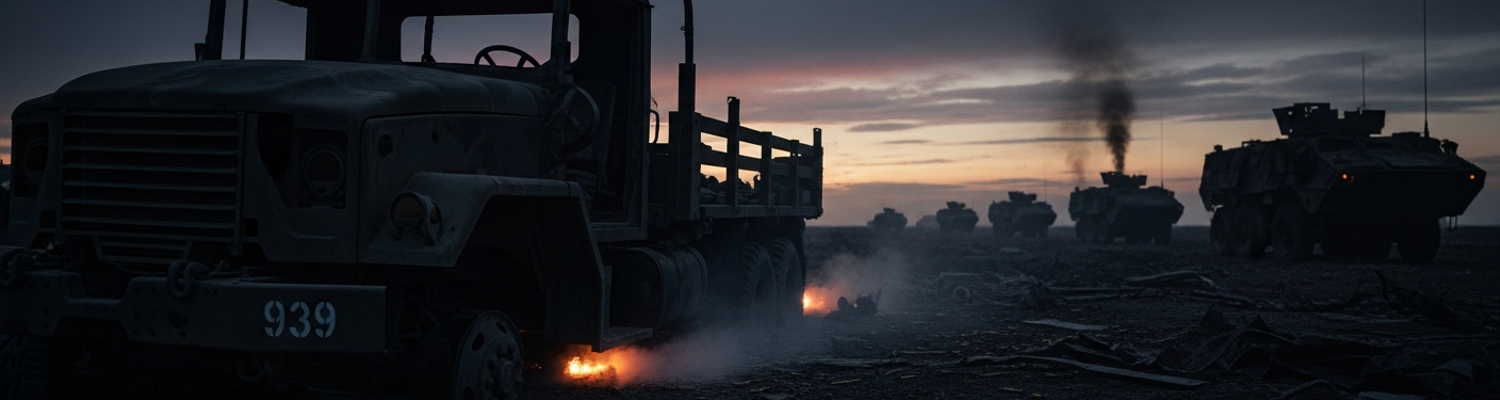
The world for the medic inside the M939 5-ton truck vanished in a storm of pressure and heat. A command-detonated IED, later assessed to be composed of three 155mm artillery shells, detonated directly under the engine block. The blast atomized the front axle and transmission, peeling the truck’s hood back and killing the driver instantly. In the cargo bay, the force of the explosion was a physical blow, throwing the medic and the four infantrymen in the back against the steel walls and scattering pallets of ammunition and water. A profound darkness, thick with the smell of diesel, cordite, and vaporized metal, descended. The initial moments were pure disorientation. A review of after-action reports from similar incidents along Baghdad's MSR Irish during the 2004-2005 period shows that the primary challenge was re-establishing situational awareness. The medic, his vision obscured and ears ringing from the primary blast wave, had to first determine his own condition before he could act. The truck bed was a wreck of splintered pallets, ruptured water cans, and rolling ammunition boxes, all slick with hydraulic fluid from severed lines. The only light came in strobing flashes from the firefight that had immediately erupted outside. In this violent, unstable, and near-pitch-black environment, the medic had to begin the work of finding and assessing his patients.
The explosion was the prelude. The sniper was the enforcer.
As surviving soldiers from the convoy’s other vehicles established a defensive perimeter, the distinctive high-velocity crack of a single, well-aimed rifle began to cut through the cacophony of small-arms fire. The shot was not random. Analysis of insurgent tactics from Ramadi and Fallujah shows a methodical approach: disable a key vehicle, then use a sniper to suppress any response and specifically target leaders and medical personnel. The sniper, positioned in a third-story window of a residential block approximately 600 meters distant, had a clear field of fire on the crippled M939. Rounds began to methodically punch through the thin aluminum skin of the truck’s sides and the canvas cover of the cargo bay. This active, precise fire pinned the medic down with his casualties. He could hear the calls for aid from other members of the convoy, but moving outside the relative cover of the truck was a death sentence. The sniper’s fire created an isolation bubble, turning the wrecked vehicle into a self-contained crisis zone. Command decisions became desperate shouts over the radio, ordering suppressive fire on a building that gunners in the other vehicles could not positively identify. For the medic, the tactical reality was simple. No help was coming into the truck, and he could not get his casualties out.
Inside the darkened confines of the M939, the medic initiated the MARCH protocol, a brutal calculus of survival. The first casualty, a young private, had suffered a traumatic bilateral amputation high on both legs. Massive hemorrhage was the most immediate threat to life, so the medic, working by the intermittent light of his headlamp, applied two C-A-T tourniquets, wrenching them tight until the arterial bleeding slowed to a dark ooze. His attention then shifted to the second soldier, who was gasping for air, a piece of shrapnel having created a sucking chest wound. Ignoring the sniper rounds still perforating the truck, the medic ripped open an Asherman Chest Seal and slapped it over the wound to prevent a tension pneumothorax. A third soldier was unconscious, his breathing shallow, a clear sign of a significant head injury. The medic had to make a choice. He could not manage all three simultaneously. After clearing the unconscious soldier’s airway, he returned to the double amputee, whose blood pressure was crashing. He needed to establish circulation with an IV, but finding a vein on a patient in shock, inside a vibrating metal box, while under fire, was a near-impossible task. This frantic, multi-tasking effort, moving from one dying soldier to the next, represented the core of the medic’s burden: the knowledge that while he was saving one life, another was actively slipping away.
Every application of a pressure dressing was an act of defiance.
The medic was forced to perform a needle decompression on the casualty with the chest wound, a delicate procedure made extraordinarily difficult by the conditions. He had to locate the second intercostal space, mid-clavicular line, a precise anatomical landmark, while the truck shuddered from the impact of nearby RPGs aimed at the convoy’s other vehicles. Inserting the 14-gauge needle and hearing the hiss of trapped air escaping the soldier’s chest cavity confirmed the life-saving intervention, but it came at a cost of precious seconds lost for the other casualties. Analysis of medical logs from this period indicates that extremity wounds and thoracic trauma were the most common survivable injuries from IEDs, putting medics in the constant position of prioritizing massive bleeding and respiratory failure. The entire triage process, lasting perhaps no more than ten minutes, took place in a state of extreme sensory overload, a combination of the screams of the wounded, the deafening noise of the battle outside, and the medic’s own internal monologue racing through treatment algorithms.
Detonation of an IED against a lightly armored vehicle, such as the M1114 HMMWV prevalent in the early 2000s, created a unique and catastrophic wound profile. A review of operational logs and medical after-action reports from convoy support units in Iraq shows that the immediate aftermath of a blast was a multi-layered assault on the human body. The primary blast wave itself could cause severe barotrauma, damaging air-filled organs like the lungs and eardrums, but the secondary effects were often more visually gruesome and immediately lethal. The explosion atomized parts of the vehicle, turning the floor plate, transmission components, and road debris into a high-velocity spray of secondary projectiles. This fragmentation was not uniform; it was a chaotic mix of jagged steel shards from the chassis, pebble-sized rocks from the roadbed, and splintered pieces of the vehicle’s interior. These projectiles would tear through the flesh of the occupants, causing deep, complex lacerations and avulsions. The most devastating injuries were often traumatic amputations, where the force of an underbelly blast would simply sever limbs, a tragically common outcome given the HMMWV’s flat-bottomed design. The kinetic energy transfer from even small, fast-moving fragments could shatter bone and pulverize muscle tissue far from the initial entry point, creating a wound track that was exceptionally difficult to treat.
The radio was dead.
In the moments following the blast, the medic was plunged into a state of profound tactical isolation. The very electronic warfare systems designed to protect the convoy by jamming radio-controlled IEDs would simultaneously sever friendly SINCGARS communications, creating an electronic black hole. This was compounded by the physical destruction of the vehicle’s radio equipment by the blast itself. Archival evidence from convoy ambushes along main supply routes in Baghdad and Ramadi details a recurring pattern: a lead or central vehicle is disabled, and the medic inside is immediately cut off from the platoon leader, the supporting gun trucks, and the battalion aid station. They could not transmit a 9-Line MEDEVAC request, provide an accurate count of the wounded, or receive guidance from command. All medical intervention had to be performed in this vacuum, with the medic relying entirely on their training and the contents of their aid bag. The sounds of the ensuing firefight outside, the crack of incoming small-arms fire and the thump of RPGs, served as the only context, a constant, terrifying reminder that no help was immediately available and that they were entirely alone with the casualties.
This isolation was amplified by an overwhelming sensory assault inside the wrecked vehicle. The air became thick with a nauseating chemical cocktail. The smell was a compound of acrid, burning diesel fuel from a ruptured tank, the sharp metallic odor of superheated and vaporized steel, and the sweet, cloying scent of hydraulic fluid and engine oil atomized by the blast. Layered over all of this was the coppery, unmistakable smell of blood, which became more pronounced as the medic began triage. In the cramped, darkened confines of a HMMWV’s rear compartment, lit only by a headlamp or the strobing flashes of gunfire outside, the medic had to execute the MARCH protocol. This algorithm forces a brutal prioritization based on what will kill the patient fastest. The first step, Massive Hemorrhage, meant ignoring screams and focusing solely on finding and stopping catastrophic arterial bleeding, often from a traumatic amputation. Working through the haze of smoke and chemical fumes, the medic would apply tourniquets, wrenching them tight until the bleeding stopped, before moving to the next casualty to check their Airway, then Respiration, all while the overpowering stench clogged their throat and the sounds of battle hammered the vehicle’s hull. Each breath was a fresh wave of these toxic smells, a constant, physiological reminder of the chaos.