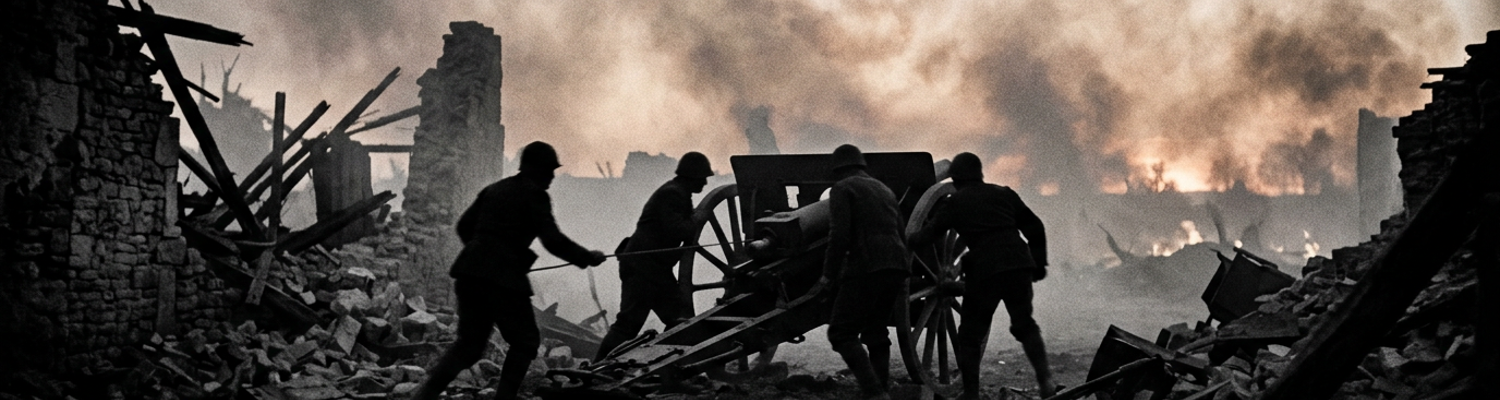

28th Infantry Division Foothold at Fismette
Military records indicate the German 7th Army massed over fifty battalions of infantry along the northern heights of the Vesle River by early August 1918. Arrayed against a single American division were elements of the German 17th, 29th, and 52nd Reserve Divisions. These units received support from hundreds of pre-registered artillery batteries. Field reports from the era indicate this enemy force held every geographic advantage. They occupied the elevated ridges overlooking the valley. These entrenched units possessed clear lines of sight into the basin below.
The adversary outnumbered the approaching American units by a factor of three to one in the immediate sector.
In August 1918, the 28th Infantry Division established a defensive foothold across the Vesle River at the small commune of Fismette. A close review of operational logs indicates the Pennsylvania guardsmen of the 109th, 111th, and 112th Infantry Regiments received direct orders to push north from the adjacent town of Fismes on August 8. Troops had to cross a twenty-foot-wide stream littered with the debris of a demolished stone bridge and twisted iron girders. Engineers from the 103rd Engineer Regiment attempted to lay pontoon floats under concentrated Maxim machine-gun fire. Most infantrymen simply waded through the chest-deep water while carrying sixty pounds of ammunition and combat gear. Once on the northern bank, the soldiers occupied a tightly packed cluster of stone houses, walled gardens, and narrow alleys comprising Fismette.
This advance created a highly vulnerable salient projecting directly into the German trench network.
The divisional command staff operated miles to the south. These senior officers tracked the assault using outdated French topographic maps. They lacked real-time intelligence regarding the exact deployment of their forward companies.
The headquarters staff issued tactical directives based on reports that were often twelve hours old.
German forces subjected the isolated Fismette salient to continuous heavy artillery bombardment. When examining the historical record, archival documents indicate the enemy artillery command utilized a precise grid system to systematically obliterate the bridgehead. Batteries of 77mm field guns and 150mm heavy howitzers fired high explosives onto the American positions day and night. German infantry also deployed trench mortars known as Minenwerfer from concealed positions just two hundred yards away in the Chateau du Diable.
These short-range weapons lobbed heavy explosive charges.
The munitions easily collapsed the reinforced stone cellars where American troops sought shelter. Mixed into the barrages were chemical munitions. Phosgene and mustard gas pooled in the low-lying ruins of Fismette. Soldiers fought while wearing restrictive box respirators.
The constant barrage severed every physical communication link between the salient and the southern bank.
Signal corps personnel laid hundreds of yards of twisted-pair copper wire across the Vesle River to establish connections for Model 1914 field telephones and Service Buzzer sets. Shrapnel from the relentless shelling severed these lines within minutes of their installation. Runners dispatched to carry handwritten messages back to the command posts faced concentrated zones of sniper fire and mortar explosions. Very few survived the return trip across the river.
Brigade commanders sat in complete isolation inside dugouts located far to the rear.
Operators stared at silent switchboards while frontline companies took heavy casualties in the rubble. Major General Charles Muir and his staff could only guess at the survival rates inside the salient. Division headquarters continued to order small squad-sized reinforcements into the bombardment zone to hold the line.
These replacement troops marched blindly into the exact coordinates where previous units had just been annihilated.
AEF Signal Regulations and Goniometric Threats
When examining the historical record, AEF General Headquarters enforced a rigid prohibition against transmitting unencrypted messages over wireless sets. Signal officers attached to the 28th Infantry Division operated continuous-wave spark-gap radio transmitters. They specifically used the Signal Corps Radio models SCR-77 and SCR-54. These bulky devices required heavy lead-acid batteries and a multi-man crew to deploy in the ruins of Fismette. AEF doctrine dictated that every tactical coordinate or request for artillery support had to be manually processed through complex field ciphers before transmission.
This was mandatory.
Signalmen utilized the trench code books. They relied specifically on the Potomac and Suwanee codes alongside secondary Playfair cipher grids. The mechanical process of encoding a basic three-sentence request for reinforcements took a minimum of twenty minutes under standard conditions. Operators had to write out the plaintext on a message pad. They converted each word into a randomized alphanumeric cluster. They manually tapped the sequence into the telegraph key. Artillery shells routinely collapsed the cellars where these signalmen worked during this tedious process.
Transmitting a raw unencrypted plea for immediate counter-battery fire constituted a court-martial offense under the strict theater regulations drafted by staff officers in Chaumont.
Signalmen died holding unsent messages while trying to encrypt grid coordinates.
A close review of operational logs indicates the German 7th Army deployed specialized signal intelligence detachments to exploit any violation of Allied radio discipline. These Peil-Kompagnien operated sophisticated goniometric equipment arrayed along the high ground north of the Aisne River. Enemy technicians utilized large rotating loop antennas to intercept the electromagnetic waves generated by American spark-gap transmitters. By positioning three separate listening stations at distinct geographic nodes, German operators could triangulate the exact origin of a radio signal within a fifty-yard margin of error.
The mathematics were exact.
They fed these coordinates directly via insulated buried telephone lines to the centralized artillery command posts. Forward batteries of 150mm schwere Feldhaubitze 13 howitzers maintained pre-calculated firing tables for every sector of the Fismette basin. German gunners required less than ten minutes to adjust their elevation dials and pull the lanyards after receiving the triangulated coordinates. Any American radio operator who held down a telegraph key for more than a few seconds instantly designated their own position for immediate destruction.
The resulting counter-battery fire obliterated the transmitting station.
The airwaves stayed dead to ensure basic survival.
Archival evidence shows the senior American commanders operating out of the III Corps headquarters at the Chateau de la Foret existed in a state of complete detachment from these frontline conditions. Major General Robert Lee Bullard and his staff officers worked inside well-lit dry rooms located miles behind the heavy artillery lines. They tracked the 28th Infantry Division daily progress by moving colored pins across large-scale French topographic maps laid out on dining tables. These rear-echelon commanders continued to enforce the rigid communication bans without adjusting for the specific tactical emergency inside the Fismette salient.
Division headquarters repeatedly sent runners demanding that the forward battalions utilize their wireless sets to transmit encrypted status reports.
Staff officers refused to authorize artillery barrages based on unverified flares or incomplete runner messages. Corps artillery commanders required standard ciphered radio transmissions to confirm target coordinates before releasing the 107th Field Artillery Regiment to fire. Frontline company commanders faced a choice between staying silent and receiving no artillery support or transmitting an encrypted message and inviting immediate German goniometric triangulation. Men in the salient bled out in ruined cellars while the division staff waited for properly formatted cipher intercepts.
Brigade commanders issued written reprimands to dead officers for failing to report their positions.
Destruction of Landline Infrastructure Under Fire
Field logs confirm signalmen from the 103rd Field Signal Battalion attempted to establish a hardwired communication grid across the Vesle River immediately following the initial infantry crossing. These technicians utilized heavy wooden spools of Signal Corps specification W-110-B twisted-pair copper wire. Each spool weighed over one hundred pounds. Teams of two men unrolled this thick insulation through the mud-choked banks and directly across the damaged bridge spans connecting Fismes to the Fismette salient.
Standard AEF doctrine required linemen to bury these cables at least three feet underground to protect against artillery fragmentation.
The chalky soil and continuous German bombardment made deep excavation physically impossible. Signal corps personnel instead strung the lines through ruined stone walls. They wrapped them around shattered tree trunks. They submerged them directly into the shallow river water. Men worked under the cover of darkness to attach these direct lines to Camp Telephone Model 1914 units and Service Buzzer sets located in reinforced cellars on the northern bank.
The heavy leather cases of the field telephones sat on wooden crates while operators cranked the hand magnetos to test the circuit back to division headquarters.
This localized communication network failed almost instantly.
A close review of operational logs indicates German artillery batteries fired high-explosive shells continuously into the crossing points. This fire systematically shredded the exposed infrastructure. Batteries of 77mm field guns and 150mm heavy howitzers targeted the exact geographic coordinates where the American wire networks converged near the riverbanks. Shrapnel from these detonations sliced easily through the thick rubber insulation of the W-110-B cables.
A single concentrated barrage routinely severed the copper strands in dozens of separate locations along a hundred-yard stretch of terrain.
Linemen from the signal battalion crawled out of their dugouts with splicing pliers and friction tape to repair the breaks. These repair crews suffered high casualties from localized mortar fire while attempting to locate the severed ends in the dark. The mechanical process of stripping the wire and twisting the copper back together took minutes. New artillery impacts destroyed the repairs seconds later. Division command staff operating in the southern rear areas experienced total silence on their switchboards as the physical lines snapped in multiple places simultaneously.
The magneto cranks spun freely without generating a connection.
Senior officers issued blind tactical directives to frontline units they could no longer reach.
When examining the historical record, the total collapse of the telephonic grid forced forward company commanders to rely exclusively on infantry runners. Men from the 109th and 112th Infantry Regiments received direct orders to hand-deliver paper message books across the contested river basin. These soldiers had to navigate a heavily shelled geographic bottleneck consisting of collapsed buildings and the open water of the Vesle. German machine-gun crews operating MG 08 Maxims maintained overlapping fields of fire directly onto the ruined stone bridge and the surrounding shallows.
Enemy snipers occupied elevated positions in the Chateau du Diable.
They specifically zeroed their scopes on the narrow alleys leading down to the southern riverbank. The physical terrain offered zero concealment. Every messenger attempting to carry a situational report back to the brigade headquarters had to sprint through this concentrated zone of incoming fire while wearing heavy wool uniforms and carrying their standard combat equipment.
The casualty rates for these couriers climbed exponentially within the first forty-eight hours of the occupation.
Commanders sitting miles away in dry headquarters continually demanded updated situation reports from the isolated Fismette salient. This rigid demand for information forced frontline captains to dispatch successive waves of runners into the pre-registered artillery barrages. Messengers tucked handwritten coordinate requests into leather pouches. They buttoned their tunics and left the relative safety of the stone cellars. High-explosive detonations threw jagged steel fragments across the crossing routes.
The shrapnel cut down the infantrymen before they reached the water edge.
Some runners drowned in the chest-deep river after sustaining gunshot wounds to their extremities. Rear-echelon staff officers interpreted the lack of returning messengers as a sign of poor discipline or cowardice rather than high mortality. The headquarters bubble insulated the generals from the physical destruction occurring at the crossing points. They ordered additional men to cross the river carrying duplicate copies of the exact same unacknowledged orders.
These replacement runners stepped over the bodies of the previous couriers as they pushed through the mud.
Unopened message pouches collected in the shallows next to the dead.
Improvised Water Pipe Antennas and Transmitters
Unit diaries show that by August 10, the total severance of W-110-B copper landlines left the 103rd Field Signal Battalion with a singular communication alternative. Operators attached to the 112th Infantry Regiment inside the Fismette salient possessed a limited number of low-power spark transmitters. Standard deployment of these specific wireless units required the erection of large geometric loop antennas above ground level to propagate electromagnetic waves effectively.
Erecting these canvas-wrapped wire frames in the rubbled streets instantly drew localized mortar fire from the Chateau du Diable.
Technicians retreating into the reinforced cellars beneath the Rue de la Gare found themselves surrounded by the shattered remnants of the town municipal plumbing system. Exposed iron water pipes and heavy lead conduits protruded from the collapsed masonry walls.
The operators stripped the thick rubber insulation off their copper output leads.
A close review of operational logs indicates these signalmen bypassed the standard antenna arrays entirely to avoid immediate destruction. They attached the raw copper wiring directly to the grounded metallic water pipes using friction tape and heavy steel alligator clips. The primary oscillator circuit of the low-power spark transmitters pushed radio frequency energy straight into the municipal plumbing network. Damp chalky soil surrounding the subterranean pipes acted as a highly conductive medium.
The iron conduits radiated the signal beneath the Vesle River directly toward the receiving stations operated by the 28th Division on the southern bank in Fismes.
This improvised subterranean transmission method drastically reduced the airborne electromagnetic signature detectable by the German Peil-Kompagnien listening stations arrayed along the Aisne heights. Enemy direction-finding technicians relying on large rotating loop antennas failed to isolate the ground-propagated waves.
German goniometric dials registered nothing but static.
Establishing this localized transmission capability immediately triggered a severe conflict with the rear-echelon commanders operating out of the III Corps headquarters. AEF signal doctrine drafted in Chaumont strictly prohibited the transmission of unencrypted tactical data. Staff officers located miles away at the Chateau de la Foret expected frontline operators to manually encode every coordinate using the complex Playfair cipher grids.
The mechanical encryption process consumed twenty minutes.
High-explosive 77mm shells routinely collapsed the exact cellars where the signal personnel operated. Men bleeding from shrapnel wounds lacked the physical time to consult heavy codebooks under continuous bombardment.
Signal personnel deliberately broke standing operational orders.
When examining the historical record, forward operators tapped out raw plaintext Morse code directly over the water pipe antennas. They transmitted exact geographic coordinates for immediate counter-battery fire and desperate requests for medical extraction directly to the southern bank. Forward captains bypassed the entire divisional cryptography chain to coordinate survival tactics. Platoon leaders dictated unencrypted artillery requests detailing the exact location of German Maxim machine-gun nests positioned less than fifty yards away.
The spark gaps buzzed in the damp cellars.
They sent clear English text through the iron pipes beneath the riverbed.
Senior officers in the rear responded to these unauthorized transmissions by threatening the forward signalmen with courts-martial.
Major General Charles Muir and his divisional staff operated inside an insulated command bubble far removed from the artillery barrages. These officers reacted to the raw intercepts with rigid disciplinary measures rather than adjusting their tactical expectations. Division headquarters dispatched runners carrying written warnings to the salient. They explicitly ordered the signalmen to cease all unencrypted communication immediately. Rear-echelon artillery commanders refused to process the plaintext target coordinates.
They demanded that the bleeding operators resubmit the firing requests using the official Potomac trench codes.
Staff officers prioritized administrative compliance over the immediate survival of the infantry companies holding the bridgehead.
The command staff demanded strict adherence to cipher protocols from soldiers fighting hand-to-hand in ruined kitchens.
Restoration of Direct Artillery Relay Links
After-action reports demonstrate the unauthorized unencrypted transmissions radiating through the subterranean plumbing network reached the southern bank of the Vesle River with extreme clarity. Signalmen from the 103rd Field Signal Battalion stationed in the ruined train station at Fismes intercepted the raw Morse code using standard SCR-54 receiving sets connected to the municipal pipe mains. These receivers utilized a vacuum tube detector circuit powered by heavy lead-acid batteries. The hardware translated the ground-propagated radio frequency back into audible tones.
Operators immediately recognized the exact geographic grid coordinates tapping through their headsets.
They identified specific sectors along the Rue de la Gare. They chose to bypass the rigid AEF cipher protocols mandated by the III Corps headquarters entirely. Technicians transcribed the plaintext target data onto standard field message blanks and handed them directly to runners assigned to the 53rd Field Artillery Brigade. These couriers sprinted three hundred yards south along the Rue des Juenes. They avoided the shattered masonry of the Fismes Hotel de Ville and the burning wreckage of supply wagons to reach the forward gun emplacements of the 107th Field Artillery Regiment.
Battery commanders standing next to their camouflaged French 75mm Model 1897 field guns received these exact coordinate slips without any interference from the division staff officers located miles away.
The gunners calculated the required deflection and elevation adjustments directly from the unencrypted frontline data.
The artillery crews pulled their firing lanyards less than four minutes after the forward signalmen tapped the first Morse character into the iron pipes.
Archival evidence shows this improvised localized signal loop delivered highly accurate defensive fire support to the isolated American infantry companies trapped inside the Fismette salient. Elements of the German 52nd Reserve Division initiated a large-scale ground assault against the scattered units of the 112th Infantry Regiment on the morning of August 11. Stosstruppen detachments equipped with Wechselapparat flamethrowers and Model 24 Stielhandgranaten advanced through the narrow alleys and walled gardens north of the Rue de la Gare.
They utilized localized mortar barrages to clear the American cellars.
Frontline captains dictated the exact coordinates of the advancing German columns to their signalmen operating the water-pipe transmitters. The resulting American artillery barrage saturated the northern approach routes with high-explosive and shrapnel shells fused to detonate twenty feet above the ground. Hundreds of lead balls dispersed at high velocity through the tight confines of the commune. The shrapnel stripped the masonry from the walls and inflicted heavy casualties on the advancing assault teams.
Detonations ripped through the German staging areas near the Chateau du Diable.
The barrage stopped the enemy infantry before they could overrun the American defensive perimeter. The 107th Field Artillery Regiment maintained a continuous rate of fire. They dropped shells exactly fifty yards ahead of the American positions.
Senior staff officers operating at the Chateau de la Foret possessed no knowledge of these unauthorized fire missions.
When examining the historical record, the forward infantry commanders established a real-time artillery correction cycle that entirely circumvented the isolated command staff. Platoon leaders observing the initial artillery impacts from their reinforced cellars shouted immediate adjustments down to the signal operators huddled by the exposed plumbing. These technicians transmitted short raw commands specifying fifty-yard drops or one-hundred-yard lateral shifts directly into the pipe network using their modified spark-gap telegraph keys.
Receiving stations in Fismes relayed these adjustments straight to the gun lines.
Artillery crews spun their elevation handwheels and adjusted their sights in seconds. This direct relay obliterated a concealed German Minenwerfer position firing from a sunken road just two hundred yards north of the American perimeter. The 75mm shells struck the ammunition cache stored beside the German mortar tubes. The impact triggered a secondary explosion that leveled the adjacent stone walls.
The rapid counter-battery fire silenced the trench mortars that had previously collapsed multiple American dugouts.
Major General Charles Muir staff continued to track the battle on outdated topographic maps. They remained completely disconnected from the physical survival mechanics employed by their own men. Rear-echelon commanders dispatched angry written memorandums demanding strict adherence to the Potomac trench codes while this localized artillery network actively destroyed the German offensive capability. The division staff waited for properly formatted cipher intercepts at their dry wooden desks.
Forward gunners loaded another round into the breech based on plaintext coordinates.