
The end in Tunisia came with a speed that defied all projections. Planners at Allied Force Headquarters, their calculations based on the brutal arithmetic of Kasserine and the Mareth Line, had prepared for a fight lasting into the summer of 1943. They were wrong. The Axis defenses did not bend. They shattered. After the fall of Tunis and Bizerte on May 7th, the German command structure dissolved. Generaloberst Hans-Jürgen von Arnim, Rommel's successor, was taken by British forces on May 12th. The Italian 1st Army, on orders from Rome, capitulated the next day. The war in North Africa was over.
The silence that fell across the front between May 13th and May 15th was, according to AFHQ operational logs, deeply unsettling. The command structure was forced into a violent, immediate pivot. Planning for Operation Husky, the invasion of Sicily, was in progress, but the entire tactical and logistical apparatus on the ground was still configured for North African combat. Signal traffic changed within hours. Demands for ammunition and armored replacements vanished. In their place came frantic requests for military police, quartermaster companies, engineers, and medical personnel. The combat units of the British First and Eighth Armies, alongside the US II Corps, were spent from the final push. They were now handed a fundamentally different mission: guard, process, and sustain a defeated army that had materialized in their lines.
The numbers were difficult to process. Initial estimates prepared for 70,000 prisoners. Contingency plans stretched to 150,000. The final count surpassed a quarter of a million German and Italian troops. Archival evidence from May 15th to May 18th details a command grappling with a crisis of scale. The formal surrender of Army Group Africa was not a clean event. It was a chaotic flood. Entire divisions, their fuel, food, and ammunition gone, simply stopped fighting and marched toward Allied positions. Makeshift prisoner enclosures, often just wheat fields ringed with a single strand of wire, sprang up near road junctions and towns like Tunis and Mateur.
This was not administration. It was a security and humanitarian failure cascade.
The immediate challenge for combat units like the British 6th Armoured Division on the Cape Bon peninsula and the US 1st Armored Division near Bizerte was disarming and containing this mass of men. There were not enough guards. There was not enough transport. There was not enough water. Unit diaries from this period detail an ad-hoc response. Columns of prisoners stretching for miles were often supervised by a handful of infantrymen. The process was brutally simple. Weapons were thrown into piles, a cursory search was conducted, and the men were pointed toward a collection area. There, they were often left to their own devices for days. Disease became an immediate concern in the overcrowded, unsanitary collection points. Separating German troops from their Italian allies to prevent friction, or identifying senior officers for interrogation, was a task the depleted frontline soldiers were completely unequipped to handle. The logistical machine built to destroy the enemy now had to sustain them.
The bureaucratic breakdown occurred under intense pressure from political directives demanding an immediate pivot. The Casablanca Conference in January 1943 had set the direction: after North Africa, the Allies would invade Sicily. The unexpectedly rapid victory did not relax this schedule. It compressed it. Leaders in London and Washington expected General Eisenhower to immediately redeploy his experienced forces for the invasion, slated for early July. This created a direct conflict of priorities for AFHQ. The very combat divisions needed to spearhead the amphibious assault, units from the US II Corps and the British Eighth Army, were the same forces now entangled in guarding a quarter-million defeated soldiers. Directives flowing from the Combined Chiefs of Staff stressed adherence to the Husky timeline, viewing the Mediterranean as the place to pressure the Axis and potentially knock Italy out of the war.
The consequence was a direct cannibalization of assets intended for the invasion of Sicily. The most strained resource in the Mediterranean theater was shipping. A severe shortage of transport vessels and, more specifically, amphibious landing craft like LSTs (Landing Ship, Tank) and LCIs (Landing Craft, Infantry) already threatened the feasibility of Operation Husky. In the weeks following the surrender, a significant portion of this scarce shipping was diverted. It was used to transport Axis prisoners from North African ports to camps in Egypt, the United Kingdom, and the United States. Every vessel used to move POWs was one less vessel available to transport the men and supplies of the invasion force. Beyond shipping, the prisoner crisis absorbed other assets. Engineer units that should have been training for beachhead consolidation were instead building prisoner enclosures. Medical supplies, food, and water were consumed in vast quantities to sustain the captured armies, straining a supply chain already tasked with building the massive reserves needed for Husky.
The strategic planning for Operation Husky was born from a fractured Anglo-American consensus. A review of the Combined Chiefs of Staff records from Casablanca in January 1943 reveals a coalition with two different strategic worldviews. American military leadership, particularly Army Chief of Staff George C. Marshall and Chief of Naval Operations Ernest J. King, saw the Mediterranean as a diversion. Their focus was on a direct cross-Channel invasion of France. To them, every division and landing craft sent to the Mediterranean was a resource subtracted from the main effort. Admiral King, in particular, saw British advocacy for Mediterranean operations as a self-serving attempt to secure imperial lines of communication at the expense of the Pacific War and the buildup for France.
The British saw the map differently.
For Prime Minister Winston Churchill and Chief of the Imperial General Staff Alan Brooke, the Mediterranean offered a path of opportunistic, attritional warfare. They argued that a premature assault on France was a recipe for failure. They championed the 'soft underbelly' approach: a campaign to knock Italy out of the war and force Germany to divert divisions to a new southern front. The invasion of Sicily was, for the British, the logical next step. For the Americans, it was a reluctant compromise to maintain Allied unity. This fundamental disagreement ensured Operation Husky would be planned under a cloud of political tension.
This high-level friction filtered down into the operational planning at AFHQ. General Eisenhower and his staff were tasked with mounting one of the largest amphibious operations in history, yet they lacked a clear, unified directive on the ultimate objective. The central question of what was to happen after Sicily was left unanswered. British planners, assuming success would be exploited, pushed for a flexible plan that could transition to an invasion of the Italian mainland. American planners, wary of a protracted Italian campaign, insisted on a more limited scope. This ambiguity directly affected their ability to make long-term logistical requests. The political compromise was to approve the seizure of Sicily and postpone the debate on Italy, forcing Eisenhower’s command to plan a major offensive without knowing if it was a terminal operation or the opening phase of a larger one.
The most damaging consequence of this discord was the contested allocation of landing craft. The feasibility of Operation Husky depended on a sufficient number of Landing Ship, Tank. These were the workhorse vessels required to deliver armor directly onto invasion beaches. Naval allocation logs (Record Group 38, NARA) show a bitter struggle for these assets. Admiral King consistently fought to limit the number of LSTs assigned to the Mediterranean, viewing the Pacific as the priority theater. The number of LSTs AFHQ planners deemed essential to land the U.S. Seventh Army and the British Eighth Army simultaneously was systematically reduced. This forced a high-risk change to the operational plan. Instead of a single, powerful lift, the invasion had to be conducted in two echelons. Landing craft would discharge their initial load and return to North African ports to embark follow-on forces. This decision accepted a period of extreme vulnerability for the initial beachheads and forced a concentration of landings on the southeastern corner of the island, simplifying shuttle routes for the navy at the cost of complicating the subsequent ground campaign for the army.
Signal logs and initial after-action summaries transmitted from US II Corps and British First Army formations in the 72 hours after May 13th reveal a system shifting from kinetic warfare to administering its aftermath. The raw nature of these reports paints a picture of front-line units overwhelmed by the burden of victory. Signal traffic from units like the US 1st Armored Division near Ferryville and the British 6th Armoured Division on the Cape Bon peninsula shows a near-total cessation of requests for artillery or close air support. They were replaced by terse demands for military police, transport companies, and water purification equipment. Division headquarters were not compiling lessons on enemy tactics. They were generating preliminary counts of captured personnel that grew by the hour.
The men were broken.
The physical state of the Allied soldiers was catastrophic. Months of campaigning, from Kasserine Pass to the final assaults on Tunis and Bizerte, had hollowed out the infantry and armored formations. Medical annexes to unit reports describe rampant dysentery, respiratory infections, and the first signs of malaria. The defining characteristic was exhaustion. American psychiatrists, who had believed stringent selection could prevent anxiety neurosis, were confronted with hundreds of cases of 'combat exhaustion' following the fighting for Hill 609. A soldier in the US 1st Infantry Division or the British 78th 'Battleaxe' Division was physically and mentally depleted. The fighting from April 22nd to May 7th had been particularly intense. The sudden silence after May 13th did not bring rest. These same exhausted men were immediately tasked with guarding tens of thousands of prisoners, a mission for which they were unprepared.
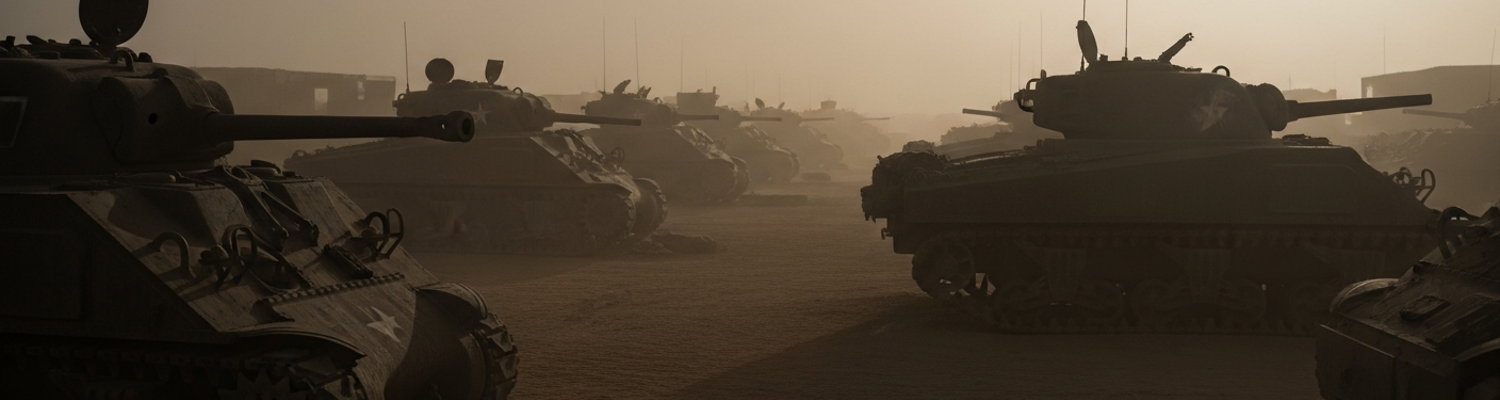
An audit of the quieted battlefields revealed an arsenal on the verge of mechanical collapse. The final offensive had consumed the functional service life of hundreds of vehicles. Maintenance logs from the US 1st Armored Division and British IX Corps armored units show a force that was largely fought out. M4 Sherman tanks, critical to the breakthrough, were sidelined in depots with final drive failures, engines choked by fine dust, and suspensions shattered by rocky terrain. A significant number of tanks still running had worn their tracks and road wheels to destruction. The constant movement had left maintenance battalions with a backlog of repairs that was impossible to clear. The state of the soft-skinned transport fleet was equally dire. Trucks and half-tracks were crippled by months of overuse on primitive roads. The cessation of hostilities allowed ordnance teams to finally conduct a full triage of their equipment. The level of attrition revealed would have severely hampered any immediate follow-on operations. The army that existed on paper in London was, on the ground in Tunisia, fought-out.