
Battleship Bombardment Aftermath and Airfield Triage
Silence returned as an ear-splitting shock at 0230.
Rebuilding an operational naval strike flight out of Henderson Field by sunrise was a mathematical impossibility. When examining the historical record of the Pacific War, no land-based airfield absorbed naval gunfire of this caliber. Vice Admiral Takeo Kurita had parked the battleships Kongo and Haruna less than sixteen thousand yards offshore. They sat unmolested by American shore batteries. Their turrets angled directly down the alignment of the single east-west runway. Between 0120 and 0230 on October 14, 1942, these two dreadnoughts fired 918 rounds of 14-inch shells onto the perimeter. Kurita's gunners alternated between standard Type 0 high-explosive rounds and Type 3 incendiary shrapnel projectiles. The latter were known as San Shiki shells. They were packed with hundreds of burning steel cylinders designed to shred unarmored aircraft skins across wide areas. The explosive tonnage tore twenty-foot-deep craters through the coral subgrade. It sheared through underground telephone lines connecting the marine command post at Pagoda Hill. Entire engineering dispersal compounds vaporized. Japanese spotter aircraft coordinated corrections over open radio channels until the barrage ceased precisely at half past two in the morning.
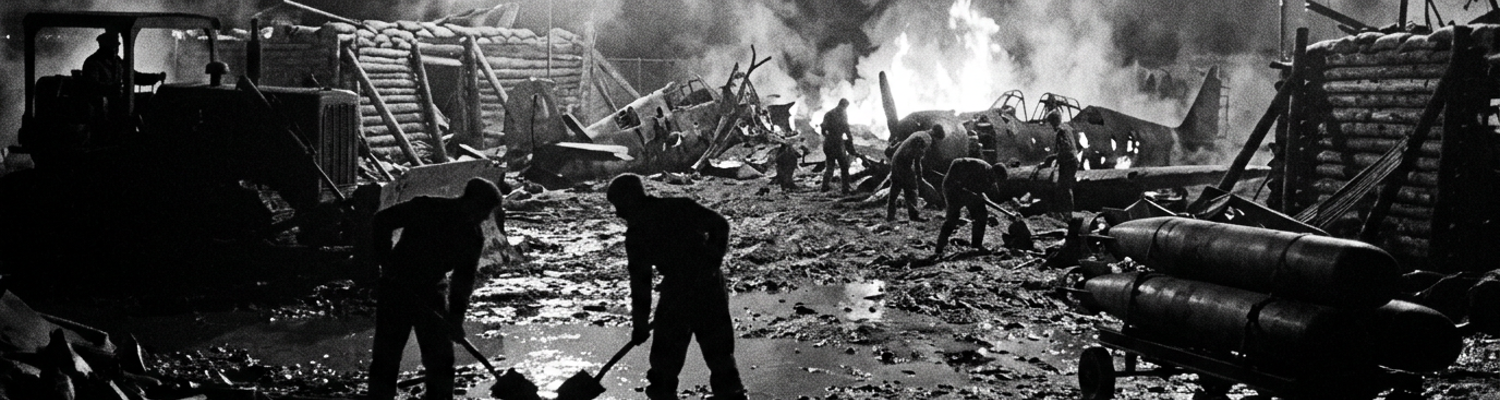
Archival evidence shows that Torpedo Squadron 8 revetments along the southwest sector of the Lunga perimeter absorbed several direct hits. Severe earth displacement followed. The squadron had parked its Grumman TBF-1 Avengers within U-shaped earthen revetments reinforced with coconut palm logs. The concussive blast pressure of 1,400-pound naval projectiles breached these fortifications with mechanical ease. Blast waves collapsed the retaining berms inward. Hundreds of tons of pulverized clay and mud dumped directly onto the flight controls, engine cowlings, and exposed cockpits. Mechanics digging through the debris found sheared oleo struts. They found ruptured hydraulic lines running to the wing-fold assemblies. Wright R-2600-8 engines sat packed solid with volcanic dirt. Shrapnel had perforated the self-sealing rubber fuel bladders inside the center wing sections. Heavy timbers crushed the dorsal gun turrets. Squadron enlisted ratings scrambled into the pits. They were forced to use entrenching tools and bare hands to locate serial numbers on buried tails. They evaluated which airframes were salvageable and which were reduced to scrap iron.
Only three of the squadron's airframes still possessed intact landing gear.
A close review of operational logs indicates that illumination over the shattered airfield did not vanish when the guns ceased fire. Japanese floatplanes had suspended dozens of magnesium parachute flares above the tree line. These drifted slowly on the light thermal currents. They cast a harsh white glare across the pulverized flight line. Below them, thousands of gallons of 100-octane aviation fuel burned unchecked. The fuel bled from ruptured 55-gallon drum dumps situated along the taxiways. Thick black smoke from the petroleum fires swept across the main strip. It mingled with white-hot magnesium vapor and the stench of scorched cordite. Ground personnel emerging from shallow dirt trenches looked out onto an airfield where the crushed coral runway was impassable. It was covered in jagged naval shell splinters, splintered timber, and burning rubber. Every square yard of the revetment area lay coated in fine grey dust. This dust fouled delicate ignition harnesses and choked open carburetor intakes.
The maintenance crews had exactly three hours until dawn.
Structural Assessment of Buried Avenger Airframes
Every surviving airframe sat pinned beneath tons of collapsed fortifications.
When examining the historical record of the Lunga dispersal bays, the structural failure of the revetments was complete. Marine engineers had constructed these defensive pens using horizontal coconut palm retaining walls. These were pinned by vertical timber pilings and backed by eight-foot mounds of excavated coral fill. Shockwaves from 14-inch naval impacts fractured the twelve-inch diameter logs into splinters. This dumped hundreds of cubic yards of saturated volcanic clay directly across the parked aircraft. Grumman built the TBF-1 Avenger with an all-metal cantilever mid-wing configuration capable of carrying heavy torpedo payloads. The airframe was never stressed for downward static loads of this scale. In revetment four, a collapsed timber beam smashed through the canopy greenhouse. It severed internal instrument linkages and crushed the pilot seat armor plate downward into the cockpit floor. Wet coral muck filled the engine cowlings. It submerged the dual ignition magnetos. It pushed cylinder baffling out of alignment and packed the induction scoops of the Wright R-2600-8 engines. Blast displacement drove the outer wing panels upward past their locking pins. This sheared the internal hydraulic wing-fold actuators and bent the main hinge pins inside the center-section carry-through spars.
Triage eliminated half the squadron in twenty minutes.
Archival evidence shows that Torpedo Squadron 8 maintenance personnel conducted minute-by-minute structural assessments in pitch darkness. They had to distinguish repairable aircraft from terminal write-offs. Petty officers crawled along twisted fuselage skins using shielded flashlights. They ran bare hands across the outer aluminum plating to detect structural distortion. Wrinkled skin panels along the dorsal spine indicated that the main fuselage truss had suffered catastrophic torsional buckling. This rendered an airframe unairworthy regardless of engine condition. Mechanics pulled out inspection mirrors to examine the main wing spar attachment points at the fuselage station 112 bulkhead. If the 24ST aluminum spar webs exhibited hair-line cracking around the lower trunnion bolt fittings, the aircraft was condemned immediately. Squadron leaders made harsh tactical determinations at each dispersal pen. They wrote off five crushed Avengers to preserve the remaining three. Mechanics marked write-off airframes with white grease pencil on their rudders. This signaled scavenge crews to strip them of functional components. Ground ratings unbolted unbent variable-pitch Hamilton Standard propeller blades. They removed siphon lines, engine cowl flaps, and intact Stromberg carburetors from the dead airframes. They transferred the parts to the few machines that stayed intact.
A close review of operational logs indicates that the primary physical crisis centered on the undercarriage assemblies. Tropical rains had combined with high-explosive crater displacement. This flooded the revetment drainage trenches with two feet of stagnant water, thick mud, and raw 100-octane fuel. Ground ratings dropped into these flooded trenches with entrenching spades, steel pry bars, and bare hands. They dug out the trapped landing gear before Japanese air units launched their standard dawn counter-strikes from Rabaul. Hydraulic jacks hauled from the maintenance tents failed instantly. They sank eighteen inches into the liquefied coral soup under the Avenger's eight-ton empty weight. Enlisted mechanics scavenged ruptured pierced-steel landing mats from the runway edge. They slid the interlocking metal planks into the muck beneath the jack footplates to establish firm bases. Workers chipped hardened mud out of the oleo strut scissors. They flushed grit from the wheel hubs with gasoline drained from severed fuel lines. They pumped emergency manual hand hydraulic valves to verify down-and-locked indicators. Time was fixed against the 0530 sunrise. Eleventh Air Fleet Mitsubishi G4M bombers and carrier-borne dive bombers were expected over Savo Island within thirty minutes of dawn.
Work on the third aircraft ended when the manual extension linkage snapped at 0415.
Field Cannibalization of Hydraulic Systems
Replacement tubing did not exist on Guadalcanal.
Archival evidence shows that Torpedo Squadron 8 mechanics systematically stripped intact hydraulic manifolds and control linkages from burned-out fuselages scattered across the Lunga perimeter. Working inside shell-cracked revetments, aviation machinist ratings unbolted four-way directional control valves. They removed bomb-bay door selector assemblies and main wing-fold distribution manifolds from aircraft gutted by Japanese 14-inch naval fire. Grumman designed the TBF-1 hydraulic system to run at an operating pressure of 850 to 1,000 pounds per square inch. This depended on engine-driven pump output. Shrapnel had punctured the exposed aluminum lines snaking along outer wing panels. The heavy armor plate protecting the forward firewall preserved several internal valve blocks. Ratings used open-end wrenches to back off stripped B-nuts on flared half-inch tubing. They caught escaping fluid in tin ration cans. Ground crews drained contaminated hydraulic oil from cracked reservoirs. They strained the red fluid through cotton undershirts to filter out coral dust and paint flakes. Enlisted men severed jammed push-pull elevator rods using hacksaws. They transferred unbent sections into surviving airframes to re-establish manual flight control connectivity.
When examining the historical record of the Cactus Air Force, Japanese naval dominance along New Georgia Sound cut off all standard maritime resupply. Deprived of regular logistics across the Slot, ratings combined parts from multiple damaged airframes into single operational aircraft. Aviation metalsmiths unriveted bent outer wing sections from three separate TBF-1s. They selected the least damaged structural components to rebuild one flight-capable assembly. In revetment two, ground crews attached a port main wing pulled from Bureau Number 00380 onto the center section of Bureau Number 00497. Mechanical fasteners posed an immediate crisis. Ratings extracted AN-standard bolts from charred empennages. They cleaned damaged threads with hand dies before torquing them into replacement wing-root fittings. Where correct aviation-grade hardware was exhausted, mechanics stripped grade-five steel bolts from disabled Marine Corps diesel generators and bulldozers. Actuating cylinders from shattered undercarriage assemblies were disassembled on dirty canvas tarps. They were rebuilt using salvaged O-ring seals and fitted onto surviving landing gear legs.
Four dead airframes yielded one flyable machine.
A close review of operational logs indicates that complex Grumman avionics and radios were pulled from shrapnel-torn cockpits. They were cleaned using dry rags and solvent. Naval shell splinters had shattered the greenhouse plexiglass across the squadron dispersal line. This sprayed glass dust, coral grit, and acid into radio racks mounted behind the pilot bulkheads. Avionics ratings leaned inside the blood-stained cockpits to disconnect wiring looms from ARC-5 communication sets and RU-16 receiver units. With no repair benches available, technicians positioned themselves beneath canvas blackout shelters. They tore down receiver chassis under shielded red flashlights. Ground personnel used carbon tetrachloride solvent and dry cotton rags to strip corrosive salt residue. They removed powdered coral and oil soot from variable tuning capacitors. Technicians separated jammed relay points with pocket knives. They scraped oxidation off copper contacts before testing circuit continuity with handheld battery meters. Antennas severed by shell fragments were spliced together using twisted copper wire. They were wrapped with friction tape to restore high-frequency transmission capability before daybreak.
The radio receiver in Bureau Number 00380 passed its power test at 0450.
Manual Fuel Filtration and Revetment Logistics
Water in the fuel line meant an engine cut out at fifty feet.
When examining the historical record of fuel logistics on Guadalcanal, the primary aviation fuel reserves along the northern taxiways suffered direct destruction during Kurita's bombardment. Japanese high-explosive ordnance ruptured fuel caches dispersed through the jungle fringe near the fighter strip. This turned supply dumps into flaming craters. Hundreds of standard 55-gallon steel drums stacked beneath camouflage netting were perforated by high-velocity steel splinters. This released thousands of gallons of volatile 100-octane gasoline across the soaked soil. Torrential rainfall pooling in the fresh shell craters mixed directly with the leaking fuel. It churned a toxic mixture of water, volcanic silt, and pulverized coral dust into the ruptured containers. Navy fuel supply officers discovered that nearly seventy percent of the remaining surface drum supply contained high concentrations of suspended grit and free water. Running this contaminated fuel through a Wright R-2600-8 Cyclone engine meant instantaneous failure. Suspended silica particles would score the internal impellers of the Pesco engine-driven fuel pumps. Water entering the Bendix-Stromberg PR-58A injection carburetors would disrupt air-fuel mixture ratios. This caused complete vapor lock and cylinder detonation across the eighteen-cylinder radial bank.
Archival evidence shows that maintenance ratings improvised a field filtration system. They used hand tools and raw materials salvaged from supply lockers. Working inside blacked-out revetments under the constant smell of fumes, ground personnel clamped natural chamois skins across the rims of wide galvanized steel funnels. Properly wetted chamois used surface tension to allow 100-octane avgas through while trapping water and microscopic coral silt. Two-man teams tipped partially breached 55-gallon drums across wooden sawhorses. They poured the discolored fluid into the funnels suspended over open five-gallon galvanized buckets. Gravity filtration progressed at a grueling rate of barely two gallons every three minutes. Corrosive grey silt formed a dense sludge across the leather grain. This required mechanics to lift the chamois every five gallons to scrape off caked grit with bayonets. They flushed the leather pores with splashes of clean fuel. Static electricity posed an immediate explosion hazard. Crewmen wrapped ground wires around the funnel stems and drove iron spikes into the mud to dissipate surface charges.
A single spark would ignite the entire revetment.
A close review of operational logs indicates that ground crews transferred every gallon of purified avgas to the surviving aircraft through sheer physical exertion. Grumman built the TBF-1 to hold 335 gallons of fuel within its self-sealing rubber wing tanks and main center-section cell. This required nearly seventy bucket transfers per aircraft. With all motorized fuel bowsers destroyed and mechanical hand pumps jammed with debris, enlisted mechanics formed bucket brigades. They moved through deep mud churned up by the bombardment. Men hauled five-gallon buckets weighing thirty pounds each across two hundred yards of cratered ground between the filtration points and the revetments. Physical exhaustion was severe among ratings who had spent two hours under 14-inch naval fire. These men had to scale slippery aluminum wing roots. They balanced on narrow rubber walkway treads while hoisting open buckets up to chest height. Pours had to be slow and steady through secondary hand strainers into the wing filler necks. This prevented splashing fuel across hot cowl surfaces or stripped wiring looms. Hand filtration and manual filling continued past five in the morning to service three operational Avengers before sunrise.
The wing tanks of Bureau Number 00497 reached capacity at 0512.
Torpedo Gyroscope and Exploder Calibration
Grit inside the tail assembly turned a one-ton weapon into dead iron.
When examining the historical record of Torpedo Squadron 8 ordnance division, the battleship barrage had inundated the subterranean munitions shelters. They were filled with fractured coconut logs and liquefied earth. Aviation ordnancemen dragged four Mark 13 Mod 0 aerial torpedoes out from beneath the collapsed timber roofs of the weapon revetments at 0340. Saturated volcanic silt had forced past the joint rings of the afterbodies. It packed tightly around the steering assemblies. Armorers stripped the bronze casing nuts with open spanners. They completely detached the tail sections to expose the Mark 12 steering gyroscopes. These brass guidance units relied on tiny, high-speed turbine rotors spinning on miniature sapphire pivot bearings. These were mechanisms incapable of tolerating even microscopic grains of silica. Technicians flushed the air jets and rudder actuator pushrods with dry cleaning solvent siphoned from broken maintenance kits. Small dental scrapers and camel-hair brushes were used to clear mud from the gimbal bearings. This ensured the directional air nozzles could pivot freely without binding against the steering plates. Any friction in the rotor frame meant the weapon would enter a fatal turning circle immediately after dropping into Ironbottom Sound.
Archival evidence shows that ordnance ratings performed delicate adjustments on the torpedo exploders inside semi-flooded storage bunkers. They used only battery-powered battle lanterns. Torpedo Squadron 8 held five Mark 4 Mod 1 contact exploder mechanisms in dry boxes. Blast overpressure had cracked their moisture seals and caked the firing pins with pulverized coral dust. Working inside a collapsed dugout whose timber ceiling sagged under three feet of earth, technicians unthreaded the base rings. They extracted the firing pin sleeves and inertia weights. Enlisted specialists checked spring tensions against field manuals under the weak beam of a single sealed-beam lantern. They knew an overtightened spring would prevent detonation upon ship impact. A slack spring would trigger premature explosions upon water entry. Mechanics reset the arming impeller shaft clearances using brass feeler gauges. They scraped rust flakes from the firing plungers with straight razors. Men sat directly on live 400-pound TNT warhead casings to steady their trembling hands in the damp heat. Calibration completed on the third exploder mechanism precisely at 0445.
A single slip of a screwdriver risked detonating four hundred pounds of cast explosive.
A close review of operational logs indicates that surviving maintenance personnel transferred three assembled Mark 13 torpedoes across two hundred yards of bomb craters. They had to reach the flight line. Flight crews required these weapons loaded before dawn. They were ordered to strike six Japanese army transports approaching Tassafaronga Point under the escort of destroyer leader Naganami. Without tractors or bomb trucks, ratings wrestled the 1,949-pound torpedoes onto wooden skids. They dragged each weapon through hub-deep mud using hemp towing hawsers. Ground crews positioned the torpedoes directly beneath the open bomb bays of Bureau Numbers 00380 and 00497 inside the western revetments. Mechanics hooked Mark 7 hand winches to the overhead structural hardpoints inside the Grumman fuselages. They dropped steel hoist cables around the torpedo belly bands. Four men cranked each manual winch handle simultaneously. They levered the heavy weapons upward an inch per pull. The bomb bay doors of Bureau Number 00497 locked shut over its payload at 0528.