
Northern Pacific Island Bastions and Expeditionary Deadlines
At 0417 Zulu.
The telemetry downlink flattened into unbroken static across the super-high-frequency receiver. This severed the forward detachment on Shemya Island from Pacific Fleet command.
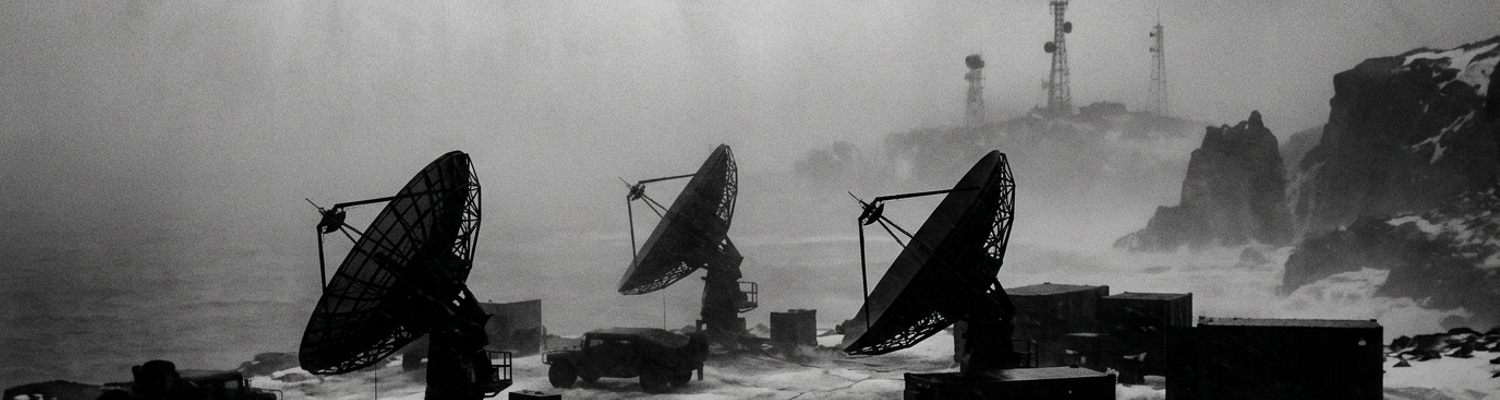
A close review of operational logs indicates that engineering crews faced an uncompromising sixty-hour deadline. They had to pull functional signals out of that void. The transport aircraft touched down on the frozen runway at Eareckson Air Station. The clock began running against Naval Mobile Construction Battalion personnel. Technical specialists from the 354th Communications Squadron joined them on the tarmac. Fleet commanders demanded an operational extremely-high-frequency link established across the Aleutian chain. This was required before the opening phase of the renewed fleet maneuvers. Ground crews worked through continuous fifty-knot crosswinds. They assembled the transportable AN/USC-38 satellite communication terminals.
Sub-zero temperatures caused the synthetic rubber hydraulic seals on the antenna elevation drives to harden.
They split during initial mechanical articulation. Mechanics burned through their spares inventory within twelve hours. They heated replacement gaskets over portable naphtha stoves inside unheated Jamesway huts. Grounding rods could not penetrate the three feet of iron-hard permafrost without heavy pneumatic drills. These drills repeatedly seized as condensation froze inside the air lines. At hour thirty-four saltwater intrusion disabled two primary MEP-806B diesel generator sets. Technicians spliced power feeds directly into the decaying island power grid under driving sleet.
The countdown granted zero operational margin for physical material failure.
Archival evidence shows that this extreme operational posture was dictated by the deliberate resurrection of the northern Pacific maneuver corridors. These were first mapped during Fleet Problem XVI. Back in May 1935 the United States Navy sent dozens of vessels into the fog-shrouded waters between Dutch Harbor, Midway, and Oahu. They evaluated fleet endurance along high-latitude subarctic axes. Modern operational planners extracted those exact pre-war maritime axes north of the 50th parallel. They routed carrier battle groups through the Aleutian trench. This tested theater-wide dispersion under contested electromagnetic conditions. High-latitude geometry severely degraded conventional orbital paths. Task force commanders relied on the polar coverage capabilities engineered into the newly launched Milstar Flight 1.
Fleet Problem XVI had exposed the severe toll of freezing spray and heavy sea swells on mechanical systems.
The resurrected exercise sought to prove that modern digital command-and-control networks could overcome those historical physical vulnerabilities. Strike group commanders running out of Adak and Cold Bay had strict orders to maintain complete radio silence. They bet the entire exercise architecture on the timely activation of the island-based terminal dishes.
Electronic warfare staff officers in Hawaii tracked the fleet movements exclusively through those fragile ground links.
When examining the historical record from the Adak deployment site the physical limits of the terrain proved nearly fatal to the timeline. Concrete footing pads poured for the heavy radar tracking pedestals at 51 degrees 52 minutes North latitude cracked along their stress lines within six hours. Rapid-cure chemical additives reacted poorly with the moisture-saturated volcanic peat. Field engineers scrambled to anchor the heavy steel tripods. They used aircraft tie-down chains bolted into fractured basalt outcroppings. By hour fifty-two technicians manually turned the directional feed horns toward the calculated orbital slot. They struggled against violent gusts that threatened to warp the carbon-fiber dish panels. The final low-data-rate handshake was logged at hour fifty-eight. This was just two hours before carrier strike aircraft launched into the subarctic sky.
Cold War Origins and Milstar DFS-1 Development
When examining the historical record of the Air Force Space Division at Los Angeles Air Force Station the architectural foundation of the program formally began in 1982. Direct presidential guidance mandated the securement of nuclear command and control. Strategic planners recognized that existing Defense Satellite Communications System nodes would degrade rapidly during a high-altitude nuclear detonation. Milstar was engineered to guarantee unbroken contact between the National Command Authorities and Strategic Air Command missile wings in Minot and Malmstrom. EC-135 Looking Glass airborne command posts and ballistic missile submarines operating under Arctic ice required the same connectivity. Designers rejected vulnerability to terrestrial relay destruction. They engineered autonomous 60-gigahertz crosslinks that routed signals directly between spacecraft in geosynchronous orbit.
Ground stations did not need to coordinate transmission paths.
Spacecraft electronics were shielded with heavy tantalum layers. Circumvention circuits automatically severed power lines within fractions of a microsecond during ionizing gamma flashes. This prevented component burnout. To prevent directional blinding from hostile interference the system incorporated automated nulling antennas. These shifted reception patterns away from ground-based emitters in milliseconds. Operating on extremely high frequencies of 44 gigahertz uplink and 20 gigahertz downlink the satellite utilized narrow spot beams and rapid frequency-hopping algorithms. These cut through Soviet electronic warfare networks.
Survival across a prolonged nuclear exchange drove every single drafting decision.
Archival evidence shows that this extreme doctrinal mandate trapped the spacecraft in a grueling twelve-year procurement cycle. Relentless redesigns plagued the timeline. Lockheed Missiles and Space Company secured the prime contract in 1983. They intended the satellite for launch inside the payload bay of the Space Shuttle. The loss of the Challenger orbiter in January 1986 obliterated that deployment schedule. Engineers rebuilt the spacecraft bus for the untried Titan IV booster. When the Soviet Union collapsed in 1991 congressional committees challenged the justification for a multi-billion-dollar strategic communications platform built solely for an atomic exchange. Lawmakers slashed funding. They demanded immediate tactical utility for expeditionary field units.
Program managers responded by splintering the contract.
They stripped out planned tactical capabilities to rush the initial low-data-rate configuration into production as Milstar Flight 1. The subsequent restructuring eliminated high-risk components. Engineers grafted low-data-rate digital processing equipment onto a satellite frame originally slated for heavier high-data modules. Technicians at Sunnyvale continuously tore down and rebuilt the internal chassis wire harnesses. They aligned them with shifting Department of Defense specifications. Months were lost to testing anomalies in cleanroom facilities.
Each administrative revision compounded the physical weight of the airframe.
A close review of operational logs indicates that the payload weight expansion nearly exceeded the throw-weight capacity of operational boosters. TRW delivered an electronic payload packed with armored traveling wave tubes. Automated signal processors and mechanical steerable antennas doubled early engineering mass estimates. Weight projections grew by over forty percent across the design phase. Structural engineers replaced planned composite struts with reinforced high-load aluminum alloys that elevated dry weight. Radiation shielding and thick beryllium support frames pushed the total wet mass of Development Flight Satellite 1 to 10,200 pounds. Dual 120-pound-force thruster systems added further bulk.
Titanium propellant tanks were enlarged.
They carried enough hydrazine and nitrogen tetroxide to execute the orbital insertion burn into geosynchronous drift. This added hundreds of pounds of volatile chemical propellant. Martin Marietta propulsion engineers discovered that this payload bulk left zero safety margin for the Titan IV-Centaur launch vehicle sitting on Launch Complex 40 at Cape Canaveral. Thermal vacuum chamber runs conducted at minus 150 degrees Celsius caused the feed horn structural brackets to warp. The uneven mass distribution of the expanding sensor package caused this distortion. Assembly teams milled down secondary titanium mounting brackets by fractions of a millimeter to shed critical structural ounces. DFS-1 finally rolled out to Launch Complex 40 carrying 3,600 pounds of volatile liquid propellants in its titanium fuel cells.
Travelling Wave Tube Amplifiers and Launch Integration
A close review of operational logs indicates that the primary engineering hazard within the satellite communications payload lay inside the traveling wave tube amplifiers. TRW built these units in Redondo Beach. During thermal vacuum chamber testing at the Lockheed Sunnyvale facility the high-power vacuum tubes driving the 20-gigahertz downlinks and 60-gigahertz crosslinks routinely breached maximum operating temperature thresholds.
These tubes were designed to generate the radio-frequency energy required to penetrate dense Arctic weather.
The collector cores of the tubes radiated concentrated thermal energy directly into the enclosed electronics chassis. Standard aluminum-ammonia heat pipes could not transfer the thermal flux away from the radio-frequency components fast enough under simulated orbital vacuum conditions. Thermocouples embedded along the amplifier mounting plates recorded junction temperatures spiking above 85 degrees Celsius. This threatened to soften the high-voltage potting compound. It also threatened to crack the ceramic vacuum envelopes and cause internal electrical breakdown across the electron guns. Ground technicians detected localized thermal runaway within forty-five minutes of continuous transmission testing at full operational wattage.
Heat rejection margins dropped to zero.
Archival evidence shows that resolving this thermal failure forced Air Force Space Systems Division managers to alter the physical architecture of the spacecraft bus six months before delivery. Lockheed engineers stripped off the secondary passive radiator blankets. They replaced them with silverized quartz optical solar reflector tiles glued across the north and south equipment panels. Mechanics bonded thick copper-braided thermal straps between each traveling wave tube assembly and the external heat-sink radiators. They hand-shimmed the gaps to ensure uninterrupted conductive pathways across the chassis.
Command personnel accepted severe tactical trade-offs.
They ordered TRW to rewrite the internal payload flight software to introduce automated thermal duty-cycling. These microcode routines continuously polled the onboard thermal sensors. They automatically throttled the amplification output or switched to low-power modes if any tube exceeded 78 degrees Celsius. This deliberately cut signal margins over polar coverage sectors to protect tube cathodes. The modified satellite cleared thermal vacuum qualification with a margin of three degrees Celsius.
When examining the historical record from Launch Complex 40 at Cape Canaveral Air Force Station integration with the launch stack exposed the vehicle to severe mechanical and thermal risks. On February 7 1994 the 45th Space Wing prepared to launch Milstar DFS-1 aboard a Titan IV 401A booster designated vehicle K-10. Weighing 10,200 pounds the satellite was the heaviest military communications payload ever placed onto an expendable booster. It was encapsulated inside an eighty-six-foot bisector fairing atop a Martin Marietta Centaur-T upper stage. Pad technicians monitored ambient temperatures inside the fairing continuously. Thermal build-up threatened to overheat the satellite sensor arrays prior to mobile service tower retraction. Two solid rocket motors ignited at 1647 Eastern Standard Time. Each generated 1.7 million pounds of thrust. They lifted the 1.9-million-pound vehicle off the pad along an eastern flight azimuth.
Centaur-T stage engines ignited three separate times across five hours of flight.
Following solid motor burnout and stage-one separation the twin Pratt and Whitney RL10A-3-3A engines on the Centaur executed their initial burn. They reached an eighty-nautical-mile parking orbit. Liquid hydrogen and liquid oxygen burns were timed precisely to prevent propellant boil-off while the stage coasted through space. A second burn propelled the stack into an elliptical geosynchronous transfer orbit. A final apogee burn circularized the trajectory directly into geostationary orbit at 35,786 kilometers altitude over the equator. Pyrotechnic separation nuts fired at 2215 Zulu to release the payload into its assigned Pacific orbital slot. The satellite stabilized in zero gravity with all payload solar arrays locked in stowed positions. Telemetry confirmation arrived at the Sunnyvale Satellite Test Center sixteen seconds later.
Island Ground Terminal Failures and Environmental Attrition
A close review of operational logs indicates that the physical instability of the subarctic soil profile systematically broke the geometric pointing accuracy of the ground terminals. On Shemya Island positioned at 52 degrees 43 minutes North and 174 degrees 07 minutes East the expeditionary communications team anchored their transportable AN/USC-38 terminals across an eight-inch gravel pad. This pad was laid over active-layer muskeg tundra. Sustained sub-zero gale winds exerted cyclic aerodynamic loading on the eight-foot parabolic dishes. This drove repetitive mechanical oscillations down through the tripod support struts directly into the loose crushed-rock substrate.
Daily temperatures hovered near freezing.
Solar radiation and engine exhaust from nearby support vehicles melted the top twelve inches of permafrost. Trapped meltwater could not drain downward through the underlying basalt rock layers. Pore-water pressure surged within the saturated gravel matrix under the continuous vibration of the antenna drive motors. This triggered localized liquefaction across the foundation beds within forty-eight hours of setup. The gravel base lost shear strength. Terminal mounting legs settled unevenly by up to four inches. This introduced an uncorrected 1.8-degree physical tilt into the tracking pedestal elevation assemblies. The 44-gigahertz uplink beam possesses an angular half-power beamwidth of less than 0.6 degrees. This structural displacement completely broke the closed-loop tracking lock with Milstar DFS-1.
Antenna autotrack systems could not compensate for footings sinking into liquefied mud.
When examining the historical record from the Naval Mobile Construction Battalion detachment at Adak field engineers attempted to arrest the tilting pedestals through aggressive physical shoring. Seabees hauled sixty tons of quarried riprap to backfill the sinking pad perimeters. They drove steel pickets ten feet into the saturated volcanic silt to lash down the terminal frame with high-tensile steel aircraft cables. Every time an antenna stepped its tracking servos to follow the slight orbital inclination drift of the satellite the unbalanced torque caused the structural pads to lurch again. Technicians from the 354th Communications Squadron were forced to disconnect the automated tracking gyros. They entered the elevation and azimuth offsets manually every fifteen minutes using handheld optical inclinometers exposed to sixty-knot wind chills.
Alignment errors continuously threw the transmission sidelobes into open ocean space.
Archival evidence shows that atmospheric chemistry ruined the terminal weather shielding just as rapidly as the ground gave way beneath it. Aleutian storm fronts swept dense marine fog containing high concentrations of suspended sea-salt aerosols across the coastal bluffs. This drenched the exterior antenna assemblies in corrosive brine. The synthetic elastomeric seals lining the tactical radome shell panels deteriorated under this chemical bath. They shed their hydrophobic coatings within thirty-six hours of continuous exposure. Salt crystals accumulated inside the microscopic seal joints. They hardened into abrasive crusts that split the vulcanized rubber gaskets under persistent wind buffeting. Saturated ocean air pushed past the compromised seams directly into the radome interior. It coated the parabolic dish surface and the corrugated horn feed with a conductive salt glaze. This induced severe radio-frequency attenuation across the 20-gigahertz downlink band.
Simultaneously wind-driven surf and airborne salt spray penetrated the louvered air-intake baffles of the MEP-806B sixty-kilowatt tactical diesel generator sets. These were positioned fifty yards upwind. Seawater droplets bypassed the primary moisture separators. They deposited corrosive sodium chloride deposits across the copper windings of the alternators and grounded out the solid-state voltage regulators. Corrosive moisture entered the fuel-injection pump housings through unsealed breather vents. This caused internal mechanical binding within the fuel distribution plungers. At 1840 Zulu both primary generators suffered excitation loss within eleven minutes of each other. This sent uncontrolled electrical surges through the terminal power distribution panels. It fried the step-down transformers supplying the high-power traveling wave tube power supplies.
Coordinated Peer Electronic Barrage Jamming Threats
A close review of operational logs indicates that the electronic engagement began at 0422 Zulu. High-power noise transmitters along the Chukotsk and Kamchatka coasts opened multi-axis barrage broadsides against the 44-gigahertz uplink receiver package of Milstar DFS-1. Coordinated shore installations focused narrow-beam radio-frequency energy across the entire uplink spectrum. This saturated the multi-beam antenna front end of the spacecraft. High-wattage traveling wave tubes stationed near Cape Dezhnev and Petropavlovsk synchronized their output. They projected continuous broadband white noise directly into the orbital intercept window. This focused radiation raised the system noise floor by thirty-two decibels across a four-hundred-megahertz bandwidth.
Gallium arsenide low-noise amplifiers in the satellite receiver bays were driven into non-linear gain compression within sixty seconds of transmission initiation.
The onboard circumvention circuits attempted to mitigate the input overload. The rapid cross-axis phasing prevented the analog gain stages from stabilizing. Automated gain control loops pinned at maximum attenuation. Signal processors failed to resolve the pseudo-random frequency-hopping sequence beneath the artificial electromagnetic floor.
The spacecraft processor dropped ninety-six percent of incoming command frames.
When examining the historical record from the 4th Satellite Operations Squadron at Falcon Air Force Base orbital analysts attempted emergency reconfiguration of the adaptive nulling antenna array on the spacecraft. Command teams transmitted override strings through protected S-band tracking telemetry and control downlinks. They forced the physical feed horns into modified geometric orientations. The mechanical actuators drove the nulling reflectors by fractions of an arcsecond. They placed synthesized reception notches over the terrestrial emitter coordinates at 64 degrees 45 minutes North and 177 degrees 30 minutes East. Null steering algorithms required clean phase differentiation between the authentic signal sources and hostile noise fields. The opposing emitters broadcast simultaneously from three separate geographic azimuths separated by hundreds of nautical miles. The spatial filter failed to resolve discrete nulling vectors. Internal servomotors on the antenna gimbal mounts overheated under continuous recalibration cycles. Commands sent by space system engineers at hour forty-one to switch the satellite payload to localized spot-beam modes failed to reach the input buffer.
The receiver architecture remained blinded across the entire Pacific subarctic sector.
Terminal handshakes ceased entirely.
Archival evidence shows that arctic meteorological phenomena magnified this electronic disruption through severe physical signal attenuation. Across the Aleutian operating area an intense subarctic frontal boundary generated a dense ceiling of supercooled liquid water droplets. Maritime sleet and freezing fog stretched from sea level up to eighteen thousand feet. Millimeter-wave signals operating at 44 gigahertz suffer extreme dielectric losses when propagating through suspended moisture. Liquid water densities inside the cloud layers exceeded 1.8 grams per cubic meter along the line of sight between the ground stations and the geosynchronous orbital slot. Atmospheric absorption stripped eighteen decibels of radio-frequency energy from the uplink transmission path before the signal could exit the troposphere. Marine boundary layer temperature inversions formed anomalous radio refractivity gradients across the Shemya sector. These conditions bent the physical propagation path. They generated severe multi-path phase cancellation that distorted the incoming waveforms.
At the naval communications facility on Adak technicians measured link margins degrading past all engineering tolerance limits. Tropospheric attenuation interacted directly with the synthetic noise floor. Downlink reception at 20 gigahertz lost twenty-one decibels to heavy wet snow accumulation on the radome exterior panels. This reduced carrier-to-noise density ratios below thirty-eight decibel-hertz. Digital demodulators inside the AN/USC-38 terminals could not hold bit synchronization. Bit error rates spiked from nominal values of ten to the minus six straight to ten to the minus one within twelve minutes. This scrambled the digital message packets before cryptographic decryption units could process the framing headers. Fleet units operating south of the Andreanof Islands attempted to compensate by driving terminal traveling wave tube power outputs to maximum limits. The thermal protection relays on three ground-based power amplifiers tripped on over-temperature alarms at 51 degrees 53 minutes North latitude.
Improvised Orbital Reconfiguration and Antenna Nulling
A close review of operational logs indicates that at 0514 Zulu orbital controllers from the 4th Satellite Operations Squadron at Falcon Air Force Base initiated manual dynamic antenna nulling sequences. They needed to recover the blinded uplink receiver of the spacecraft. Hostile ground emitters broadcasting from coastal sites near Cape Dezhnev and Petropavlovsk continued to flood the 44-gigahertz front end with continuous wideband noise. Orbiting at 35,786 kilometers above the equator Milstar DFS-1 relied on an adaptive multi-beam antenna array comprised of nineteen individual feed horns mapped across the earth disk. Satellite operators bypassed the frozen onboard autonomous tracking routines. They calculated complex phase-shift profiles by hand on terrestrial mainframe consoles to depress reception sensitivity along specific northern azimuths.
Ground controllers systematically altered the phase and attenuation weights across the variable power dividers feeding the central antenna array.
They projected deep mathematical nulls down to minus thirty-eight decibels directly over the coordinates of the Chukotsk electronic warfare complexes. Each adjustment required delicate balancing. Driving a deep reception notch over northeastern Siberia degraded the reception beam perimeter along the Aleutian chain. This shrank the operational link margin for the transportable terminals on Shemya and Adak down to 1.2 decibels.
Phase calibration loops failed twice under rapid manual stepping.
Technicians persisted. They micro-stepped the digital beam-forming networks through real-time telecommand sequences to carve out the interference sectors without dropping coverage over the northern Pacific maneuver corridor. Ground operators routed command sequences through the 21-meter antenna at the New Hampshire Tracking Station. They transmitted encrypted S-band commands at one-second intervals to adjust the feed-horn phase states. Gallium arsenide variable-gain stages within the spacecraft payload responded to the revised coefficient tables. They pulled the input low-noise amplifiers out of deep saturation by 0548 Zulu. The artificial noise floor inside the 44-gigahertz receiver dropped by twenty-four decibels across the Pacific subarctic sector. This restored the ability of the satellite to lock onto the low-power frequency-hopping preambles generated by isolated naval units.
Archival evidence shows that restoring data throughput across the task force required raw binary modifications to the operational flight software governing the inter-satellite links of the satellite.
Engineers at the Space and Missile Systems Center discovered that DFS-1 had trapped its internal routing matrix in a recursive processing loop. Designed to route traffic autonomously through 60-gigahertz V-band crosslinks to sister satellites the onboard MIL-STD-1750A payload computers kept dumping incoming low-data-rate message packets into unallocated crosslink transmitter buffers. No second Milstar satellite existed in orbit to close the circuit. The factory microcode mandated inter-satellite handshakes before downlinking fleet-broadcast streams. The communications processor rejected direct loopback paths to terrestrial receivers. Working out of cleanrooms at Sunnyvale software architects wrote an emergency eight-kilobyte binary patch. They rewrote the routing lookup tables stored inside the electrically erasable programmable read-only memory of the spacecraft.
The command upload cleared through Kaena Point in sixteen minutes.
When examining the historical record from the remote tracking station at 21 degrees 34 minutes North and 158 degrees 16 minutes West ground controllers beamed the compiled patch directly into the central memory registers of the satellite over the tracking telemetry and control channel. The uploaded hex code disabled the crosslink polling subroutines entirely. It forced the payload digital signal processor to bypass the vacant 60-gigahertz transmitter bays and cross-connect all demodulated uplink packets directly into the 20-gigahertz downlink framing hardware. Technicians executed a memory dump to verify byte integrity across the modified address blocks at 0612 Zulu. DFS-1 re-established low-data-rate teletype channels at 2,400 bits per second to the carrier battle group operating at 51 degrees 30 minutes North and 176 degrees 45 minutes West.
Spacecraft Thruster Fuel Depletion and Graveyard Orbit
A close review of operational logs indicates that three decades in the geosynchronous belt steadily degraded the physical subsystems of Milstar DFS-1. Positioned at 35,786 kilometers above the equator the spacecraft absorbed continuous bombardment from trapped electrons and solar protons within the outer Van Allen radiation belt. Cover glass shielding the silicon photovoltaic arrays darkened under this ionizing radiation flux. This reduced solar cell light transmittance by over twenty-five percent. Micrometeoroid impacts eroded the anti-reflective quartz layers across the fifty-foot solar panel wings. They fractured individual semiconductor interconnects and created cascading electrical open circuits. Total bus electrical output dropped from its initial five-kilowatt design rating down toward the absolute three-kilowatt payload operational limit. This compelled orbital controllers to deactivate secondary chassis heaters.
Simultaneously maintaining position inside the designated longitudinal slot consumed an irreplaceable chemical inventory.
Natural gravitational perturbations from the moon and the sun pulled the 10,200-pound frame out of orbital alignment on a bi-weekly basis. The asymmetric shape of Earth contributed to this drift. Countering this continuous inclination drift required regular pulsed burns from the onboard monopropellant hydrazine thrusters of the spacecraft. High-pressure helium pressurant forced liquid propellant through catalytic thruster beds. This steadily wore down the platinum-iridium screens. It vented pounds of volatile propellant into open space with each orbital station-keeping cycle. Telemetry transducers monitored fuel storage levels dropping toward exhaustion.
Propellant margins fell past safety thresholds.
Archival evidence shows that controllers from the 4th Satellite Operations Squadron at Schriever Space Force Base faced an unforgiving deadline to initiate disposal before thruster feed lines ran dry. Under space debris mitigation requirements governed by the Inter-Agency Space Debris Coordination Committee defunct satellites occupying geostationary slots must vacate the operational ring. This eliminates kinetic collision threats to incoming constellations. Flight dynamics officers calculated a multi-stage delta-V burn sequence designed to lift the satellite into a permanent super-synchronous graveyard orbit. Ground operators routed encrypted execution strings through tracking antennas at Kaena Point and Diego Garcia. They fired the primary twelve-pound-force thruster bank during equatorial apogee crossings.
Five separate orbital insertion burns imparted ninety meters per second of total velocity change to the chassis.
These controlled maneuvers raised orbital perigee to 36,150 kilometers. This placed the craft more than three hundred kilometers above the active geostationary lane. The resulting orbital period increased beyond twenty-four hours. This initiated a slow westerly orbital drift that removed the satellite from critical military transmission pathways.
The vehicle was stranded beyond human reach.
When examining the historical record of the disposal sequence ground controllers executed terminal passivation protocols to prevent post-mission fuel tank explosions. Flight technicians pulsed the attitude control thrusters until the propellant feed pipes registered zero pounds per square inch of differential pressure. They vented every remaining ounce of liquid hydrazine into vacuum. Helium pressurant gas was blown down through open relief valves. This neutralized internal pressure vessels against thermal expansion. Commands transmitted through the Air Force Satellite Control Network isolated the nickel-hydrogen battery arrays of the spacecraft. They bypassed charge regulators to drain all stored chemical energy before mechanical relays tripped open. Reaction control flywheels were spun down to zero revolutions per minute to halt rotational momentum. At 1942 Zulu ground crews transmitted final unmodulated radio commands through the S-band tracking transponder. They cut off onboard electrical buses and ended carrier downlink reception at 36,182 kilometers altitude.