
A Shattered Sunday Morning
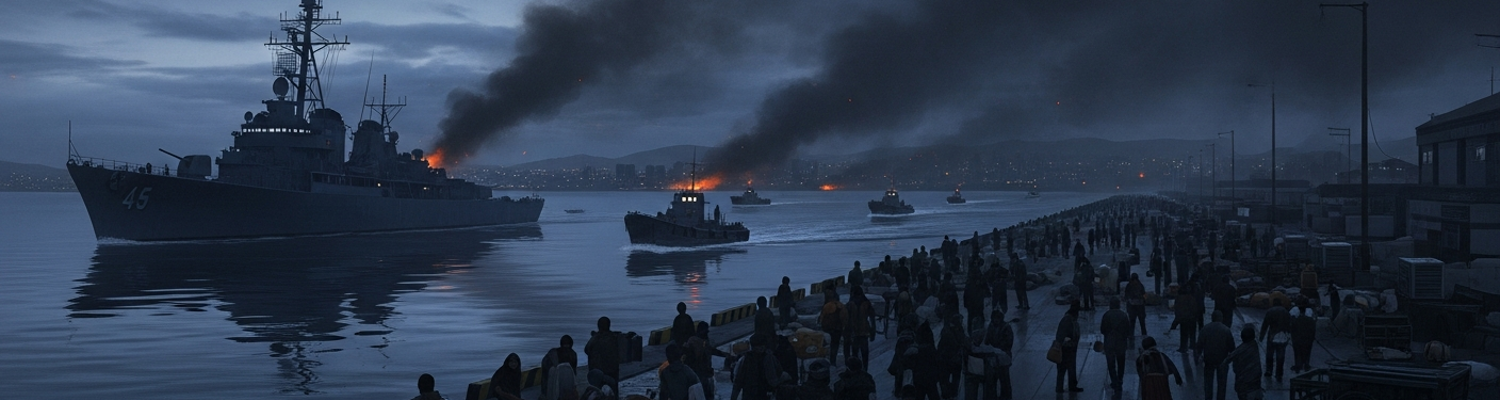
The teletype machines at the headquarters of U.S. Naval Forces, Far East (NAVFE) in Tokyo clattered to life before dawn on Sunday, June 25, 1950. The message traffic confirmed the worst fears of the small contingent of American military advisors in South Korea. The North Korean People’s Army, the NKPA, had launched a full-scale invasion across the 38th Parallel. Spearheaded by Soviet-supplied T-34 tanks and supported by a massive artillery barrage, the assault shattered the unprepared Republic of Korea (ROK) Army divisions guarding the border. In Washington, politicians and strategists began a frantic debate over the geopolitical implications. On the ground in Korea, the reality was simpler and far more brutal, it was a rout. For Vice Admiral C. Turner Joy, the commander of NAVFE, the immediate problem was not geopolitics but the safety of American citizens caught directly in the path of the communist advance. The capital city of Seoul, with its large population of diplomatic staff, military dependents, and civilian contractors, lay perilously close to the front. The primary port of escape on the peninsula's west coast was Inchon. Admiral Joy, a sharp, experienced officer who understood the unique capabilities of sea power, did not wait for formal directives from the Joint Chiefs. He began moving his assets. The first, most urgent mission of the Korean War for the U.S. Navy would not be combat, but a desperate evacuation against a rapidly closing window.
Joy’s command, while substantial on paper, was stretched thin across the vast Pacific. The core of his combat power resided in the Seventh Fleet. The closest available and suitable warships were ordered to prepare for sea. The light anti-aircraft cruiser USS Juneau (CLAA-119), serving as the flagship for Rear Admiral J. M. Higgins, received its orders at its berth in Japan. The Juneau, a modified Atlanta-class design, was a vessel built for fleet defense, bristling with a main battery of twelve 5-inch/38-caliber dual-purpose guns. Its high speed and firepower made it a formidable warship, but its immediate task required it to be a rescue platform. Steaming alongside her was the Allen M. Sumner-class destroyer USS De Haven (DD-727), a veteran of the Second World War's Pacific campaigns. Under the command of Captain H. C. Bruton aboard the Juneau, the small task group made for the Korean coast at flank speed. Their orders were direct: proceed to Inchon, locate and embark American and other foreign nationals, and get them out. The speed of the NKPA advance meant every hour counted. The ships were sailing into a collapsing state, with no clear intelligence picture and no guarantee of a secure port upon their arrival.
Into the Flying Fish Channel
The operational challenges facing the Juneau and De Haven were profound. Inchon is a notoriously difficult port, a fact well known to any mariner who has plied the waters of the Yellow Sea. Its tidal range is one of the most extreme in the world, often exceeding thirty feet. At low tide, the harbor's approaches transform into miles of viscous, impassable mudflats. Vessels are forced to use a narrow, winding passage known as the Flying Fish Channel, and their entry and exit must be timed with meticulous precision to the flood tides. A miscalculation could leave a deep-draft warship like the Juneau stranded on the mud, a helpless, stationary target for enemy artillery or air attack. This inherent hydrographic danger was now magnified by the chaos of war. Local port authorities had disintegrated. There was no pilotage, no traffic control, and no security. The docks themselves were a scene of human desperation. Thousands of fleeing South Korean civilians and disorganized, demoralized ROK soldiers swamped the port facilities, creating a panicked bottleneck that made any organized military operation a logistical nightmare. The air was thick with fear and the sounds of a nation coming apart.
From the American embassy in Seoul, Ambassador John J. Muccio sent a stream of increasingly urgent cables. He reported the rapid disintegration of ROK defenses along the Han River and confirmed that NKPA armored columns were closing on the capital. His calm leadership on the ground was essential. Muccio organized the assembly of American dependents and other foreign nationals, directing them to make the perilous journey by road from the capital to Inchon. He also took the initiative to negotiate with the masters of civilian merchant ships in the harbor. He successfully persuaded the Norwegian-flagged freighter SS Reinholt to take on evacuees. The vessel departed packed with 682 people, a testament to the master's courage. But with land routes becoming impassable and the enemy closing in, only the speed and capability of the U.S. Navy could extract the rest. The warships of NAVFE were not just sailing into a difficult port, they were entering a tactical battlespace where the front line was fluid and moving by the minute. The threat of encountering NKPA ground forces, even tanks, at the water's edge was very real. Communication links were fragile, and intelligence on enemy positions was dangerously unreliable, often hours out of date.
Command Decisions in the Fog of War
The success of the Inchon evacuation hinged on a chain of decisive leadership choices made under immense pressure. The foundational decision was Admiral Joy's. By mobilizing his forces on June 25th, before receiving a formal United Nations resolution or a directive from Washington, he seized the initiative. Joy understood that the speed of the military collapse on the ground would outpace any political process. His willingness to act on his authority as the operational commander saved lives. In Seoul, Ambassador Muccio’s efforts were equally vital. He was the indispensable link on the ground, not only organizing the evacuees but also providing what little ground-truth intelligence was available to the approaching ships. His reports, however grim, allowed the naval commanders to form a rudimentary operational picture.
On the bridges of the Juneau and De Haven, the tactical decisions were just as critical. The captains had to navigate the treacherous Flying Fish Channel with no local assistance, relying solely on charts and their own seamanship. Upon arrival, the chaos at the pier was so great that the large cruiser could not safely go alongside. The warships anchored in the channel, and the evacuation had to be conducted using the ships' own motor whaleboats and launches. This ferry service, running back and forth from the chaotic docks to the relative safety of the anchored ships, was a slow, arduous process. Sailors trained for combat found themselves gently handling frightened children and elderly civilians, all while gun crews remained at their stations, scanning the shoreline for any sign of hostile forces. The 5-inch guns of the destroyer and cruiser provided a potent, if unseen, deterrent. The operation was a textbook Non-combatant Evacuation Operation (NEO), executed under the most difficult of circumstances. It was a material demonstration of the Navy's flexibility, a gritty, hands-on rescue that successfully extracted hundreds more civilians from the closing trap.
From Evacuation to Sea Control
The late June 1950 evacuation from Inchon was far more than a successful humanitarian mission. It was the U.S. Navy's first operational act of the war, and it immediately established a strategic precedent that would shape the conflict. The action proved the value of forward-deployed naval forces. While the Army and Air Force began the complex process of moving units and aircraft from Japan and the continental United States, the Navy was already on station, influencing events directly. Admiral Joy's rapid response set the tone for the entire naval campaign. The sea control established to protect the evacuation missions was the critical first step in securing the sea lanes to the Korean peninsula. This maritime dominance became the lifeline for the desperate buildup of U.N. forces in the southeastern port of Pusan, forming the Pusan Perimeter that would prevent the complete conquest of South Korea.
The ships themselves demonstrated this rapid transition from one role to another. After completing their evacuation tasks, the Juneau and De Haven were not withdrawn. They were immediately tasked with patrol and interdiction missions along the Korean coast. On June 28, just days after pulling civilians from Inchon, the two ships were operating off the east coast near Chumunjin. There, they located and destroyed several North Korean torpedo boats and shelled enemy shore installations. This engagement marked the first naval gunfire support mission of the war. The same vessels that had served as rescue platforms seamlessly transitioned into offensive combatants. This sequence of events, from humanitarian sealift to the establishment of sea control and the application of naval firepower, was a powerful illustration of sea power's utility as a flexible instrument of national policy. The unglamorous, difficult work at Inchon was the first, essential act that enabled everything that followed, from the defense of Pusan to the famous amphibious assault at the very same port months later.