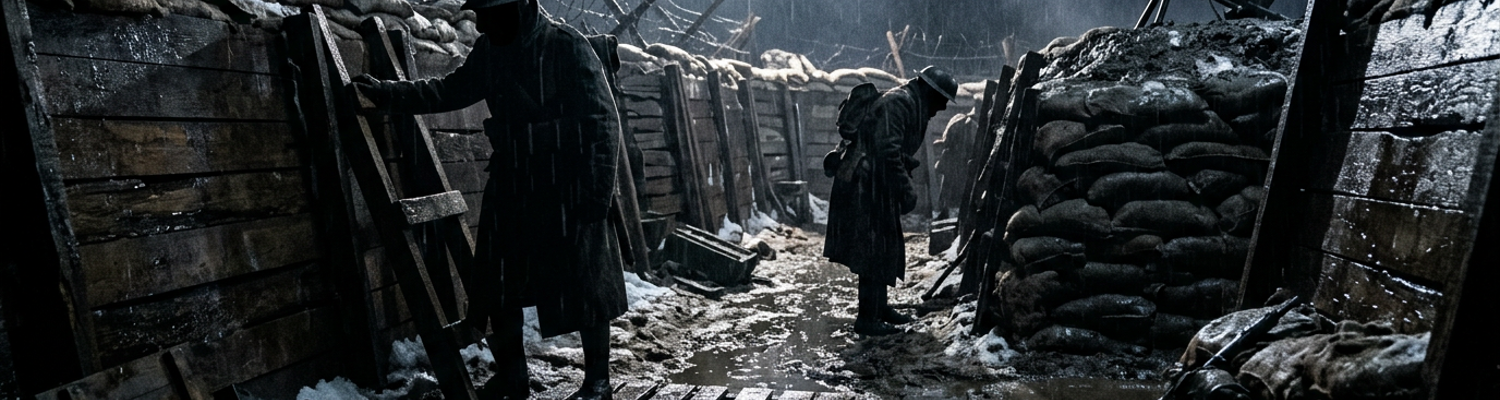

Aftermath of the Han River Defensive Collapses
Physical exhaustion broke the operational effectiveness of frontline rifle companies long before the defensive lines washed away. Foot patrols marched through thirty miles of adhesive clay along the southern bank of the Han River. They carried seventy-pound combat loads across roadless salt marshes north of Kimpo airfield. Supply trucks bogged down to their axles along Main Supply Route 1 five miles south. This cut off hot rations. Men subsisted on frozen cans of pork and beans. Exposure to wet, near-freezing rain stripped the infantry of sleep for seventy-two consecutive hours. Frostbite cases climbed into double digits daily. Soldiers stood ankle-deep in saline ground water without dry socks or warming tents.
Riflemen fell asleep standing against muddy trench walls.
Archival evidence shows the total structural collapse of forward infantry trenches across the Kimpo Peninsula mudflats began along the low-lying river perimeter during the last week of November 1952. Combat engineers constructed the forward trench lines into unconsolidated tidal alluvium. They relied on sandbag revetments and untreated pine timber braces to hold back the waterlogged earth. Late November brought heavy rainfall. This precipitation combined with thirty-foot tidal surges from the Yellow Sea. Water tables pushed directly into the trench subfloors. Soil shear strength dropped to zero. Drainage sumps overflowed within forty minutes of high tide. The water backed up through firing bays and communication runs. The vertical earthen trench walls lacked reinforced concrete footings or deep pilings driven down to bedrock. They began sloughing off in continuous thirty-yard sections along a five-kilometer defensive perimeter. Main lateral trenches connecting Hill 120 with forward listening posts caved inward under excessive lateral hydrostatic pressure. Timber crossbars snapped under the deadweight of saturated clay. Overhead log covers dropped directly into the fighting pits. Entire platoon-sized defensive sectors ceased to function as fortified fighting positions. Long open furrows of standing muck lay exposed to enemy mortar fire across the river flats.
Earthworks dissolved wherever river water penetrated the unlined trench floors.
When examining the historical record of I Corps operations, the true scale of the physical destruction emerges in the smothering of frontline positions under tons of liquified tidal silt. Frontline companies of the Kimpo Provisional Regiment bore the direct impact when the saturated river dikes gave way during the evening ebb tide on November 27. Saturated silt flowed through cracked revetment timbers at an estimated weight of one hundred and ten pounds per cubic foot. The mud poured into covered bunkers where soldiers sought shelter from the cold. Browning M1917A1 water-cooled machine guns were buried on their tripods under five feet of gray mud. The weapons became totally inoperable before crews could extract them. Fine particulate silt fouled receiver groups and feed mechanisms within seconds. North of Tongjin, a heavy parapet failure crushed the Company C command bunker. Eight personnel were buried under six feet of liquefied mud. Field telephone wire networks snapped across the forward positions. This severed battery-powered communications between forward observation posts and the I Corps artillery fire direction center at Uijeongbu.
Excavation squads required thirty-six hours of manual digging to clear the entrance to the command dugout.
Estuary Tidal Fluctuations and Geotechnical Instability
A close review of operational logs from the Kimpo Provisional Regiment indicates engineers miscalculated the hydraulic force of the Yellow Sea semidiurnal tidal cycle. Twice every twenty-four hours, the tide drove seawater thirty feet upward into the Han River estuary. Brackish water forced its way deep into the alluvial silt beds underlying the defensive perimeter. At high tide, this surge raised the localized water table by twelve feet. Subterranean drainage pipes installed by the 185th Engineer Combat Battalion near Wolgot-ri submerged completely. Corrugated iron conduits backing onto the low-lying river dikes filled with salt mud rather than discharging runoff. The tide abruptly receded. This created a rapid drawdown state. Saturated silt behind vertical revetment walls retained trapped water. Extreme outward hydrostatic pressure generated against structural timbering. Sandbag walls five feet thick lacked weep holes or gravel filter blankets to release this weight. They bowed outward before splitting along their base stringers. Over thirty forward outposts along the riverbank found their perimeter bunkers transformed into water basins within ninety minutes of high water slack.
The tide withdrew faster than the waterlogged silt could drain.
Archival evidence shows this cyclical saturation destroyed the cohesion of the underlying marine clay across Company B front lines opposite the Yeomha Channel. Soil friction dropped from twenty-eight degrees to less than four. Combat engineers drove spruce retaining pickets five feet into the earth. The softened sediment failed to provide lateral bearing support. Thirty-foot tide lines pushed against the outworks. Entire trench curtains detached from the subgrade. They slid wholesale into the channel. Centrifugal pump units brought up by battalion supply officers seized up within fifteen minutes. The intake screens could not filter out the dense suspension of river silt and decomposed reed matter. Forward troops attempted to bail the positions using five-gallon water cans. Saltwater backflow through porous trench bottoms neutralized every manual effort. Defending infantry watched as their firing steps liquefied.
The steps slid directly downward into the standing mire.
When examining the historical record of meteorology logs from Kimpo Air Base in late November 1952, a secondary geotechnical breakdown accelerated through continuous freeze-thaw cycles. Freezing sleet swept off the Yellow Sea. It struck the peninsula at temperatures fluctuating between twenty-eight and thirty-four degrees Fahrenheit. During daylight hours, heavy sleet soaked deep into the upper eighteen inches of the compacted parapet soils. Micaceous silts became fully saturated. Nightfall brought clear skies and sub-freezing winds from Manchuria. Temperatures plummeted to fourteen degrees within four hours. Water held in the fine pore spaces between clay particles froze. Horizontal ice lenses expanded soil volume by nearly ten percent. Frost heave sheared the root systems of sod reinforcement. Barbed wire screw pickets popped directly out of the ground. Solar radiation warmed the parapets the following morning. Ice lenses melted instantly. Compacted soil caps turned into low-viscosity mud. The slurry slumped downward into the fighting bays.
Solid earthworks transformed into a fluid slurry in less than six hours.
Field reports from the 1st Marine Division defensive sector confirm drainage ditches suffered identical structural destruction. Runoff channels hand-dug with two-to-one slope ratios collapsed inward. Frozen crusts separated from wet, unfrozen subsoils underneath. Slush and dislodged clay jammed the wooden flumes leading down to secondary marsh areas. Frozen meltwater pooled against the rear revetments of three heavy machine-gun emplacements. The water reached depths of eighteen inches before freezing into solid sheets across the ammunition benches. Machine gunners attempted to clear frozen discharge troughs. They cracked their entrenching tools against four-inch ice sheets. The ice locked ammunition boxes to the trench floor. Every secondary drainage channel along a three-mile front between Hill 120 and the riverbank lay entirely choked with frozen debris by midnight on November 28.
Eighth Army Depot Shortages and Supply Constraints
Archival evidence shows Eighth Army rear supply depots at Pusan and Incheon carried less than twelve percent of the dimensional structural timber mandated by theater operational reserve tables by November 1952. Combat engineer requisitions submitted by the 185th Engineer Combat Battalion went completely unfilled. They requested five thousand pieces of eight-by-eight-inch Douglas fir timbers and twelve thousand four-by-eight-inch structural framing planks. Port of Pusan offload manifests confirmed cargo hulls arriving from commercial mills in the American Pacific Northwest allocated seventy percent of their holds to artillery ammunition and petroleum drums. Class IV construction lumber dropped down the maritime priority list. Rear-echelon depots in Yokohama could not fill the requisition gaps through Japanese domestic sawmills. These mills were already tapped out supplying bridge-repair timber across the southern rail net. Frontline engineer detachments on the Kimpo Peninsula received unseasoned, round scrub pine logs felled directly from the hills behind Yongdungpo instead of kiln-dried, dimensional four-by-fours. These green round logs possessed irregular diameters varying from three to nine inches. They lacked squared bearing faces. They split under point loads exceeding two thousand pounds.
Supply depots in Pusan were empty of dry framing lumber.
A close review of operational logs from the Eighth Army Engineer Section reveals theater construction officers diverted the remaining stocks of milled two-by-ten stringers. These materials went exclusively to airfield runway repairs at K-14 and heavy railway trestles along the Main Supply Route north of Seoul. Kimpo Provisional Regiment combat teams along the river dikes received zero board-feet of squared retaining lumber during the four weeks leading up to the late November freezes. Frontline rifle squads attempted to shore up collapsing communication trenches. They pinned their positions with rough three-inch pine poles lashed together with telephone wire. The unnotched round poles lacked flat load-bearing surfaces. They slipped out of horizontal alignment under five hundred pounds of lateral silt pressure.
When examining the historical record of Eighth Army Quartermaster inventories, an equally severe breakdown occurred in the supply of rot-resistant Class IV earthwork materials. Rear depots carried standard ten-ounce untreated jute burlap sandbags manufactured under early World War II contracts. These bags lacked the copper-naphthenate chemical dip required to prevent fungal decomposition in wet marine environments. Standard military specifications demanded weather-resistant, rot-proofed osnaburg cotton or vinyl-treated synthetic bags for positions exposed to continuous river immersion. Production delays at commercial textile plants in North Carolina left Far East Command depots entirely without rot-treated bag allocations. Supply priority directives favored the European Command. Frontline quartermasters issued standard burlap bags. These disintegrated within ten days of direct exposure to the alkaline brackish water of the Han River estuary. Soil microbes and saline moisture dissolved the coarse plant fibers. The bottom seams of the sandbags split while they sat stacked three tiers deep along the firing steps.
Untreated burlap rotted on the parapets within seventy-two hours of tidal submersion.
Deprived of weather-resistant sacking, Company A of the Kimpo Provisional Regiment halted revetment construction along a fifteen-hundred-yard stretch of dikes north of Wolgot-ri. Combat engineers instructed infantrymen to pile raw tidal clay directly against the vertical dirt faces. They worked without structural reinforcement, geotextile barriers, or sandbag counterweights. Infantrymen shoveled saturated alluvial mud into bare earthen mounds. These mounds possessed no interior retention framework. Machine gunners on Hill 120 piled loose river mud behind low brush hurdles woven from dead estuary reeds. The mud parapets lacked burlap skin reinforcement to hold the fill together. They slumped forty percent in height during the first six hours of continuous November rain. Weapon crews were left exposed to direct small-arms fire from the opposite bank.
Improvised Brushwood Reinforcement and Structural Degradation
A close review of operational logs indicates field commanders in the Kimpo Provisional Regiment ordered front-line squads to strip vegetation from the tidal flats near Wolgot-ri on November 25, 1952. Standard four-by-eight-inch tongue-and-groove revetment planks had run out entirely across the northern river frontage. Soldiers of Company B worked under Chinese mortar observation from the far shore. They used bayonets and machetes to hack down thickets of wild Korean willow and marsh alder growing along the salt-marsh margins. These green stems were saturated from root to bark with estuarine water. They measured between one-half inch and three inches in diameter. Combat engineers bound the freshly cut willow branches into rough bundles known as fascines. They lashed them with rusted signal wire and field-telephone scrap. The improvised bundles were shoved into the excavation behind two-inch spruce guide stakes. This formed a retaining barrier along six hundred yards of primary communications trenches. Fresh sap ran through the living wood. The interior core remained wet, heavy, and structurally unsuited for supporting horizontal earth pressure.
Green willow held four times its dry weight in trapped moisture before ever touching the mud.
Archival evidence shows standard engineer doctrine in Field Manual 5-15 required cured, dry brush hurdles woven tightly onto squared vertical pickets. This allowed proper drainage through the revetment skin. The Kimpo detachments wedged green willow fascines directly against raw silt walls along Trench Line Delta instead. This position sat four hundred meters south of the Yeomha Channel. The living branches retained flexible bark layers that prevented mechanical interlocking between individual twigs. The wire bindings slipped along the wet bark surfaces under the weight of surrounding earth. The bundles loosened within three hours of placement. Combat engineers attempted to drive split-pine anchor pegs through the fascine bundles. They intended to secure them to deadmen buried ten feet into the parapet. The soft green willow wood split along its grain under the blows of ten-pound sledges. The structural integrity of the individual bundles was destroyed before backfill operations even finished.
The wire bindings slid down the slick bark.
When examining the historical record of structural evaluations conducted by the 185th Engineer Combat Battalion, the introduction of estuarine mud reduced the load-bearing capacity of the improvised fascine walls by over eighty percent. River sediment along the Kimpo flats consisted of fine-grain colloidal marine silts. Liquid limits exceeded sixty percent water by weight. Infantrymen shoveled this fluid grey slurry behind the green willow revetments. They forced the mud deep into every void space between the round branches. Direct contact with the saturated silt lubricated the smooth outer bark of the stems. Pore-water pressure built up within the packed mass. Lateral earth pressures rose from an anticipated thirty pounds per square foot to over one hundred and twenty pounds per square foot against the lower timber pickets. Green willow stems bowed outward under the hydrostatic head.
Structural load limits fell from eight tons per linear yard to less than nine hundred pounds.
Engineering field notes recorded the revetment wall at Outpost Charlie (coordinate CS124845) experienced complete structural shear at 0300 hours on November 28. A seventy-yard section of willow-reinforced parapet collapsed inward without warning. An M2 Browning heavy machine gun position was buried under eight tons of liquified silt. Spruce guide stakes measuring two inches thick snapped at the base trench floor line. They showed clean diagonal shear fractures caused by the lateral pressure of the unvented mud matrix. Field telephone lines buried behind the revetments broke beneath the descending slurry. Communications to the regimental mortar battery at Tongjin were severed. Saturated mud poured through the collapsed willow bundles at a rate of twenty cubic feet per minute. The bottom twenty-four inches of the primary traverse filled within ten minutes. Excavation teams attempting to extract the buried crew found the green willow stems crushed flat into the subsoil. The clay pressed them down to a uniform thickness of two inches.
Subsurface Moisture and WD-1 Wire Failures
A close review of operational logs from the Kimpo Provisional Regiment reveals signal detachments attempted to safeguard their communications lines. They buried standard WD-1/TT infantry field telephone wire six inches beneath the trench floors. Each WD-1 pair consisted of two flexible conductors insulated with an inner layer of polyethylene and an outer jacket of extruded nylon. These encased four tinned-copper wires for electrical conductivity and three galvanized-steel strands for tensile strength. Entrenching tools used by infantrymen digging in the dark nicked the exterior nylon coating across dozens of forward sectors. The estuarine mud was saturated with brackish runoff from the Yeomha Channel. It carried high concentrations of sodium chloride, magnesium, and decomposed organic sulfates. Water penetrated the microscopic fissures in the damaged nylon within minutes. Dissolved ions turned the surrounding mud into an active electrolyte. This bridged the positive and negative conductors directly through the soil. Line voltage dropped from forty-eight volts down to absolute zero across eighteen forward line circuits between Wolgot-ri and Hill 120.
The salt water grounded every circuit along the riverbank.
Archival evidence shows signal crews operating EE-8 field telephones encountered severe impedance collapse as early as November 26. Damp sediment saturated the wire splices. Loop resistance plummeted below the operating threshold of two hundred ohms required to actuate the internal ringer coils of the phone. Signal current generated by hand-cranked GN-38 magneto generators leaked directly into the surrounding subsoil instead of reaching the destination handsets. Subsurface moisture seeped into the terminal lugs of forward junction boxes. Rapid galvanic corrosion dissolved the copper strands within twenty-four hours. Signalmen attempted to isolate the lines by lifting the wire out of the muck. Freezing air temperatures quickly cracked the wet polyethylene jackets. Fresh ground faults emerged along every exposed yard. Inside the telephone handsets, dual BA-30 carbon-zinc dry batteries drained completely within ninety minutes of connection to the shorted lines. The direct-current path to earth remained continuously closed.
Dry replacement batteries ran out by midday on November 27.
When examining the historical record of regimental communications architecture, theater defensive doctrine required a dual-loop redundant layout. This connected forward positions to battalion headquarters. Every frontline listening post along the tidal dikes operated a primary wire run routed straight to the company switchboard. This was paired with an alternate lateral trunk line connecting to adjacent platoon redoubts. This structural redundancy ceased to exist when localized mud revetment failures destroyed the lateral bypass routes. The sudden structural collapse of an eighty-yard communication trench tore the alternate line linking Listening Post 2 to the command bunker of Company A at coordinate CS131848. Mud pressures crushed the field lines against the buried revetment pickets. The copper cores were cut in two. The primary lines leading from Listening Post 1 and Listening Post 4 back to the 1st Battalion command post at Tongjin suffered simultaneous short circuits. Both positions were left unable to ring the BD-71 six-line switchboards.
Battalion switchboard operators stared at dead annunciator drops.
Efforts to restore contact through emergency radio nets failed immediately. Forward observers at Listening Post 3 carried backpack-mounted SCR-300 FM radios. The five-meter low-lying dike walls blocked very-high-frequency line-of-sight signals to the battalion command bunker three miles inland. SCR-536 portable AM transceivers lacked the battery power to penetrate the heavy sleet storms moving off the Yellow Sea. Signal officers dispatched foot messengers across the two-mile swamp expanse to deliver target coordinates to the regimental 4.2-inch mortar batteries. The runners sank past their knees into the adhesive tidal mud. They required fifty minutes to cover distances that telephone current had crossed in milliseconds. Five frontline listening posts had ceased all transmissions to the battalion fire direction center by 0400 hours on November 28. Chinese reconnaissance units were left entirely unmonitored as they crossed the exposed mud flats.
Task Group 95.1 Illumination and Estuary Interference
A close review of operational logs from Task Group 95.1 reveals naval patrol craft anchored off Kanghwa Island initiated uncoordinated night-firing missions across the Han River estuary at 2100 hours on November 27. Patrol gunboats and coastal minesweepers assigned to Task Unit 95.1.2 maneuvered within shallow, tide-ripped channels near coordinate CS080890. They cycled through defensive illumination routines designed to interdict waterborne infiltration. Gun crews operated without updated fire-control charts from the Kimpo Provisional Regiment. They elevated their 3-inch/50 caliber dual-purpose naval mounts to sixty-five degrees. Mark 27 illumination rounds were fired across the mouth of the estuary. Each steel projectile contained a barium nitrate and magnesium pyrotechnic candle attached to a fifteen-foot ribbed rayon parachute. These were calculated to burn at two hundred and fifty thousand candlepower for fifty seconds. Shipboard gunners mates timed the mechanical time fuzes to burst at fifteen hundred yards downrange at a burst altitude of one thousand feet. They intended to drop the flares directly over suspected Chinese assembly areas along the northern shore. Gale-force sea gusts pushing out of the northwest at thirty-five knots caught the open parachutes the moment the base ejection charges fired.
The flares drifted two miles southeast across the friendly shoreline.
Archival evidence shows this uncontrolled downwind drift completely reversed the planned illumination geometry along the defensive sector. The suspended magnesium candles descended directly behind the friendly frontline dikes instead of exposing enemy assault squads crossing the northern shallows. Harsh overhead brilliance bathed the salt-marsh flats. Forward positions held by the Kimpo Provisional Regiment were backlit. Observers at Listening Post 1 and Listening Post 2 found their low-profile sandbag revetments thrown into sharp relief against the blinding white surface of the wet mudflats. Every parapet silhouette, barbed wire apron, and exposed observation slit cast a distinct seventy-yard black shadow pointing straight toward Chinese spotting posts on the bluffs of Songsan-ri. Saturated tidal silt coating the helmets and field parkas of the defenders produced a bright sheen under the descending five-hundred-thousand-lumen flares. Every trace of nocturnal concealment was stripped away. Friendly riflemen pinned inside three-foot-deep mud furrows could not shift position without generating stark kinetic silhouettes against the luminous background.
Severed WD-1 wire runs prevented frontline observers from telephoning the naval liaison fire desk.
When examining the historical record of regimental casualties, Chinese mortar crews exploited this visual advantage within four minutes of the opening illumination salvo. Direct-fire 76mm field guns and 82mm Type 20 mortars deployed near Kaesong opened up on the silhouetted parapets with high-explosive rounds. They walked barrages straight down the illuminated communication trenches leading to Outpost Charlie. Forward observers fired red emergency star clusters from hand pyrotechnic projectors to signal a cease-fire. Sea fog and sleet obscured the signals from lookouts aboard the patrol vessels three miles out in the channel. Strong eight-knot tidal currents swung the patrol craft on their single bow anchors. The line of naval fire shifted thirty degrees further over friendly positions with each subsequent firing cycle. Spent four-pound steel base plugs and heavy parachute casings plummeted out of the sky. They punctured the improvised willow fascine roofs of Listening Post 3 at coordinate CS129849. Task Group 95.1 maintained the scheduled firing rate of two shells per minute until 0340 hours. Four hundred and twelve rounds of illumination were expended before securing their gun mounts.
Hostile Mortar Shelling and Earthwork Liquefaction
Archival evidence shows Chinese artillery detachments from the 194th Division of the 65th Army exploited the parachute illumination flares at 0345 hours on November 28. They opened rapid battery fire from coastal bluffs along the Songsan-ri ridge. Chinese forward observers adjusted twenty-four Soviet-manufactured 120-PM-38 heavy mortars and thirty-six 82mm Type 20 mortars directly onto the water-weakened trench lines of the Kimpo Provisional Regiment. Spotters registered coordinates along the northern bank of the Yeomha Channel. They zeroed in on wet trench seams that had already begun slumping under tidal backwash. High-angle plunging fire saturated the perimeter flanking Wolgot-ri and Outpost Charlie at coordinate CS126847. Battery officers concentrated three hundred rounds per square kilometer directly along a four-hundred-meter front where standing brackish water had already degraded revetment footings. Contact fuzes on the thirty-five-pound 120mm high-explosive bombs were set to super-quick detonation. Incoming projectiles descended at steep eighty-degree angles. They impacted the exposed lips of the water-logged mud parapets at eight-second intervals.
Shrapnel tore the wet willow fascines into splintered fragments.
When examining the historical record of structural failure assessments compiled by Eighth Army engineers, the defensive collapse was driven primarily by high-explosive concussions passing through saturated ground rather than surface shrapnel. Alluvial estuarine clay around the Yeomha Channel possessed an internal moisture content exceeding sixty percent by weight. The soil matrix was left in a critical state of zero effective cohesion. Detonations of three-pound cast-TNT charges produced instantaneous ground shockwaves. These surged through the subterranean water table. Water held within the fine micaceous pore spaces could not drain away during the millisecond pressure spike. This mechanical vibration generated an immediate rise in localized pore-water pressure. It canceled the effective confining stress and broke the frictional contact between microscopic silt platelets. The saturated earth experienced instantaneous liquefaction under the rapid cyclic loading of the mortar concussions. Five-foot-high mud parapets along Trench Line Delta ceased to behave as solid retention structures. They collapsed under their own mass within milliseconds of each blast wave.
Entire parapet walls slumped inward as fluid mud.
A close review of operational logs from the Kimpo Provisional Regiment indicates this instantaneous slumping buried frontline fighting bays before riflemen could withdraw down the communication ditches. Shock concussions from 120mm rounds shattered the rough scrub-pine pickets supporting the trench walls at coordinate CS128846. Twenty yards of liquified mud cascaded into the 2nd Platoon fighting positions. Heavy silt poured into weapon embrasures. Browning M1919A4 machine guns were buried. The timber baseplates of forward 60mm mortar pits were crushed under three feet of thick grey sludge. Fine particulate mud jammed the bolts of M1 Garand rifles and caked over ammunition boxes before crews could pop the latches. Infantrymen attempting to dig out trapped soldiers with lightweight M1943 entrenching tools found the fluid silt running back into the excavations faster than it could be shoveled away. Saturated mud completely filled the covered fighting pits of Outpost Charlie. Six men were suffocated under five tons of collapsed earth within four minutes of the bombardment.
Chinese spotters checked their fire at 0420 hours. Two hundred yards of the forward trench system lay flattened into the surrounding marsh.