
Sapper Infiltration of Da Nang Airfield
At 0130 hours on July 1, 1965, a panicked radio transmission over the Da Nang joint tactical net reported sappers inside the runway wire. Aircraft were detonating. The fuel farm was fully engulfed in flames.
Archival evidence shows that six teams from a specialized Viet Cong sapper unit crawled undetected through low marshland flanking the western boundary of the base. These forty-five men stripped down to loincloths and greased their skin with charcoal soot. They carried Bangalore torpedoes built from threaded water pipes. They carried Soviet-manufactured RPG-2 launchers. They carried burlap-wrapped satchel charges packed with ten pounds of C-4 explosive. The infiltration party sliced through three distinct concertina wire aprons near the southern end of the primary 10,000-foot runway. Watchtowers manned by the Air Force 6252nd Security Police Squadron failed to detect the silent advance. Timed charges detonated simultaneously beneath parked aircraft. Three United States Air Force C-130A Hercules transports assigned to the 315th Air Division disintegrated almost instantly. Shrapnel ripped into wet-wing fuel tanks. Widespread detonations threw burning structural aluminum across the apron. A Marine Corps F-8E Crusader from Fighter Squadron 235 was destroyed seconds later. An explosive charge was tossed directly into its nose intake. Multiple nearby transport planes and two fighter airframes sustained heavy fragmentation damage before base floodlights could be engaged.
Dense smoke from burning JP-4 aviation kerosene blinded the defensive watchtowers within four minutes.
When examining the historical record, the physical destruction of the northern fuel bladder farm revealed severe tactical vulnerabilities. High-explosive satchel charges ripped open three 10,000-gallon rubber fuel bladders. Burning fuel spilled into open drainage ditches running directly toward parked auxiliary power units. Shrapnel sliced through the cast-iron distribution manifolds of the mobile pumping skids. This drop in pipeline pressure across the apron left the base fire department unable to feed water-foam proportioners mounted on their O-11A crash trucks. Small arms fire from 7.62mm Chicom carbines pinned down base security police along the perimeter road. Marine personnel from Marine Aircraft Group 11 ran onto the flight line under tracer fire with hand-drawn carbon dioxide extinguishers. They manually winched undamaged aircraft away from the asphalt while high-explosive 20mm cannon ammunition detonated inside secondary storage racks.
Base defense command nets collapsed as telephone landlines burned through.
A close review of operational logs indicates that the penetration succeeded because of a fragmented command arrangement. This arrangement divided the airfield from its outer perimeter (NARA Record Group 338). Outside the base wire, the 3rd Marine Division maintained forward infantry outposts positioned along high terrain miles to the west. This left the immediate five-hundred-meter dead zone to regional militia forces equipped with minimal night surveillance gear. Senior Marine commanders had previously requested unified ground control over the hamlets and paddy land directly bordering the airstrip runway. High-level directives divided the terrain into separate zones. The Air Force retained internal base defense. South Vietnamese authorities controlled civilian ground up to the runway fence. Because of this jurisdictional seam, neither command had surveyed the marshy western approaches for pre-registered artillery defensive fires. Battery D of the 2nd Battalion, 12th Marines occupied positions within range. Its 105mm howitzers lacked pre-cleared firing coordinates for the swampy ground directly outside the perimeter fencing. The sappers crossed that unmonitored strip of terrain without triggering a single trip flare.
Defensive Reorganization Along the Cau Do River
First Marine Regiment command chronologies recorded an urgent restructuring of defensive sectors south of the air base. Field commanders abandoned the passive inner-perimeter fence doctrine within seventy-two hours of the sapper raid. They shifted the primary defensive screen outward by thousands of meters. Regimental orders directed rifle companies to push across the southern lowlands toward the northern banks of the Song Cau Do. Dry paddy dikes were converted into reinforced fighting holes. Combat engineers from the 1st Engineer Battalion hauled concertina wire, timber baulks, and heavy sandbags to erect fortified observation points. Trip flares and Claymore mines were wired into interlocking belts. Squads cleared dense bamboo thickets to open flat fields of fire for M60 machine guns. Southern sector boundaries were redrawn along topographic map sheet 6641-II. This eliminated the jurisdictional void that had previously shielded North Vietnamese reconnaissance squads. Tactical responsibilities shifted from passive airfield security to aggressive counter-reconnaissance operations.
The Cau Do River formed the immediate physical boundary separating base security from insurgent-held hamlets.
Archival evidence shows that Marine infantry units and artillery liaison officers established coordinated indirect fire zones across the Cau Do River corridor. Battery fire direction centers worked alongside infantry company commanders. They bound organic rifle company defenses directly to four-gun batteries of M101A1 105mm towed howitzers emplaced at nearby artillery cantonments. Artillery liaison officers deployed directly with company headquarters elements. They carried AN/PRC-25 radio transceivers linked directly to the regimental fire direction net. Working over M10 plotting boards, these teams plotted pre-registered target reference points along the southern riverbank. They zeroed guns onto sandbars, tree lines, and tributary junctions. Every primary avenue of waterborne infiltration received a pre-calculated concentration number. These included pre-cut propellant charges and pre-computed deflection angles recorded on battery fire control sheets. Defensive concentrations were registered to drop high-explosive ordnance within fifty meters of friendly forward outposts.
Every square meter of river mud received a designated target number.
A close review of operational logs indicates that this indirect fire screen introduced intense friction between immediate reaction times and civilian clearance protocols. Field telephone crews strung miles of heavy WD-1/TT wire through brackish water. This connected river outposts to South Vietnamese sector headquarters in Hoa Vang. Marine artillery liaison teams discovered that clearance to fire into target zones south of the river required verbal authorization from local district chiefs. These officials were often absent from their command posts after dark. To bypass these delays during emergency contacts, artillerymen pre-cleared specific free-fire bands over the river water itself. They adjusted shell trajectories to detonate using M557 point-detonating fuzes against the water surface. Adjusting the guns to engage the water surface allowed shrapnel patterns to sweep the sandbars without sending rounds into the inhabited villages on the southern bank. Forward observers recorded final registered coordinates for twenty-four distinct river targets on August 12, 1965.
Altered Mortar Flare Illumination Altitudes
Regimental fire direction directives issued to the 81mm mortar platoons of the 1st Battalion, 1st Marines mandated an immediate change to standard illumination doctrine around the airfield perimeter. Battery gunners operating the smoothbore M29 81mm mortar systems had previously set M65 mechanical time fuzes to crack flare canisters open at approximately four hundred feet above ground level. This cast an intense circle of 500,000 candlepower directly over assigned coordinates. Sector commanders believed this tight cone left perimeter tripwires in peripheral darkness. On August 18, 1965, revised fire tables arrived at the mortar pits ringing the southern perimeter. Fire direction officers instructed mortar crews to twist the graduated fuze rings out past fourteen seconds. They increased barrel elevation above sixty-five degrees. Mortar teams adjusted propellant charge increments on the fin assembly to pop the M301A2 illumination rounds between eight hundred and one thousand feet above the paddies.
Higher altitudes meant longer drifts across coastal skies.
Archival evidence shows that this tactical modification aimed directly at detecting low-crawling sappers before they reached the primary concertina wire barriers. Infiltrators from the Viet Cong 402nd Sapper Battalion routinely crossed the swampy lowlands of Hoa Vang by pulling their bodies through irrigation ditches on their elbows. They kept their torsos flat against the river mud to stay below the visual horizon of sandbagged bunkers. Standard low-burst mortar flares produced sharp, horizontal shadows that swept across the terrain as the parachutes swung in the lower wind currents. These moving shadows created blind spots behind low paddy dikes. This gave crawling sappers five to eight seconds of deep cover with every swing of the burning candle. Regimental planners calculated that detonating the pyrotechnic canisters at a much higher altitude would cast light at a near-vertical angle. A steeper angle of illumination minimized lateral ground shadows. Base security personnel needed unobstructed sightlines to track infiltrators.
Every millimeter of wire had to be visible from the guard towers.
A close review of operational logs indicates that the physical mechanics of the M301A2 shell reacted unpredictably to these adjusted firing tables. Mortar crews dropped the twenty-pound rounds down the smoothbore steel tubes with increased propellant charges. The shells climbed into coastal thermal layers blowing inland from Da Nang Bay. The six-foot rayon parachutes deployed properly when the expelling charge sheared the casing pins. The high-altitude offshore breeze caught the broad silk canopies. Instead of settling directly over the outer concertina line, the burning illumination canisters drifted west at fifteen knots toward friendly forward outposts along the riverbank. Forward observers with Company B reported that the candle output dropped below five-tenths of a foot-candle at ground level. The illumination dispersed across too wide an area. Gun crews in the rear pits expended double the allotted illumination ammunition trying to maintain continuous light over the designated sectors. They burned through barrel liners and fouled tube breeches with unburnt propellant flakes before midnight.
Tactical Blindness and Silhouetted Aid Stations
The mandated altitude adjustment generated immediate and severe tactical complications for forward units. As the M301A2 illumination canisters drifted inland on the coastal thermals, the light source moved behind the forward Marine listening posts positioned along the Cau Do River. This inverted the intended visual advantage. Instead of illuminating the marshy approaches to the south, the flares cast harsh light directly onto the backs of the Marine defenders. The swinging parachutes created massive, oscillating shadows that stretched forward into the suspected infiltration zones. Marine riflemen staring into the darkness found their night vision completely ruined by the erratic glare reflecting off the flooded rice paddies.
The shadows moved like men crawling through the mud.
Archival evidence shows that this artificial backlighting completely blinded the forward observation posts. Sentries reported seeing phantom movement as the elongated shadows of paddy dikes and bamboo stands shifted back and forth with the swinging flares. This optical illusion caused nervous machine gunners to initiate unauthorized recon-by-fire missions. They expended thousands of rounds of 7.62mm linked ammunition into empty mud flats. The continuous firing gave away their exact primary fighting positions to North Vietnamese spotters waiting on the southern bluffs. The Viet Cong 402nd Sapper Battalion exploited this visual chaos. They used the moving shadows to mask their forward movement through the irrigation ditches. The high-altitude flares failed to penetrate the deep shadows cast by the steep riverbanks.
The drifting light exposed the rear echelon.
When examining the historical record, the most severe consequence of the drifting flares fell upon the battalion casualty collection points. The 1st Battalion, 1st Marines aid station was situated in a semi-sunken revetment three hundred meters behind the primary defensive line. Under standard illumination doctrine, this position remained cloaked in darkness. The new high-altitude flares drifted directly over the medical bunkers. The intense 500,000-candlepower light pierced the camouflage netting. It cast sharp silhouettes of medical personnel and stretcher-bearers against the canvas walls of the triage tents. North Vietnamese forward observers immediately registered these illuminated targets. Within twenty minutes of the first high-altitude flare deployment, 82mm mortar rounds began impacting directly along the aid station perimeter. The tactical attempt to secure the outer wire had inadvertently painted a target on the medical evacuation zone.
Field Triage Amid Danger-Close Barrages
Sandbags absorbed the shockwaves.
Archival evidence shows that Navy hospital corpsmen attached to the 1st Battalion, 1st Marines aid station operated under absolute blackout restrictions as incoming 82mm mortar rounds bracketed the southern perimeter wire. Battalion surgeons and enlisted corpsmen worked inside semi-sunken revetments covered by split coconut logs and heavy canvas tarpaulins. White illumination of any kind was banned across the perimeter. North Vietnamese spotters on the southern bluffs targeted any muzzle flash or lantern glow. Corpsmen taped red plastic filters into the screw-on bezels of standard military MX-991/U angle-head flashlights. They clamped the olive-drab plastic cylinders between their teeth to keep both hands free. Red light preserved night-adapted vision. It completely obscured venous blood from bright red arterial bleeding against soaked olive-drab utilities. Navy personnel checked pulse points entirely by touch. They pressed index fingers into femoral triangles and carotids while feeling along mangled limbs for compound fractures and torn flesh.
Tagging casualties in near-total dark required tactile markers.
When examining the historical record, medical officers adapted standard triage sorting into a three-tiered mechanical system based on physical knots tied into litter handles. Casualties carried into the bunker from rifle pits along the Song Cau Do arrived with severe trauma caused by ChiCom Type 59 stick grenades and 7.62mm fragments. Corpsmen tied a single strip of surgical tape to the right carry handle for urgent cases requiring airway interventions or immediate chest decompression using large-bore 14-gauge needles. Patients marked with two strips waited on canvas litters for debridement of wide fragmentation wounds. Casualties with zero detectable respirations after airway clearing were shifted to the perimeter wall. Working by the dim crimson beam of two-cell batteries, medical personnel secured sucking chest wounds with vaseline-impregnated gauze torn from foil wrappers. They bound the dressings with three-inch elastic bandages before shock could collapse the vascular system.
Steel howitzer tubes were firing less than two hundred meters away.
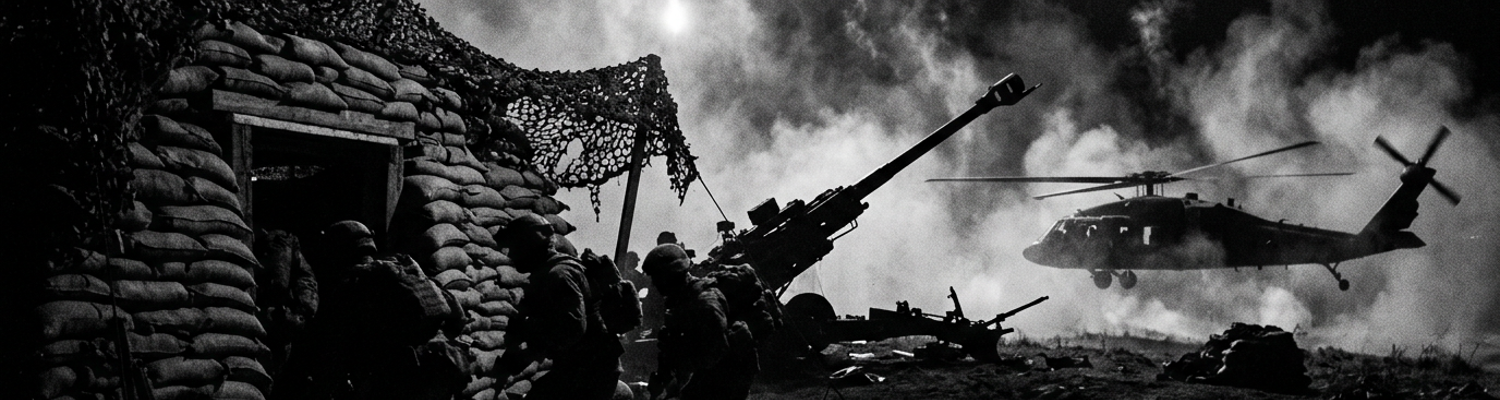
A close review of operational logs indicates that Battery D, 2nd Battalion, 12th Marines had depressed the barrels of four M101A1 105mm towed howitzers to provide direct defensive fire over the heads of the aid station personnel. Gun crews burned through green-bag charge-one propellant increments. They sent high-explosive M1 shells screaming across the wire on trajectories clearing the bunker roofs by twenty feet. Firing orders called for mechanical time fuzes set to detonate fifty feet above the mud paddies. This rained jagged steel fragments into open drainage ditches where infiltrators were assembling. Each muzzle blast blew out the kerosene lanterns inside the aid station. The treatment shelter filled with choking carbon monoxide and sulfur. Concussive overpressure from the howitzers repeatedly dislodged surgical hemolamps. It tore open pinned thoracic dressings and knocked suspended glass bottles of normal saline off wooden uprights. Surgical teams stabilized severed femoral arteries and shattered limbs while the ground buckled under recurring artillery bursts.
Night Evacuation Operations Under Indirect Fire
Ground crews cleared wet gravel from Pad Four by hand.
When examining the historical record, flight logs from Marine Aircraft Group 16 indicate that two Sikorsky UH-34D Seahorse helicopters assigned to Marine Medium Helicopter Squadron 163 initiated emergency low-level approaches directly through the illumination umbrella south of the airstrip. Pilots operated nine-cylinder Wright R-1820-84 radial engines at elevated manifold pressures. They descended into an extraction zone lit entirely by drifting M301A2 mortar flares. Revised firing tables had detonated those flares at nearly one thousand feet. This exposed the rayon parachutes to fifteen-knot coastal thermal currents moving inland from Da Nang Bay. As the pyrotechnic canisters swayed under their suspension lines, light levels across the landing zone oscillated rapidly between harsh glare and pitch blackness. Long, distorted shadows swung across the wet paddy dikes. This blinded the pilots through their Plexiglas windscreens and stripped away depth perception during collective pitch adjustments. Rotor downwash from the four-bladed main rotors whipped muddy water into the engine cooling gills. Pilots fought stick shake while setting tail wheels onto narrow dikes fifty yards from the aid station revetment.
Shadow angles across the touchdown zone shifted forty yards every two seconds.
Archival evidence shows that flight crews and battalion triage personnel maintained rapid radio coordination through the tactical air control party to route inbound and outbound flights through active artillery safety corridors. Battery D of the 2nd Battalion, 12th Marines continued firing danger-close defensive missions with four M101A1 105mm towed howitzers. They suppressed Viet Cong assault squads seventy meters west of the riverbank. Outgoing high-explosive shells cleared the helicopter approach path by less than one hundred and fifty feet. To prevent mid-air collisions between low-flying rotary-wing aircraft and outgoing artillery rounds, the fire direction center plotted a rigid two-minute firing lull coordinated over the battalion tactical net. Gun crews held their lanyards taut while incoming North Vietnamese 82mm mortar rounds bracketed the pad perimeter. Hot casing fragments sprayed across the mud. Marine litter teams sprinted through the mud under this indirect fire. They hauled blood-soaked canvas stretchers beneath spinning thirty-two-foot rotor blades. Navy corpsmen loaded priority trauma cases onto corrugated aluminum cabin floors within eighty seconds of wheel touchdown.
Mortar fragments punctured the tail boom of the lead helicopter during litter loading.
A close review of operational logs indicates that the flight lead initiated maximum-power vertical lift-offs precisely as the artillery safety window expired. The Wright radial engines consumed aviation gasoline at surge rates. They generated twelve hundred horsepower to haul overloaded airframes out of the river mud. Aviators held the helicopters below fifty feet of altitude across the paddies to avoid intersecting the descending trajectory of resumed 105mm howitzer barrages along the gun-target line. Flight crews bypassed the primary Da Nang airfield control tower. They routed the evacuated casualties north along the coastline toward the advanced medical facilities of Company A, 3rd Medical Battalion at surgical revetments near Da Nang harbor. Both aircraft deposited eight critical casualties onto triage tables sixteen minutes after receiving the emergency launch signal.