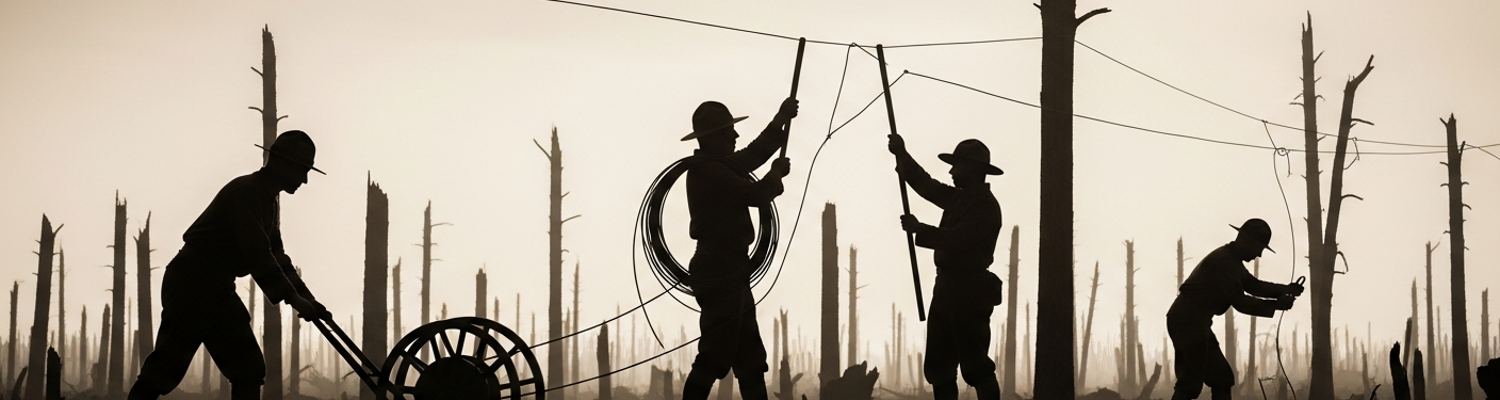

The industrial slaughter of the First World War presented the American Expeditionary Forces (AEF) with a fundamental paradox. Its command structure, built on the principles of modern, centralized control, depended entirely on a communication network stretched to its breaking point across the churned mud and splintered forests of France. This network, the responsibility of the US Army Signal Corps, was a fragile thing. Its lifelines took two primary forms, one a product of the industrial age and the other a creature of antiquity. The first was the lineman, burdened with spools of copper wire, and the second was the homing pigeon, a living messenger that flew where technology failed.
Forging a Nerve System
When the United States declared war in April 1917, the Signal Corps was a small, technically-focused branch, more occupied with the Army's new aviation experiments and telegraph lines in the American West than with the prospect of continental warfare. Its total strength was a mere 55 officers and 1,570 enlisted men. The organization was utterly unprepared for the communication demands of a static trench war defined by the ceaseless thunder of artillery. Under the leadership of Chief Signal Officer Major General George Owen Squier, a physicist and inventor, the Corps underwent a radical transformation. Squier, who had been an early advocate for military aviation, understood the technological and logistical requirements of the new battlefield. He initiated a massive recruitment and procurement drive, pulling engineers, telephone company employees, and technical experts from civilian life. By the Armistice in November 1918, the Signal Corps within the AEF alone numbered 1,462 officers and 33,038 enlisted men. The organization fielded dozens of specialized units, including Field Signal Battalions, Telegraph Battalions, and Depot Battalions, each with a specific role in building and maintaining the AEF’s nervous system. This rapid growth presented immense logistical challenges. The Corps had to establish a transatlantic supply chain for everything from delicate vacuum tubes to thousands of tons of copper wire and telephone poles. It worked directly with American industry, with companies like Western Electric and AT&T providing both equipment and expert personnel. A major research and development center was established at Camp Alfred Vail in New Jersey to refine existing technologies and develop new ones, including portable radio sets. In France, the need for bilingual telephone operators was so acute that the Army recruited 223 women who became the Signal Corps Female Telephone Operators Unit. These “Hello Girls” operated critical switchboards, connecting American commanders with their French counterparts and proving essential to coalition warfare.
Spool and Rifle
The backbone of this sprawling network was simple twisted-pair field telephone wire. Signalmen, universally known as linemen, were tasked with laying and maintaining these vital connections. Their job was one of the most hazardous on the battlefield, with a casualty rate that rivaled the infantry. These soldiers worked in the open, often in full view of the enemy, making them priority targets for snipers and artillery gunners. A lineman’s silhouette, burdened with a heavy reel of wire, was an unmistakable and inviting target. Equipped with reels of wire, such as the lightweight W-130 assault wire or heavier D-series cable, and field telephones like the hand-cranked EE-3, linemen ventured into no-man's-land. The terrain they crossed was a blasted moonscape of craters, stagnant water, and tangled barbed wire. The simple act of unspooling a wire could draw immediate machine-gun fire. A single artillery barrage could sever communications for an entire sector, leaving attacking units isolated or defensive positions unable to call for support. When a line went dead, the linemen went out. They worked day or night, under fire, to find and repair breaks. This meant crawling through mud-filled shell holes, navigating shattered trenches, and enduring gas attacks while carrying their tools and equipment. Finding a break in the dark often meant feeling their way along the wire with bare hands, hoping to locate the severed ends in the muck. Splicing the thin copper strands with frozen, mud-caked fingers required immense concentration while shells burst nearby. Even burying the lines, a labor-intensive process, offered little protection against the deep-penetrating power of heavy artillery. The constant failure of these physical lines could mean the difference between a successful operation and a slaughter.
The Feathered Alternative
When artillery shattered the wire network and runners could not get through the maelstrom of fire, commanders turned to their most reliable, low-tech solution: the homing pigeon. General John J. Pershing, observing the success of the British and French pigeon services, authorized the Signal Corps to establish its own Pigeon Service in November 1917. The service grew quickly. By the end of the war, the Signal Corps had trained and supplied over 15,000 pigeons to the AEF. These were not ordinary birds. They were trained to return to mobile lofts, ingeniously designed wagons or trucks that could be moved to keep pace with the advancing front lines. This required a specialized training regimen where birds were settled to a new loft location in a matter of days. A soldier in a forward observation post or a surrounded trench could write a message on a small piece of paper, roll it into a tiny canister attached to the pigeon’s leg, and release it. The bird’s powerful homing instinct would guide it back to its loft, often flying through shellfire and chemical gas to deliver its message. The success rate was remarkably high, with pigeons successfully delivering over 95 percent of their messages.
The most famous example of the pigeon service's value came in October 1918, during the Meuse-Argonne Offensive. Nine companies of the 77th Division, commanded by Major Charles W. Whittlesey, became trapped behind German lines. The “Lost Battalion” of roughly 554 men was cut off without food, water, or ammunition. Runners were killed or captured, and their telephone lines were obliterated. To compound the horror, American artillery, unaware of their exact location, began dropping shells directly on their position. Whittlesey dispatched several pigeons, but each was shot down by German marksmen. With casualties mounting from friendly and enemy fire, he released his last pigeon, a black check cock named Cher Ami. The message attached to its leg read, “We are along the road parallel to 276.4. Our own artillery is dropping a barrage directly on us. For heaven’s sake, stop it.” Cher Ami took flight and was immediately hit by enemy fire, tumbling to the ground. Yet the bird took to the air again. It arrived at its loft 25 miles away, blinded in one eye, shot through the breast, with a leg hanging only by a tendon. The message canister was intact. The barrage was lifted, and the 194 survivors of the Lost Battalion were eventually rescued.
Cher Ami was not an isolated case. Another pigeon, President Wilson, delivered a critical message for an infantry unit in the Meuse-Argonne, flying through heavy fire and losing a leg in the process, helping to save his associated unit from being overrun.
The AEF’s communication strategy was a pragmatic response to the logistical nightmare of the Western Front. It layered modern technology with an ancient, living system to create a resilient, redundant network. The lineman, burdened with his heavy spool of copper, and the pigeon, flying high above the destruction, together formed the indispensable lifeline that kept the Army connected, allowing it to fight and ultimately prevail.