
An Alliance Forged in Betrayal
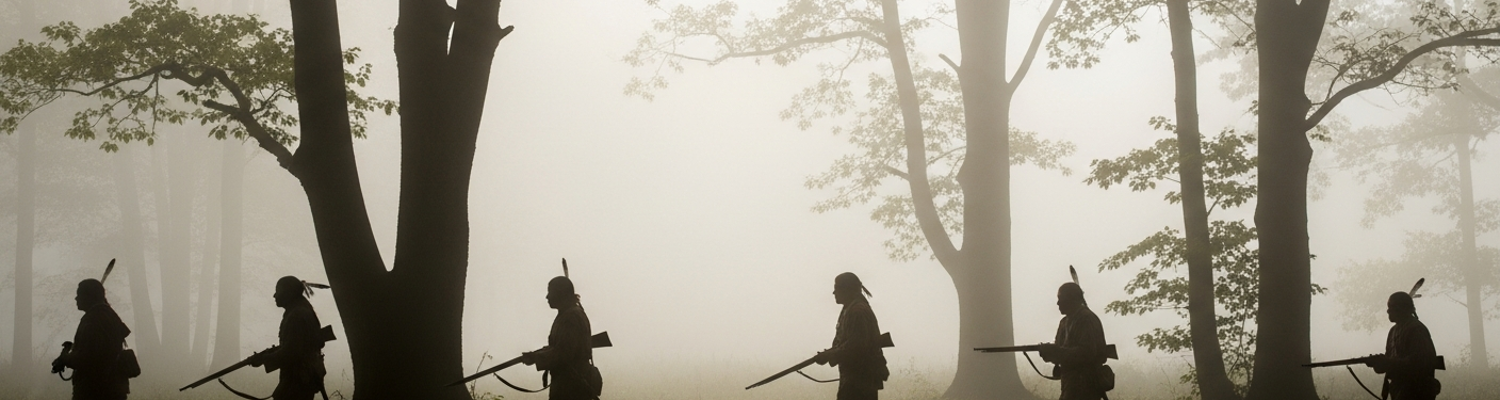
The men who became some of the Continental Army’s most effective scouts already understood the cost of conflict with European powers. They were the Stockbridge Mohicans, a community formed from the remnants of Mohican, Wappinger, and Munsee peoples systematically displaced from their ancestral Hudson Valley homelands. By the mid-18th century, they resided in Stockbridge, a so-called “praying town” in western Massachusetts. There, they adopted English-style farming, governance, and Christianity, walking a difficult line between their heritage and the encroaching colonial world.
This acculturation, however, offered no real security. Land-hungry colonial settlers, backed by a labyrinthine and often corrupt legal system, continued to chip away at their territory. Their petitions to the British colonial government, and even to London, fell on deaf ears, met with indifference and broken promises.
This profound sense of betrayal by the Crown pushed the Stockbridge community toward the burgeoning Patriot cause. They saw in the colonial rebellion a parallel to their own struggle for sovereignty. More pragmatically, they calculated that an alliance with their colonial neighbors against a distant king was the better path to protecting what remained of their land and people. Their leaders, seasoned diplomats in their own right, made a strategic choice born of desperation and a slim hope for a more just future. In April 1774, months before the first shots at Lexington and Concord, they formally pledged their allegiance to the Massachusetts colonists.
“Wherever your armies go, there we will go,” they promised. “You shall always find us by your side; and if providence calls us to sacrifice our Lives in the field of battle, we will fall where you fall, and lay our bones by yours.”
Their commitment was not mere words. The community organized a militia company, drawing on a deep tradition of military service that extended back to the French and Indian War. Many of their men had served as effective rangers alongside British and colonial forces, learning the hard lessons of forest warfare.
Men from Stockbridge, including a contingent led by sachem Solomon Uhhaunauwaunmut, traveled to the siege lines outside Boston in 1775. Their arrival at the Cambridge camp was noted by the Continental Congress. The company was soon formally organized within the Continental Army, a distinct unit of Native American soldiers led by their own. Captain Solomon Uhhaunauwaunmut, a respected community leader, took command. He was joined by other key figures like Captain Abraham Nimham, son of the influential Wappinger sachem Daniel Nimham. These men, fluent in English but steeped in the woodland skills of their ancestors, offered General Washington’s fledgling army a unique and vital capability that few other units could provide.
The Shadow War for Saratoga
The Stockbridge scouts possessed a mastery of fieldcraft that few Continental soldiers could match. They moved through dense forests with a silence and speed that seemed supernatural to their colonial counterparts. They were expert trackers and intelligence gatherers, able to read the land for signs of enemy movement that were invisible to the untrained eye. Their operational philosophy stood in stark contrast to the linear tactics of European armies. Captain Solomon Uhhaunauwaunmut articulated this difference with blunt clarity, stating,
“I am not used to fight English fashion, and you must not expect me to train like your men. Only point out to me where your enemies keep, and that is all I shall want to know.”
This was the doctrine of the frontier scout, focused on results, not parade ground drill.
This expertise proved indispensable during the critical Saratoga Campaign in the summer and autumn of 1777. As British General John Burgoyne’s army advanced south from Canada, aiming to sever New England from the rest of the colonies, the Stockbridge company joined the Northern Department of the Continental Army under General Horatio Gates. They operated on the army’s flanks and far ahead of its main body, acting as its eyes and ears in the wilderness of upstate New York.
They shadowed Burgoyne’s columns, skirmished with his German auxiliaries and Loyalist pickets, and captured prisoners for interrogation. Their constant harassment slowed the British advance and frayed the nerves of Burgoyne's men. They gathered crucial intelligence on his strength, supply lines, and direction of march, often slipping past enemy patrols to deliver reports directly to American commanders.
Their reconnaissance provided Gates with a clear, real-time picture of the threat, allowing him to position his forces to counter the British advance effectively at key moments like the battles of Freeman's Farm and Bemis Heights. They worked in concert with other irregular units, such as Colonel Daniel Morgan's riflemen, creating a layered screen that prevented Burgoyne from gathering his own intelligence.
The American victory at Saratoga was the war’s great turning point, persuading France to enter the conflict as an American ally. While grand strategy and the bravery of the main Continental line rightly receive credit, the quiet, dangerous work of the Stockbridge scouts in the forests was an essential component of that success. They screened the American army from surprise and delivered the actionable intelligence that allowed American commanders to make sound tactical decisions.
After Burgoyne’s surrender in October 1777, the Stockbridge company’s value was so recognized that they were transferred to Washington’s main army, joining the hardened soldiers who had survived the brutal winter at Valley Forge.
Slaughter at Kingsbridge
The summer of 1778 found the war in a tense stalemate around British-occupied New York City. The Stockbridge company, now attached to an elite light infantry corps under the command of General William Heath, was tasked with screening American positions in Westchester County. This region, known as the “Neutral Ground,” was a brutal no-man’s-land of partisan warfare, raids, and ambushes. On August 31, 1778, while on a scouting mission near the northern tip of Manhattan, the company moved into an area of wooded hills known today as Van Cortlandt Park in the Bronx.
They were knowingly marching into danger. British Lieutenant Colonel John Graves Simcoe, commander of the Loyalist Queen’s Rangers, was a ruthless and highly effective partisan officer. Having been harassed by the Stockbridge scouts in previous weeks, Simcoe set a deliberate and lethal trap. He used a small detachment of Hessian Jägers, elite light infantry, as bait to lure the Mohican company forward. As Captain Abraham Nimham led his men to engage the Jägers, Simcoe’s Rangers and a detachment of Banastre Tarleton's dragoons sprung the ambush from concealed positions, surrounding the vastly outnumbered company on three sides.
The fight on Cortlandt’s Ridge was a brutal, close-quarters affair. According to Simcoe’s own journal, the Stockbridge men “fought most gallantly.” They refused to break or flee, fighting hand-to-hand against cavalry and infantry. The elder sachem Daniel Nimham, Abraham's father, who was present with the company, saw the situation was hopeless. He reportedly yelled to his men that he was old and would die there, urging the younger warriors to try and escape. He was cut down by a British dragoon.
The battle became a massacre. Simcoe’s forces gave little quarter, and the surrounded scouts were killed without an opportunity to surrender. When the fighting ended, a significant portion of the company lay dead. Casualty reports vary, but at least seventeen Mohicans were killed and more wounded, including both Daniel Nimham and his son, Abraham. The losses were catastrophic for the small Stockbridge community, effectively destroying their company as a fighting unit and wiping out many of their leaders and young men in a single afternoon.
The survivors returned home to a bitter reality. While they had been fighting and dying for American liberty, their own lands in Stockbridge had been systematically stolen through debt, legal fraud, and legislative action by the very neighbors they fought to protect.
The price of their loyalty was immense. Yet, their sacrifice did not go unnoticed by the highest command. General George Washington held the Stockbridge soldiers in high regard.
In 1783, he provided a 1,100-pound ox for a feast to honor them in Stockbridge. More formally, in a letter dated July 8, 1783, Washington gave written testimony of his respect. He wrote that throughout the war, the Stockbridge people “have remained firmly attached to us and have fought and bled by our side.” He declared, “we consider them as our friends & Brothers.”
It was a powerful acknowledgment from the Commander-in-Chief. This respect, however, could not halt the political and economic forces arrayed against them. Soon after the war, the remaining members of the Stockbridge-Munsee community were forced from their homes once more, beginning a long westward migration that would eventually lead them to Wisconsin, their service to American independence a tragic prelude to their own continued dispossession.