
The end of the Cold War created a strategic vacuum for the United States. With the collapse of the Soviet Union, the decades-old policy of communist containment was obsolete, replaced by uncertainty regarding America's role as the world's sole superpower. Policy debates from the period show a government grappling with fundamental questions of intervention. Somalia became the proving ground. The initial mission under the Bush administration, Operation Restore Hope, began in December 1992. It had a limited, humanitarian objective: secure corridors for famine relief. Public support was high.
By 1993, the situation had changed. The Clinton administration inherited a mission that was morphing under a UN-led operation, UNOSOM II. The mandate expanded from humanitarian aid to nation-building, a task that included disarming Somalia's powerful clans. This shift put UN and US forces on a collision course with local faction leaders, most notably Mohamed Farrah Aidid.
It was institutional mission creep.
Operation Gothic Serpent was the tactical result of this strategic escalation. In June 1993, Aidid's Habr Gidr clan militia ambushed and killed 24 Pakistani peacekeepers. The mission was no longer about peacekeeping; it became enforcement. The objective shifted to the capture of Aidid and his lieutenants. President Clinton authorized the deployment of Task Force Ranger in August 1993, a joint special operations unit composed of the 75th Ranger Regiment, Delta Force operators, and the 160th Special Operations Aviation Regiment (SOAR). This was a specialized tool for capture-or-kill missions.
Operational logs (TF-Ranger AAR, Oct. 1993) show the task force conducted six successful missions before October 3rd. The seventh mission targeted the Olympic Hotel, where two of Aidid's senior commanders were believed to be meeting. The plan was built on speed and technological dominance, intended to last no more than one hour. The strategic assumption in Washington was that decapitating Aidid's leadership would break his militia's power, allowing the UNOSOM II mission to proceed. This was an attempt to solve a political problem with a tactical tool. The approach was reactive, born from a desire for regional stability but with a limited appetite for risk. A key decision by Defense Secretary Les Aspin to deny requests for heavy armor, including AC-130 gunships and tanks, was based on the political need to maintain the appearance of a limited peacekeeping operation. This decision would have profound consequences.
The dense urban architecture of Mogadishu effectively defeated Task Force Ranger's primary communications. The Single Channel Ground and Airborne Radio System (SINCGARS) relied on frequency-hopping technology to resist jamming, but its VHF signals required line-of-sight. In the multi-story canyons of the Bakara Market district, that principle was nullified. A review of after-action reports details a severe degradation of signal strength. Transmissions from operators inside concrete buildings were absorbed and scattered, becoming unintelligible to units just blocks away. The ground convoy, with its command element inside a Humvee, became a communications black hole, its antennas unable to penetrate the urban labyrinth. This physical fragmentation of the radio network directly caused the tactical fragmentation of the force. Commands from the Joint Operations Center (JOC) at the airport were often delayed, requiring relay through an orbiting P-3 Orion aircraft. This relay introduced fatal latency between a request for fire support and its execution. Less experienced Ranger elements, cut off from their leaders, were forced to shout commands, a primitive fallback for a technologically advanced force.
Somali National Alliance militia, under Aidid, waged a surprisingly effective, low-tech electronic campaign. They did not possess sophisticated jamming equipment capable of overpowering the frequency-hopping SINCGARS. Instead, they used commercially available radios to exploit the chaos. By flooding single-channel frequencies used for air-to-ground and inter-unit coordination with noise, they introduced confusion. This opportunistic jamming was difficult for US signals intelligence to pinpoint and counter. It severed command links at decisive moments, isolating ground units from the oversight and firepower of the circling helicopters. It demonstrated that an enemy does not need technological parity to disrupt a superior force; they only need to understand and exploit its dependencies.
The most tragic consequence of this communications failure was felt during the attempts to rescue downed aircrews. At approximately 16:20 local time, the Black Hawk with call sign Super 6-1 was struck by a rocket-propelled grenade and crashed. The ground convoy, tasked with moving to the site, could not get a clear location. A review of the command loop (JOC Log, 3OCT93) shows fragmented location data being passed from an overhead aircraft to observers, then to vehicle drivers, resulting in crippling delays. The convoy drove for nearly 45 minutes, at times passing within a block of the crash site without knowing its location, all while taking heavy fire. The situation worsened when a second Black Hawk, Super 6-4, was shot down twenty minutes later. With the command network already in tatters, coordinating a second rescue became nearly impossible. The inability to transmit precise, real-time grid coordinates through the storm of urban interference and enemy jamming left the survivors of both crashes perilously isolated.
Two Delta Force snipers, Master Sergeant Gary Gordon and Sergeant First Class Randall Shughart, were inserted to protect the pilot of Super 6-4. They were on their own.
The helicopters of the 160th SOAR were operating at the extreme edge of their performance capabilities. Maintenance logs from the deployment reveal the severe toll of the environment. Ambient temperatures often exceeded 100 degrees Fahrenheit, creating a high-density altitude environment. Hot, thin air provides less lift, forcing the General Electric T-700 turboshaft engines of the MH-60 Black Hawks to run at higher power settings just to remain airborne. This constant strain reduced the power margin available for critical combat maneuvers. The fine, abrasive sand of Mogadishu was ingested into the engines, acting as a grinding agent that eroded compressor blades and degraded performance with every flight hour. This type of wear leads to a measurable loss of engine power, directly impacting the aircraft's ability to carry fuel, ammunition, and personnel. Helicopters were forced to fly with lighter loads, reducing their loiter time over the target.
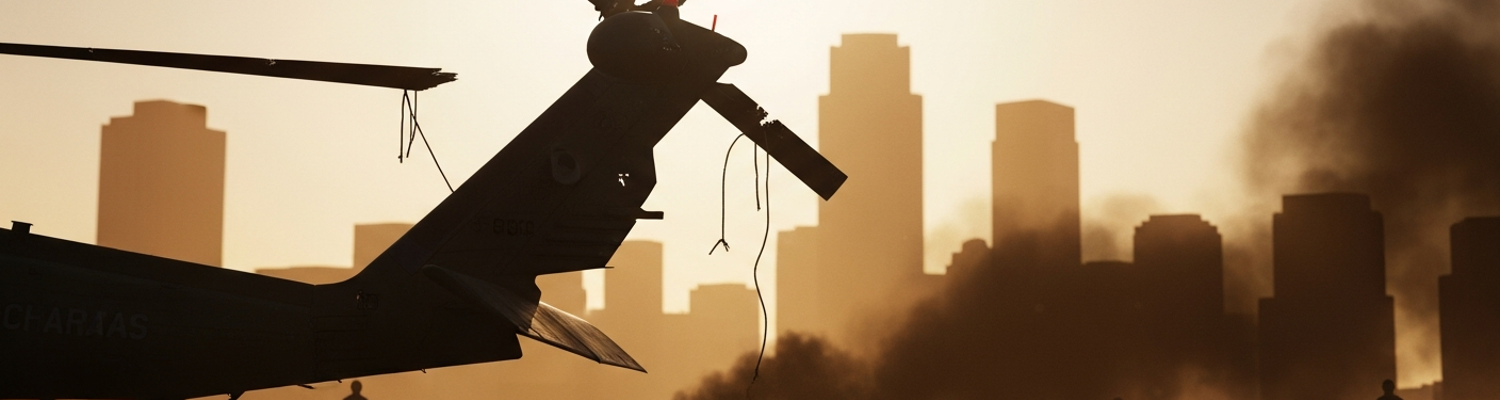
The city's layout imposed its own mechanical stresses. Flying fast and low between buildings, a tactical necessity, demanded constant, aggressive flight control inputs. These maneuvers placed enormous strain on rotor heads, transmissions, and airframes. Pilots navigated a three-dimensional maze where a single miscalculation could result in a catastrophic rotor strike. The MH-6 Little Birds, flying close support, were especially exposed. Holding a steady, low-altitude hover to allow Rangers to fast-rope onto a building was one of the most dangerous phases of any mission. It made the aircraft a stationary target and subjected components to maximum sustained stress. This flight profile accelerated metal fatigue. The RPG that downed Super 6-1 struck its tail rotor assembly, a known vulnerability during low-speed flight in a confined area.
These performance limitations had a cascading effect on the ground. When Super 6-1 crashed, a Combat Search and Rescue (CSAR) team from the Air Force was inserted. The helicopter that brought them in, Super 6-8, was itself hit by an RPG but managed to return to base. The CSAR team, including Pararescueman Scott Fales, roped into a maelstrom. Their mission immediately shifted from rescue to a desperate defense of the crash site. At the second site, the situation was worse. After their initial requests were denied, Gordon and Shughart were inserted about 100 meters from the wreckage of Super 6-4. With only their personal weapons, they fought their way to the downed pilot, Chief Warrant Officer 3 Michael Durant. Their exposure was total. With the ground convoy lost and other units pinned down, they were completely cut off, holding back a converging mob until they were killed. Their prolonged, unsupported defense was a direct result of the inability of other assets to reach them.
The ground support element was configured for a rapid, one-hour extraction, not a prolonged urban battle. The convoy, commanded by Lieutenant Colonel Danny McKnight, consisted of twelve vehicles, mostly unarmored Humvees and several M939 5-ton trucks. The open beds of the trucks left the Rangers inside them completely exposed to fire from rooftops. The plan had no contingency for the convoy becoming a primary combat element. When ordered to fight its way to the first crash site, the force was ill-suited for the task. Lost in the city's streets and under a deluge of fire, the convoy absorbed damage and casualties without being able to effectively navigate or suppress threats. The absence of integrated heavy weapons and armor made every intersection a lethal problem.
The paralysis of the initial convoy forced the creation of a Quick Reaction Force (QRF). This was not a pre-planned unit but a hastily assembled multinational formation. It included elements of the U.S. 10th Mountain Division, Pakistani Army units with M48 tanks, and Malaysian forces in Condor armored personnel carriers. The command timeline shows this process was crippled by delay. These forces had never trained together, operated under different command structures, and lacked common communications. Assembling the column took hours. An attempt by a company from the 10th Mountain Division to push into the city alone was quickly repulsed. The main armored column, nearly two miles long, finally moved out from the New Port at 23:24 hours. More than seven hours after Super 6-1 went down. It fought its way block by block, with Pakistani tank crews and Malaysian APC drivers who did not share a common language with the American infantry they were sent to rescue. Their late arrival was a direct consequence of a command structure with no rehearsed plan for large-scale reinforcement.
Medical evacuation planning was predicated on total air superiority. The system was designed around the speed of a Black Hawk helicopter. This plan failed to account for the helicopters themselves becoming a source of mass casualties. When Super 6-1 and Super 6-4 were shot down, their crews became patients in inaccessible locations. On the ground, there were no dedicated armored ambulances. Wounded soldiers from the convoy, like Sergeant Dominick Pilla, the first American fatality, were evacuated in unarmored Humvees under fire. At the first crash site, the CSAR team and Rangers established a casualty collection point using salvaged armor plates from the wreckage for cover. They could not move their wounded. This lack of evacuation assets fixed the ground forces in place, forcing them into a static defense of their dead and wounded.
Televised images from Mogadishu caused an immediate political crisis in Washington. Public support for the Somalia mission evaporated. A review of Clinton administration records (NARA, Clinton Presidential Library) shows a government forced into a rapid re-evaluation of its foreign policy. The fallout was swift. Defense Secretary Les Aspin resigned. The administration announced a six-month withdrawal of all U.S. troops from Somalia. This retreat was codified in May 1994 with Presidential Decision Directive 25 (PDD-25). The directive established a stringent new set of conditions for future U.S. participation in UN peacekeeping operations. It required a clear national interest, a defined exit strategy, and congressional approval. It effectively ended the administration's support for ambitious multilateral interventions.
The events in Mogadishu altered future military doctrine. A deep aversion to casualties in operations without a clear threat to national survival became a dominant feature of American military planning. The experience reinforced the Powell Doctrine, which advocated for the use of overwhelming force for clearly defined objectives. The Mogadishu raid was seen as a failure of this principle. Subsequent military deployments showed a clear pattern of risk aversion. This was evident in the administration's reluctance to intervene in the Rwandan genocide in 1994, where the memory of Somalia paralyzed discussions of deploying ground troops. Force protection became a primary strategic concern, sometimes elevated above mission objectives.
The Battle of Mogadishu also became a foundational case study for urban warfare. For decades, military planners had been advised to bypass or isolate cities. Mogadishu proved this was no longer an option. Military training centers began constructing large, complex mock cities to replicate the environment that had crippled Task Force Ranger. Doctrine was rewritten. Studies found that existing field manuals on urban operations were obsolete. The lessons were specific: light infantry was vulnerable without integrated armored support; air superiority did not guarantee safety on the ground; and a technologically inferior enemy could use the urban terrain to level the playing field. Subsequent training emphasized combined arms operations, resilient communication systems, and detailed intelligence preparation of the urban environment. The fight in Mogadishu forced the U.S. military to confront the future of urban combat.