
Base Establishment at Rendova and Lumberi Island
At 1600 on July 2, 1943, twenty-five Japanese twin-engine bombers penetrated the radar shadow of the New Georgia peaks. They severed the primary naval communications wire linking the Rendova shoreline to Task Force 31 command ships. Blast fragmentation sliced clean through the high-frequency radio sets of the 43rd Infantry Division. This blacked out direct contact with headquarters at Tulagi. The forward echelons on the beachhead were isolated. Offshore, the grey hulls of Motor Torpedo Boat Flotilla 1 rolled in the heavy chop of Blanche Channel. Lieutenant Commander Barry K. Atkins had brought his squadrons forward to interdict Japanese destroyer runs through Blackett Strait. The bomb strikes severed all tactical coordination. The staging echelon was detached from rear support.
Isolation arrived without warning.
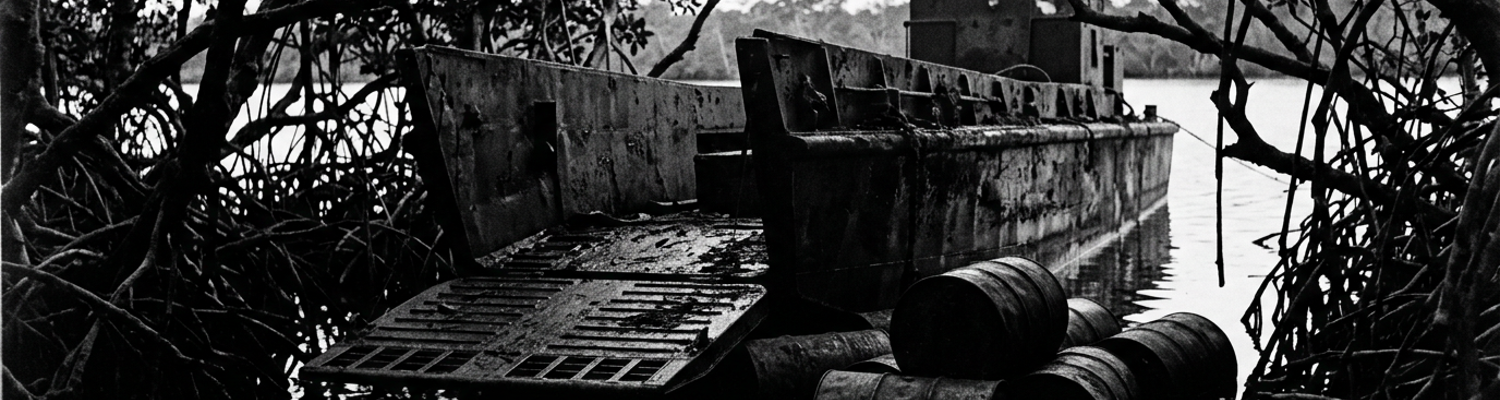
Archival evidence shows that Flotilla 1 could not safely anchor in Rendova Harbor proper without a concealed shore station. They needed shelter from Japanese artillery batteries positioned at Munda Point. That was five miles across the water. Command selected Lumberi Island. It was a coral spit measuring four hundred yards long by one hundred yards wide (coordinates eight degrees twenty-four minutes south, one hundred fifty-seven degrees nineteen minutes east). The terrain consisted of mangrove swamps, stagnant tidal pools, and razor-sharp coral shelves. Work details from the 47th Naval Construction Battalion and MTB Base 7 operated in waist-deep black silt. They used hand axes and block-and-tackle rigs. They lashed coconut logs across exposed roots to assemble floating walkways.
Packard 4M-2500 V-12 marine engines required dry hardstands.
The swamp could not provide them. These engines featured cast-aluminum blocks that corroded quickly in sulfurous mud. Salt spray fouled the Holley 1685F carburetors. Uncharted coral heads sheared the bronze-alloy propellers of any patrol craft attempting to tie off to the trees. Personnel hauled 2,000-gallon synthetic rubber fuel bladders onto jagged limestone outcroppings by hand. Japanese six-inch shore guns targeted the reef line twice daily.
Saltwater and silt destroyed equipment faster than mechanics could clean it.
A close review of operational logs indicates that the base possessed no deep-water approaches. This created a total reliance on shallow-draft supply craft operating across exposed coastal supply lines from depots in the Russell Islands and Guadalcanal. Deep-draft transports like the attack cargo ship Algorab (AK-25) could not enter the uncharted channels without grounding on submerged shoals. Everything that sustained the twenty-four wooden boats of Flotilla 1 arrived aboard unarmored Landing Craft, Tank and wooden-hulled Landing Craft, Mechanized. These flat-bottomed craft made the one-hundred-twenty-mile crossing over open water at eight knots. They were exposed to land-based Aichi D3A dive-bombers and nighttime sweeps by enemy destroyers.
Every gallon of 100-octane aviation fuel reached Lumberi in steel 55-gallon drums stacked on open decks.
The drums leaked under tropical heat. Cargo wells filled with explosive fumes. Unloading required no cranes. Sailors shoved five-hundred-pound steel drums off bow ramps directly into the surf. They rolled them through the roots and hand-cranked rotary wobble pumps to feed distribution lines. An LCM would frequently throw a drive shaft or puncture its hull on a submerged reef. Patrol operations stopped within twelve hours of these accidents. By July 15, fuel consumption had exhausted the forward depot to fewer than three hundred barrels.
Aviation Fuel Contamination in Estuarine Waters
A close review of operational logs indicates that Motor Torpedo Boat Squadron 9 consumed roughly twelve thousand gallons of 100-octane aviation fuel during every standard night sweep through Ferguson Passage and Blackett Strait. Supply runs to replenish this draw originated one hundred twenty miles to the southeast at the Banika Island supply depot in the Russells. Lumberi Island lacked any dredged wharfage. Navy fleet oilers could not pump gasoline directly through pipelines into shore bladders. Service Squadron 3 work parties rolled individual 16-gauge steel fifty-five-gallon fuel drums onto the open well decks of Landing Craft, Tank and twenty-ton Landing Craft, Mechanized.
These shallow-draft lighters scraped bottom along the mangrove shoals.
Deckhands did not have dry dock storage or cranes. Working parties dumped hundreds of drums over the ramp into the estuarine shallows. They roped the metal barrels into floating rafts that sat half-submerged in the brackish, sulfur-heavy shoreline water for days.
Every drum became an unmonitored intake valve for estuarine water.
Archival evidence shows that equatorial sun drove temperatures on open lighter decks and tidal flats above one hundred ten degrees Fahrenheit. This expanded the vapor inside each drum and strained the screw-in bungs. Afternoon squalls followed by incoming evening tides quickly submerged the chime rims under several inches of swamp water. This rapid drop in ambient temperature cooled the trapped 100-octane gasoline. It caused the inner vapor pocket to contract and formed an internal vacuum. Defective Buna-N synthetic rubber gaskets failed to maintain an airtight seal against the negative pressure. These gaskets were degraded by petroleum exposure and direct tropical heat. Estuarine water seeped past the threaded bungs into the aviation fuel.
Microscopic organisms flourished directly along the water-fuel interface inside the darkness of the submerged drums.
Specifically, the hydrocarbon-utilizing fungus Cladosporium resinae multiplied rapidly. The organism fed on aviation hydrocarbons and dissolved nitrates from rotting mangrove vegetation. It multiplied into thick, gelatinous brown bio-sludge. This material settled across the bottom bung ports of the drum supply. Refueling crews pumped this living sediment straight into boat fuel tanks.
When examining the historical record from the third week of July, the tactical results of this contaminated supply chain showed up immediately in the engine rooms of Motor Torpedo Boat Flotilla 1. Each 77-foot and 80-foot Elco boat ran on three supercharged Packard 4M-2500 marine engines. This high-compression machinery required clean fuel metered through Holley 1685F carburetors. The gelatinous fungal bio-sludge and suspended saltwater bypassed coarse brass wire-mesh basket strainers. It entered the main metering jets. Idle tubes, main fuel discharge nozzles, and accelerating pump circuits filled with thick biological slime and white zinc oxide corrosion.
Skippers throttled up to thirty-five knots to intercept Imperial Japanese Navy destroyers off Kolombangara. Fuel starvation choked the engines instantly.
Manifold pressure collapsed from fifty inches of mercury down to ten. Cylinders backfired through induction systems. Power dropped to zero. Boats drifted dead in open water under coastal artillery fire. On the night of July 19, Lieutenant Arthur H. Berndtson reported four out of six assigned PT boats from Ron 9 aborted patrol within forty minutes of clearing Rendova Harbor. Fuel strainers were entirely packed with black organic mud. Motor machinist mates spent twelve-hour shifts disassembling three carburetors per vessel. They boiled bronze jet orifices in carbon tetrachloride solvent and blew out passages with hand bicycle pumps. By July 24, Base 7 logistics personnel discarded over two thousand gallons of aviation gasoline drawn from drums submerged along the southern coral shelf of Lumberi Island.
Coral Reef Hazards During Night Refueling
Archival evidence shows that by late July 1943, Lieutenant Commander Barry K. Atkins shifted all Squadron 9 fueling operations from exposed shore dumps on Lumberi Island to converted Landing Craft, Tank anchored in the deeper pockets of Blanche Channel. LCT-63 and LCT-181 served as auxiliary fueling pontoons. Their cargo beds were stripped to hold two hundred fifty fifty-five-gallon drums each. Tank landing craft dropped hook in twenty fathoms north of Bau Island. They operated completely blacked out beneath the New Georgia artillery arc.
PT boats approached at idle speed on their centerline engines.
They relied on muffled exhausts and hand signals to avoid detection from Japanese spotters across the channel. Deck crews used hemp mooring lines to lash the wooden Elco hulls directly alongside the unarmored steel lighters. Open lighters lacked proper fenders. Swells smashed the mahogany planking against steel ribs while fuel hoses were dragged across wet decks. Men worked without flashlights. They felt for bung caps and bronze grounding wires by hand while ocean swells lifted both vessels in the dark.
Darkness masked volatile gasoline slicks across the gunwales.
A close review of operational logs indicates that approaching these floating fueling stations exposed the patrol craft to jagged underwater terrain. This terrain had never appeared on British Admiralty charts. Coral barrier heads and limestone pinnacles rose straight up from seventy-foot depths to within thirty inches of the surface. They were completely hidden by black water. The 80-foot Elco hulls drew five feet six inches aft at the skegs. Between July 20 and July 28, five different patrol craft from Flotilla 1 suffered severe underwater strikes while maneuvering toward LCT fueling stations at speeds under four knots.
PT-107 clipped a submerged limestone shelf on July 23.
The impact tore the center strut clean through the bottom planking. It sheared the two-inch manganese-bronze alloy drive shaft directly behind the transmission coupling. Propeller blades crumpled into twisted lumps of metal. This unseated the rudder posts and opened seams in the double-planked mahogany hulls. Field repairs required hauling replacement Monel shafts from the depot at Tulagi (sixty miles away). Front-line squadrons were left down three operational hulls during key interdiction runs against the Tokyo Express.
Coral damage disabled more patrol craft than Japanese 120-millimeter artillery fire.
When examining the historical record from Base 7 maintenance units, mechanical fuel pumps deployed on the converted LCT decks broke down systematically during these nighttime evolutions. Crews depended on portable Wisconsin single-cylinder gasoline engines turning Yale and Towne rotary vane pumps. These pushed 100-octane aviation fuel from open deck drums into boat tanks. Ambient temperatures above ninety degrees caused fuel to boil inside pump suction lines. This generated severe vapor locks that seized pump rotors without warning. Neoprene internal seals degraded after seventy-two hours of exposure to high-octane gasoline. Pump casings sprayed atomized fuel directly over red-hot exhaust pipes in pitch blackness.
Mechanics had to shut down the engines instantly to prevent fatal detonations.
Deckhands were forced to switch to manually operated Blackmer rotary wobble pumps. Pumping three thousand gallons per vessel by hand-cranked lever required five hours of backbreaking labor per boat instead of ninety minutes. The delay left PT-103 and PT-105 moored in the open channel well past 0430. They were vulnerable to incoming morning strikes from Kahili-based A6M Zero fighters. By dawn on August 2, three patrol craft sat dead in the water off Lumberi with split pump impellers and empty fuel tanks.
Radar Transformer Failures in Tropical Humidity
Archival evidence shows that during June and July 1943, naval technicians retrofitted Raytheon SO-13 microwave search radar sets onto the eighty-foot Elco hulls of Motor Torpedo Boat Flotilla 1. This was an attempt to counter Japanese night traffic. Crews mounted the twenty-four-inch waterproof radome atop a light tubular steel mast elevated eight feet above the forward charthouse roof. Below deck, the five-inch Plan Position Indicator cathode-ray display unit occupied the tight, unventilated navigator compartment forward of the engine bulkhead. Naval technicians integrated sensitive microwave electronics into light wooden combat vessels. This created severe mechanical friction.
Steel-hulled fleet destroyers formed a single continuous electrical ground. The double-planked mahogany hulls of the Elco craft offered no natural earthing path.
Technicians had to fasten braided copper bonding straps along structural oak frames. They connected the radar modulator chassis directly to an external bronze grounding plate bolted through the bottom timbers. Heavy low-frequency vibrations generated by three supercharged Packard 4M-2500 engines running at full throttle constantly sheared these bonding fasteners. Hull flexing in the rough waters of Blanche Channel twisted antenna waveguide flanges out of alignment. This broke the neoprene perimeter seals and admitted sea spray into the feedhorns.
Plywood and mahogany provided zero protection against the saturated tropical atmosphere.
A close review of operational logs indicates that the primary failure point centered on the high-voltage step-up transformers housed within the radar transmitter-modulator assemblies. Moored along the mangrove shorelines of Lumberi Island, vessels operated in ambient humidity levels consistently exceeding ninety-five percent. Charthouse interiors trapped heat up to one hundred fifteen degrees Fahrenheit. The SO-13 step-up transformer was designed to boost electrical output to four thousand volts direct current to fire the transmitter magnetron. It relied on shellac-coated kraft paper insulation layered between high-density copper windings.
Microscopic water vapor penetrated the non-hermetic transformer housings.
Acidic sulfur mist from decaying mangrove roots and salty ocean moisture saturated the fibrous paper insulation. This caused catastrophic dielectric breakdown within forty-eight hours of harbor deployment. High-voltage electrical arcs burned conductive carbon tracks across the inner windings. This shorted the secondary circuits and liquefied the black asphalt potting compound. Base 7 radio technicians attempted to dry wet coils inside wooden ammunition crates heated with single sixty-watt incandescent bulbs. Moisture reinfiltrated the assemblies within hours of returning to the boats.
Arcing circuits melted fine copper coils and filled crew compartments with blinding smoke.
When examining the historical record from the New Georgia campaign, these recurring electrical burnouts grounded dozens of planned night interdiction sorties aimed at disrupting the Tokyo Express. Japanese commanders relied on armored Daihatsu barges and fleet destroyers hugging the jagged reefs of Kolombangara to move troops into Vila under cover of tropical squalls. Without functioning SO-13 microwave screens, patrol skippers could not detect these low-profile barges against the sheer clutter of dark coastlines until incoming 25-millimeter cannon fire bracketed their boats. Lieutenant Commander Barry K. Atkins canceled scheduled patrols through Blackett Strait and Ferguson Passage whenever service squads could not supply functional radar-equipped lead boats.
Squadron doctrine prohibited sending blind hulls into restricted reef-choked waters alone.
It required at least one functional radar set to guide two or three companion vessels. On the night of August 1, electrical shorts in transmitter modulators grounded five of the fifteen boats assigned to interdict four Japanese destroyers approaching Blackett Strait. This left PT-109 and three companion craft from Section B to operate without radar detection capability. By midnight on August 2, half the patrol flotilla remained tied off to mangrove trunks with melted transformers sitting cold in the damp dark.
Vacuum Tube Logistics and Tender Vulnerabilities
Glass vacuum tubes failed faster than weapons in the Solomon Islands.
Archival evidence shows that the motor torpedo boat tender USS Jamestown rode anchor one hundred twenty miles to the rear in Purvis Bay off Tulagi. Fleet commanders would not expose a vulnerable repair vessel to Japanese airstrikes and coastal artillery. Aboard Jamestown, dry storerooms held crates of replacement vacuum tubes. These included 6AC7 pentodes, 6SN7 dual triodes, 5R4GY rectifiers, and 725A magnetrons required to operate Raytheon SO-13 radars and TCS radio transceivers. Forward at Lumberi Island, Base 7 lacked dry storage buildings or shock-absorbing racks.
Unpressurized glass tubes were shipped in thin single-ply paper cartons.
They suffered structural failure when exposed to severe humidity, tropical heat cycles, and engine concussion. Atmospheric moisture penetrated unsealed tube bases. Intense vibration from three Packard engines fractured the internal filament welds. By July 26, Flotilla 1 possessed fewer than five spare 6AC7 amplifier tubes across twenty-four boats. This disabled radio transmitters and left radar displays dark. Delicate glass envelopes shattered long before crates reached the frontline berths.
A close review of operational logs indicates that moving replacements from Purvis Bay to Rendova meant pushing small craft across sea lanes monitored by Japanese reconnaissance planes. Supply runs depended on wooden 110-foot subchasers and flat-bottomed Landing Craft, Tank that crawled past the Russell Islands at eight knots. Imperial Japanese Navy floatplanes and twin-engine Mitsubishi G4M bombers based at Kahili airfield swept Blanche Channel nightly. Supply skippers blacked out all running lights and steered away from open water.
Near the southern mouth of Ferguson Passage, Japanese shore batteries and armed Daihatsu barges shelled these coastal transit channels.
Transports were forced into evasive seventy-mile detours through uncharted reefs. Saltwater crashed over the low gunwales of the lighters. This drowned cargo spaces and ruined cardboard packaging. These detours delayed delivery schedules by up to six days. Combat crews were left without replacement components for critical communication frequencies. Supply craft frequently pulled into Lumberi with submerged decks and ruined electronics.
When examining the historical record of Base 7 maintenance units, radio technicians survived this supply drought by stripping electronics from wrecked patrol hulls. Craft immobilized by reef impacts were dragged into the mangrove shallows and treated as salvage depots. This included PT-107 with its sheared propeller shaft and damaged bottom planking. Mechanics boarded the listing hulls with wire cutters, hand-cranked soldering irons, and canvas tool rolls. Base personnel ripped 6SN7 tubes, mica capacitors, and porcelain standoff insulators directly out of wet radio frames.
Technicians pried loose structural shock mounts.
They stripped copper shielding from main wire trunks and de-soldered socket pins from ruined transmitter boards. In stifling bilge compartments lit by hand torches, sailors wiped saltwater off glass envelopes with gasoline-soaked rags. They checked filament continuity using hand-cranked battery ohmmeters. Every salvaged tube that showed unbroken continuity went directly into operational boats berthed for the evening combat patrol. On the afternoon of August 1, maintenance personnel pulled two 6V6 power tubes from the flooded radio compartment of PT-107. They restored the high-frequency transmitter on PT-109 three hours before its final departure into Blackett Strait.
Communications Saturation at Lumberi Island Base
Archival evidence shows that by late July 1943, the Base 7 communications station on Lumberi Island operated out of a sandbagged timber hut measuring ten by twelve feet. It was equipped with Navy TCS high-frequency transmitter-receiver units crystal-tuned to 2844 kilocycles. Three radiomen per watch monitored the local tactical channels. Incoming traffic from Blanche Channel and Ferguson Passage overwhelmed the receivers. Hull damage from uncharted coral pinnacles combined with engine shutdowns caused by fungal sludge in fuel lines. This turned the operational frequency into an emergency clearinghouse for stranded boats.
Between 2100 and 0400 each night, base operators handled an unending stream of urgent salvage traffic.
Skippers of disabled eighty-foot Elcos broadcast repeated calls for towing assistance. Their Packard engines were stopped cold by clogged carburetor jets or stripped propeller shafts. Shallow-draft Landing Craft, Mechanized hauling 55-gallon fuel drums broke their rudders on submerged reefs near Sasavele Island. They tied up frequencies with urgent position reports. Radiomen struggled to log coordinate grids and vector the base retrieval boats across five miles of open water. These two unarmed 36-foot Eureka boats operated under direct threat from Japanese shore batteries at Munda Point. Distress calls from immobilized lighters crowded out tactical reporting before midnight.
A close review of operational logs indicates that this non-combat radio traffic collapsed battle coordination during night interdiction missions against the Tokyo Express. Lieutenant Commander Barry K. Atkins dispatched fifteen patrol craft from Motor Torpedo Boat Squadrons 5, 9, and 10 to intercept Japanese destroyers transiting Blackett Strait. All divisions shared the same crowded voice nets. Voice traffic on the TCS sets suffered from severe heterodynes. Two operators keying microphones simultaneously created high-pitched carrier squeals that wiped out both transmissions.
At 0030 on August 2, four Japanese destroyers of the Reinforcement Unit rounded the southern coast of Kolombangara at thirty knots.
Section B skippers struggled to establish contact. Radar-equipped lead craft attempting to broadcast target bearings, speeds, and torpedo spread angles found the frequency blocked. Disabled vessels five miles south were requesting hawser tows and battery recharges from Lumberi. The resulting delays prevented division leaders from coordinating their torpedo runs. Individual boats like PT-109 were detached in the dark without radar tracking data or early warning of approaching enemy destroyers. Signal jamming left skippers shouting into dead handsets while Japanese targets passed.
When examining the historical record from Base 7 maintenance units, shore-side repair personnel experienced physical breakdown while overhauling high-compression engines under strict tactical constraints. Patrol craft returned to Lumberi at dawn with cracked cylinder heads, burned sodium exhaust valves, and copper-lead bearings scored by sand drawn through estuarine cooling intakes. Command orders enforced absolute blackout conditions between 1830 and 0600. This prevented Japanese artillery spotters at Munda Point and night-flying Mitsubishi G4M bombers from sighting the anchorage.
Base mechanics executed complete teardowns on 1,500-horsepower Packard 4M-2500 V-12 engines beneath suffocating, rubberized canvas tarpaulins.
These tarps were lashed over the open engine hatches. Inside these sealed bilges, ambient air temperatures climbed past one hundred twenty degrees Fahrenheit. Relative humidity held at ninety-eight percent. Machinists worked twelve-hour continuous shifts. They inspected engine blocks using shielded, dim red-lens flashlights that obscured valve clearance markings. Gasoline fumes and carbon monoxide pooled in unventilated bilges. This caused nausea and dizziness among motor machinist mates adjusting valve tappets to fifteen-thousandths of an inch with shaking hands. Dropped wrenches fell into oily bilge water beneath engine beds. Mechanics fished blindly through toxic sludge to retrieve hardware before boats departed for evening patrol at 1700. On the morning of August 3, three senior mechanics collapsed from acute heat prostration while torquing cylinder head studs on the center engine of PT-103.
Tactical Impact on Blackett Strait Interdictions
A close review of operational logs indicates that the mechanical attrition at Lumberi Island decimated patrol density across Blackett Strait and Vella Gulf throughout late July and early August 1943. Motor Torpedo Boat Flotilla 1 suffered mission abort rates exceeding forty percent across Squadrons 5, 9, and 10. Skippers pushed throttles forward into Ferguson Passage. Gelatinous Cladosporium resinae sludge choked the metering jets of Holley 1685F carburetors. This starved the Packard 4M-2500 engines of fuel within minutes of leaving harbor. Suspended volcanic silt and coral sand scored raw-water cooling impellers. Manifold temperatures spiked past two hundred degrees Fahrenheit and forced emergency shutdowns.
Hull damage from uncharted coral pinnacles north of Gizo grounded vessels before they reached designated patrol sectors.
Between July 25 and August 1, division commanders logged twenty-two distinct mechanical aborts during twenty-eight scheduled sorties. Engines seized at sea. Propeller shafts vibrated violently from damaged bronze blades. This rattled structural fasteners loose and threatened hull integrity. Patrol sections scheduled to deploy four boats routinely arrived at their patrol stations with only two hulls. Critical interdiction gaps opened along the western coast of Kolombangara. Vessels limped back into Blanche Channel on single engines before midnight.
Archival evidence shows that these combined equipment failures forced an operational regression from radar-directed interception to unguided visual spotting against Japanese destroyers. Over seventy percent of the Raytheon SO-13 radar sets were disabled by burned-out step-up transformers and ruined vacuum tubes. Combat craft operated blind in pitch blackness. Patrol divisions lost the ability to track incoming surface targets beyond three hundred yards.
Skippers had to rely on naked-eye lookouts.
They searched for phosphorescent bow waves, white wake foam, and engine exhaust sparks against the looming black silhouette of Mount Kolombangara. Imperial Japanese Navy destroyers of the Tokyo Express possessed optical lookouts equipped with high-magnification twelve-centimeter night binoculars mounted on elevated bridge structures. This granted them surface sighting ranges up to three miles. This sensory disparity created tactical paralysis. On the night of August 1 to 2, fifteen American patrol craft deployed into Blackett Strait fired thirty Mark 8 and Mark 13 torpedoes at four Japanese destroyers of the Reinforcement Unit. Not one struck home. Operating without radar guidance, PT-109 drifted at idle speed along Section B patrol line until the destroyer Amagiri, traveling at thirty knots, sliced the wooden hull in two before the crew could align their manual steering gear or fire a shot.
When examining the historical record, the disaster in Blackett Strait compelled the Bureau of Ships and the Commander of Motor Torpedo Boat Squadrons Pacific Fleet to enact sweeping doctrinal revisions regarding forward-base naval logistics. Navy commanders recognized that establishing bare-bones staging bases on isolated coral atolls like Lumberi invited operational failure. New deployment doctrine barred squadrons from operating out of advanced anchorages without self-contained mobile tender support and dedicated repair ships like the USS Niagara (AGP-1) or USS Jamestown (AGP-3) stationed within thirty miles. The practice of rolling 55-gallon drums of 100-octane aviation gasoline into estuarine shallows ended by formal directive.
Service squadrons received specialized mobile fueling barges.
These units were fitted with multi-stage centrifugal fuel-water separators, desiccant air breathers, and closed-circuit vapor recovery pumps. Naval electronics commands overhauled the procurement standards for marine radar sets. Factory specifications mandated full tropicalization for all forward radar modulator assemblies. Porous kraft-paper insulation was replaced with hermetically sealed, oil-filled transformer canisters capable of withstanding ninety-eight percent relative humidity. Subsequent campaigns in the Treasury Islands, Bougainville, and the Philippines banned the deployment of patrol boat echelons until forward logistics units could guarantee sheltered, hardstand engine repair bays and dry, shock-resistant electronics lockers. By October 1943, Base 7 was dismantled and its personnel reassigned to floating drydocks in Purvis Bay.