
Pacific Debriefs and the Melville Tactical Crisis
Shipfitters scrambled across the damp timber docks of Narragansett Bay under an urgent operational deadline to ready patrol craft for immediate deployment. Mechanics wrestled heavy crates of spare parts down narrow wooden ramps while boat crews tuned roaring Packard marine engines and tested steering gear through the cold morning mist. Action reports from the Solomon Islands and New Guinea revealed that prewar doctrine targeting capital ships was failing against shallow draft Japanese Daihatsu barges. American tactical planners had built the motor torpedo boat service to attack enemy aircraft carriers, battleships, and cruisers across open water with long range torpedo spreads. Japanese fleet commanders in the Pacific quickly abandoned large warship sorties in restricted island waters, deploying instead heavily armored, diesel powered Daihatsu landing barges that drew less than five feet of water and carried thick steel plating over their engine compartments. These flat bottomed steel craft moved supplies over shallow shoals and coral reefs where deep draft American destroyers and cruisers could not maneuver, exposing the entire Allied coastal interdiction campaign to failure.
Torpedoes fired at these shallow barges proved completely incapable of stopping the nightly supply runs. Action debriefs showed that torpedoes set to standard fleet running depths passed beneath the shallow hulls without contacting the hull plating, while weapons set to run near the surface struck submerged coral heads and exploded harmlessly. Heavy Mark 8 torpedo tubes proved ineffective against armored barges, requiring instructors at the Motor Torpedo Boat Squadrons Training Center at Melville to overhaul tactical training. Each individual torpedo tube assembly added tons of topside weight to the wooden PT boats, degrading hull speed and maneuverability while leaving crews virtually defenseless against barge mounted twenty five millimeter autocannons. Instructor officers realized that teaching trainees to conduct conventional high speed torpedo approaches was sending crews into combat with weapons that could not strike their targets. Naval planners had to discard their textbook fleet doctrine and rebuild the training syllabus around surface gunnery before the next wave of boat crews shipped out to combat zones.
Instructors gathered on the Melville repair pier at 0802 to carry out this doctrinal change during a critical five minute inspection. Senior officers boarded a wooden training boat with the Pacific dispatches in hand, evaluating how rapidly the vessel could be transformed into a functional gun platform. The chief tactical instructor climbed onto the starboard gunwale at 0804, seized the heavy bronze release mechanism of a Mark 8 tube, and confirmed that the three ton assembly was dead weight against shallow draft barges. He took a piece of yellow shipyard chalk from a dockworker at 0805 and drew bold crosses across the mounting lugs of every torpedo carriage. Yard mechanics ignited cutting torches and grabbed socket wrenches at 0806 as he issued direct verbal orders to strip the boat down to its bare wooden decking. The five minute inspection ended at 0807 when the first securing nut spun free from the cradle, sealing the training center commitment to an all gun combat syllabus.
Squadron Four training vessels began stripping excess torpedo gear in spring 1944 to reconfigure hulls for rapid close quarters coastal gunnery. Riggers removed the bulky cylindrical launching tubes, uncoupled pressurized compressed air tanks, and lifted the Mark 8 hardware away with dockside cranes to lighten the hulls. Carpenters reinforced the forward mahogany decks with heavy timber backing plates and bolted armored mounting rings directly over the keel frames to absorb the immense recoil of heavy weapons. Crews mounted rapid firing forty millimeter Bofors guns, twin fifty caliber machine gun tubs, and automatic cannon in place of the discarded torpedo gear. Gunnery instructors drilled student sailors in high speed tactical passes across Narragansett Bay, teaching helmsmen and gunners to lay down overwhelming barrages at ranges inside one hundred yards. Melville dispatched these newly converted gunboats into daily live fire exercises against moored target rafts, unleashing thousands of armor piercing rounds into the wooden structures until they disintegrated into splinters and sank beneath the bay.
Combat Conversion Timings at Narragansett
Target rafts anchored in Rhode Island Sound shattered under continuous automatic fire, yet instructors quickly recognized that stationary firing runs masked fatal flaws in combat approach timing. A simulated night interception drill off Point Judith exposed the critical five minute window where gun crews transitioned from silent approach to point blank broadsides. Patrol boats prowled through rolling ocean swells with underwater mufflers engaged, stalking radar directed course lines at seven knots before spotters sighted the silhouettes of simulated enemy hulls. Sailors struggled to coordinate engine throttles, searchlight illumination, and gun training in the sudden rush of cold spray and deafening noise as boat captains rang up flank speed. Crew members fumbled with ammunition belts and safety catches in the darkness, leaving weapons silent during the exact moments when crossing targets presented their broadest exposure. Gunnery officers realized that if crews could not bring their weapons to bear within those five minutes, Japanese barge gunners would spot the boat wakes and rake the unarmored wooden cockpits with twenty five millimeter explosive shells.
Helmsmen wrestling with heavy steering wheels in churning wakes discovered that residual topside weight nearly capsized the wooden patrol craft during sudden high speed turns. Replacing heavy torpedo tubes with lightweight Mark 1 roll off racks saved critical tonnage, enabling immediate stability corrections during sudden combat maneuvering. The discarded Mark 8 steel tubes and their bulky support hardware had locked thousands of pounds of dead metal high above the waterline, forcing boats to heel over at dangerous angles whenever pilots threw their rudders hard over to align their weapons. The compact Mark 1 racks rested flat against the deck edges, carrying torpedoes that rolled smoothly over the side without the need for heavy launch tubes or pressurized air cylinders. Eliminating the bulky carriages lowered the center of gravity across the entire eighty foot hull, allowing boats to snap back level immediately after sharp evasive turns. Gunners standing in the open tubs could now track their targets without fighting the violent deck roll that previously threw their aim into the sky or down into the ocean swells.
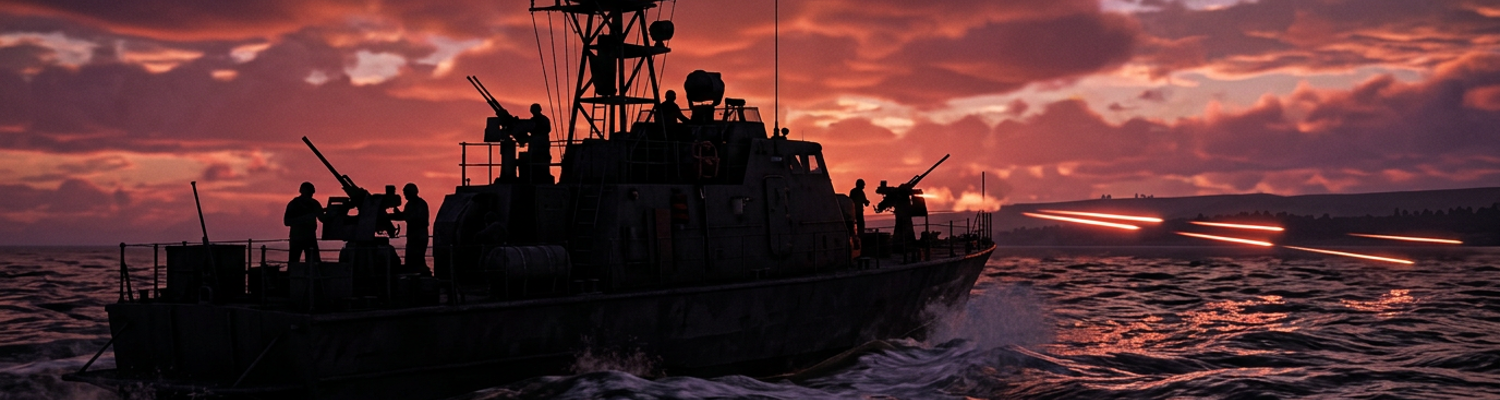
Deck space cleared by removing the heavy torpedo gear allowed shipyard workers to anchor heavier firepower directly into the longitudinal hull frames. Installation of forty millimeter Bofors and thirty seven millimeter automatic cannon mounts transformed PT hulls into dedicated gunboats capable of neutralizing armored barge gun tubs. Riggers positioned a single barrel forty millimeter Bofors on the reinforced aft deck, securing its steel mounting ring through thick mahogany timber pads into the keel structure. Armorers bolted a rapid firing thirty seven millimeter automatic cannon onto the forecastle, giving forward gunners the flat trajectory and high muzzle velocity needed to pierce boiler plate steel. These weapons threw dense showers of armor piercing and high explosive rounds that shattered sandbag barricades, punched through the steel gun tubs shielding Daihatsu crews, and ignited onboard fuel drums at ranges under one hundred yards.
Crews steered these reconfigured gunboats back into the dark water off Point Judith to rerun the five minute interception exercise under realistic combat conditions. Lookouts picked up the simulated barge profile, allowing the helmsman to steer silently into position before the captain threw three throttles forward to summon three thousand horsepower from the supercharged engines. The lightened hulls planed cleanly across the chop without hazardous roll, holding flat platforms as gunners ignited searchlights and opened fire simultaneously with both heavy cannons and twin machine guns. Shells tore through the mock barge positions within three minutes of the opening sprint, leaving the target waterlogged and shattered before return fire could organize. Melville instructors recorded the split second drill timings on waterproof clipboards, calculating the exact rotation speed of the Bofors mounts and the reload cycle of the thirty seven millimeter cannons.
Engineering Protocols and Packard Engine Vulnerabilities
Machinists running engine test stands immediately felt the physical consequences of these violent tactical sprints, as rapid throttle advances from idle to full combat speed pushed marine propulsion machinery far past peacetime tolerance limits. The Motor Torpedo Boat Repair Training Unit drilled thousands of machinists on managing the temperamental, supercharged 1,500 horsepower Packard 4M-2500 V-12 engines. Every patrol boat housed three of these massive liquid cooled engines, each demanding exact valve clearances, delicate carburetor synchronization, and constant oil pressure monitoring to keep the superchargers from blowing out during sudden accelerations. Instructors forced student mechanics to crawl into cramped, suffocatingly hot engine compartments to swap out fouled spark plugs and detect cylinder misfires by sound alone while hulls shook violently against dockside mooring lines. Failure to keep all three V-12 engines balanced during a high speed sprint would starve an outboard propeller of power, slewing the wooden boat off its firing run and exposing the unarmored crew to enemy return fire. Continuous high speed maneuvers also jarred internal fuel supply lines, shaking connections loose and spilling liquid gasoline across the bilges.
Fuel vapors pooling beneath the vibrating deck plates created an immediate risk of fire whenever a boat banked hard on its side through ocean chop. Rigid handling procedures for volatile 100 octane aviation fuel were established to mitigate catastrophic bilge and engine compartment explosions during high speed turns. Trainee crews learned to sniff bilge vents before every engine startup, run electric exhaust blowers for several minutes to clear trapped fumes, and ground all bronze fueling nozzles to prevent static electrical discharge. Fuel transfer manifolds required continuous leak inspections by flashlight, as pressure spikes from mechanical fuel pumps could spray volatile gasoline directly onto hot generator casings. Students caught skipping these mandatory safety steps faced immediate reassignment because a single spark from an electrical starter switch or a loose battery terminal could blow the light wooden hull apart. Even with vapor hazards kept under tight control, the massive thermal stress of running three supercharged engines at top speed threatened to burn through exhaust pipes and cooling jackets.
Manifolds glowed red hot inside the darkened hull during flank speed runs, while raw seawater circulating through thin cooling jackets frequently boiled away under sustained battle power. Trainees practiced jury rigged manifold and cooling repairs under combat conditions to prevent catastrophic mechanical failure during combat egress. Instructors simulated battle damage by cutting primary water lines or loosening exhaust flange bolts during high speed runs, filling the engine room with dense white steam and toxic carbon monoxide fumes. Sailors plunged into the hot bilge with heavy canvas gloves, wrapping ruptured exhaust manifolds in asbestos cloth, securing split hoses with twisted wire bands, and redirecting raw seawater lines using spare rubber tubing. These hasty mechanical fixes kept the Packards from seizing up long enough for the helmsman to pull clear of enemy coastal batteries and steer into open water. Yard personnel checked each patched engine immediately after these mock escapes, measuring the exact temperature of the cylinder heads and logging the remaining oil pressure on the mechanical gauges.
Radar Integration and Night Interdiction Tactics
Electricians bolted waterproof junction boxes and radar housings directly into these freshly serviced hulls, preparing the vessels for dark water operations off the New England coast. Night training operations around Block Island integrated newly fielded SO radar displays into cramped Elco and Higgins cockpits. Radar technicians squeezed five inch Plan Position Indicator scopes into the narrow spaces between steering wheels, magnetic compasses, and engine telegraphs. Sailors wrapped heavy canvas light shields around the rubber viewing hoods so that no green glow from the cathode ray tube could reflect off cockpit windscreens or alert enemy lookouts. Antenna radomes fixed atop wooden mastheads rotated continuously through salt spray, sweeping the open water with microwave beams that penetrated thick fog banks and heavy rain squalls. Navigators tracked these returning echoes on glowing circular screens, calling out distance markers and compass bearings to guide boats along rocky coastlines without visual landmarks.
Navigators used grease pencils to mark these radar coordinates across bulkhead plotting boards, turning isolated radar blips into precise intercept vectors for group attacks. Crews developed standardized voice radio plotting protocols to communicate real time contact vectors without breaking radio silence prematurely. Radio operators held their transmissions until targets reached designated strike sectors, broadcasting brief three letter codes over low power tactical voice transmitters. Lead navigators transmitted bearing angles, target speeds, and range estimations in rapid, monotone pulses that lasted only two or three seconds. Trailing boat crews transferred these coordinates directly onto grease pencil plotting sheets, bringing multiple hulls into echelon attack formations without broadcasting continuous chatter that Japanese radio direction finders could locate. Gun captains locked their weapon mounts onto these calculated vectors while running blind, waiting for visual confirmation before firing their first rounds.
Machinists moved heavy bronze levers in the engine compartments to close overhead exhaust flappers as the boats closed within striking range of the target. Crews utilized muffled underwater exhaust systems for station keeping and practiced strict visual recognition signaling to eliminate persistent friendly fire incidents. Diverting hot exhaust gases through copper pipes beneath the hull transom suppressed the roaring combustion noises, permitting the wooden hulls to idle at four knots while holding exact station lines in pitch darkness. Engine crews monitored cooling water temperatures continuously because back pressure from underwater exhaust outlets threatened to overheat the idling V-12 engines. Helmsmen maintained position along designated patrol lines through gentle rudder adjustments, using the silent exhaust to drift through ocean swells without generating luminous phosphorescent surface wakes. Spotters peered through heavy darkness to detect the sound of opposing engines, confident that their own muffled hulls remained acoustically invisible against the background noise of coastal surf.
Lookouts scanned the black water for low riding silhouettes as simulated enemy targets closed to point blank firing ranges. Gun crews held their fire until signalmen aimed hooded Aldis lamps across the water, flashing prearranged challenge codes through colored lenses to confirm target identities. Responding vessels answered instantly with matching dual color flashes, proving their friendly identity before gun captains tripped electric firing solenoids. Rigorous visual recognition signaling eliminated accidental engagements between patrolling divisions, teaching gunners to distinguish Elco and Higgins profiles from Japanese Daihatsu barges in split seconds. Skippers advanced all three throttles to flank speed the moment an unidentified contact failed to provide the proper optical reply, bringing thirty seven millimeter and forty millimeter cannons into action at ranges inside seventy five yards.
Gunboat Deployments in the Southwest Pacific
Graduates of the modified Melville curriculum deployed directly to front line squadrons across the New Guinea and Philippine combat theaters, carrying these rapid seventy five yard gunnery drills straight into equatorial combat waters. Replacement crews stepped off transport ships at advance staging bases like Dreger Harbor, Aitape, and Leyte Gulf, reporting to motor torpedo boat tenders that were already converting standard hulls into heavily armed gunboats. Frontline squadron commanders assigned these newly arrived sailors to veteran boat divisions that had spent months improvising armor plate and field modifying weapon decks. The new arrivals brought standardized training in high speed approaches, synchronized radar plotting, and rapid fire coordination that seasoned veterans had previously learned only through costly trial and error. Shipfitters at island repair bases quickly stripped remaining torpedo gear from operational boats, bolting forty millimeter Bofors cannons onto reinforced forward decks and securing thirty seven millimeter mounts over engine spaces. Crews loaded racks with high explosive ammunition and checked electric trigger solenoids before casting off mooring lines at dusk, heading out to establish night interdiction patrols across narrow island channels.
Radar operators hunched over glowing scopes as patrol divisions slipped past barrier reefs and into shallow coastal corridors where deep draft American destroyers could not safely navigate. Navigators plotted green radar blips that appeared against dark land echoes, guiding the muffled patrol boats along jagged shorelines at an idling speed of six knots. Spotters confirmed the low silhouettes of heavily armed Japanese transport craft creeping through the shallows with diesel engines rumbling over the surf. Boat captains shoved all three engine throttles to flank speed, executing the rapid five minute attack sprint developed in the training runs off Point Judith. Deck guns erupted simultaneously at close range, pounding the lead vessels with forty millimeter explosive shells, armor piercing cannon rounds, and heavy machine gun fire before Japanese lookouts could organize a coordinated defense. The sudden volume of metal shredded wooden decks and ignited fuel drums, leaving the enemy convoy burning brightly in the surf.
Daihatsu barges destroyed in these night ambushes littered coastal reefs across New Guinea, Halmahera, and the central Philippines. The newly designated gunboats successfully severed Japanese coastal resupply networks by systematically sinking Daihatsu barges along inter island routes. Patrol divisions hunted down these flat bottomed supply craft night after night, cutting off the flow of rice, ammunition, and replacement troops between isolated island bases. Japanese army detachments defending shoreline positions ran out of medical supplies and food, while coastal artillery units exhausted their shells without any hope of ocean replenishment. Crews aboard the gunboats maintained these hunting sweeps through Surigao Strait and Ormoc Bay, pouring continuous automatic cannon fire into loaded barges until the shattered steel hulls sank beneath the tropical waters.
Admirals evaluating the shattered Japanese supply lines discontinued long range torpedo strikes against enemy battle lines, directing patrol squadrons instead to support amphibious landings, suppress shore batteries, and sweep shallow bays. Shipbuilders incorporated the gunboat layout directly into factory assembly lines, delivering late production hulls equipped with armored cockpits, multiple automatic cannons, and rocket racks straight from domestic yards. Mechanics at advance bases welded additional steel plating over the engine compartments of these new arrivals to deflect shrapnel during close quarters river patrols. Squadron skippers in forward operating areas steered these heavily armed craft deep into enemy harbors, firing high explosive rockets into concrete bunkers and strafing shoreline troop concentrations. The modified patrol boats prowled the coastal shallows of the Pacific theater, hunting down the last remaining diesel barges and blasting their wooden superstructures into the sea.