
Isolated Troop Morale Challenges
The supply equation for the Marines on Peleliu was simple. For every ton of materiel successfully delivered, three tons were lost. Lost to enemy fire, to mechanical failure, or to the island's punishing coral topography. This defined the world for the rifle companies of the 1st, 5th, and 7th Marines inside the Umurbrogol Mountain cave systems.
Operational logs from the 7th Marines (Record Group 127, NARA) show men spending over 200 hours in the same two-man fighting hole. Isolation was absolute. Platoons were cut off from adjacent units, sometimes only yards away. They endured constant humidity, the stench of decay, and the psychological corrosion of fighting an enemy they could hear moving through the rock but rarely see. Medical debriefs from the 1st Marine Division document a sharp increase in non-combat casualties after the first ten days of fighting in the caves, citing rampant dysentery and a condition documented as combat fatigue. It was the breaking point.
The single most requested non-essential item was mail.
In this environment, mail was a psychological lifeline. Morale Office reports show a direct link between mail arrival and fighting spirit. K Company, 5th Marines, endured 60 days without mail in the Umurbrogol Pocket. Disciplinary infractions increased by 200 percent. Weapons-maintenance failures spiked by 40 percent. After a high-risk night drop delivered two sacks of V-Mail, the same unit’s after-action reports noted improved fire discipline during a subsequent Japanese counter-attack. The arrival of letters, often photographed onto microfilm to save cargo space, provided a concrete sense of time and a future to fight for, counteracting the timeless quality of cave warfare. The absence of mail amplified feelings of abandonment and directly corresponded to spikes in combat fatigue cases. Men felt that if the mail could not get through, then they were truly written off.
The system went beyond personal letters. Official postal circulars from the Army Postal Service were administrative command tools. These were not personal notes. They were mass-produced documents, proof that the vast machinery of the armed forces had not forgotten the individual Marine. They carried essential information: updates to pay schedules, details on the GI Bill, criteria for promotion and rotation. A captured Japanese intelligence assessment (dated October 1944) noted that disrupting American mail was as effective as disrupting ammunition supplies. For a soldier whose world had shrunk to a few square yards of rock, a circular confirming his pay was still accumulating was a powerful anchor to organization and purpose.
Pacific Theater Supply Chain Obstacles
The 2.5-ton CCKW truck was supposed to be the logistical workhorse of the advance. In New Guinea, it failed. Army quartermaster logs show that for every ten trucks put into service, three were rendered inoperable within the first hundred miles. The terrain was an active opponent. Volcanic soil turned to viscous mud, clogging axles and overwhelming transmissions. On improvised routes like the Kokoda Track, carburetors flooded on steep inclines, stalling vehicles completely. Engineering units, primarily the U.S. Navy Seabees and Army Engineer Battalions, laid corduroy roads over the swamps, but flash floods frequently washed them away. This logistical breakdown forced a reliance on native carriers, a system that could move only a fraction of the required tonnage.
The supply lines ended at the high-tide mark.
Amphibious assaults faced a different set of problems. Japanese doctrine on islands like Tarawa and Peleliu was designed to defeat an attack at the water’s edge. Logs from the 2nd Marine Division's assault on Tarawa's Betio islet detail the strategy's effectiveness. The Japanese built interlocking fields of fire from concrete pillboxes and revetments, all sighted on the shallow reef approaches. The plan for Tarawa required a high tide to float Landing Craft, Vehicle, Personnel (LCVPs) over the coral. The tide never came. The boats grounded hundreds of yards from the beach. First-wave Marines were forced into chest-deep water, directly into pre-sighted machine guns and mortars. Even the tracked LVT "Amtracs," designed to crawl over reefs, were systematically targeted by Japanese 75mm field guns.
For units that pushed inland on Peleliu, the supply chain vanished. The Umurbrogol Mountain, later called Bloody Nose Ridge, was a six-mile maze of raised coral and limestone. Naval bombardment had shattered it into impassable ridges and ravines. American intelligence had misidentified it as a series of low hills. Japanese engineers had spent months blasting hundreds of interconnected bunkers into the rock, creating a defense impervious to air or artillery strikes. Wheeled vehicles were useless. Airdrops were impossible; the close proximity of fighting meant supplies would land in Japanese positions. The 1st Marine Division found itself in a state of siege. Every can of water, every box of ammunition, had to be carried up near-vertical slopes by hand. These carrying parties suffered high casualties from snipers and machine-gun fire from the mutually supporting cave mouths. The 1st Marine Division suffered over 6,500 casualties in its battle for the ridges, a significant portion being the men tasked with supplying the front.
Risky Naval Mail Delivery Strategy
An analysis by III Amphibious Corps staff concluded the supply effort in the Umurbrogol Pocket was failing. The attrition of carrying parties was degrading combat power faster than direct Japanese action. Command re-evaluated the entire supply chain. A review of Maj. Gen. Roy S. Geiger’s command group files shows a shift in perspective. Mail was no longer a comfort. It was a component of operational endurance. The decision was made to sanction a high-risk naval delivery directly to the shoreline. Higher command justified this as a calculated gamble, weighing the slow bleed of existing casualties against the potential for a one-time loss of a naval craft. The math was direct. Losing one vessel and its crew was a more acceptable risk than losing dozens of Marines over several days to deliver a fraction of the same cargo.
The chosen instrument for this gamble was the Landing Craft, Tank.
The American-built LCT(6) was selected for the task. This was not a warship. It was a flat-bottomed, box-like cargo hauler designed to run aground on beaches. Just over 114 feet long, it was powered by three Grey Marine diesel engines, giving it a maximum speed of a slow ten knots. Its large cargo well, designed for tanks, could hold thousands of pounds of mail sacks. Its shallow draft of three and a half feet allowed it to navigate over the coral reefs that kept larger ships far from shore. The trade-offs were severe. The LCT was lightly armored with thin steel plate, making it vulnerable to Japanese 47mm anti-tank guns and mortars concealed in the caves.
Standard supply lines were a guaranteed failure.
The established route was broken. It involved offloading supplies from ships into amphibious tractors (LVTs), which crawled to the main landing beaches miles south of the fighting. From there, trucks moved supplies to the base of the foothills. The final, most lethal stage of the journey began by hand. The new plan would bypass this entire chain. A single LCT would make a nighttime run, hugging the western coastline to approach an insignificant beach directly adjacent to the Umurbrogol Pocket. This route took the craft directly under the interlocking fields of fire from the cave network the Marines were trying to assault. Marine G-2 intelligence had mapped numerous Japanese positions overlooking this approach, turning the channel into a kill zone.
Perilous Naval Mail Run Operations
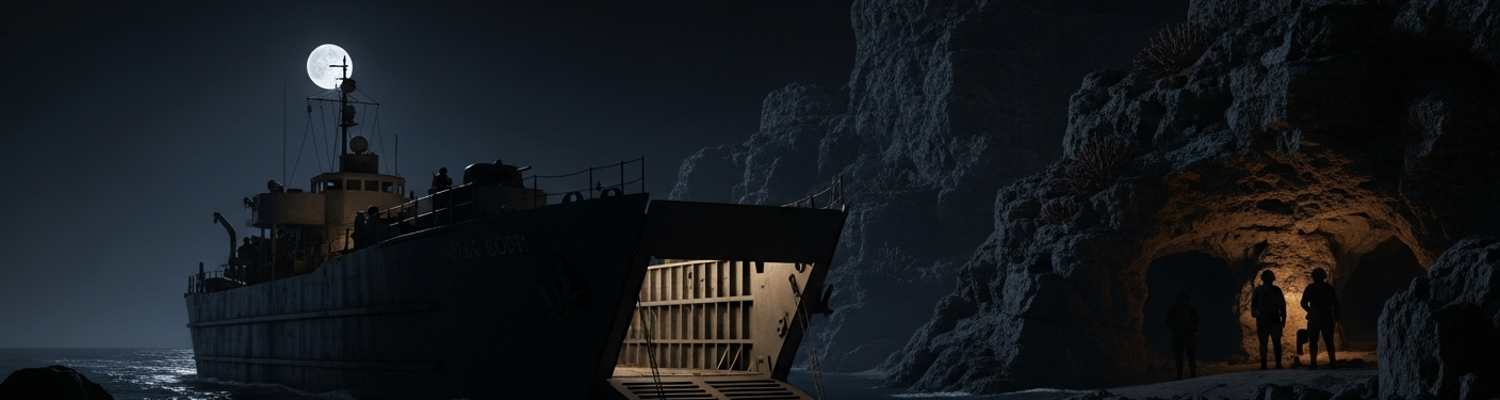
The plan was direct. A single Landing Craft, Tank, would run a solo transit at night along Peleliu's western coast. The route offered no cover. It passed directly under Japanese observation from the Umurbrogol massif. Naval charts from the period (USN H.O. Chart 2992) show a coastline littered with uncharted coral formations. A navigational error of a few yards could ground the vessel. The crew relied on dead reckoning and compass headings in near-total darkness. Any use of lights or signals would betray their position. The craft's three Grey Marine 6-71 diesel engines were reliable but loud, their acoustic signature carrying for miles over the still water. Any mechanical failure would turn the supply run into a stationary target drill for Japanese mortar crews.
This was a designated kill zone.
The Umurbrogol massif rose from the shore, giving Colonel Nakagawa’s defenders a commanding field of fire. Intelligence reports had identified hundreds of defensive positions in the coral ridges. These were not foxholes. They were interconnected caves and reinforced bunkers housing heavy machine guns, Type 96 25mm cannons, and mortars with pre-sighted firing lanes covering the exact channel the LCT had to use. The LCT(6) had only thin steel plating on its wheelhouse, offering scant protection from rifle-caliber rounds and no defense against artillery. At ten knots, the vessel would be exposed to this fire for the duration of its approach.
The transfer had to be completed in less than five minutes.
Upon beaching, the LCT’s bow ramp would slam down. This was the moment of maximum vulnerability. The noise would give a precise location to Japanese mortar teams. On the shore, a fire team from the 5th or 7th Marines had to break cover from their fighting positions and sprint to the water’s edge. After-action reports show any movement in this area drew immediate, heavy fire. The LCT crew of roughly 13 men would frantically throw the heavy sacks of V-Mail and postal circulars onto the sand. The shore party had to retrieve the sacks and drag them back to the caves before the LCT retracted its ramp and reversed engines into the darkness.
Success was measured in seconds.
The operation hinged on surprising the Japanese defenders enough to prevent a coordinated response. The LCT would pull back from the beach as enemy flares illuminated the area. For the Marines of the 1st Marine Division, who had suffered over 6,500 casualties in the ridges, the arrival of these mail sacks was a tactical necessity. The letters and circulars were a link to a world beyond their 900-by-400-yard pocket of rock.
Operational Success Morale Impact
The effect of the mail delivery on the 7th Marines was immediate. After-action reports from units at the northern edge of the Umurbrogol Pocket document a near-instantaneous shift in posture. A fire team from K Company recovered the mail sacks from the beach under sporadic fire. Within the hour, letters were being passed down the line, read by flashlight. Operational logs for the next 72 hours show a sharp decline in disciplinary infractions. More importantly, they show an increase in proactive small-unit actions. Marines were observed field-stripping weapons without direct orders. Fire discipline during the next Japanese probe was described by company command as notably improved.
This was a psychological victory.
The success was noted by the III Amphibious Corps staff. A review of Maj. Gen. Geiger’s command group records shows the LCT mail run report was analyzed with interest. The operation, once a desperate measure, was now a viable template. It set a precedent for future unconventional logistics. This led to a new contingency plan, informally designated "Neptune’s Postman." It codified the use of light naval craft for high-speed, high-risk deliveries of low-volume materiel. The plan had specific criteria for activation: casualty rates among carrying parties exceeding 5 percent per mission, a breakdown of other supply methods for more than 48 hours, and a specific need for morale items or specialized equipment like radio vacuum tubes.
The Peleliu mail run validated the calculated gamble. The initial risk assessment had weighed the loss of one LCT(6) and its crew against the certain, attritional loss of dozens of Marines. Casualty reports for the 7th Marines in the 96 hours after the delivery confirmed the logic. Losses attributed to supply-party duties dropped to zero. The gamble had not only succeeded but had proven to be the more conservative course of action for preserving manpower. This outcome gave commanders like Geiger validated authority to authorize similar unorthodox measures in the face of attrition warfare. The doctrine would be quietly adapted for the far larger campaign on Okinawa, where isolated Marine units fighting in the Shuri Castle complex received supplies via similar night runs.