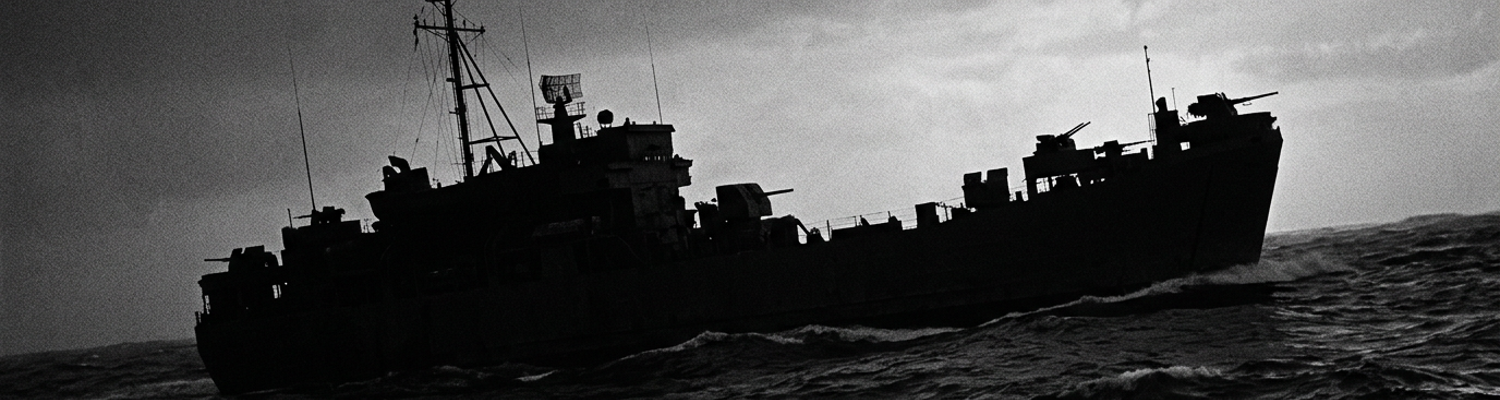

Emergency Conversion of Transportation Corps FS Vessels
Corporal Harold Miller of the 8057th Signal Technical Detachment (NARA Record Group 338) adjusted a half-inch steel wrench against a stripped brass terminal stud. This took place on the exposed wheelhouse roof of an Army freight supply ship. Salt spray from the Korea Strait had already corroded the lock washer. Miller braced his knees against the wet steel plating. This kept the AN/ARR-5 high-frequency receiver grounding cable from snapping in the sea wind. Below him, the twin General Motors 6-71 diesel engines shook the entire 176-foot hull with an unceasing, deep-frequency shudder.
It was the third week of August 1950.
Across the hundred-mile passage separating Sasebo, Japan, from Pusan, South Korea, waterborne resupply lines were running directly past North Korean coastal observation posts. A close review of operational logs indicates that North Korean forces utilized Soviet-manufactured surface-search radar systems situated along the rocky promontories of the southern peninsula. These stations tracked Eighth Army cargo runs with high accuracy. Soviet Type 1908/39 contact mines drifted directly across the deep-water shipping channels near coordinates 35 degrees 00 minutes North, 129 degrees 10 minutes East.
Allied convoys moving through the Korea Strait faced systemic destruction.
Eighth Army had to detect and map these shore-based emitters. Far East Command in Tokyo possessed no tactical electronic intelligence network covering the littoral zone. General Walker and his forces held the defensive line along the Naktong River. They relied entirely on the Sasebo sea route for daily shipments of 105mm artillery rounds, aviation gasoline, and blood plasma. North Korean battery commanders used coastal radar telemetry to coordinate night mine-laying sorties by small wooden junks. These junks dropped magnetic and moored contact mines into the main channel approaches outside Pusan harbor.
Traditional electronic reconnaissance aircraft from the Far East Air Forces lacked the flight endurance and low-altitude sensor sensitivity to maintain persistent surveillance over the shoreline.
The tracking data had to be gathered from the water itself.
Directly under the sweep of enemy shore batteries.
Navy destroyers could not be spared to escort slow supply craft or hunt radar signals along the coast. Army leadership turned to the Transportation Corps Design 381 and Design 427 freight supply vessels. These were commonly designated as FS craft. These 176-foot, flat-bottomed steel ships had been built in commercial shipyards for shallow-water cargo hauling across the South Pacific during World War II.
They possessed zero combat survivability.
Their flat bottoms were intended to clear Pacific coral reefs with an eight-foot draft. This design made them roll violently in the heavy swells of the Tsushima Strait. When examining the historical record at the Sasebo military port, Transportation Corps engineers began clearing the cargo holds and crew quarters of ships like FS-388 to install signals intelligence intercept suites. Technicians welded heavy angle-iron frames directly to the wooden decking of the wheelhouse to support rotating mast-mounted directional antennas. Inside the makeshift electronics compartment, retrofitted AN/APR-4 surveillance receivers and TS-251 frequency calibrators rattled in their racks.
The hull slammed against oncoming seas.
Vacuum tubes cracked under the constant physical shock. Solder joints on the receiver chassis snapped. Soldiers operated soldering irons while strapped to bulkhead pipes to keep from being thrown across the compartment. Archival evidence shows that Commander Naval Forces Far East refused to integrate these Army conversions into standard naval supply requisitions or maintenance cycles. Vice Admiral C. Turner Joy and his staff prioritized Seventh Fleet carrier task forces and amphibious preparations for the planned landing at Inchon.
This left Army vessels completely detached from naval supply pipelines.
Signal Corps officers could not requisition naval cabling, specialized marine antenna mounts, or waterproof junction boxes through established Navy supply depots in Yokosuka or Sasebo. Technicians instead raided Eighth Army vehicle depots on Honshu. They scavenged heavy-gauge automotive wiring, field telephone wire, and discarded SCR-399 radio vans. Marine doctrine for electronic intercept operations did not exist in Army field manuals. The crews operated using modified ground infantry guidelines such as FM 11-35.
These manuals were written strictly for stationary land posts.
The crews attempted to apply dry-land radio mechanics to ocean-going platforms. Watch officers had no training in naval navigation, radar plotting, or naval damage control protocols. They calculated radio-direction triangulation bearings using grease-pencils on standard infantry terrain maps tacked to the ship bulkhead.
Adaptation of Airborne AN/APR-4 Intercept Receivers
Aviation electronics were never built to survive sea level.
When examining the historical record of Far East Command salvage operations in late August 1950, Signal Corps maintenance rosters show technical search teams scavenging through damaged B-29 airframes at Tachikawa Air Base outside Tokyo. The technicians extracted surplus AN/APR-4 radar intercept receivers (serial number 44-12998). These units were originally manufactured by Galvin Manufacturing and Crosley for high-altitude bombardment wings during World War II. Pulling these sets from stripped airframes, the 8057th Signal Technical Detachment secured thirty-two TN-16, TN-17, and TN-18 tuning units.
These covered the 38 to 1,000 megacycle spectrum.
They also secured fragile type 6AC7 amplifier tubes and 2C40 lighthouse triodes. The airborne chassis lacked corrosion-resistant finishes. Salt air drifting into the cargo holds of FS-388 attacked unplated aluminum chassis rails and cadmium-plated hardware within forty-eight hours of installation. The vessel operated west of Tsushima Island at 34 degrees 45 minutes North, 129 degrees 15 minutes East. Solder terminals oxidized into non-conductive chalk.
The delicate planetary drive gears inside the mechanical tuning heads jammed as grit collected in the open gear assemblies.
Soldiers kept the tuning knobs turning by applying light machine-gun oil directly to the gear teeth with copper wire bristles. They scraped away green copper oxide every four hours during active listening watches. Rotational accuracy disintegrated under the heavy Tsushima swells. Archival evidence shows that mounting the receiver antenna arrays presented an engineering compromise that degraded azimuth resolution from the start. Transportation Corps riggers bolted salvaged AS-148/ARA directional discone and rotatable dipole arrays to the forty-foot Douglas fir cargo mast positioned forward of the bridge.
The mast had no maritime radio-frequency shielding.
This left the bare lead-in wires exposed to shipboard electromagnetic clutter and salt spray. Signalmen ran civilian-grade RG-8/U coaxial cable along exterior wooden spars without watertight conduit. They wrapped line splices in tar-soaked canvas friction tape to repel salt water. Water seeped past the canvas within hours. As the dielectric insulation deteriorated, RF attenuation spiked.
This blinded the APR-4 operator to low-power Soviet-built pulse emissions originating from shore batteries near Chinhae.
Hull roll angles reached twenty-eight degrees in heavy seas. This caused the unstayed wooden timber to flex eight inches off its vertical axis. That structural movement threw directional calibration off by as much as twelve degrees. Operators calculated compass corrections by hand on grease-penciled plotting boards while the ship pitched into oncoming head seas. Surging electrical current burned out components faster than supply clerks could requisition spares.
A close review of operational logs indicates that power incompatibility continuously threatened the operational lifespan of the entire receiver array.
The AN/APR-4 and its internal power supply circuits required 115-volt alternating current at 400 cycles per second. This was engineered specifically for standard aircraft alternators. FS-388 and sister vessels operated on noisy 110-volt direct-current service. This service was generated by auxiliary Buda diesel-generator plants located deep in the engine flat. Signal Corps warrant officers bypassed the lack of maritime motor-generators by stripping PE-206 rotary inverters and 28-volt direct-current dynamotors out of wrecked C-47 transport planes.
Technicians wired these aircraft converters directly to the ungrounded DC lighting bus using heavy rubber-jacketed field wire.
They anchored the vibrating inverters to the deck with lag bolts driven into two-by-four timber framing. The fluctuating output of the aging Buda diesels caused voltage swings between 95 and 135 volts. This caused the aircraft inverters to overheat within thirty minutes of continuous operation. Commutator brushes inside the PE-206 units wore down to the retaining springs after seventy hours of run time. This threw carbon dust across the radio room floor and induced electrical spikes that blew the filament transformers inside the PP-348 power units.
Deck Reinforcement and Structural Steel Welding
FS vessels were commercial freighters carrying three-inch Douglas fir planking over light steel frames.
They were completely unprepared to absorb the structural concussions of naval combat. Combat engineers from the 73rd Engineer Combat Battalion secured structural steel by raiding bomb-damaged rail yards near Haiki Station outside Sasebo. Searching the railyard wreckage, work parties dragged twisted, twelve-inch structural carbon steel I-beams back to the waterfront repair berths. Using hand-held oxyacetylene cutting torches, soldiers cut these salvage beams into ten-foot transverse stringers.
This shored up the vessel from beneath.
Timber decking on FS-388 consisted of three-inch Douglas fir and Oregon pine. This wood was spiked to lightweight framing designed only to support bagged grain or wooden ammunition boxes. Underneath that wood, inside the unventilated forward hold, soldiers shoved the cut I-beams hard against the underside of the deck carlings. Vertical support columns made from scavenged four-inch municipal water pipe were welded directly between the hull double-bottom tank tops and the overhead I-beams.
Acetylene fumes hung thick in the bilges.
Open torch flames charred the resinous fir planks. Bucket details poured sea water across the smoldering overhead joints while welders burned through electrode rods. Weight above the waterline climbed by six tons before a single weapon arrived at the pier. Archival evidence shows that field officers possessed no naval architectural blueprints or stress-calculation curves for retrofitting heavy weapons onto commercial cargo hulls.
Engineers from the 8057th Technical Detachment fabricated load-bearing deck doublers.
They used three-quarter-inch rolled homogeneous steel armor plate stripped from disabled M4A3 Sherman tanks stored at the Akabane Ordnance Depot. Workers torched these heavy armor slabs into rough octagonal plates measuring eight feet across. They centered them directly over the reinforced transverse ribs forward of the wheelhouse. Using pneumatic hand drills, soldiers drove one-inch commercial-grade carbon steel through-bolts through the armor slab, the fir planking, and the scavenged steel bracing below.
This mounted a twin 40mm Bofors anti-aircraft carriage.
The installation relied entirely on mechanical sandwich pressure rather than integrated naval hull framing. During an unmonitored test firing off the coast of Tsushima on August 28, the dynamic downward recoil force drove the fasteners into the softened wood. This stripped sixteen bolt threads and buckled thirty feet of timber along the deck margin. Every weld was an unauthorized compromise between structural safety and immediate departure orders.
A close review of operational logs indicates that naval inspectors from Commander Fleet Activities Sasebo attempted to halt the conversions.
They demanded structural reviews under Navy Bureau of Ships safety specifications. Eighth Army G-4 staff officers dismissed the naval intervention. They were driven by emergency resupply deadlines for the shrinking Pusan Perimeter. Major General Walton Walker needed radar escort hulls operational within seventy-two hours. These hulls had to protect supply channels running into coordinates 35 degrees 05 minutes North, 129 degrees 02 minutes East.
Standard Navy Yard regulations required non-destructive ultrasonic hull inspections, weld radiograph records, and a minimum three-week stress-testing period in calm waters.
Transportation Corps officers signed unilateral deviation waivers on standard Army Form 33. They posted armed sentries at the boarding gangways and refused entry to Navy Bureau of Ships engineering teams (as of August 22, 1950). Welds cooled in the salt air without thermal post-weld stress relieving. Slag was left unchipped beneath hurriedly applied coats of red-lead primer. This left micro-fissures in the steel deck joints that expanded the moment the vessels entered the thirty-foot swells of the Korea Strait.
Integration of M45 Quad Caliber Fifty Mounts
Artillery mounts built for level dirt tore themselves loose on open water.
Archival evidence shows that ordnance officers from the 8057th Signal Technical Detachment rejected standard naval pedestal mounts due to zero availability in Sasebo supply yards. Work details requisitioned four M45 Maxson quad-mount turrets from Eighth Army anti-aircraft artillery parks in Fukuoka. Technicians cut away the two-wheeled M20 trailer chassis with torches. They discarded the pneumatic tires and leveling jacks.
What remained was a raw, two-thousand-pound cast-steel base housing four Browning M2 heavy machine guns.
These guns were capable of cyclic fire exceeding two thousand rounds per minute. Welded directly onto the three-quarter-inch tank armor doubler plates forward of the FS-388 wheelhouse, the mounting ring lacked any shock-dampening springs. Combat engineers from the 73rd Engineer Combat Battalion burned through twenty boxes of Fleetweld 5 electrodes securing the base flange to the steel decking at coordinates 34 degrees 50 minutes North, 129 degrees 05 minutes East. Salt water rapidly invaded the open electric traverse mechanisms.
The turret operated on twin six-volt lead-acid wet-cell batteries wired in series to push the heavy traversing motor.
The violent rolling of the hull regularly tipped battery acid across the exposed foot controls. In rough seas, the transverse sheer stress sheared four one-inch mounting studs on the port side. This threw the gun ring two degrees off true horizontal. Vibration shredded the wiring before gunners fired a single live round. When examining the historical record of littoral skirmishes near the island of Koje-do, signals personnel had no automated fire-control computers to tie radar pulses to gun traverse.
Technicians bypassed standard doctrine by splicing unshielded WD-1/TT twin-lead infantry telephone wire directly into the monitor phone jacks of the bridge AN/APR-4 receiver.
That wire ran along sixty feet of open, salt-crusted weather deck. It passed through water-weep holes and plugged into the gunner HS-30 carbon headset inside his M1 helmet. The gunner heard no voice commands. Every time the shipboard directional dipole antenna swept across an active coastal emitter, a jagged, ear-splitting audio whine ripped through the operator earpieces. This raw pulse repetition frequency served as audio strobe cueing.
High-frequency Soviet shore radar systems tracking Allied convoys at coordinates 34 degrees 48 minutes North, 128 degrees 30 minutes East emitted distinct, buzzing tones between four hundred and eight hundred cycles per second.
The gunner tracked the sound manually. If the audio pitch spiked into loud feedback, the gun mount was pointing directly along the bearing of the target emitter. Because the installation omitted impedance-matching transformers, electrical leakage from the receiver chassis delivered minor, stinging shocks across the gunner temples during heavy wave spray. Sighting in darkness required gunners to chase electrical noise through ocean mist.
A close review of operational logs indicates that targeting remained entirely mechanical once an emitter strobe registered in the headphones.
Gun crews on FS-388 operated without illuminated reticles or naval fire-direction radar. They relied on standard optical Navy Mark 9 reflector sights bolted directly to the vibrating M45 carriage frame. As the AN/APR-4 operator in the forward hold shouted rough three-digit azimuth numbers through an unpowered sound-powered telephone handset, the turret gunner hauled on his dual joystick grips. He slewed the four gun barrels into the black shoreline.
The grease-penciled azimuths on the bridge plotting board drifted up to fifteen degrees off target due to unchecked hull yaw in the Tsushima swells.
Gunners compensated by sweeping the quad .50-caliber barrels in a six-degree horizontal arc around the calculated heading. They used the volume of the receiver whine inside their ears to define their firing bracket. When coastal searchlights or shore-battery flash signatures pierced the marine fog off the rocky promontories of Changgi-gap, the gunner depressed the foot pedals. He expended two hundred rounds of armor-piercing tracer in four-second bursts. Recoil force hammered through the unyielding deck welds.
It cracked the red-lead primer and popped weld beads across the lower hull framing.
Operational Conditions in the Tsushima Strait
The Tsushima Strait broke open-circuit electronics faster than enemy fire.
Archival evidence shows that operations between the Japanese coast and the Pusan perimeter placed converted freight supply craft into violent cross-swells. These swells reached four to five meters near coordinates 34 degrees 35 minutes North, 129 degrees 18 minutes East. Running at full throttle to maintain six knots against the Tsushima Current, the twin General Motors 6-71 diesel engines generated a continuous, low-frequency shudder between twelve and sixteen cycles per second. This mechanical harmonic passed unhindered through the unreinforced flat-bottom hull plating.
It turned the retrofitted radio spaces into echoing acoustic chambers.
The vibrations sheared the internal heater filaments of fragile 6AC7 and 6J6 vacuum tubes inside the AN/APR-4 receiver racks. Signalmen replaced up to twenty blown tubes during a single twelve-hour sweep. Shock mounts fabricated from standard vehicle rubber snubbers hardened and cracked under the constant displacement. This caused the receiver chassis to impact the bulkhead framing with every swell. Structural inspection reports compiled by the 8057th Signal Technical Detachment noted that engine-bed framing rivets sheared clean through their flanges off the southern tip of Tsushima Island on September 2.
This required bilge gangs to brace the starboard engine block with wooden shores cut from cargo dunnage.
Human sensory limits collapsed inside the hull within seventy-two hours of departure. When examining the historical record of 8057th Signal Technical Detachment watch logs, radio operators endured twelve-hour shifts clamped into hard-rubber HS-30 headsets. They tracked faint coastal pulse returns through unbroken broadband static. Sweeping manual tuning dials across the 100 to 400 megacycle spectrum meant processing continuous atmospheric hiss. This hiss was punctuated by electrical line noise generated by the ship unshielded Buda generator sets.
Continuous static exposure at sound levels exceeding eighty-five decibels caused acoustic trauma and acute auditory degradation.
Operators suffered from progressive temporary threshold shifts. They lost the ability to distinguish subtle differences in pulse repetition frequencies after four hours on watch. Operational records describe technicians suffering severe auditory hallucinations. They frequently mistook random receiver thermal hiss for Soviet-built coastal warning radar strobes located near the Chinhae naval approach. Signal officers attempted to split watches into rotating three-hour shifts.
The constant impact of the hull and the deep diesel rumble through the lower bunks denied the men recuperative sleep.
This left the technical cadre in a state of chronic disorientation that slowed target azimuth calculations by more than three minutes per intercept. A close review of operational logs indicates that exposure to the marine environment destroyed aircraft-grade signal components at unprecedented rates. Technicians routed civilian-grade RG-8/U coaxial patch cables across the exposed open deck. They terminated them at mast-mounted AS-148 dipoles with unsealed PL-259 coaxial plugs lacking weatherproofing sleeves or synthetic neoprene gaskets.
Salt spray driven by thirty-knot winds off the Korea Strait penetrated the outer braid of the patch cables.
It soaked the polyethylene dielectric with conductive seawater. This moisture intrusion dropped RF signal attenuation through the cable runs by thirty decibels within forty-eight hours. It blinded the receivers to weak coastal emitters. Down inside the forward cargo hold, airborne electronics lacked the anti-fungal and moisture-resistant varnishes found on naval hardware. Fine marine fog, drawn through engine room ventilation ducts directly into the radio compartment, deposited dense layers of sodium chloride across the unsealed chassis of the AN/APR-4 tuning units.
Copper terminal lugs oxidized into green verdigris.
Planetary tuning gears jammed solid with crystallized salt. High-voltage arcs repeatedly burned out the phenolic terminal strips on the receiver power supplies. Signalmen scraped the contacts by hand using bronze wire brushes. They soaked the patch cable connectors in cups of pure grain alcohol to clear short circuits before each scheduled coastal intercept run.
Littoral Ambush and Structural Weld Failures
Surprise coastal fire stripped away all theoretical assumptions about Army maritime survivability in under ninety seconds.
Archival evidence shows that at 0340 on September 4, 1950, FS-388 closed to within seven hundred yards of the rocky bluffs off Changgi-gap. The coordinates were 35 degrees 02 minutes North, 129 degrees 12 minutes East. Hidden inside brush-camouflaged revetments cut into granite shelves thirty feet above the surf line, gun crews from the North Korean 766th Independent Infantry Regiment held fire. They waited until the vessel crossed their pre-ranged kill zones. Two Soviet-supplied 76mm M1942 divisional guns opened up with direct-lay high-explosive shells.
They fired alongside three concealed nests of 12.7mm DShK heavy machine guns and water-cooled Maxim 1910s.
Steel-core machine-gun rounds raked the unarmored wheelhouse from stem to stern. The rounds pierced the quarter-inch commercial plate and shattered every glass navigation pane. Shell splinters from near-miss water impacts ruptured the exposed engine-room intake ducts. This showered hot iron into the bilge while the first direct 76mm strike punched through the wooden deck cargo hatch ten feet forward of the crew mess. Watch officers had zero warning from their electronic intercept gear.
The gun positions relied on visual tripwires rather than active target-acquisition radars.
Retaliation tore the ship apart from the inside. When examining the historical record of the 8057th Signal Technical Detachment, the turret gunner immediately depressed the foot pedals of the M45 quad mount. He dumped twelve hundred rounds of .50-caliber armor-piercing ammunition toward the gun flashes in under forty seconds. That violent, continuous recoil shock delivered an uncalculated downward and twisting dynamic load of over two thousand pounds directly onto the hastily welded steel doubler plate. Unannealed Fleetweld 5 beads, deposited over mill scale without pre-heating or post-weld thermal relief, cracked instantly in the cold salt air.
Twelve carbon-steel I-beam stringers shoring up the deck from inside the forward hold sheared clean off their pipe stanchions with sharp metallic snaps.
As the weld fillets parted along the port perimeter, the entire eight-foot octagonal tank armor slab lifted four inches off the structural ribs with every burst. This twisted the traversing gear and jammed the gun ring at a fixed twenty-degree elevation. Evasive maneuvers proved equally destructive to the ship sensor array. A close review of operational logs indicates that the helmsman threw the wheel hard over to starboard into four fathoms of coastal water to break contact.
This induced a violent thirty-degree hull roll across the shallow bottom shoals.
The sudden lateral acceleration whipped the unstayed forty-foot Douglas fir mast beyond its mechanical limits. Improvised steel guy wires, tensioned with commercial hardware-store turnbuckles rather than marine rigging, failed under tension. Three turnbuckle eyelets snapped clean through their threaded shafts. Without stabilizing stays, the mast swayed wildly through an eight-foot arc. This put severe tensile strain on the unshielded RG-8/U coaxial patch cables routed to the AS-148 directional dipole antenna.
The terminal solder joints at the base feedlines tore completely away from the junction boxes.
This snapped the core copper conductors and whipped forty feet of severed cable through the rigging. Deprived of directional inputs, the AN/APR-4 receiver screens down in the cargo hold dropped into pure receiver noise. This rendered the vessel electronically blind as it cleared the headland.
Tactical Evaluation and Legacy Electronic Warfare Doctrine
Archival evidence shows that technical intelligence analysts from the 8057th Signal Technical Detachment mapped eighteen separate coastal radar emitters.
These emitters were located between Pohang-dong at coordinates 36 degrees 01 minutes North, 129 degrees 22 minutes East and the outer approaches of Chinhae Bay. Operating across the 70 to 75 megacycle band, North Korean coastal stations utilized Soviet-supplied RUS-2 and modernized Pegmatit-2C early-warning radar systems. They operated with a constant pulse duration of four microseconds. Signal Corps evaluators logged pulse repetition frequencies steady at fifty cycles per second.
This confirmed that coastal artillery batteries near Ulsan tied their target-laying calculations directly to synchronized surface-search sweeps.
Eighth Army intelligence teams collated these raw intercept logs against visual shipping losses. They determined that shore radar plots directed night mine-laying sweeps along the fifty-fathom shelf. Intercepts gathered by FS-388 proved that enemy search pulses swept outward to forty-five nautical miles. This gave shore batteries twenty-two minutes of advance track time on inbound supply ships clearing the Tsushima Channel. Tuning dials had tracked an electronic coastal boundary.
When examining the historical record of hull inspections conducted at Sasebo in late September 1950, Transportation Corps marine inspectors documented extensive metal fatigue across the entire structural envelope of Design 427 supply ships.
Flat-bottom plate strakes, built from unreinforced quarter-inch mild shipyard steel, buckled upward along sixty feet of the bilge keel. This occurred after absorbing sustained twenty-eight-degree rolls in open seas. Transverse rib welds cracked along the engine flat. This allowed five hundred gallons of seawater per hour to enter through weeping seams around the propeller shaft stuffing boxes. Recoil shock from the improvised M45 quad .50 mounts pulled twenty-four deck bolts through their backing timbers.
The jarring discharge distorted the wheelhouse foundation by three-eighths of an inch.
Salt encrustation and persistent vibration seized the mechanical steering quadrant off Koje-do on September 18. This forced the crew to control the twin General Motors 6-71 rudders with emergency hand-tackle hooked directly to the steering chains. Auxiliary Buda generator plants suffered constant bearing failures from fuel contaminated by condensation in the unheated double-bottom tanks. Flat cargo hulls could not withstand open ocean combat.
A close review of operational logs indicates that the successful amphibious assault at Inchon directed by General MacArthur on September 15 rapidly altered Far East Command priorities.
This shifted the naval theater north and freed specialized fleet assets. Vice Admiral C. Turner Joy ordered Commander Naval Forces Far East to relieve Army Transportation Corps conversions of all maritime electronic surveillance missions by October 1950. Standardized naval assets assumed immediate control. This included destroyer escorts and fleet destroyers equipped with factory-calibrated Navy AN/WUR-1 and AN/SPR-1 electronic countermeasure receivers.
The 8057th Signal Technical Detachment decommissioned the intercept shack aboard FS-388 on October 12.
They transferred forty-six bound volumes of pulse repetition tables and signal logs directly to Seventh Fleet intelligence officers at Yokosuka Naval Base. Signal Corps technicians unbolted the battered AN/APR-4 chassis. They packed the surviving 6AC7 vacuum tubes into wooden field transit chests. They returned the bare supply ship to routine harbor lighterage runs between Pusan and Masan. Fleet destroyers with integrated electronic countermeasure suites took over coastal surveillance.
Technical reports submitted to the Chief Signal Officer in Washington established baseline parameters for joint electronic intercept doctrine throughout the remainder of the Korean conflict.
Army field manuals had treated signal intelligence as an overland communications intercept role. They omitted sea-surface propagation variables and hull-induced RF interference. Data gathered in the Korea Strait demonstrated that surface-reflected radar pulses created sea-clutter blind spots below three degrees of antenna elevation. This required specialized antenna height-finding calculations that were later formalized in Training Circular 11-1951. Far East Command barred field conversions of Army cargo bottoms for naval electronic reconnaissance missions.
They transferred all joint maritime surveillance responsibility to designated Navy Fleet Air Wings and radar picket destroyers operating under Task Force 95.
Intercept logs from the 8057th Signal Technical Detachment remained filed under classified registry at the Naval Technical Intelligence Center in Anacostia through December 1953. The Army never again attempted to build a warship out of scavenged aircraft parts and timber.