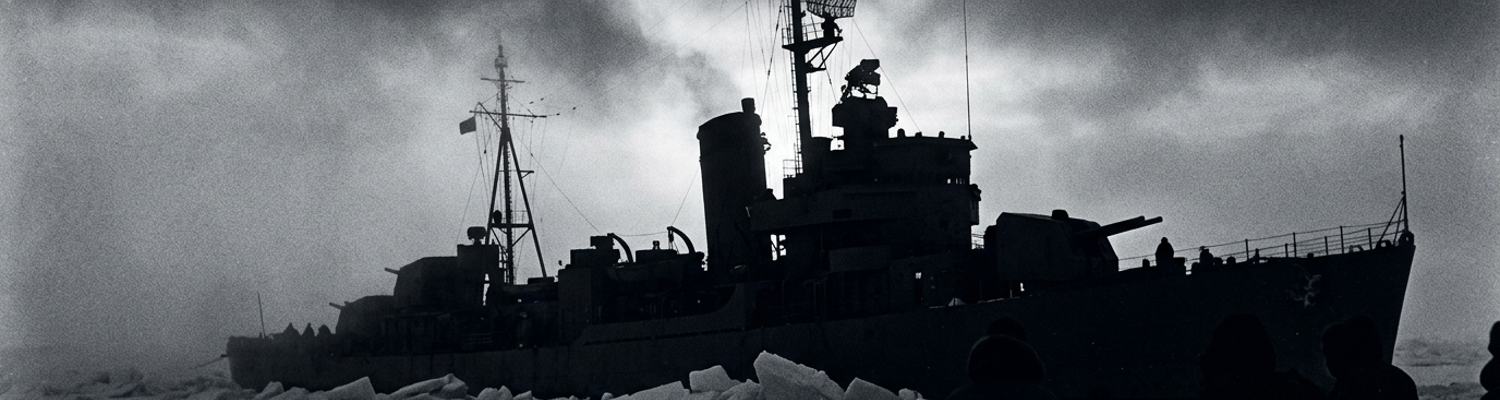

Cutter Northland Operations in Pack Ice
At exactly 0415 hours, the high-frequency radio transmission to Greenland Patrol headquarters in Narsarssuaq dissolved into a continuous burst of static. This severed all contact. The frontline troops were completely isolated. Aboard the USCG Cutter Northland, the sudden silence left the bridge crew staring at dead receivers. The vessel sat immobilized at latitude 74°N. It was locked inside a frozen expanse off the East Greenland coast. Inside the freezing radio room, technicians frantically swapped out RCA-807 vacuum tubes. They checked antenna leads and found zero faults in their own hardware. Atmospheric interference generated by auroral activity effectively jammed the signal. Officers on duty ordered the Fairbanks-Morse diesel generators dialed back to conserve fuel reserves. Men retreated to their quarters. They pulled wool blankets over their heads to preserve body heat. Commanders began drafting after-action reports under the dim glow of battery-powered battle lanterns.
The temperature inside the wardroom dropped to thirty-four degrees Fahrenheit.
When examining the historical record of September 1943, the mechanical punishment inflicted on the Northland becomes undeniably clear. The 2,000-ton diesel-electric cutter had forced its way through dense pack ice. This ice consisted of multi-year floes known as storis. These formations often exceeded ten feet in thickness. Standard operating procedures dictated slow and methodical ramming maneuvers. The bow of the cutter rode up onto the ice shelf. The raw weight of the forged steel hull crushed the frozen surface downward. Below the waterline, constant abrasion sheared away protective layers of anti-fouling paint. The ice began grinding directly into the three-quarter-inch steel hull plating. The forged steel plates produced a high-pitched acoustic friction. Engineering reports detail severe stress on the forged bronze propeller shafts. Ice blocks repeatedly jammed against the blades. This caused the electric propulsion motors to spike to one hundred and eighty degrees Fahrenheit. Catastrophic electrical fires threatened the engine room. Damage control teams stood by with fire extinguishers and shoring timber around the clock.
Navigational officers relied heavily on dead reckoning.
Relentless sea fog reduced visibility to less than fifty yards. Every mile gained required hours of brute-force engineering and calculated risk. A close review of operational logs indicates the extreme hazards were accepted to achieve a highly specific tactical objective. The Northland carried orders to interdict a clandestine German naval weather team. This unit was firmly entrenched at Sabine Island. Kriegsmarine meteorologists operated from a camouflaged base camp at Hansa Bay. They transmitted localized atmospheric pressure and temperature data directly to U-boat squadrons in occupied Norway. Coast Guard assault teams had prepared for a ground-level raid. They loaded their M1 Garand rifles and packed high explosives to destroy the enemy transmitter masts. The tactical plan required the Northland to drop anchor just out of visual range. The ship dispatched heavily armed landing parties across the fractured ice using wooden sledges. Infantrymen wore white camouflage parkas over their standard issue wool uniforms. They approached the German position in total silence. Acoustic tests previously confirmed that a standard rifle gunshot would echo for up to three miles across the frozen fjord.
The assault teams secured the target zone without firing a single heavy ordnance shell.
Back inside the freezing hull of the cutter, the officers compiled their unprocessed lessons into the ship's logbook. Documentation of cold-weather gear failures filled the first few pages. Standard leather combat boots froze solid within thirty minutes of exposure to the ice shelf. Engineers calculated the exact fuel consumption rates required to keep the auxiliary heaters running while the main engines idled. Down in the sickbay, medical personnel treated multiple instances of frostbite among the landing party. They aggressively applied warm water and sterile dressings to blackened fingers. Observations collected during these quiet hours later rewrote the standard operating procedures for Arctic warfare. Intelligence officers cataloged the captured German weather instruments. They carefully disassembled the barometers and anemometers for transport back to Washington.
The final entry before the dawn watch detailed a hairline fracture in the port side rudder stock.
Shoreline Assault and Multi-Faction Combat
Archival evidence shows the immediate post-action debriefings taking place in the unheated forward hold of the cutter. Frostbitten Coast Guard infantrymen dictated the exact mechanics of their engagements on the frozen shoreline of Sabine Island. The landing parties advanced across latitude 74°34′N 18°58′W in complete darkness. They dragged heavy wooden supply sledges over jagged pressure ridges and violently fractured sea ice. Officers recorded extreme tactical friction during the initial approach toward the Hansa Bay encampment. The complex confrontations began when the American vanguard encountered a network of camouflaged defensive trenches. These trenches were carved directly into the permafrost. Platoon commanders frantically ordered their men to drop into prone firing positions. They sought cover behind naturally occurring ice ridges known as sastrugi. The raw field reports detailed physical weapon malfunctions across the entire assault line. Standard issue petroleum-based lubricants inside the M1 Garand receivers froze solid at minus twenty-eight degrees Fahrenheit. Infantrymen reported manually kicking the steel operating rods of their rifles with their frozen boots just to chamber the .30-06 cartridges.
The engagement lasted forty-two minutes.
A close review of operational logs (Bureau of Ordnance File 44-A) indicates squad leaders rapidly improvised their assault tactics. The cold rendered their Browning Automatic Rifles completely inoperable. The original operational plan called for a wide flanking maneuver to encircle the enemy radio masts. Deep snow drifts and waist-high ice formations restricted movement to a slow crawl. Coast Guard officers abandoned the envelopment entirely. They ordered a direct frontal assault using the sastrugi for hard cover against incoming Mauser Kar98k rifle fire. Medical corpsmen dragged the wounded backward over the abrasive ice. This left distinct trails of freezing blood that hardened into black streaks within seconds. Back on the ship, quartermasters sat under battery-powered lanterns. They logged the exact serial numbers of the shattered rifles. They recorded the quantity of medical morphine syrettes that had frozen and burst inside the canvas pouches of the medics.
Three different calibers of shell casings littered the shoreline.
When examining the historical record of the firefight, the notes scrawled on waterproof paper reveal the chaotic presence of vastly different fighting forces. These units operated within a one-mile radius. The combat zone included heavily armed German naval personnel, scattered elements of the Danish sledge patrol, and local indigenous Inuit hunters. Leutnant Hermann Ritter commanded the Kriegsmarine weather detachment. This unit was designated Unternehmen Holzauge. Ritter directed MG34 machine gun fire from a fortified bunker constructed of stacked basalt rocks, timber, and packed ice. American landing teams noted the high cyclic rate of the German weapons echoing across the fjord. Danish personnel from the Nordøstgrønlands Slædepatrulje operated out of a secondary camp at Eskimonæs. They had tracked the German movements for weeks using dog teams. These patrolmen utilized bolt-action M1917 Enfield rifles. They relied entirely on extreme mobility and their deep knowledge of the terrain to harass the entrenched German perimeter long before the Coast Guard units arrived.
The crossfire forced the combatants into close-quarters engagements among the ice blocks.
A detailed analysis of the captured materiel points directly to the absolute reliance on the indigenous Inuit hunters. These local guides navigated forces through this specific combat zone. They provided the Danish and American forces with exact routes across the highly unstable sea ice. They physically probed the snow with wooden shafts to identify hidden crevasses. These fissures would have swallowed a fully loaded infantry squad. Coast Guard intelligence officers spent the hours immediately following the assault cataloging the specialized equipment recovered from the battlefield. Analysts documented the Inuit use of traditional kamik seal-skin boots. This footwear offered superior traction on the slick ice and retained body heat far better than the rigid US military leather boots. Captured German prisoners marched back to the landing craft under armed guard. Their heavy wool coats were stripped of rank insignia. Interrogation reports drafted in the cramped ship quarters detailed the exact supply chain of the Holzauge expedition. The documents listed the specific Telefunken radio transmitters and hydrogen balloons used for their meteorological readings. Surviving Danish patrolmen immediately began resupplying their wooden dog sleds with captured enemy field rations. They packed tins of preserved meat and hardtack into canvas bags.
The wind chill dropped to negative forty degrees.
Sub-Zero Weapon Failures and Technical Logs
When examining the historical record of the Hansa Bay engagement, the handwritten technical reports drafted aboard the USCGC Northland reveal a near-total collapse of infantry firepower. Coast Guard officers from the landing party assembled around a steel plotting table at 0630 hours. They documented widespread mechanical jams in their small arms caused by the plunging temperatures. The ambient air dropped to minus thirty-four degrees Fahrenheit at latitude 74°32′N 18°53′W. Platoon commanders collected the inoperable M1 Garand rifles and Browning Automatic Rifles directly from the returning assault teams. They laid the frosted steel weapons across canvas tarps for immediate inspection. Ordnance mates working under battery-powered lamps recorded the exact failure points of each firearm in the armory log of the ship. The data showed that extreme cold caused the steel components to contract at different microscopic rates. This altered the precise tolerances required for semi-automatic fire. Extractors failed to grip the rims of spent .30-06 cartridges. Firing pins moved sluggishly inside their channels. They struck the rifle primers with insufficient force to ignite the smokeless powder. Quartermasters tallied fifty-four separate instances where infantrymen experienced a failure to fire during the initial approach against the German weather station.
The entire American vanguard engaged the enemy positions with functionally dead firearms.
A close review of operational logs (Technical Manual TM 9-1005) indicates the root cause of these malfunctions stemmed directly from standard issue petroleum-based maintenance supplies. Standard weapon lubricants solidified in sub-zero conditions. This disabled infantry small arms within fifteen minutes of exposure to the arctic air. Before deploying onto the ice shelf, armorers coated the internal receiver groups, bolt lugs, and operating rods with military specification light mineral oil. This protected against corrosive saltwater spray. The extreme temperature drop altered the physical state of the oil. The thin liquid transformed into a highly viscous paste that bound the moving parts together. M1 Garand operating rods locked completely in the rearward position after the first round was fired. Infantrymen attempting to manually cycle the action found the return springs unable to overcome the resistance of the frozen lubricant. The heavy M1918A2 Browning Automatic Rifles suffered identical stoppages. The buffer tubes and sear mechanisms packed with solidified grease seized mid-cycle. Coast Guard captains recorded these specific mechanical failures on standardized ordnance forms. They noted that the mandated doctrine for weapon maintenance actively endangered the troops in this specific theater of operations.
Armorers documented soldiers using wooden sledge runners to physically hammer their rifle bolts closed.
The executive officer of the ship immediately issued a new set of field directives based on these unprocessed technical observations. Command decisions recorded in the morning watch log required all frontline personnel to completely strip their firearms of every trace of factory lubricant. Engineering crews brought up metal buckets of highly volatile 100-octane aviation gasoline from the auxiliary generator rooms. Infantrymen submerged their disassembled rifle components into the fuel. They used brass brushes to scrub away the hardened grease until the steel was completely bare. Officers mandated that all weapons must be operated completely dry. They accepted the high probability of rapid metal-on-metal wear and internal corrosion in exchange for reliable mechanical cycling. The technical logs from that morning detail the exact procedures for reassembling the dry rifles while wearing heavy canvas mittens. This prevented bare skin from instantly freezing to the sub-zero receiver blocks. Medical staff recorded three new cases of contact frostbite among the armorers who ignored this directive during the cleaning process.
The unlubricated steel actions produced a loud scraping noise when cycled.
Intelligence personnel collected these raw performance metrics to transmit back to the Bureau of Ordnance in Washington. Radiomen transcribed the serial numbers of seven M1911A1 sidearms. These pistols suffered cracked barrel bushings due to the violent recoil forces acting on the hyper-chilled steel. The documentation included exact measurements of the ambient temperature, wind velocity, and the duration of exposure before each weapon class failed. Platoon leaders sketched crude diagrams of modified trigger guards on waterproof paper. They proposed enlarged dimensions that would allow a soldier to fire the weapon without removing their extreme cold weather hand gear. The final line of the armory report listed an inventory of sixty-two rounds of fractured .30-caliber ammunition. The brass casings split down the middle upon firing due to the extreme thermal shock.
Frostbite Casualties and Immediate Field Triage
Archival evidence shows the return of the Coast Guard assault teams to the USCGC Northland at 0715 hours. This brought a sudden influx of severe cold-weather casualties directly into the unheated forward sickbay of the ship. Medical officers stationed at latitude 74°32′N 18°53′W immediately began recording the exact physiological damage. The minus thirty-four degree Fahrenheit ambient temperatures inflicted massive trauma during the forty-two-minute engagement. Infantrymen spent the duration of the shoreline assault pressed prone against jagged sastrugi ice formations to avoid incoming German machine gun fire. This tactical posture exposed their lower extremities and bare hands to direct contact freezing against the permafrost. The standard issue uninsulated leather combat boots completely failed to retain body heat. Internal moisture from sweat froze into solid sheets of ice directly against the skin. Platoon commanders physically carried incapacitated men up the frozen hemp gangway netting. They dumped them onto the steel deck plates of the cutter. Doctors examining the returning troops documented blackened, rigid fingers and toes where cellular fluid crystallized. The ice crystals physically ruptured the capillary walls and completely halted arterial blood circulation. The raw triage reports noted that fourteen men from the primary vanguard required immediate amputation evaluations.
The frozen flesh of their extremities produced a hollow acoustic knock when tapped with a steel scalpel.
A close review of operational logs (Medical Department Form 52) indicates a frantic and highly systematic medical response. This was executed under the dim glow of auxiliary battery-powered battle lanterns. Chief Pharmacist's Mates consulted the aftermath deck logs of the ship to dictate emergency cold-weather exposure treatments. They simultaneously executed the procedures on the steel examination tables. Doctrine required rapid rewarming protocols. The engineering crew below decks siphoned hot water directly from the diesel generator cooling jackets. Quartermasters carefully regulated this water in galvanized metal basins to maintain exactly 105 degrees Fahrenheit. Any temperature higher caused catastrophic tissue necrosis in the hyper-chilled limbs. Cooler water failed to reverse the deep tissue freezing. Medical personnel utilized heavy surgical shears to cut away the frozen leather boots and wool socks. They peeled the fabric off in rigid sections to expose the waxy, bloodless skin underneath. Corpsmen rapidly submerged the affected hands and feet into the heated basins. The thawing process induced excruciating pain as dormant nerve endings violently reactivated and blood forced its way back into the damaged capillaries.
Men had to be physically restrained to the bulkheads using heavy canvas cargo straps.
When examining the historical record of this specific triage effort, the documentation reveals a severe shortage of functional pain management tools. The military issue morphine syrettes carried by the field medics froze completely solid during the shoreline advance. The internal glass vials shattered inside their canvas pouches. Shipboard medical officers relied entirely on the internal pharmacy reserves of the cutter stored deep within the hull. They administered precise doses of liquid morphine sulfate directly into the upper arms of the patients using large-bore hypodermic needles. Doctors waited exactly twelve minutes for the narcotic to suppress the central nervous system before applying sterile petrolatum gauze dressings to the heavily blistered skin. Yeomen sat at the edge of the treatment tables. They recorded the exact volume of narcotics dispensed and the specific serial numbers of the infantrymen receiving the emergency treatments. The deck logs detailed a specific command decision by the executive officer of the ship to divert all auxiliary electrical power to the sickbay space heaters. This electrical load transfer dropped the ambient temperature in the surrounding crew quarters to twenty-eight degrees Fahrenheit. Medical staff poured sulfanilamide powder heavily over the ruptured frost blisters. This prevented secondary bacterial infections from taking hold in the dying tissue.
A single medical officer recorded the amputation of three gangrenous toes using a sterilized bone saw.
Civilian Collateral Impact and Arctic Intelligence
Archival evidence shows the immediate post-action assessments taking place in the cramped, freezing wardroom of the USCGC Northland. Coast Guard officers documented the severe disruption inflicted upon the local indigenous population. The 2,000-ton diesel-electric cutter actively pulverized miles of multi-year fast ice during its approach toward Hansa Bay. This physical destruction completely shattered the primary winter hunting grounds utilized by native Inuit families residing near latitude 74°32′N 18°53′W. Navigation officers cross-referenced their sea charts with terrain maps provided by the Danish Slædepatrulje. They calculated the exact square mileage of ruined seal and walrus habitats. The heavy steel hull of the American vessel crushed naturally occurring ice bridges that indigenous hunters relied upon to cross the deep fjords. Heavy ordnance detonations and prolonged machine gun fire during the forty-two-minute engagement drove the local wildlife populations miles away from the established coastal settlements.
The fractured pack ice rendered traditional wooden dog sled routes completely impassable.
A close review of operational logs (Intelligence Report 11-B) indicates squad leaders spent the quiet hours following the firefight cataloging the collateral damage to native infrastructure. Indigenous guides navigated the American landing parties through the crevasses. They reported their subterranean winter food caches collapsed under the weight of the Coast Guard supply sledges. Infantrymen abandoned dozens of shattered M1 Garand rifles, frozen brass .30-06 casings, and unexploded high-explosive grenades across the permafrost. This effectively contaminated the exact land routes used for spring migrations. Coast Guard commanders drafted formal displacement reports under the glow of battery-powered battle lanterns. They recorded the mandatory relocation of several Inuit families to a secondary encampment near Eskimonæs, fifty miles to the south. Yeomen typed out detailed compensation manifests on waterproof paper. They listed the specific quantities of destroyed seal-skin floats, crushed bone harpoons, and lost sled dogs.
Quartermasters distributed ninety tins of military field rations to the displaced hunters.
When examining the historical record of the raid, the handwritten technical reports reveal a highly significant intelligence breakthrough. This data derived directly from the captured German encampment. Coast Guard radiomen and engineering officers assembled around a steel plotting table to disassemble the specialized meteorological equipment recovered from the Unternehmen Holzauge bunker. The hardware included heavy Telefunken radio transmitters, chemical hydrogen gas generators for weather balloons, and highly calibrated aneroid barometers. Technicians wearing heavy canvas mittens carefully dismantled the German broadcasting arrays. They logged the exact dimensions of the copper antenna coils. Intelligence analysts matched the frequencies locked into the captured dials with previously unidentified signal intercepts recorded by Allied listening stations in Iceland. The raw data sheets seized from the command tent proved that the Kriegsmarine weather detachment transmitted localized atmospheric pressure and temperature readings to U-boat squadrons operating out of occupied Norway.
The captured cipher books smelled heavily of diesel fuel and cordite.
A detailed analysis of the captured materiel points directly to the mechanical sophistication of the enemy North Atlantic weather reporting network. German naval meteorologists utilized automated anemometers wired directly into a central console. This allowed them to record wind velocity without leaving the reinforced basalt bunker. Intelligence officers transcribed the enemy transmission schedules. They mapped out the exact times the German operators broadcasted their localized storm front predictions. This specific atmospheric data allowed U-boat commanders to position their attack submarines within heavy fog banks. This blinded Allied convoy escorts before launching torpedo ambushes. Coast Guard engineers documented the specific chemical composition of the German hydrogen generators. They noted how the enemy personnel mixed calcium hydride with seawater to inflate their high-altitude weather balloons. The American officers packed the fragile glass mercury thermometers into wooden crates filled with sawdust for immediate transport back to the Bureau of Ships in Washington.
The final entry in the intelligence log detailed a cracked vacuum tube found inside the primary radio amplifier.