
Farragut's Curse and Institutional Amnesia
The American Civil War provided a brutal, undeniable demonstration of naval mine effectiveness. Confederate forces, lacking a conventional navy to challenge the Union’s sea control, turned to asymmetric means. They called them torpedoes, a term borrowed from the electric ray, and these weapons inflicted more damage on the Union Navy than all other weapons combined. Devices ranged from the simple Rains keg torpedo, a powder-filled barrel with a contact fuse, to the sophisticated Singer torpedo, an electrically detonated weapon. In total, Confederate mines sank or damaged twenty-seven Union vessels. The sinking of the ironclad USS Tecumseh during the Battle of Mobile Bay became the conflict’s most iconic mine-related event, prompting Admiral David Farragut’s command, “Damn the torpedoes! Four bells. Captain, go ahead!” The USS Cairo, a City-class ironclad, met its end from a Confederate mine in the Yazoo River in December 1862, becoming a sunken monument to the weapon’s potency.
Despite this battlefield proof, the post-war United States Navy entered a period of profound institutional amnesia regarding mine warfare. The dominant naval culture, centered on capital ships and decisive fleet actions, viewed mines with disdain. They were perceived as a weapon of the weak, a defensive tool unsuited for a navy with global aspirations. The Northern press had labeled their use during the war as an "unchristian mode of warfare." This strategic failure to internalize the war’s clear lessons led to the wholesale abandonment of organized mine warfare. Expertise was allowed to dissipate. There was no formal doctrine, no dedicated procurement, and no significant budget allocated to mine development or countermeasures. The Navy, focused on reconstruction and then on a period of technological stagnation known as the "doldrums," turned its back on the submerged frontier it had just been forced to confront. While the Confederacy had established a Torpedo Bureau to professionalize mine development and deployment, the Union Navy dismantled its nascent capabilities. The officers who had gained hard-won experience in clearing Confederate minefields found no career path in this specialty. The service's leadership, men steeped in the tradition of sail and cannon, prioritized blue-water projection over what they considered static, unglamorous harbor defense. This decision represented a significant strategic miscalculation, leaving the nation’s harbors vulnerable and the fleet unprepared for a crucial aspect of modern naval combat.
Newport’s Cautious Embrace of Foreign Fire
The Navy’s self-imposed exile from mine warfare began to thaw, albeit slowly, in the decades following the Civil War. The catalyst was not internal innovation but the steady advance of European technology. Alarmed by developments abroad, the Navy established the Naval Torpedo Station on Goat Island, Newport, in 1869. This facility, under the initial guidance of officers like Commander Edmund O. Matthews and hand-picked by visionaries like Admiral David Dixon Porter, became the reluctant cradle of American underwater ordnance. The station’s early work was not a bold leap forward but a hesitant and often troubled attempt to catch up. Its primary focus was on studying and reverse-engineering European systems, particularly British and German designs for controlled and contact mines. The station became a laboratory for material science as much as for ordnance.
The technical challenges were formidable. Early electrical mines were plagued by unreliable components. Waterproofing the extensive electrical cables connecting the mines to shore-based detonation panels proved exceptionally difficult. Gutta-percha insulation, the standard of the day, would degrade in saltwater, leading to short circuits and failed detonations. The galvanic action between dissimilar metals used in casings and electrical contacts caused rapid corrosion. The firing mechanisms themselves were temperamental. The station experimented extensively with wet guncotton, a powerful but sensitive explosive. A guncotton factory was established at the Torpedo Station in 1881, its production a hazardous process of nitrating cotton fibers. While considered safer than nitroglycerin, processing guncotton required meticulous handling to ensure stability, especially in the damp, corrosive marine environment. Accidental detonations during manufacturing and testing were a constant threat. Storing these weapons was a logistical nightmare. Magazines required careful climate control to prevent the volatile explosives from becoming inert or, worse, dangerously unstable. A single faulty mine could render an entire defensive field useless.
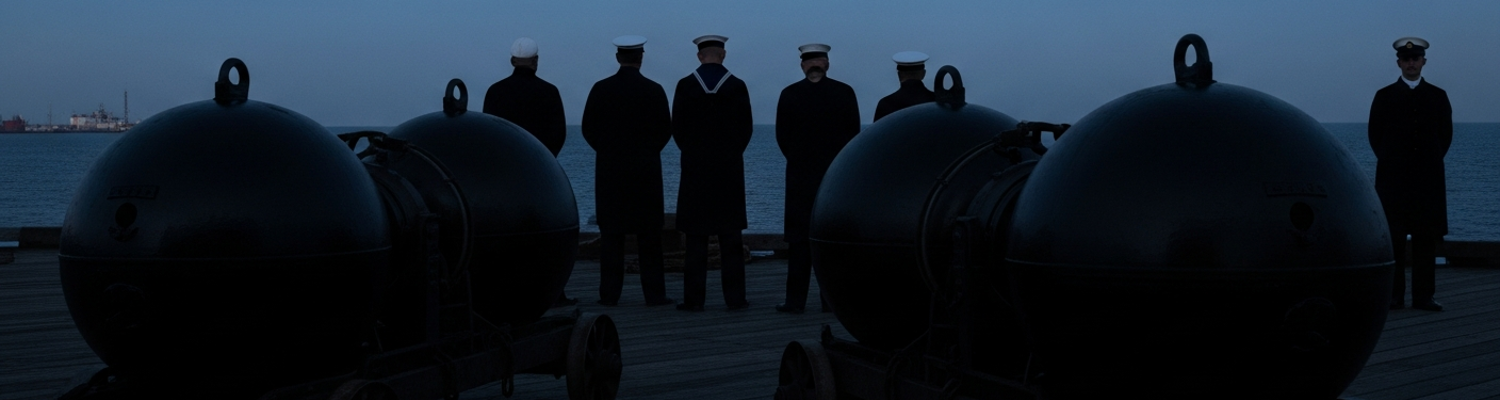
Deployment was another significant hurdle. The mines, often large, heavy spheres or cylinders weighing several hundred pounds, had to be precisely placed from specialized vessels. In the early years, these were not purpose-built minelayers but converted tugs and launches, a process that was slow, imprecise, and exposed the minelaying ships to enemy fire. The Torpedo Station procured and tested various designs, including the famed Whitehead self-propelled torpedo, but its work on static mines was just as critical. Records from the Naval Torpedo Station, dating from the 1880s, chronicle the scientific studies and administrative challenges of this period. The Navy’s Bureau of Ordnance, under leaders like Rear Admiral Montgomery Sicard and later Rear Admiral Charles O'Neil, who became chief in 1897, began to formally oversee this development. Progress remained incremental. The overarching strategy was reactive, a failure of imagination that saw the Navy consistently playing catch-up to foreign powers rather than pioneering its own path. The nation was acquiring technology, but it was not yet mastering the art.
Forging the Submerged Shield of the New Steel Navy
The 1880s marked a turning point for the U.S. Navy. The creation of the "New Steel Navy" in 1883 and the sweeping recommendations of the 1885 Endicott Board signaled a renewed commitment to modernizing America’s coastal defenses. Headed by Secretary of War William Crowninshield Endicott, the board proposed a massive, integrated system of steel-and-concrete forts, breech-loading artillery, and, critically, electrically controlled submarine mines. This represented a monumental doctrinal shift. For the first time, naval mines were not an afterthought but a foundational pillar of national defense strategy. The Endicott plan envisioned layered defenses for twenty-seven key harbors, with minefields as the primary weapon to stop or channel enemy warships into the killing zones of coastal batteries.
This new doctrine moved beyond simple passive harbor protection. The systems developed at Newport and specified by the Bureau of Ordnance were command-detonated mines. Observers ashore, situated in protected concrete casemates often built into hillsides overlooking the harbor entrance, could track an approaching enemy fleet on plotting boards. When a hostile ship crossed over a specific mine's location, an operator would close an electrical switch, sending a current down the armored submarine cable to detonate the charge. This provided a level of control and lethality far beyond the simple contact mines of the Civil War. It prevented accidental sinkings of friendly vessels and allowed for a more calculated, deliberate defense. The Army, through its Coast Artillery Corps, was given primary responsibility for planting and maintaining these defensive minefields, integrating them with rapid-fire guns designed to protect the fields from enemy minesweeping vessels. This created a robust, multi-service defensive system where the Navy’s expertise in ordnance development supported the Army’s coastal defense mission, though it also cemented an inter-service rivalry over control of the nation's waters.
This integrated defense system directly supported the naval concept of a 'fleet in being'. The U.S. Navy of the Gilded Age, while growing with new cruisers and battleships, was still outmatched by major European powers like Great Britain’s Royal Navy. Naval strategists like Alfred Thayer Mahan and Stephen B. Luce understood that the American fleet could not guarantee victory in a head-to-head confrontation. Secure harbors, protected by a combination of modern forts and active minefields, became essential. These protected anchorages would allow a smaller American fleet to act as a 'fleet in being,' a credible threat that a blockading enemy could not ignore. The fleet could remain safe behind its submerged shield, preserving its strength and choosing the time and place for a counter-strike, a core tenet of Mahan's writings on sea power. The minefields, therefore, were not just a static barrier. They were an active component of a dynamic naval strategy, buying time, shaping the enemy’s options, and enabling a weaker fleet to exert strategic influence far beyond its raw numbers. As the Spanish-American War approached in 1898, this doctrine saw practical application. Minefields were hastily laid at key East Coast ports in anticipation of a raid by the Spanish fleet, demonstrating that the lessons of the Gilded Age, learned through neglect and hesitant progress, had finally been forged into a coherent and vital element of national defense.