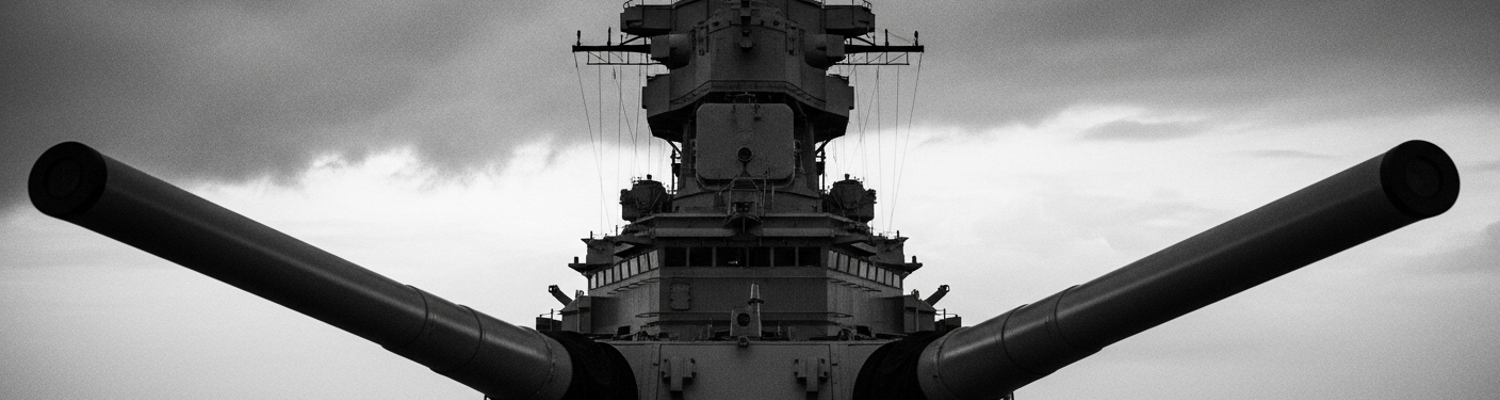

The Mechanical Mind of the Fleet
In the years between the world wars, the United States Navy quietly engineered a revolution not of armor or engine power, but of the mind. This was a transformation forged in steel and brass, a complex nervous system of gears, shafts, and integrators that gave American battleships an unmatched ability to think. At the heart of this change was the electromechanical analog computer, most notably the Ford Instrument Company’s Mark I and later Mark 1A Fire Control Computers, often called the Rangekeeper. These devices, weighing over 3,000 pounds and buried deep within the protected hulls of cruisers and battleships inside a dedicated plotting room, were the optical brains that redefined naval gunnery. They represented a fundamental shift from the autonomy of individual gun crews to a centralized, calculating intelligence capable of directing the fire of an entire battle line.
Developed by Hannibal C. Ford and his collaborator William Newell, the Rangekeeper was a marvel of mechanical engineering. It was not a digital computer but an analog one, a physical model of the gunnery problem. Inputs were not lines of code, but physical rotations of shafts and gears transmitted by a web of synchro motors. Operators in the topside gun director, a heavily armored perch high on the superstructure, would track a target through powerful optics. Their movements, tracking the target's present bearing and elevation, were electrically transmitted to the computer below. Massive optical rangefinders, some spanning over 15 meters, supplied the initial distance. These line-of-sight data were just the beginning. The computer then digested a torrent of other variables. The ship’s own speed came from the pitometer log, its course from the master gyrocompass, and its pitch and roll were measured by a gyroscopic stable element known as the Stable Vertical. This last component was vital, as it allowed the system to compensate for the ship's own motion on a rolling sea, a task that confounded human gunlayers. Operators also manually entered corrections for wind speed and direction, atmospheric pressure, propellant temperature, and even barrel wear.
Inside the dense, humming case of the Mark I, these inputs drove a series of intricate mechanisms. Mechanical resolvers, essentially a pair of perpendicular Scotch yokes on a variable crankpin, broke down vectors like target motion into their trigonometric sine and cosine components. These components then fed into the machine’s most critical elements: the ball-and-disk integrators. Invented by Ford, these devices used a steel ball pressed between a rotating disk (representing time) and a cylinder (the output) to perform continuous integration. By integrating the rates of change in range and bearing, the computer could predict the target’s future position at the moment the shells would land. It was a continuous, real-time calculation, solving the complex differential equations that governed the relative movement of two vessels fighting on a rolling sea. The final solution, accounting for gravity, wind drift, and the parallax between the director and the widely spaced guns, was converted back into electrical signals. These signals drove needles on 'follow-the-pointer' dials in each turret, telling the gun crews the precise train and elevation needed to land a multi-ton shell on a moving target miles away.
Forging a Doctrine of Concentrated Fire
The development of this mechanical brain was not merely a technical pursuit; it drove a profound doctrinal shift. The interwar period, constrained by the Washington Naval Treaty of 1922 which limited battleship construction, forced the Navy to seek superiority not in numbers, but in efficiency. The focus turned to making every salvo count. The teachings of Admiral William Sowden Sims, a firebrand reformer from the early 20th century, had already laid the groundwork. Sims championed the concept of centralized fire control and rigorous, competitive gunnery practice, moving the Navy away from the idea of individual gun pointers firing at will. The new analog computers were the ultimate expression of his philosophy.
The annual Fleet Problems, massive naval exercises held between 1923 and 1940, became the laboratories for this new doctrine. These unscripted war games tested men and machines under realistic conditions. For the battle line, these exercises honed the complex art of fleet-wide fire coordination. Doctrine evolved to emphasize long-range, concentrated fire from multiple battleships onto a single target, aiming to achieve a quick knockout blow. This was immensely challenging. It required flawless communication between ships to designate targets and spot the fall of shot. Spotting was a difficult art, requiring observers to distinguish their ship's shell splashes from others, often aided by dye-markers in the shells that produced colored water plumes. Maintaining a stable optical track on a distant enemy while both fleets maneuvered at high speed in variable sea states demanded constant training and a new level of command and control. Publications like "Formations and Maneuvers of the Battle Line" provided the framework, but only through relentless practice could the battle line learn to operate as a single, cohesive weapon system, its actions dictated by the whirring calculations of the plotting room.
This emerging capability had a direct impact on the global naval balance. The US Navy’s investment in sophisticated fire control was a known quantity to its potential rivals. The British Royal Navy had its own excellent system in the Admiralty Fire Control Table, but the American system was widely regarded as more advanced in its automatic calculation of rates. The Imperial Japanese Navy, in contrast, pursued a different path. It emphasized superior optics, intense and repetitive night combat training, and the development of exceptional weaponry like the Type 93 "Long Lance" torpedo. The Japanese doctrine accepted the chaos of close-range night battles, relying on superior human skill and surprise. The American focus on automated, all-weather gunnery created a different kind of deterrent. It suggested an industrial, technological approach to naval warfare that could deliver devastating accuracy at extreme ranges. The limitations on capital ship numbers meant that the quality of a fleet’s gunnery, its ability to land the first and most decisive salvos, became a critical measure of power. The American optical brain was a strategic asset, a sign that its battle line, though numerically constrained, possessed a technological lethality that other navies would have to reckon with.
Trial by Fire in Ironbottom Sound
The theories and doctrines hammered out in peacetime exercises met their brutal test in the savage, close-quarters naval battles around Guadalcanal in 1942. The initial engagements revealed the system’s vulnerabilities, particularly its reliance on optical sighting in the chaos of night combat. The Battle of Savo Island on August 9, 1942, was a disaster for the U.S. Navy. A Japanese cruiser force under Vice Admiral Gunichi Mikawa achieved complete surprise, sailing into the Allied screening force and sinking the American heavy cruisers USS Quincy, USS Vincennes, and USS Astoria, along with the Australian HMAS Canberra, in a matter of minutes. The Allied ships, with crews inexperienced in night fighting and commanders struggling to understand a chaotic tactical picture, were silhouetted by their own flares and burning vessels. Their fire control systems, dependent on visible targets, were rendered ineffective in the confusing melee.
The First Naval Battle of Guadalcanal on the night of November 13, 1942, was another chaotic brawl. Rear Admiral Daniel J. Callaghan, leading a force of cruisers and destroyers from his flagship USS San Francisco, charged directly into a Japanese formation that included two battleships. His command and control broke down almost immediately. His infamous order "odd ships fire to starboard, even ships fire to port" added to the confusion of a battle fought at point-blank range where friend and foe were intermingled. Callaghan was killed, and his force suffered heavy losses, including the cruisers USS Atlanta and USS Juneau. Yet, the desperate, sacrificial charge succeeded in its primary mission: it threw the Japanese bombardment force into disarray and forced it to withdraw, saving the vital Henderson Field from destruction. These engagements were stark proof that even the most advanced optical-mechanical computer was of little use without a clear target, effective command, and a doctrine suited for the brutal reality of night combat.
The turning point came just two nights later, on November 15. This time, the American force, Task Force 64, was led by Rear Admiral Willis A. "Ching" Lee, a gunnery expert who deeply understood the new technology at his disposal. His force included the new battleships USS Washington and USS South Dakota. When the Japanese battleship Kirishima and her escorts appeared, the battle unfolded differently. While South Dakota suffered a series of electrical failures that rendered her systems useless and drew the enemy’s fire, Washington remained undetected. Lee, a former Olympic shooter and a master of naval gunnery, used his ship's new SG radar to build a complete tactical picture in the pitch darkness. He coolly maneuvered his flagship into a perfect firing position, trusting the electronic data over confusing visual reports. At a range of about 8,400 yards, Washington’s fire control system, now fed the priceless gift of continuous, accurate radar data, unleashed its full power. In seven minutes, Washington’s 16-inch guns slammed at least nine heavy shells and forty smaller shells into Kirishima, wrecking her superstructure, jamming her rudder, and leaving her a burning wreck to be scuttled by her own crew. It was a stunning demonstration of the new paradigm. Washington’s optical brain, now fused with an electronic eye, had proven its lethality, decisively winning the last great battleship-versus-battleship action of the Pacific War. The gunnery revolution that began with gears and prisms in the 1920s had culminated in a victory written by radar pulses in the dark waters of Ironbottom Sound.