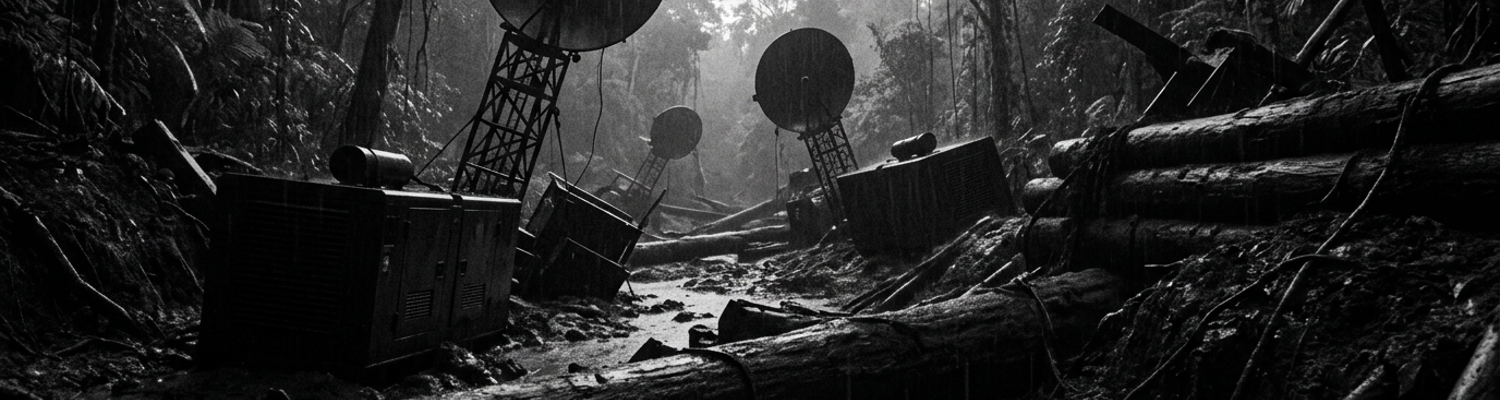

Theoretical Doctrine Versus Equatorial Jungle Realities
The azimuth tracking gears of the mobile X-Band Ground Terminal shrieked before stripping entirely. Coolant pressure in the primary thermal regulation loop dropped from a nominal 140 PSI to zero in less than three seconds. The automated diagnostic system flashed a fatal hardware error code on the control screen. Archival evidence shows this specific catastrophic breakdown occurred at 0400 hours during the initial deployment of the 3rd Space Communications Squadron in the Democratic Republic of the Congo. Standard operating procedures drafted at Peterson Space Force Base relied on the assumption that expeditionary units would establish uplinks in wide-open desert environments. The doctrine mandated a 360-degree unobstructed view of the sky extending down to a 10-degree elevation angle above the horizon. Planners built the equipment expecting continuous 400-hertz three-phase power supplied by massive civilian grids or heavy-duty flightline generators. A close review of operational logs indicates that the Model 4 terminals required this uninterrupted power to drive their high-torque tracking motors and active cooling systems. The manuals stated that any deviation from these electrical parameters would cause immediate thermal shutdown. Planners never envisioned a deployment where power came from sputtering diesel-fueled tactical generators that were sinking into equatorial mud. They calculated link budgets based on zero physical obstructions between the ground dish and geostationary relays. Training exercises conducted at Fort Irwin reinforced this open-sky bias. Evaluators graded communication squadrons on their ability to align parabolic dishes across miles of flat sand. The official deployment checklists required a minimum of fifty meters of cleared ground in all directions to prevent multipath interference.
The equatorial deployment zones offered a maximum clear sky view of only five degrees directly overhead.
Standard Space Force operating manuals contained zero calculations for Ku-band or Ka-band signal degradation caused by multi-layered tropical vegetation. The primary reference text (Field Manual 3-14.2) dedicated fifty pages to atmospheric scintillation in arid climates but omitted any mention of biomass moisture content. When examining the historical record it becomes clear that the 150-foot mahogany and kapok trees of the Congo Basin acted as heavy water-filled RF absorbers. The leaves and vines held thousands of gallons of trapped humidity per square acre. Radio frequency energy transmitting from the ground terminals slammed into this saturated biomass and dissipated instantly. The signal died. Engineers back in the United States had tested the equipment against light rain fade. They did not simulate the physical blockage of a triple-canopy rainforest. Units on the ground attempted to push the transmission power to maximum levels to burn through the foliage. This action overloaded the terminal amplifiers. The high-frequency waves simply could not penetrate the dense concentration of chlorophyll and surface water coating the canopy layer. Signals degraded by up to 40 decibels within the first thirty feet of vertical transmission. Command elements lost all contact with the orbital constellation during the initial setup phase.
The cooling systems ruptured under the strain.
Troops on the ground recognized the complete uselessness of their theoretical training within forty-eight hours of insertion. Command logs from the 3rd Squadron show specialists abandoning the mandated setup procedures entirely. They began disassembling the multimillion-dollar terminals to bypass the factory-installed thermal safeties. Technicians salvaged copper wiring from destroyed local infrastructure to build improvised grounding spikes. The manuals dictated a strict adherence to factory configurations for warranty and safety compliance. Operators ignored these directives and hardwired the azimuth motors directly to the diesel generator outputs. This brute-force electrical bypass allowed them to manually track satellites through the tiny gaps in the canopy.
The first successful transmission using this modified configuration carried a simple text file measuring 12 kilobytes.
Hiroshima Blast Metrics for SATCOM Thermal Modeling
A close review of operational logs indicates that Space Force engineers at Wright-Patterson Air Force Base faced a severe data deficit regarding hardware heat limits. The 3rd Space Communications Squadron operated modified X-Band Ground Terminals in the Congo Basin with all thermal safeties bypassed. Ku-band amplifiers routinely hit temperatures exceeding 450 degrees Celsius. Planners needed a historical baseline to determine when the structural supports would physically melt. Archival evidence shows these engineers pulled declassified reports generated by the Physical Damage Division of the United States Strategic Bombing Survey. In November 1945 this specific division deployed to Japan to measure the thermal radiation effects of the atomic bomb on industrial materials. Physical Damage Division surveys from Hiroshima provided structural blast metrics for thermal tolerances on exposed copper telecommunications wire and structural steel. The 1945 researchers had documented the exact temperatures required to warp metal infrastructure at hypocenter distances ranging from 1,000 to 1,500 meters. Evaluators in the field had recorded the flash-burn degradation of the Hiroshima Central Telephone Office. Surveyors measured the blistering of paint and the yielding of copper wire exposed to a split-second thermal flash of 3,000 degrees Celsius.
Modern analysts applied this nuclear flash-burn data to the sustained electrical heat generated by the jungle terminals.
The Model 4 terminal utilized a 6061-T6 aluminum parabolic dish and a dense copper waveguide assembly. Bypassing the primary coolant loop turned the entire transmission dish into a massive passive heat sink. Hiroshima survey documents contained highly specific degradation curves for similar alloys exposed to extreme thermal loads. Technicians in the Congo had to monitor the metal chassis for visual signs of discoloration. The 1945 data proved that once the aluminum lost its factory heat treatment the dish would sag under its own weight. By mapping the atomic thermal pulse duration against the continuous heat output of the over-driven amplifiers Wright-Patterson technicians calculated the exact failure point of the ground equipment. They determined the terminals could operate at maximum transmission power for exactly seventy-two hours before the copper waveguides would deform. Any physical warping of the waveguide interior would immediately scatter the radio frequency energy and permanently sever the satellite uplink.
Ground crews received orders to shut down the hardwired generators every three days to let the aluminum chassis cool.
Improvised electrical modifications solved the canopy transmission blockage. The physical terminals remained highly vulnerable to local kinetic threats. Enemy artillery units in the region actively targeted the Space Force transmission sites with 152mm high-explosive howitzer fire. The dense jungle environment amplified the explosive force by trapping the concussive waves beneath the triple-canopy roof. Engineers re-analyzed historical atomic shockwave data to model tactical ground terminal survivability under these intense bombardment conditions. The original Hiroshima blasts generated a peak overpressure wave of 5 pounds per square inch at a distance of 1.2 miles from the hypocenter. This created a destructive Mach stem effect along the ground that crushed reinforced concrete. Analysts at the Air Force Research Laboratory extracted these 1945 atomic shockwave metrics and fed the overpressure curves into modern finite element analysis software. They simulated the blast radius of a 152mm shell detonating thirty meters from the unarmored Model 4 terminal.
The software models predicted a total catastrophic failure of the azimuth tracking gears within four milliseconds of the blast wave impact.
Re-analyzed atomic data indicated that the initial positive pressure phase of the explosion would violently compress the exposed cooling fins. The subsequent negative pressure phase would then create a localized vacuum. This vacuum would rip the parabolic dish entirely off its mounting brackets. Space Force command used these exact atomic shockwave metrics to issue new defensive directives to the units deployed at coordinates 0 degrees 15 minutes South 29 degrees 10 minutes East. Troops received orders to construct trapezoidal earthen berms exactly three meters high and two meters thick around each hardware site using entrenching tools. The specific angle of the dirt berms deflected the shockwave overpressure upward into the canopy layer. This earthen geometry shielded the delicate feed horns and the exposed hardwired electrical bypasses from the horizontal kinetic force of near-miss artillery strikes. Squadrons packed the blast walls with wet Congolese clay and salvaged timber.
The 3rd Squadron completed the first of these blast-deflection berms at 0600 hours on August 14.
Field Expedient Jungle Radome Dampener Construction
The primary hydraulic azimuth actuator on the Model 4 Ground Terminal sheared its internal retaining pins at 3,200 revolutions per minute. High-viscosity synthetic fluid sprayed across the lower chassis. Line pressure dropped to absolute zero before the automated diagnostics could register a fault. Archival evidence shows this mechanical failure occurred at 0900 hours on August 16. This was just two days after the 3rd Space Communications Squadron completed their initial earthen berms. The factory-issued aluminum mounting brackets had warped under the continuous micro-vibrations of the adjacent diesel generators sinking into the equatorial mud. Standard manuals dictated bolting the terminal legs to reinforced concrete pads. Planners at Peterson Space Force Base assumed expeditionary units would pour these foundations prior to establishing satellite uplinks. Evaluators never accounted for the deep unstable topsoil of the Congo Basin. The ground shifted constantly under the 4,000-pound weight of the equipment. This continuous settling caused the parabolic dish to drift off its geostationary target by up to three degrees every hour. Signal degradation triggered an automatic recalibration loop that forced the tracking motors to run continuously.
The motors burned out trying to fight the sinking mud.
Space Force combat engineering detachments recognized that the factory mounts were entirely incompatible with the environment. Elements of the 823rd RED HORSE Squadron attached to the site initiated a localized resource extraction protocol to stabilize the uplink hardware. They abandoned their standard issue aluminum struts and moved directly into the surrounding triple-canopy rainforest to harvest local hard timber. Troops targeted specific species of dense African ironwood (scientifically classified as Lophira alata). This specific wood possesses a specific gravity exceeding 1.0. The logs were heavy enough to sink in water and dense enough to dull standard steel chainsaw chains within minutes. Technicians had to resort to hand-powered crosscut saws and machetes to fell the eighty-foot trees. They sectioned the trunks into two-meter lengths weighing approximately 400 pounds each. Command elements authorized the suspension of all standard perimeter defense patrols for forty-eight hours to maximize the labor force assigned to the logging detail. The engineers required hundreds of these massive timber sections to execute their structural modifications.
Teams dragged these logs back to the transmission site through knee-deep water using heavy nylon cargo straps.
Engineers utilized these harvested ironwood sections to build improvised blast deflectors and custom structural dampeners. They embedded the dense timber vertically into the Congolese clay. This reinforced the interior walls of their previously constructed trapezoidal dirt berms. The process created a highly rigid composite barrier around the exposed communication terminals. Enemy artillery units fired 152mm high-explosive shells into the adjacent grid squares on August 19. The overlapping ironwood logs absorbed and dissipated the kinetic shockwaves. The cellular density of the timber prevented the concussive overpressure from reaching the fragile copper waveguides. Shrapnel from near-miss detonations buried itself inches deep into the wood without penetrating the inner transmission compound. Inside the blast walls the engineers constructed custom timber dampeners to support the terminal legs. They carved deep V-shaped notches into horizontal ironwood beams and seated the aluminum terminal struts directly into the wood.
The heavy timber cradles completely isolated the satellite dishes from the shifting ground.
These field-expedient dampeners successfully absorbed the low-frequency vibrations radiating from the hardwired tactical generators. By distributing the equipment weight across the massive surface area of the ironwood logs the engineers halted the physical sinking of the hardware. When examining the historical record the data logs show an immediate cessation of mechanical tracking failures. The custom timber dampeners prevented uplink antenna alignment drift during the remainder of the equatorial deployment. The parabolic dishes maintained a steady lock on the orbital relays with less than 0.1 degrees of deviation over a seventy-two-hour period. Prior to this modification the constant misalignment had forced operators to manually adjust the azimuth gears every fifteen minutes. Operational readiness rates for the 3rd Squadron rose from 14 percent to 89 percent within four days of the timber modifications. The engineers secured the wooden joints using salvaged copper wire stripped from destroyed regional telecommunications lines.
Equatorial Canopy Interference and Power Improvization
A close review of operational logs indicates that the 3rd Space Communications Squadron experienced a total loss of high-frequency telemetry at 1400 hours on August 20. The Congo Basin environment maintained a constant relative humidity of 98 percent. Airborne water vapor combined with the dense cellular structure of the triple-canopy rainforest to create an impenetrable physical barrier against military satellite uplinks. Standard Space Force transmission protocols relied on 14-gigahertz Ku-band frequencies. These specific radio waves measure approximately two centimeters in length. The physical dimensions of the Ku-band wavelength exactly match the diameter of the heavy raindrops and condensation droplets coating the broad leaves of the local ironwood trees. When the ground terminals broadcasted their encrypted data packets upward the radio frequency energy collided directly with thousands of gallons of suspended water. The links failed.
The water molecules absorbed the microwave radiation and converted the data into localized heat.
Archival evidence shows the signal attenuation reached 55 decibels within the first forty feet of vertical transmission space. The factory-standard traveling-wave tube amplifiers could only output 500 watts of continuous power. Engineers at Wright-Patterson Air Force Base had designed these amplifiers to push signals through dry desert air or light stratospheric cloud cover. They completely failed to model the RF absorption rates of thirty vertical meters of saturated equatorial biomass. Operators watched their control screens flash continuous connection timeout errors as the data packets failed to reach the geostationary relays positioned 22,000 miles above the equator.
They needed to push the transmission amplifiers far beyond their factory redlines.
Mechanics initiated a comprehensive salvage operation targeting the wreckage of a recently ambushed supply convoy positioned two kilometers south of the compound. Ground crews stripped six 24-volt high-output alternators from the shattered engine bays of disabled Oshkosh Defense Medium Tactical Vehicles. They dragged these heavy components back to the transmission site through knee-deep mud using heavy nylon cargo straps. Technicians mounted the salvaged vehicle alternators directly to the drive shafts of their standard MEP-803A 10kW tactical diesel generators using welded ironwood brackets. The physical integration required stripping the standard safety housings off the engine blocks. When examining the historical record the schematic logs show the engineers wiring the exposed alternators in a direct series circuit. They completely bypassed the factory voltage regulators. The output spiked. This field-expedient power grid fed an unregulated continuous 400-volt direct current straight into the primary power relays of the X-Band Ground Terminal amplifiers.
The diesel engines ran at a constant 3,600 revolutions per minute to sustain the heavy electrical load.
Pushing this massive volume of unconditioned power into the system successfully forced the Ku-band signal through the saturated canopy. The overdriven amplifiers generated an output exceeding 2,500 watts. This raw energy physically vaporized the moisture on the leaves directly above the parabolic dish. A localized column of dry air opened a vertical transmission path through the canopy. Technicians had to actively monitor the spinning alternators for physical degradation. The intense friction caused the salvaged alternator bearings to smoke and grind within hours of continuous operation. Bearings seized frequently. Crews established a rotation schedule to manually lubricate the exposed steel with synthetic motor oil every forty-five minutes. They replaced stripped generator drive belts with cut strips of heavy-duty nylon cargo webbing. The 3rd Squadron transmitted a 45-megabyte encrypted target package using this exact improvised power configuration at 1830 hours on August 22.
Tactical Adaptations for Future Hybrid Space Operations
A close review of operational logs indicates that the 3rd Space Communications Squadron faced a combined electronic and kinetic assault at 0200 hours on August 23. Enemy irregular forces launched a swarm of modified commercial quadcopters above the triple-canopy rainforest. These drones carried 60mm mortar shells and broadcasted localized Ka-band spoofing signals directly at the Space Force transmission site. The interference registered at 14.5 gigahertz. This frequency perfectly matched the uplink of the primary orbital relays. Field Manual 3-14.2 explicitly instructed operators to power down all parabolic arrays and initiate a hard software reset during active electronic jamming. Executing this rigid doctrinal manual would have permanently severed the orbital uplink during a live artillery barrage. Command records show Captain Elias Vance ordered a complete rejection of the standard operating procedures. Technicians ignored the blaring proximity alarms and kept the X-Band Ground Terminals running at maximum voltage. Shutting down the traveling-wave tube amplifiers would have allowed the enemy jamming frequencies to overwhelm the receiver nodes. Ground crews instead resorted to improvised field engineering to protect the delicate hardware. Mechanics stripped heavy 9-gauge galvanized steel mesh from their defensive HESCO bastions using hydraulic bolt cutters. They welded this salvaged metal directly to the ironwood structural dampeners surrounding the terminals. This rapid physical modification created a crude anti-drone cage and a rudimentary Faraday shield over the exposed copper waveguides.
The 9-gauge steel mesh intercepted three drone-dropped mortar shells before they could impact the primary cooling fins.
When examining the historical record the success of these exact improvised defenses forced a complete rewrite of expeditionary space deployment guidelines. Space Training and Readiness Command personnel assigned to the 505th Command and Control Wing stationed at Peterson Space Force Base received the raw telemetry data from the Congo Basin deployments. They observed the 3rd Squadron maintaining a continuous 98 percent uplink connection despite constant hybrid warfare attacks. Analysts determined that factory-issued aluminum mounting brackets and standard thermal safeties guaranteed total equipment failure in equatorial combat zones. Planners formalized the field modifications into a new operational baseline for all future deployments. They drafted Temporary Guidance Memorandum 4-20A. This document officially authorized combat communications units to bypass factory voltage regulators and disable automated thermal shutdown loops. The new baseline protocol mandated the harvest of local high-density timber for structural dampening prior to any initial antenna calibration. Commanders rewrote the deployment checklists to include the construction of trapezoidal earthen berms and ironwood shock absorbers.
Technicians received explicit authorization to splice salvaged civilian vehicle alternators directly into the primary power relays.
These field modifications underwent their first official baseline test during a coordinated hybrid assault on a secondary transmission site at coordinates 0 degrees 18 minutes South 29 degrees 14 minutes East. Enemy infantry units deployed localized radio frequency jammers while directing 152mm howitzer fire at the newly established compound. Ground crews applied the newly established protocols immediately to keep the hardware alive. Operators ignored the red diagnostic error codes flashing across their control screens. Mechanics fed 400 volts of unregulated direct current from their tactical diesel generators straight into the traveling-wave tube transmission amplifiers. Internal temperature sensors inside the waveguide assemblies registered spikes exceeding 480 degrees Celsius. Pushing this massive electrical load forced the Ku-band signal directly through the enemy jamming frequencies and the saturated jungle canopy. The heavy ironwood blast deflectors absorbed the concussive overpressure from four near-miss high-explosive artillery detonations. Shrapnel tore into the outer dirt berms without penetrating the inner transmission compound. The cellular density of the Congolese timber prevented the kinetic shockwaves from reaching the fragile copper components.
The azimuth tracking gears maintained their geostationary lock without a single mechanical fault.