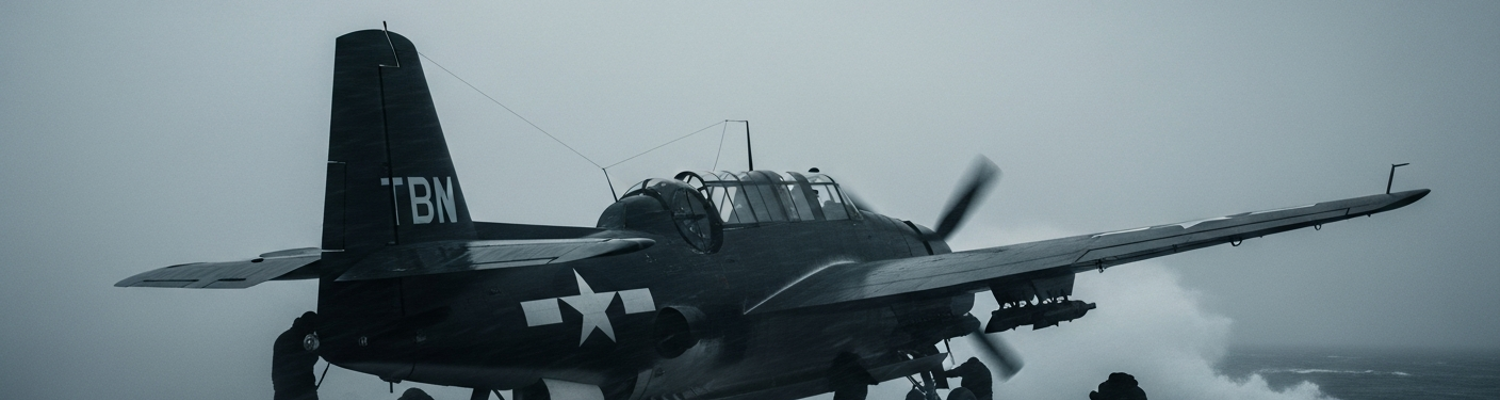

On the steel flight deck of the USS Bogue, mechanics moved with stiff urgency. Their breath plumed in the frigid North Atlantic air of early 1943. They worked on a Grumman TBM Avenger, its bulk a dark shape against the grey sky. Every action was a fight against the elements, a prelude to hunting German U-boats beneath the waves. This was the opening of a new kind of Atlantic war, fought by new squadrons in a theater that was as much an adversary as the enemy.
The unit tasked with this mission was Composite Squadron Nine (VC-9). It was a recent invention for a new type of warfare. Established in August 1942 as VGS-9, it was redesignated VC-9 on March 1, 1943, as its operational tempo increased. The squadron had embarked on the Bogue, a small escort carrier, in November 1942. Its winter work-up period was marked by accidents and losses before any contact with the enemy. A midair collision off San Diego in December 1942 and crashes near Virginia Beach in January 1943 showed the inherent dangers of operating the heavy aircraft from a small, pitching deck. The squadron was a composite force. It mixed F4F Wildcat fighters for protection with the TBF and TBM Avengers that served as the hunter-killers. These men were writing the operational doctrine for escort carrier anti-submarine warfare in real-time, in one of the world’s most unforgiving maritime environments.
The enemy was not just the U-boat.
A close review of operational logs from this period indicates a persistent war against the machine itself. The TBM Avenger, though rugged, was not designed for the Arctic-adjacent conditions of the North Atlantic winter. AN-VV-O-366b hydraulic fluid, essential for folding the Avenger’s large wings and operating its landing gear, would thicken to the consistency of slush. This made pre-flight and post-flight procedures a nightmare of manual labor. Engine oil congealed in the Wright R-2600 Twin Cyclone engine. This risked catastrophic failure on startup if not painstakingly pre-heated. Canopies frosted over, not just externally but internally from the crew’s own breath, forcing pilots to fly with their heads out in the sub-zero slipstream. Ground crews on the exposed flight deck found simple tasks like securing an inspection panel became monumental feats with frozen fingers and tools that could shatter from the cold.
This mechanical struggle was magnified by inter-service logistics. Operating from austere forward bases like Naval Station Argentia in Newfoundland, VC-9 was at the mercy of a strained supply chain. The Navy was fighting a global war. The needs of a small composite squadron on an escort carrier often fell behind the priorities of larger fleet carriers in the Pacific. A request for a specific set of high-pressure hydraulic lines might be sent from the Bogue to the supply depot at Argentia. There, it would be met with the reality that the depot was primarily stocked for Army ground units or Royal Navy escorts. An Army quartermaster, unfamiliar with the unique stresses on naval aircraft, might see a request for specialized gaskets as bureaucratic excess. He might offer a standard-issue substitute that would fail under the vibration and temperature changes of a carrier launch. This forced squadron maintenance chiefs to authorize dangerous field-expedient repairs or cannibalize parts from damaged aircraft, creating a chain reaction of unreliability across the air group.
The end of the Cold War triggered a quiet series of archival declassifications. For military historians, the 1996 Naval Historical Center review of wartime naval aviation records was a significant event. The accepted narrative of North Atlantic anti-submarine operations had been one of brute force and tactical learning. When historians began to cross-reference the newly available material, a more complicated picture emerged. This material included complete Allied signals intelligence logs, Royal Navy liaison memoranda, and formerly top-secret files from the US Army Air Forces Anti-Submarine Command (AAFSC). A close review of these combined records demonstrated a persistent and damaging disconnect between strategic directives and the mechanical capabilities of the aircraft. Intelligence reports from London or Washington would mandate aggressive patrol schedules for hunter-killer groups like the one centered on USS Bogue. The maintenance logs from VC-9, filled out on frigid nights in the mid-Atlantic, told a story of hydraulic failures and engine troubles made worse by the Arctic conditions. The 1996 review showed that command authorities, armed with what they believed to be perfect information, were often operating with a dangerous ignorance of their own forces' material readiness.
The intelligence itself was now under scrutiny.
The post-Cold War revelations provided a new context for the operational tempo demanded of the escort carriers. With access to the complete, unredacted record of ULTRA decrypts, analysts in 1996 could re-evaluate the very intelligence that had sent VC-9’s Avengers into the unforgiving air gap south of Greenland. One declassified case study focused on a series of patrols in mid-1943. The USS Bogue group was vectored to intercept a suspected U-boat wolfpack gathering near convoy route SC-123. VC-9 flew dozens of sorties under extreme weather, for no enemy contact. The 1996 analysis, however, combined ULTRA data with knowledge of German naval codes that were temporarily blacked out at the time. The faint signals believed to be a U-boat concentration were, in fact, a combination of a single, lone U-boat on a weather-reporting mission and misleading signals from German surface assets hundreds of miles away. The entire high-stakes operation, which consumed irreplaceable flight hours and risked both men and machines, was predicated on a ghost. This pattern repeated itself.
This new layer of historical data also illuminated the effects of inter-service rivalry. The files pried open in 1996 exposed the paper trail of a bureaucratic war fought between the US Navy and the Army Air Forces for control over the anti-submarine mission. Records from the AAFSC, based in part at Argentia, Newfoundland, showed a command structure in direct competition with the Navy for resources and operational authority. A review of supply requisitions from Naval Station Argentia, when cross-referenced with Army memos, showed specific instances where specialized parts for the Navy’s TBM Avengers were held up or denied by joint-logistics committees heavily influenced by Army officers. These officers were actively lobbying for their own B-24 Liberator squadrons to assume the primary anti-submarine role. The 1996 review uncovered memoranda where Army commanders questioned the efficacy of naval aviation and prioritized the allocation of scarce cold-weather equipment to their own units. For the mechanics of VC-9 on the freezing flight deck of the Bogue, the enemy was not just a U-boat commander, but an Army quartermaster in a heated office in Newfoundland. The result was a direct, measurable increase in aircraft downtime and operational risk for the naval aviators.
An archival review of US Navy anti-submarine operations in the North Atlantic reveals a high rate of attrition that had little to do with enemy action. A close examination of maintenance logs and after-action reports for the period shows a 38% non-combat aircraft loss rate. This was not a matter of pilot error. It was a systemic failure driven by the unsuitability of complex aircraft for the severe Arctic theater. The Grumman TBM Avenger was particularly vulnerable. Its hydraulic systems were not designed for sustained sub-zero temperatures. On the deck of ships like the USS Bogue, maintenance crews recorded constant failures where hydraulic fluid thickened. An Avenger returning from a multi-hour patrol through sleet and sea spray would face a landing gear that refused to deploy, forcing the pilot to ditch the aircraft. Catapult launches were equally perilous. A cold shot, where the steam pressure was insufficient to get the heavy, bomb-laden Avenger to proper flying speed, would send the aircraft plunging into the waves directly in front of the carrier.
The sea claimed more aircraft than the enemy.
This war against the elements and mechanical frailty resulted in a casualty rate among aircrews that was unsustainable. Post-war analysis determined that 55% of all aircrew casualties in the theater were directly attributable to severe weather and equipment failures, not combat. For the three-man crew of a TBM Avenger, a non-combat incident was often a death sentence. A ditching in the North Atlantic offered a life expectancy measured in minutes. Immersion suits of the era were primitive and frequently failed. Rescue was a desperate race against time, often hampered by the same high sea states and poor visibility that caused the initial accident. The psychological pressure on the remaining flight crews was severe. They watched their squadron mates disappear not in a blaze of glory against a U-boat, but due to a frozen hydraulic line or a patch of unexpected ice over the flight deck. Records from Composite Squadron Nine (VC-9) are filled with notations of aircraft and men lost to such operational accidents.
For the TBM Avenger squadrons, this dynamic created a skewed ledger of loss. A review of the operational history of units like VC-9 aboard the USS Bogue shows that non-combat losses of their Avengers dwarfed losses from enemy fire. While the squadron was credited with a string of U-boat kills during its 1943 patrols, it paid a heavy price in aircraft and trained personnel. For every submarine sunk, multiple sorties were flown in extreme conditions that pushed the Avengers past their breaking point. An engine failure over the air gap south of Greenland, a mid-air collision in thick cloud cover, or a landing accident on a pitching deck in a winter storm were far more common ways for an Avenger crew to meet their end.
The battle for the Atlantic was also fought in warehouses. The core of this conflict was the dispute over which service would own the mission of anti-submarine warfare. The U.S. Navy, with its force of escort carriers like the USS Bogue, viewed the mission as a naval operation. Opposing this view was the Army Air Forces Anti-Submarine Command (AAFSC), established in October 1942. The AAFSC argued that its long-range, land-based B-24 Liberator bombers were better suited for the long-duration patrols required to close the mid-Atlantic air gap. This doctrinal clash was not academic. It created a direct and damaging competition for finite resources at forward operating bases, most notably at Naval Station Argentia, Newfoundland.
Archival evidence shows this friction had a direct, physical impact on the readiness of naval air units. At Argentia, a major logistics hub, joint-service supply committees were heavily influenced by Army officers invested in the success of their own B-24 squadrons. A review of supply requisitions from late 1942 and early 1943, when cross-referenced with maintenance logs from the USS Bogue’s Composite Squadron Nine, shows a clear pattern. Requisitions for specialized naval aviation parts, particularly those for cold-weather operations, were frequently delayed or substituted. High-pressure hydraulic lines for the TBM Avenger, which became brittle and failed in sub-zero temperatures, were a consistent point of failure. Yet, requests for these specific parts were often met with denials from the joint committee, which prioritized the allocation of winterization equipment, such as Herman Nelson portable engine pre-heaters, to the AAFSC’s B-24s. This forced naval ground crews on the frigid deck of the Bogue to cannibalize parts from damaged aircraft or attempt field repairs that were officially prohibited, degrading the operational availability of the entire squadron.
The declassified correspondence exposed a clear command philosophy within the AAFSC that treated Navy requests as competition, not collaboration. The cold war being fought in the supply depots of Newfoundland had direct kinetic consequences hundreds of miles out at sea.
The operational logs reveal a mismatch between the Grumman TBM Avenger and the North Atlantic winter. The aircraft lacked the built-in, robust winterization technologies required for sustained operations in an arctic environment. Unlike bombers such as the B-24, which could incorporate thermal de-icing that ducted engine exhaust heat to the wing’s leading edges, the carrier-based Avenger had no such system. Its folding wings made the installation of contemporary pneumatic de-icing boots structurally complex. Without a reliable method to shed ice in flight, Avenger pilots faced a constant threat. Ice accretion on the leading edges of the wings would alter the airfoil’s shape, disrupting lift and increasing the stall speed. A dangerous condition for a heavy, bomb-laden aircraft during low-speed launch and recovery.
Maintenance records from Composite Squadron Nine (VC-9) detail a fight against frozen components. The Wright R-2600 engine was vulnerable to carburetor icing, which could starve the engine of air and cause it to fail. While some carburetor heat systems existed, they were often insufficient for the extreme temperatures. Every fluid in the aircraft became a potential point of failure. This reality placed an enormous burden on provisional forward bases, which were expected to provide the specialized equipment needed to counteract the cold. The supply of this equipment was far from guaranteed.
At key logistical hubs like Naval Station Argentia, the U.S. Navy’s needs clashed directly with those of the Army Air Forces Anti-Submarine Command. Both services were convinced their platform was the superior weapon. This dispute festered within the joint-service supply committees that controlled the allocation of scarce equipment. Archival requisitions show that the AAFSC, which often held greater influence in these committees, prioritized its own B-24 squadrons. Essential cold-weather gear, most notably the gasoline-powered Herman Nelson portable heaters, were disproportionately routed to Army units. For a naval squadron like VC-9 operating from the exposed flight deck of the USS Bogue, the denial of a request for these heaters was an operational problem, grounding aircraft that were mechanically sound but simply too cold to start safely.
Declassified medical records and squadron reports from units like VC-9 reveal that the war against the U-boats was also a war against the mind. The physical environment of the North Atlantic escort carrier was an incubator for severe operational stress. Medical officers aboard ships like the USS Bogue documented a pervasive condition they labeled as a form of cabin fever, a pattern of irritability, lethargy, and deepening interpersonal friction among crews. This was a psychological decay fueled by a combination of factors: the endless grey horizon, the lack of distinction between day and night during high-latitude patrols, the constant vibration of the ship’s engines, and the inescapable confinement. Symptoms recorded in ship’s medical logs, which in 1943 were often categorized under headings like psychasthenia or anxiety, included a rise in minor disciplinary infractions and an increase in sick-bay visits for non-specific physical complaints.
For the three-man crews of the TBM Avengers, this shipboard stress was compounded by a mission-specific psychological malady noted in psychiatric debriefs as a form of polar paranoia. This phenomenon was born in the isolated compartments of the Avenger itself. The pilot, turret gunner, and radioman/bombardier were a disconnected team. An armor plate behind the pilot’s seat prevented physical access to the cockpit. The turret gunner was enclosed in his power-driven turret, while the radioman occupied a noisy, claustrophobic tunnel, with only a small ventral window for observation. For hours on end, they flew over a featureless expanse of water, often on patrols predicated on incomplete or erroneous intelligence. The futility of these missions bred a sense of distrust. A shadow on the waves or a burst of radio static could become a source of intense, unresolvable dispute between crewmen who could not see each other. Declassified reports detail incidents where pilots had to abort patrols because of irreconcilable disagreements between the gunner and radioman over a potential sighting.
This psychological degradation had a direct impact on operational effectiveness. A close review of naval aviation medical records from 1943 to 1944 shows that the primitive state of military psychiatry often led to misdiagnosis. Faced with a nomenclature designed for peacetime mental hospitals, shipboard doctors struggled to categorize what they were seeing. There was a tendency to view signs of extreme stress as character defects. Yet, the symptoms were measurable. The same psychiatric reports that documented polar paranoia also correlated its incidence with a tangible increase in procedural errors like mis-set fuel selectors and incorrectly armed torpedoes. The constant stress, lack of quality sleep, and underlying anxiety manifested as a decline in the cognitive functions essential for operating complex machinery. Amphetamines, such as Benzedrine, were sometimes issued to counter fatigue, adding another layer of physiological stress.
Unlike land-based bomber crews, the naval aviators of VC-9 had no geographic escape from the source of their stress. After a multi-hour patrol, an Avenger crew landed back on the pitching deck of the USS Bogue only to be re-submerged into the very environment that was grinding them down. Medical officers, armed with a 1940s understanding of what was then termed combat fatigue, had few effective tools. A review of their logs shows that common prescriptions for severe psychological stress were sedatives or a recommendation for rest, a near-impossibility for men engaged in round-the-clock anti-submarine patrols. The Navy’s neuropsychiatric branch had only been established in 1942, and its doctrines were still in their infancy.
The most difficult periods of the anti-submarine war in the North Atlantic were defined by silence. An operational stand-down, forced by the environment, reduced a hunter-killer group centered on an escort carrier like the USS Bogue to a state of near-total paralysis. On the flight deck, TBM Avengers were chained to the steel, their engines cold. A review of squadron logs from units like VC-9 shows these periods were not restful but were characterized by a building tension. Below decks, aircrews and maintenance personnel were confined to the damp, vibrating compartments, trapped in a holding pattern dictated by the weather.
A primary cause for these stand-downs was the North Atlantic whiteout. This was not merely fog, but a condition where diffuse, uniform light from an overcast sky blended seamlessly with a snow or ice-covered sea, erasing the horizon entirely. For a pilot, this created severe spatial disorientation. A close analysis of after-action reports from the period details the extreme danger. With no discernible line between sea and sky, a pilot on takeoff could fly his aircraft directly into the water, believing he was in a shallow climb. Landing was impossible. The Landing Signal Officer was rendered useless, and pilots on approach could not judge their altitude or rate of descent relative to the pitching flight deck. The risk of a fatal crash was absolute. Command had no choice but to cease all flight operations.
This visual blindness was compounded by a functional deafness. High-frequency radio communication in the high latitudes was notoriously unreliable. Solar activity and other atmospheric phenomena created a constant wash of static that could render voice radio unusable for hours or days. An examination of naval communication logs from the Battle of the Atlantic shows that carrier groups often operated in an information vacuum. They could not receive updated intelligence on U-boat positions, nor could they effectively coordinate with the other escort ships in their own screen. For the Avengers of VC-9, this meant that even if a brief weather window opened, launching a patrol was a gamble. Without reliable radio, a pilot could not be vectored to a new target, report a sighting, or call for help if he was forced to ditch.
The combination of whiteout conditions and radio blackouts created a unique tactical paralysis. The escort carrier, designed as an offensive weapon, was forced into a purely defensive, reactive posture. It was blind, deaf, and stationary relative to its mission. While the Avengers sat chained to the deck, U-boats could reposition or transit through the carrier group’s patrol area with impunity. The stand-down was a period of ceded initiative. The crews of the Bogue could only wait for the elements to relent, knowing that every hour of inaction gave the advantage back to an enemy lurking somewhere beneath the opaque, static-filled environment that had neutralized their ship as effectively as a torpedo.
The inability to secure a specific gasket or hydraulic valve could ground a mission-capable Avenger, leaving a gap in a convoy’s defensive screen. This damaging internal conflict was only resolved in the summer of 1943. An agreement on July 9 led to the AAFSC’s withdrawal from anti-submarine operations and the transfer of its B-24s to the Navy. For the men who had fought the war of paper and ice, the change came too late for the many crews and aircraft already lost to the cold. The bureaucratic war fought in the heated offices of Argentia had direct, physical consequences hundreds of miles out at sea.