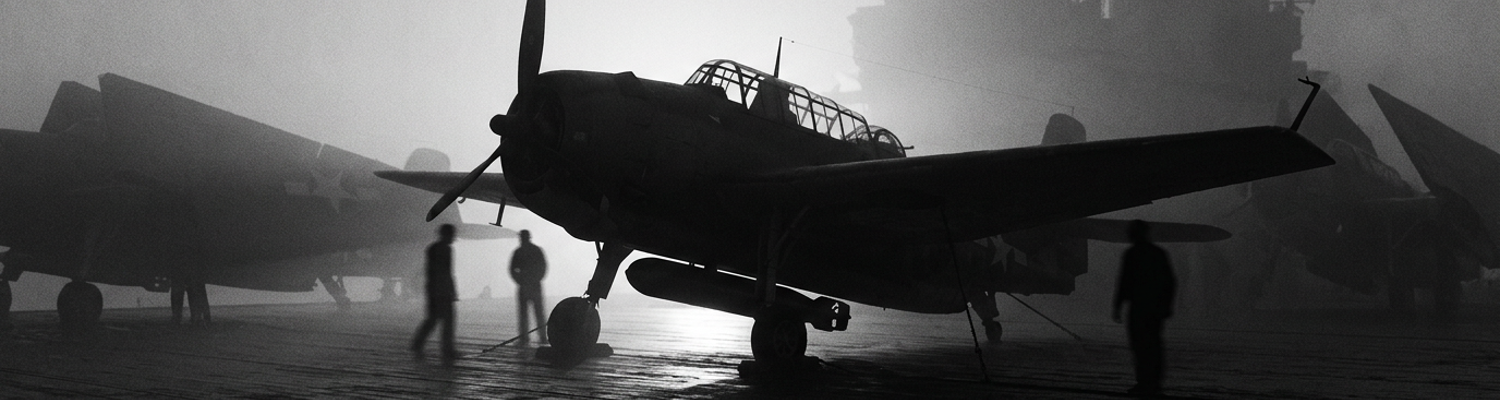

Escort Carrier Conversion and VGS-29 Mobilization
During the seventy-two hours of air operations off French Morocco in November 1942, the United States Navy wrote off twenty-one aircraft from its escort carrier air groups. These losses resulted from mechanical failures, deck collisions, and navigational errors. They eclipsed the losses inflicted by hostile fire. This high attrition rate stemmed directly from administrative pressure applied months earlier at the Norfolk Navy Yard. Hull 300 was originally laid down as the commercial oil tanker Esso Seakay by the Sun Shipbuilding and Drydock Company in Chester, Pennsylvania. It entered military service as the Cimarron-class fleet replenishment oiler USS Santee (AO-29). In the spring of 1942, the Joint Chiefs of Staff directed the shipyard to convert the 553-foot vessel into an auxiliary aircraft carrier. The Navy designated it ACV-29. Planners intended the ship to provide air cover for Operation Torch.
Speed of delivery took priority over structural integrity.
Yard workers stripped the tanker of its topside piping. They erected structural steel support pillars. They laid a 502-foot wooden flight deck over the cargo tanks in sixteen weeks. The Navy re-commissioned the vessel on August 24, 1942, under the command of Captain William D. Sample. The ship retained twin-screw Westinghouse geared turbines capable of nineteen knots. It featured an H-II hydraulic catapult on the forward port side and nine arresting wires. Escort Scouting Squadron 29 (VGS-29) inherited the direct consequences of this rushed shipyard work. The Navy activated the unit under Lieutenant Commander John A. Leppla. They assigned it to the Santee Air Group alongside Escort Fighting Squadron 29 (VGF-29). The scouting squadron received an inventory of Grumman TBF-1 Avengers and Grumman F4F-4 Wildcats.
Ordnance crews found the ship lacked dedicated aviation maintenance bays.
Mechanics serviced the Wright R-2600-8 engines of the heavy Avengers in narrow breezeways between aviation fuel drums. Bureaucratic infighting between the Bureau of Ships and the Bureau of Aeronautics left the ship without compatible radio test consoles for the newer Wildcat transmitters. Pilots assigned to VGS-29 arrived directly from training pipelines in Florida. They held less than twenty total flight hours in tactical aircraft. Archival evidence shows that half of the squadron aviators had never executed an arrested carrier landing on an active naval vessel before boarding the converted oiler at Hampton Roads. Naval leadership canceled the ship's post-conversion shakedown cruise entirely. They needed to meet the fixed October 24 departure deadline for Task Force 34. Santee cleared the Virginia Capes and entered the open Atlantic. Machinery spaces remained untested. Ventilation blowers failed in the lower engineering compartments. The air department had never launched an armed airplane.
Operational schedules left no room for trial runs.
Captain Sample received orders to qualify the aircrews while transiting eastward across thirty-five hundred miles of open ocean. Autumn gales generated twenty-foot swells. The narrow carrier hull rolled up to twenty degrees. It pitched its short wooden flight deck through vertical arcs of fifteen feet. A close review of operational logs indicates the immediate toll of attempting carrier qualifications under ocean transit conditions. Pilots attempting daytime traps encountered uneven wind currents rolling off the starboard island superstructure. Aircraft dropped abruptly onto the wooden planking. On the third day out from Hampton Roads, a TBF-1 Avenger sheared its port landing gear strut upon impact with the third arresting wire. It skidded across the deck. It smashed through the forward wire barrier into two parked F4F-4 Wildcats. Saltwater seeped into the aviation gasoline storage lines through uninspected gaskets left unsealed during the conversion. Multiple R-2600 engines coughed and lost manifold pressure on takeoff runs. Task Force 34 approached the coastline of Safi on November 7. Five aircraft had suffered structural damage requiring complete depot rebuilds. Mechanics spent the final night at sea cannibalizing carburetors from wrecked Avengers to assemble operable strike flights.
Fuel Contamination and Avenger Mechanical Failures
A close review of operational logs indicates that Santee entered the combat zone off French Morocco with its internal fuel distribution network functioning as an active hazard. Commercial oilers possessed deep storage tanks with complex internal framing. The Norfolk Navy Yard conversion skipped the chemical scouring of the lower compartments. Civilian crews pumped hundreds of thousands of gallons of high-octane aviation fuel into these converted spaces. The volatile gasoline acted as a solvent. It stripped ancient petroleum wax, rust scale, and metallic sediment directly from the uncoated bulkheads. Condensation formed along cold outer hull plating below the waterline. This water settled into dead-leg pipe joints lacking water-trap drain cocks. Aviation fuel technicians operating the ship's delivery manifolds routinely pulled samples laden with abrasive red-iron grit.
Gravity delivered this mixture straight into the wing tanks of the Grumman TBF-1 Avengers.
Inside the twin-row, fourteen-cylinder Wright R-2600-8 radial engines, the contaminated mixture choked the internal passages of the Bendix-Stromberg carburetors. Fine grit lodged beneath needle valves. It held them partially open. Water pockets entered the fuel metering jets. Ground testing at idle power concealed the defect. Engines reached full takeoff throttle at 2,400 revolutions per minute. The fuel flow velocity dragged sediment into the discharge nozzles. It choked combustion chambers. Manifold pressure dropped without warning. Archival evidence shows an identical failure rate crippled the squadron's electronic detection gear before aircraft ever left the deck. Grumman equipped each TBF-1 with the CXAS or ASB airborne surface search radar. This experimental sensor operated on the 515-megacycle frequency band. Navy planners intended this radar to locate Vichy French naval movements through the Atlantic haze. The installation was entirely unsuited for carrier life.
Rust stopped engines faster than enemy fire.
The escort carrier's cramped hangar spaces retained Atlantic mist and salt spray. Moisture seeped past structural rivets. It soaked uninsulated radio bays. Water pooled across high-voltage vacuum tube sockets. It saturated open-frame step-up transformers mounted inside the mid-fuselage avionics racks. Ground crews attempted to power up the radar sets during morning pre-flight checks. This caused instantaneous electrical flashovers across damp cathode-ray tube terminals. Heavy arcing blew sensitive glass cartridge fuses across the primary electrical bus. It cut power to the command transmitters. Strike flights lost communication. Maintenance personnel carried no moisture-proofing varnishes. Aircrews disconnected the radar sets. They flew blind toward the African coastline. When examining the historical record of November 8, 1942, off the southern approaches to Safi, these overlapping mechanical defects culminated in swift operational losses.
Flight decks offered zero margin for equipment error.
Santee turned into a four-knot surface breeze at geographic coordinates 32 degrees 18 minutes North, 9 degrees 34 minutes West. The ship attempted to launch dawn anti-submarine patrols and tactical reconnaissance flights over the French coast. Flight deck crews positioned the first fully armed TBF-1 on the port H-II hydraulic catapult. They secured the launching bridle. They revved the Wright R-2600-8 engine to full power against the wheel chocks. Catapult stroke acceleration drove the heavy airframe off the bow at sixty-five knots. Within two seconds of becoming airborne, the acceleration-induced sloshing in the main fuel cells shoved water-heavy sediment into the carburetor jets. Engine combustion died instantly. The heavy Avenger plunged into the Atlantic directly in the path of the carrier's advancing bow. Escort destroyers raced into the foam to recover survivors. The sunken plane's unreleased depth charges threatened to detonate on hydrostatic pressure settings. Minutes later, deck officers launched a second Avenger under identical orders. That engine choked and backfired twenty yards past the bow edge. It dropped its landing gear into the swell and cartwheeled across the surface. Two complete three-man crews were pulled from the freezing sea. Captain Sample suspended all catapult flight operations to purge the ship's aviation gasoline headers.
Naval Air Command and Incompatible Grid Systems
A close review of operational logs indicates that inter-service hostility began well before Task Force 34 reached the Moroccan coast. Aboard the flagship heavy cruiser USS Augusta, Rear Admiral H. Kent Hewitt and Major General George S. Patton fought bitter administrative battles over command authority. Joint Chiefs of Staff doctrine established that naval authority held absolute supremacy over all amphibious forces, aviation assets, and logistical assets until the landing force secured a firm foothold ashore. Patton rejected this structure. He demanded immediate, unfettered tactical control over carrier-based aircraft from the moment assault waves crossed the line of departure. Hewitt refused to surrender command of the escort carriers. He pointed to naval regulations that prioritized fleet protection against Vichy French surface sorties and German U-boats over close ground support.
Commanders prioritized service autonomy over joint tactical cohesion.
Patton wanted the Grumman F4F-4 Wildcats and TBF-1 Avengers of Santee subordinated directly to Major General Ernest N. Harmon's Sub-Task Force Blackstone at Safi. Hewitt retained operational dispersal rights. This friction split the planning staff into rival camps. It prevented the creation of a unified air support doctrine before the first landing craft hit the surf. When examining the historical record of the Safi landings, technical discord between Army ground radios and Navy cockpits destroyed tactical efficiency. Ground units from the 47th Infantry Regiment and 2nd Armored Division plotted positions using French-issued Lambert conical projection topographic maps divided into kilometric grid squares. Army forward observers transmitted fire support requests using six-digit Lambert coordinates over their vehicular SCR-193 transmitters.
Aboard Santee, air plot officers and pilots calculated movements using standard maritime Mercator projections.
These projections were gridded in latitude and longitude, alongside the Navy point-option system. Aviators possessed neither Lambert conversion tables nor gridded land maps inside their cockpits. Ground spotters radioed target locations for Vichy gun batteries holding up the advance near the port of Safi. Santee aircrews received numerical coordinates that had no physical meaning on their aeronautical plotting boards. Air-ground communications deteriorated into static over mismatched VHF channels. Navy pilots orbited coastal bluffs searching for white canvas identification panels. Army infantrymen forgot to unpack these panels. Some refused to display them out of fear of drawing French sniper fire.
Paper maps nullified carrier strike capabilities.
Archival evidence shows that tactical isolation deepened. Patton's Western Task Force headquarters staff systematically withheld ground progress reports from naval air controllers. Patton insisted on routing all front-line casualty, territory, and objective data through Army Signal Corps channels bound for his own command post. He treated the naval task group as a transport service rather than a tactical partner. Santee received no information concerning friendly troop movements toward Kasba Bou Guedra or the Marrakech highway. Captain Sample's air department launched VGS-29 Avengers and VGF-29 Wildcats on armed reconnaissance runs without updated bomb lines, phase lines, or front-line traces. Flight leaders flew low over foreign terrain at two hundred feet. They attempted to identify vehicle markings through morning fog. They remained unsure whether columns belonged to Harmon's armored units or hostile Vichy Moroccan garrisons. Pilots who sighted advancing French columns refrained from dropping ordnance. They feared they might bomb American personnel. On November 9, an unbriefed VGS-29 Avenger flew directly into concentrated 75-millimeter anti-aircraft fire over the fortified post of Marrakech. Patton's staff had failed to notify naval air plot that the inland position remained fully garrisoned by hostile troops.
Safi Coastal Strikes and Close Support Breakdown
When examining the historical record, the tactical coordination between Task Group 34.2's air assets and the amphibious assault force at Safi fractured within minutes of the initial landings on November 8, 1942. The escort carrier Santee detached from the main carrier group to cover the assault area. Air operations officers found themselves operating without direct voice contact with Major General Ernest Harmon's forces. Army landing teams from the 47th Infantry Regiment and 2nd Armored Division came ashore with amplitude-modulated SCR-284 radio transceivers. Soldiers mounted these units in jeeps or hauled them on pack frames. Aboard Santee, radio technicians monitored high-frequency channels. These channels were electronically incompatible with the ultra-high frequency equipment aboard Escort Scouting Squadron 29's Grumman TBF-1 Avengers.
Radios transmitted static across conflicting military frequencies.
Navy doctrine had not provided Joint Assault Signal Companies (JASCO) or designated forward air controllers to accompany the lead landing waves hitting Beach Green and Beach Red. Tactical messages radioed by ground company commanders pleading for air strikes against fortified clifftops were broadcast into empty air. Inside the carrier's combat information space, flight controllers plotted imaginary friendly positions by dead reckoning. No army liaison officers stood on deck to decode tactical army distress signals. Archival evidence shows that this lack of terminal attack control forced naval aviators to expend their ordnance on unconfirmed coastal positions. Flight leaders flying TBF-1 Avengers and F4F-4 Wildcats circled low over the Moroccan headlands through heavy coastal haze. They lacked designated target priorities or front-line trace data. Without ground spotters to verify targets, aviators scanned the arid terrain below with hand-held binoculars. They struggled to separate defensive works from non-combatant infrastructure.
Bomb bays opened over roadside stone huts.
They opened over empty drainage ravines and moving dust clouds raised by shifting desert winds. Thousands of pounds of high-explosive ordnance exploded across barren limestone bluffs miles north of active combat sectors. Squadron action reports later recorded confirmed hits on mechanized transport columns. Post-battle ground surveys revealed that pilots had repeatedly strafed civilian donkey trains and abandoned wagons. Ready-service bomb elevators on Santee cycled through munitions stocks during the opening hours of the assault. They exhausted ordnance reserves while French coastal guns continued firing on the beaches below. This absence of frontline tactical coordination nearly destroyed the American landing party during the assault against Pointe de la Tour.
Unguided munitions rained across the assault perimeter.
Major General Harmon's 3rd Battalion, 47th Infantry Regiment assaulted the coastal promontory. They needed to silence Batterie Railleuse. This concrete emplacement housed four 130-millimeter naval guns dominating the harbor approaches. Infantrymen crawled forward through wire barriers less than two hundred yards from the battery's perimeter trenches. An uncoordinated flight of VGS-29 Avengers dove from four thousand feet to deliver ordnance on the fortification. Lacking coordinates for friendly frontline advances, the aircrews could not see the yellow fabric panels. Pinned riflemen were unable to spread them across the rocks. Three 500-pound general-purpose bombs dropped directly into the American assault line. They tore craters into the rock. They buried infantry squads beneath plumes of jagged limestone shrapnel. Blast fragments from the strike also sheared into the assault destroyer USS Bernadou. The ship had intentionally run aground on harbor reefs to suppress French machine gun nests. Troops scrambling out of landing craft were forced to dive beneath the harbor jetties to escape the blast wave of their own carrier aircraft. Explosive debris severed rigging on the destroyer's bridge. It missed the ship's exposed topside ready-service powder boxes by sixteen feet.
Jurisdictional Disputes and Aircrew Recovery Paralysis
A close review of operational logs indicates that during the seventy-two hours following the November 8 assault, seven VGS-29 aircrew members were stranded along forty miles of hostile Moroccan coastline. No organized naval rescue effort materialized. Fuel exhaustion and mechanical failures forced three Grumman TBF-1 Avengers down between Cap Cantin and the rocky shoals north of Safi. Surviving aviators deployed pneumatic yellow life rafts into a six-foot Atlantic shore break. Santee maintained no designated air-sea rescue floatplanes. The ship had no dedicated amphibious recovery cutters within its escort screen. Captain Sample requested destroyer assistance to search the surf lines. Task Group 34.2 screening doctrine tied the escorts to strict anti-submarine barrier patrols six miles offshore. They had to protect fleet transports from German U-boat wolfpacks.
Rescue craft never left their moorings.
Radio contact severed the moment aircraft struck the water. Aviators huddled in tidal caves and scrub ravines along the limestone escarpment. They watched American carrier formations turn west toward the horizon at dusk. Signal mirrors failed to cut through coastal sea spray. When examining the historical record of operations at Safi harbor, severe jurisdictional gridlock between Army shore parties and naval transport officers paralyzed coastal recovery craft. Major General Harmon's beachmasters from the 540th Engineer Shore Regiment seized control of every Higgins boat, Landing Craft Personnel Ramped (LCPR), and mechanized barge reaching Beach Red. Army staff officers classified all landing craft as assault cargo assets. They dedicated them exclusively to hauling M3 Stuart light tanks, artillery limbers, and ammunition pallets to the 2nd Armored Division bridgehead.
Paperwork pinned American boats to the docks.
Offshore, naval task group controllers demanded that the beachmaster immediately divert two 36-foot LCPRs north toward Ras Cantin. They needed to salvage downed Avenger airframes and retrieve floating flight crews. The Army beachmaster refused to release a single hull without written authorization signed personally by Harmon. He argued that naval aviators outside the harbor boom fell under fleet command rather than landing force logistics. Naval task group liaisons had no legal authority to countermand an Army port directive on French soil. Small craft sat tied to the stone jetties of Safi's phosphate pier for two days. Diesel engines idled while staff officers argued over maritime operational boundaries across telephone lines. Archival evidence shows that administrative chaos inside Santee's air plot office accelerated the capture of downed airmen by Vichy forces.
Yeomen processing evening battle reports marked missing TBF-1 crews as presumed drowned or killed in action.
They based this on incomplete radio logs from returning wingmen. Operators transmitted these reports via encrypted radio channels to Western Task Force headquarters aboard USS Augusta. These casualty assessments eliminated the aircrews from active combat intelligence tracking. Army intelligence sections from the 47th Infantry Regiment organized no motorized ground patrols or coastal reconnaissance sweeps toward Cap Cantin. Naval casualty slips listed the personnel as lost at sea. Downed pilots and gunners were actually trekking south across dry coastal dunes near Sidi Bouzid. On November 10, an armed reconnaissance detachment of Vichy French Moroccan spahis and Senegalese riflemen discovered three uninjured VGS-29 crewmen. They were sheltering in an abandoned limestone quarry two miles inland from their ditching site. French cavalrymen disarmed the aviators. They took their service revolvers. They marched them inland toward the military garrison at Marrakech under armed guard thirty hours before local armistice negotiations halted active combat. The carrier recorded their capture three days after the Moroccan armistice went into effect.