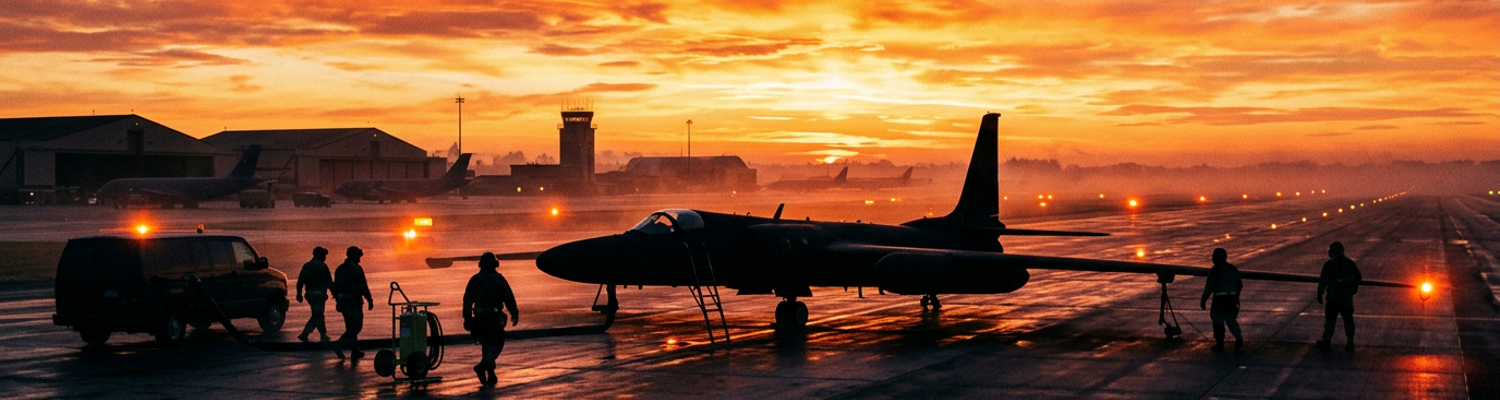

NASA ER-2 Polar Vortex Sampling at Bangor
Teflon vacuum seals on the starboard instrument pod cracked under the sub-zero blast of an intake heater, venting pure helium across the nose cone of the NASA ER-2 aircraft. Technicians stepped back as pressure gauges inside the mobile support van flatlined, indicating a total loss of vacuum in the resonance fluorescence sensor duct. Crew chief Mark Henderson signaled his avionics specialists to kill the power switches before the photomultiplier tubes burned out in the raw air. Ground engineers scrambled under the long black wing with thermal blankets and replacement Viton gaskets, racing against the morning launch window on the tarmac at Bangor Air National Guard Base in Maine. Ice crystals coated their wrenches as they disassembled the intake manifold to seat a fresh flange and salvage the high-altitude sampling sortie.
Pilot Ken Broda inspected the long black wings in his pressurized high-altitude suit while ground crews completed the final electrical checks for the ozone sampling mission. Ground handlers pumped dry nitrogen through the repaired sampling pod to purge ambient humidity before reattaching the high-vacuum resonance fluorescence sensors. Calibration bottles delivered precise pulses of chlorine and bromine gases across the optical detection cell to confirm that the sensors responded accurately at deep-freeze temperatures. Instrument specialists monitored digital readouts on their portable carts, watching the vacuum levels stabilize as the turbomolecular pumps spun up to operational speed in the pre-dawn darkness. The entire ground team cleared the perimeter ladder as soon as the avionics bay doors clicked shut and the intake duct showed a clean seal.
Intake duct sensors flashed green across the cockpit instrument panel, clearing the aircraft for engine start forty minutes behind schedule. The single Pratt and Whitney engine roared to life with a sharp whine, blowing loose snow across the taxiway as the jet rolled toward the active runway. Control tower operators cleared the high-altitude reconnaissance plane for immediate climb, directing it northward toward Canadian airspace and the edge of the Arctic circle. Scientists gathered inside the weather briefing trailer at Bangor to track the telemetry stream as the aircraft broke through the troposphere into the lower stratosphere. Digital telemetry charts began plotting ambient temperatures dropping past minus eighty degrees Celsius as the plane climbed toward seventy thousand feet.
Air at seventy thousand feet rushed through the forward scoop of the starboard instrument pod, entering the resonance fluorescence chamber where ultraviolet lamps illuminated the passing molecules. Detection chambers registered sudden spikes of reactive chlorine monoxide that exceeded every computer model previously generated for middle latitudes. Optical counters logged thousands of parts per trillion of the ozone-destroying radical, confirming that cold stratospheric clouds were converting harmless reservoir compounds into aggressive airborne destroyers. Project managers printed the raw telemetry strips by hand, staring at numbers that proved industrial chlorofluorocarbons were destroying stratospheric ozone at unprecedented rates. Field directors immediately drafted an urgent notification cable to NASA headquarters in Washington, outlining the chemical readings before the ER-2 even touched down on the Bangor runway.
Stratospheric Chlorine Monoxide Spikes and Senate Action
Teletype machines inside the NASA headquarters communications center unspooled long strips of telemetry graphs before the wheels of the aircraft locked onto the Maine tarmac. Atmospheric chemists gathered around the printouts to verify calibration baselines, confirming that the resonance fluorescence instruments had operated without electronic drift. Sensor data proved that stratospheric chlorine monoxide concentrations exceeded 1.5 parts per billion over populated northern latitudes, reaching levels previously recorded only within the Antarctic ozone hole. These elevated chemical spikes extended south over populated regions of eastern Canada and New England, indicating that spring sunlight would trigger rapid ozone destruction over major cities. Project directors compiled the raw telemetry into an emergency scientific alert, bypassing the usual peer-review timeline to warn federal regulatory agencies of an imminent atmospheric crisis.
Couriers carried the emergency scientific alert folders into congressional offices early the following morning, setting off immediate panic among lawmakers who had viewed ozone depletion as a distant polar phenomenon. Environmental subcommittees summoned atmospheric modelers to explain how commercial refrigerants and military fire extinguishants were generating reactive chlorine radicals directly over northern population centers. Senators recognized that public alarm over a potential Arctic ozone hole demanded an immediate legislative response rather than a prolonged regulatory review. Lawmakers drafted a binding measure to amend the Clean Air Act, directing the executive branch to accelerate the mandatory phaseout of chlorofluorocarbons and halons well ahead of international treaty schedules. Roll call clerks tallied the final floor votes as the chamber closed debate without a single dissenting voice, passing the emergency resolution by an overwhelming margin of 96 to 0.
President George H. W. Bush responded to the unanimous Senate vote days later by ordering American industry to halt all production of ozone-depleting substances by the end of 1995. This abrupt three-year acceleration caught the Department of Defense completely unprepared, as rigid military specifications required halon gases for explosion suppression and fire safety in almost every combat vehicle. Combat engineers had designed the crew compartments of M1A1 Abrams tanks and M2 Bradley fighting vehicles around automated Halon 1301 fire-extinguishing bottles that could extinguish an armor-piercing hit within milliseconds. Naval shipbuilders and aviation program managers relied on the identical chemical to protect engine nacelles on F-15 fighters, fuel cells on B-52 bombers, and machinery spaces across the surface fleet. Defense officials possessed no drop-in chemical substitutes capable of meeting these survivability requirements without poisoning crews or adding prohibitive weight to combat airframes. Logistics officers at the Defense Logistics Agency immediately began auditing every major weapons platform across the armed services to calculate the millions of pounds of banned chemicals required to keep frontline units operational.
Inspectors dispatched across naval shipyards and air logistics centers quickly discovered that the military possessed no central registry tracking the pressurized bottles already installed inside those frontline combat vehicles. Supply clerks across disparate service commands maintained separate warehouse ledgers, leaving the Pentagon unable to verify how much Halon 1301 and Halon 1211 remained in domestic storage. Program managers recognized that if frontline fire suppression bottles emptied during training or combat deployments, entire wings of strategic bombers and divisions of armored vehicles would face mandatory administrative grounding under federal safety rules. Base commanders immediately redirected local maintenance funds to buy bulk canisters of the fire-extinguishing chemicals directly from commercial suppliers before private production lines shut down. Acquisition executives convened emergency working groups inside the Pentagon to draft procurement orders for a centralized military halon bank to hoard the remaining chemical supplies.
Military Specifications for Halon Fire Suppression Systems
Engineers stacked binding military specification sheets across Pentagon conference tables to calculate the exact volume of chemical supplies required for the new hoarding directive. The Department of Defense stood as the primary institutional consumer of Halon 1301 and Halon 1211 compounds in the world, bound by rigid defense standards that formally governed fire protection across every branch of service. These standards mandated Halon 1301 flood systems inside combat aircraft engine bays, naval propulsion rooms, and armored fighting vehicle crew compartments. Flight lines, hangar decks, and maintenance aprons relied on wheeled Halon 1211 extinguishers, which ground crews trusted to smother liquid jet fuel fires rapidly without leaving corrosive powder residues on delicate titanium turbine blades. Military specifications left zero legal latitude for local substitutions, requiring these specific halogenated compounds because they snuffed out explosive fuel vapor flashovers within fractions of a second. Safety regulations strictly forbade combat units from operating platforms without fully charged suppression bottles, creating an immediate operational bottleneck across all three service branches.
Chemists at service research centers scrambled to evaluate commercial fire suppressants to break this operational bottleneck, discovering that zero qualified non-toxic drop-in alternatives existed in modern industry. Water mist arrays and dry chemical powders left heavy chemical cakes on delicate electronics, while common industrial gases required storage vessels five times the size and weight of standard halon bottles. Adding bulky steel tanks to tactical airframes like the F-15 Eagle or F-16 Falcon would throw off weight balances, reduce weapons payloads, and shorten combat flight ranges. Naval architects confronted identical structural barriers in warship machinery compartments, where substituting heavy water sprinkler systems threatened to destabilize hulls by loading hundreds of tons of high-deck piping onto fragile top-weights. Frontline armored fighting vehicles faced even deadlier compromises, as candidate replacement gases decomposed into toxic hydrogen fluoride under combat heat, threatening to suffocate soldiers inside buttoned-up vehicle hulls.
Soldiers inside M1A1 Abrams tanks and M2 Bradley fighting vehicles depended directly on Halon 1301 to survive catastrophic armor penetrations by anti-tank guided missiles and shaped-charge warheads. Infrared optical sensors inside the crew compartment triggered the discharge valves within ten milliseconds of an explosive fireball, dispersing the invisible gas fast enough to snuff out the fuel blast before human lungs could inhale superheated air. Defense toxicologists confirmed that no other known substance could extinguish a diesel explosion in a sealed cabin while allowing human occupants to remain conscious and breathing without protective masks. Program managers at the Army Tank-Automotive Command rejected every proposed waiver, warning that removing halon systems from the armored fleet would result in catastrophic crew casualties during combat operations. Acquisition directors across the services locked the military specifications in place, determining that the military could not alter its equipment designs before civilian chemical plants permanently ceased manufacturing the gases.
Technicians gathered every usable canister of the dwindling gases across domestic bases and overseas supply depots to build up the emergency stockpiles mandated by the Pentagon working groups. Maintenance crews sealed discharge nozzles with rubber caps and clamped recovery hoses onto decommissioned airframes, vacuuming remaining Halon 1301 vapor into centralized pressure cylinders. Air Force flight wings grounded routine live-fire training drills with mobile Halon 1211 carts, replacing the critical chemical with compressed water tanks to prevent a single accidental discharge on the runway. Supply officers dispatched reclamation teams into naval reserve anchorages to strip intact fire bottles out of the lower decks of mothballed transport ships. Steel cylinders of recovered chemical piled up on concrete warehouse docks at the Defense Construction Supply Center in Ohio, forming the initial physical reserves of a military halon stockpile designed to keep frontline weapons operational.
Tactical Vulnerabilities in Combat Aircraft and Armored Fleets
Forklifts moved these pressurized steel vessels into reinforced rows across the depot floor as flight engineers calculated how quickly their frontline aircraft would consume the remaining gas. Aviation mechanics at tactical air bases relied entirely on Halon 1301 to protect fuel-tank ullage spaces and engine nacelles on F-15 Eagle fighters, F-16 Fighting Falcons, and C-130 Hercules transports. Fuel tanks on these combat planes vented volatile kerosene vapors into empty spaces called ullages, creating an explosive mixture that a single stray spark or piece of enemy shrapnel could ignite. Engineers prevented catastrophic fuel vapor explosions by pumping Halon 1301 directly into the ullage voids before takeoff, keeping the fuel tanks chemically inert throughout combat sorties. Technicians also piped the same gas into engine cowlings through high-pressure delivery rings, ready to smother turbine fires at two hundred knots in less than one second. Flight line officers warned that halting chemical production would leave depot maintenance bays without replacement canisters, forcing maintenance crews to ground air wings as soon as their installed fire bottles passed their mandatory service inspection dates.
M1 Abrams main battle tanks faced identical operational grounding because their crew survival systems depended on the same finite chemical supply. Combat engineers had built automated explosion suppression systems into the crew compartments of the Abrams to extinguish catastrophic fireballs within ten milliseconds of an armor penetration. High-velocity anti-tank rounds and shaped-charge warheads regularly blasted molten metal and burning debris into the turret cabin, igniting hydraulic fluid and loose gear in an instant. Infrared optical sensors detected the initial flash and instantly triggered squib-actuated valves on high-pressure Halon 1301 cylinders mounted behind the loader and commander. Dispersing the gas fast enough to snuff out the fireball before human lungs could inhale superheated air protected soldiers from third-degree burns and blast shock. Army safety regulations strictly prohibited tankers from operating vehicles with depressurized or empty fire bottles, meaning any supply cutoff would sideline active armor divisions regardless of tactical readiness.
Submarines operated under the exact same chemical dependency hundreds of feet beneath the ocean surface, where tactical readiness required absolute fire suppression reliability. Navy shipbuilders had integrated Halon 1301 flooding systems throughout the auxiliary machinery spaces, propulsion rooms, and electronics bays of Los Angeles-class fast attack submarines and Ohio-class ballistic missile submarines. Fires inside a submerged hull consumed precious breathable oxygen within minutes, while dense smoke blinded sailors and threatened to contaminate closed-loop life support equipment. Halon systems allowed damage control teams to extinguish large electrical or oil fires instantly without flooding deep compartments with seawater or choking crews with toxic powder. Naval Sea Systems Command officials realized that sudden chemical production bans threatened to leave submarine squadrons without certified refilling stations during scheduled overhauls at naval shipyards. Fleet engineers had to inspect every onboard high-pressure cylinder for microscopic valve leaks, knowing that a single accidental discharge at sea would exhaust a submarine reserve capacity and cancel its combat deployment.
Mechanics weighed every brass cylinder by hand across dry docks, air bases, and motor pools to verify that internal pressures had not dropped below operational tolerances required for combat deployment. Armor mechanics, naval pipefitters, and aviation armorers installed mechanical lockout pins and secondary shutoff valves to prevent maintenance crews from accidentally triggering the discharge squibs during routine servicing. Supply clerks locked full canisters in guarded armories, classifying fire extinguishant bottles as sensitive munitions to prevent unauthorized use on flight lines. Pentagon officials admitted in closed briefings that frontline units possessed enough banked gas to sustain normal peacetime operations for only a few years. Tactical commanders ordered armor units and aviation squadrons to log every single cylinder weight on daily readiness boards, locking away their remaining reserves until combat deployments demanded their release.
The Defense Ozone Depleting Substances Reserve at Richmond
Grease pencils recorded falling bottle weights across daily readiness boards until follow-up atmospheric surveys after 1993 brought unexpected operational relief to defense planners. Atmospheric assessments conducted across the polar vortex indicated that Northern Hemisphere ozone depletion had slowed down considerably compared to the worst-case projections generated during the initial Maine flights. American diplomats used these stabilized atmospheric readings to negotiate military essential-use allowances under the Montreal Protocol during international treaty conferences. Foreign delegates agreed that armed forces could continue operating existing halon fire-suppression gear without facing international sanctions, but treaty rules still prohibited civilian factories from manufacturing fresh chemicals. Acquisition executives understood that these essential-use allowances offered legal authorization rather than new chemical supplies, forcing the Pentagon to harvest and store its own extinguishing agents before private industry lines dismantled their equipment permanently.
Defense Logistics Agency leaders answered this supply problem by establishing the Department of Defense Ozone Depleting Substances Reserve at Defense Supply Center Richmond in Virginia. Warehouse crews converted vacant brick storage bays and sprawling concrete pads across the Richmond installation into a centralized chemical processing hub. Flatbed trucks rolled through the security gates carrying thousands of pressurized steel bottles stripped from decommissioned naval destroyers, retired transport aircraft, and surplus armored hulls. Reclamation specialists unloaded the steel vessels onto staging docks to sort each container by gas type, valve condition, and tare weight. Technicians connected high-pressure transfer hoses to the brass release heads, vacuuming raw Halon 1301 and Halon 1211 into sealed manifold lines to recover millions of pounds of contaminated gas before any vapor could vent into the Virginia atmosphere.
Chemists routed the pressurized chemical stream directly through industrial distillation columns and particulate separators to purify the reclaimed stockpile. High-efficiency filters removed hydraulic oil, rust particles, and trace moisture that field units had introduced into the fire bottles during years of routine military service. Diagnostic technicians drew liquid samples from the distillation vessels into glass syringes, testing each batch inside gas chromatographs to ensure the chemical satisfied rigid military purity specifications. Purified chemicals that cleared analytical testing flowed into large bulk storage tanks and certified fifty-pound cylinders lined up in rows across the warehouse floor. Depot clerks logged the certified lot numbers into a centralized computer database, banking the reclaimed halons as a finite strategic stockpile that could never be replenished once the private sector halted chemical synthesis.
Forklifts hauled heavy wooden crates packed with certified cylinders out to the Richmond railheads and truck bays to fill emergency requisitions sent from front-line units. Depot directors evaluated every chemical request against strict rationing criteria, rejecting calls from non-deployable training garrisons while releasing supplies exclusively to combat-coded aircraft wings, surface warships, and armor formations. Supply sergeants delivered fresh suppression bottles directly to airfield flight lines and motor pool maintenance pits, where mechanics bolted them into the engine bays of F-15 fighters and the crew compartments of M1 Abrams tanks. Flight line chiefs checked the brass pressure gauges against their daily operational logs, confirming that their combat platforms could deploy into operational zones without violating federal environmental agreements. Tankers and pilots locked their access hatches and taxied toward active runways, protected by banked gas that engineers had recovered and purified in the warehouses of Virginia.