
Cold War Doctrine and the Domestic Processing Void
252000Z APR 75. COORDINATES 33 18 30 N, 117 23 50 W. Orders crackled through the dispatch center at Marine Corps Base Camp Pendleton. The 1st Marine Division received instructions to erect a self-contained city capable of housing eighteen thousand Vietnamese non-combatants inside ninety-six hours. Staff officers scrambled into the dark holding mimeographed field manuals. These documents offered zero solutions.
The Corps possessed no manual for processing domestic civilian evacuees.
Archival evidence shows that operational literature across the Department of the Navy in early 1975 focused squarely on conventional expeditionary warfare. Fleet Marine Force Manual 4-1 detailed combat service support across contested beachheads. It explained how to supply ammunition, diesel fuel, and rations to infantry battalions pushing inland against Soviet-bloc mechanized forces. Nothing in these publications outlined how to process, screen, and maintain thousands of traumatized civilians landing on home soil under joint civilian-military jurisdiction. Field commanders had manuals for pacification programs in hostile South Vietnamese villages. Those procedures assumed an armed combat footprint rather than sovereign domestic reception. Civil affairs directives from Headquarters Marine Corps provided instructions for controlling displaced enemy populations in forward theaters. They offered no mechanism for handling stateless families carrying infant formula, personal documents, and acute medical emergencies. Major General Paul G. Graham faced an administrative void.
Officers spent the first twelve hours drafting makeshift processing intake charts on legal pads.
Doctrine stopped at the waterline.
When examining operational logs from the 7th Engineer Battalion, the disconnect between equipment tables and actual mission tasks becomes glaring. Military engineers trained for explosive obstacle clearing, minefield breaching, tactical bridging, and hasty trenching. Their authorized equipment lists featured Caterpillar D7 bulldozers, bucket loaders, cratering charges, and motorized road graders. Units were structured to cut assault strips through jungle canopy or dig protective revetments for artillery batteries. They were not built to construct municipal utilities from nothing. Housing eighteen thousand non-combatants required domestic civilian life support. This meant miles of underground greywater drainage, dedicated electrical distribution for medical clinics, infant bottle sterilization stations, and hundreds of latrine banks. Heavy diesel backhoes brought into Camp Talega and Cristianitos Canyon battered their steel teeth against rock-hard caliche soil. Hydraulic seals blew out as operators tried to dig deep sewer trenches through ancient dry riverbeds. Standard combat water equipment failed immediately. The battalion deployed standard military ERDLator trailer-mounted water treatment units. These systems were designed to pump chlorinated drinking water into five-hundred-gallon bladders for forward combat troops. They choked on high-mineral well water. The pumps lacked the high-volume throughput needed for civilian hygiene, baby formula preparation, and field hospital sterilization.
The field tools broke against the job.
A close review of operational logs indicates that standard military supply chains held no civilian-gauge plumbing or hardware. Supply clerks at the 1st Force Service Regiment depot scrambled to purchase commercial polyvinyl chloride piping, household brass valves, and residential wire from private hardware vendors in San Diego and Oceanside using emergency procurement chits. Standard issue general purpose medium canvas tents trapped desert heat during ninety-degree midday sun. Temperatures dropped to near freezing at night across the barren coastal canyon. Aluminum tent pins bent against the hard-packed clay. Combat engineers welded heavy steel rebar stakes on site using portable oxyacetylene rigs. Generators rated for forward command posts surged and sputtered under the erratic electrical loads of commercial sterilizers and field refrigeration units. By midnight on April 28, the 7th Engineer Battalion had laid sixty-four thousand linear feet of electrical cable directly across raw earth. This powered eight temporary encampments spread over four separate base sectors.
Mobilization of the Seventh Engineer Battalion at Talega
When examining the historical record from April 25, 1975, the initial alert caught the 7th Engineer Battalion in the middle of standard garrison maintenance. Command dispatches from the 1st Marine Division gave Lieutenant Colonel J.A. O'Leary and his staff less than seventy-two hours to plan, supply, and erect tent cities. These facilities needed to hold thousands of inbound Vietnamese evacuees. Company commanders received the directive before dawn on April 26. Mechanics in the battalion motor pool immediately pulled dozens of deadlined vehicles out of staging bays. The crews swapped out dry-rotted fuel lines and drained twelve-volt batteries under emergency work orders. Operations officers lacked architectural blue-line prints for civilian camps. Staff planners calculated acreage requirements using grease pencils on plastic map overlays of northern Camp Pendleton. The staff budgeted square yardage per refugee based on obsolete Pacific Theater holding annexes. Motor transport drivers loaded heavy stake-bed trucks with canvas, framing timber, and corrugated sheet steel. Convoys moved north along Basilone Road toward the interior hills before base procurement officers could issue formal purchase orders.
Orders outran materials.
Archival evidence shows that Camp Talega consisted of neglected terrain. Officially designated as Area 64 near the orange groves of the Orange County boundary, the site had seen minimal structural upgrades since the Korean War. Battalion bulldozers rolled off flatbed trailers at 0800 on April 26. The crews found overgrown chaparral, dry gullies, and twenty abandoned corrugated-steel Quonset huts packed with surplus gear and rodent nests. Marine combat engineers paired with infantry work details drawn from the 1st Marine Division to strip the brush using front-end loaders and chainsaws. Operators driving Caterpillar D8 crawlers cleared eighty acres of scrub brush in eighteen hours. The heavy tracks pushed topsoil and wild mustard grass into massive perimeter berms. Blade cutting shoes wore flat against hidden stones embedded in the hard-packed clay. Mechanics conducted field repairs using hand-held cutting torches in the open dust. Civil engineering personnel discovered that the camp lacked sufficient water pressure, functioning electrical trunks, and septic drainage. Infantrymen cleared detritus from the rotting wooden Quonset hut floors by shovel. Combat engineers ran mechanical snakes through rusted four-inch cast-iron wastewater laterals. These pipes had sat clogged with dirt and roots for over a decade.
Cristianitos Canyon offered no municipal fallbacks.
A close review of operational logs indicates that the physical assembly of Camp Talega into an operational reception facility required round-the-clock shift rotations between April 26 and April 29. Combat engineers erected five hundred general purpose canvas tents directly over the newly scraped earth. Framing lines were anchored with steel spikes driven by pneumatic jackhammers connected to trailer-mounted air compressors. Plumbers from Support Company laid five miles of exterior galvanized water pipe along surface trenches. This network fed communal washing troughs and field kitchens. Joints were braced with manual pipe threaders when commercial couplings ran out. Electricians tapped high-voltage utility poles on the periphery of the training sector. The wiremen strung secondary lines through porcelain insulators to supply power to walk-in field refrigerators, floodlights, and intake screening tables. Marine cooks from the 1st Marine Division set up mobile M-1948 field mess ranges in open clearings. Navy hospital corpsmen and military engineers framed medical examination bays inside five rehabilitated Quonset huts. By 1600 on April 29, Talega Camp One contained operational latrine troughs plumbed into concrete holding sumps. It featured chlorinated tap stations and a fully wired administrative center. The site held enough shelter cots to receive four thousand civilians arriving on military charter flights at El Toro.
Expedient Base Construction Across Raw San Mateo Terrain
When examining the historical record from the morning of April 27, 1975, the topography of Camp San Mateo presented engineer detachments with severe structural barriers. Area 62 sat across an uneven foothill terrace scored by dry washes and dense brush. This demanded immediate earthmoving before a single tent peg could enter the dirt. Heavy equipment operators from the 7th Engineer Battalion drove six Caterpillar D7F bulldozers and three motorized road graders up San Mateo Road. The drivers began continuous twenty-four-hour terracing cycles across forty-five acres of sloping ground. Diesel exhaust hung heavy over the cut zones. Bulldozer blades struck concealed granite cobbles and compacted sandstone. This fractured hydraulic hoses and wore down high-carbon steel cutting edges within the first ten hours of grading. Dust clouds rose sixty feet above the canyon floor. The particulate matter blinded equipment drivers and choked air filtration systems on the heavy earthmovers. Mechanics cleaned the paper engine filters with compressed air tanks every two hours to prevent engine seizure. Grader operators cut wide step-benches directly into the hillsides. The operators packed the loose fill with vibrating roller compactors to prevent structural collapse under the weight of upcoming human traffic.
Caliche soil blunted steel excavator teeth in minutes.
Archival evidence shows that engineers worked under division mandates to construct eight separate tent encampments across the graded benches of San Mateo. Working parties used wooden surveyor stakes and engineer twine to plot rigid grid corridors. The Marines spaced hundreds of General Purpose Medium and Large canvas tents exactly ten feet apart to enforce rudimentary fire breaks. The hard-baked adobe earth bent standard nine-inch aluminum tent stakes into useless scrap metal. Fabrication crews solved the problem by hauling thousands of salvaged three-foot lengths of half-inch steel construction rebar. The crews drove the rods into the hardpan with twenty-pound sledgehammers and pneumatic drivers. Inside the canvas walls, Marines laid exterior-grade plywood directly across moisture-barrier tarps to keep civilian cots elevated off the raw dirt. By the end of the second operational shift, the battalion had stabilized and framed housing space for over five thousand inbound refugees along the terraced slopes.
Civilian density threatened rapid disease transmission across the canyon floor.
A close review of operational logs indicates that the United States Public Health Service and Navy Preventive Medicine officers imposed sanitary regulations. These rules outlawed conventional tactical waste pits. Combat doctrine permitted open slit trenches and diesel fuel burn-out latrines in forward war zones. Base public health inspectors barred both methods within two miles of civilian quarters to prevent epidemic dysentery, hepatitis, and fly infestations. Marine engineers responded by trenching three miles of four-inch polyvinyl chloride pipe into the caliche using ditch-witches and pickaxes. The engineers tied expedient latrine banks directly into temporary concrete holding tanks. Honey-wagon vacuum pump trucks from local municipal contractors were scheduled on round-the-clock intervals to empty the septic reservoirs before overflow occurred. For potable water supply, Support Company tied into the raw base distribution main at Basilone Road. The plumbers ran two-inch galvanized iron lines across the hills to feed communal wash racks and five-hundred-gallon drinking water trailers fitted with chlorination injector assemblies. Electricians simultaneously strung heavy insulated conductors from trailer-mounted sixty-kilowatt diesel generators. The technicians strung overhead drop-lines through crossarms to supply continuous 110-volt current to medical refrigeration units, infant feeding stations, and high-intensity perimeter floodlight banks.
At 0400 on April 30, inspectors cleared thirty-eight latrine banks for immediate civilian intake.
Military Airlift Command Strategic Pacific Pipeline Operations
Archival evidence shows that Military Airlift Command planners at Scott Air Force Base discarded conventional peacetime routing across the central Pacific by late April 1975. Instead of relying solely on congested oceanic island stops at Andersen Air Force Base in Guam and Wake Island airfield, Twenty-Second Air Force activated a northern strategic pipeline. This route ran through Elmendorf Air Force Base, situated at 61 15 05 N, 149 48 23 W on the edge of Anchorage, Alaska. General Paul K. Carlton ordered the installation to function as the primary northern staging hub. The base processed transport aircraft routed along the sub-Arctic corridor back from staging fields in the western Pacific. Base maintenance crews at Elmendorf worked in sub-freezing tarmac conditions. Maintenance teams de-iced control surfaces and cleared snowbanks while servicing four-engine jet transports arriving directly from Yokota Air Base in Japan and Clark Air Base in the Philippines. Fuel dispatchers pumped millions of gallons of JP-4 aviation kerosene through mobile hydrants. Refueling turnarounds were kept under ninety minutes per airframe. Ground crews serviced engine bleed-air valves. The technicians replaced clogged environmental control system filters fouled by volcanic ash and aircraft cabin dirt. Depleted liquid oxygen dewars were rapidly restocked before aircraft taxiing clearances were granted.
Runway 05/23 at Elmendorf handled continuous heavy transport landings twenty-four hours a day.
When examining the historical record from the 60th Military Airlift Wing and the 63rd Military Airlift Wing, C-141A Starlifter flight crews flew continuous multi-leg sorties. These missions exceeded thirty-two uninterrupted hours on flight decks along the Great Circle route. Aviators departed forward collection points in South Vietnam or staging depots at Clark. The aircraft crossed the north Pacific rim through Japanese airspace and past the Aleutian chain before turning southeast toward Southern California. Cockpit crews endured severe turbulence across the Gulf of Alaska. The pilots battled structural buffeting while monitoring fuel consumption rates on four Pratt and Whitney TF33-P-7 turbofan engines. Flight engineers manually balanced fuel loads across ten separate wing fuel tanks. This counteracted center-of-gravity shifts caused by hundreds of passengers seated on the cargo deck floor. Exhaustion degraded flight deck coordination. Pilots used auxiliary oxygen masks during prolonged descents to maintain alertness as flight duty day limits were waived under Department of the Air Force emergency exceptions. Cabin environmental control packs were designed to pressurize military cargo pallets rather than sustain dense human occupancy. These units overheated repeatedly under the heavy internal thermal load. Loadmasters were forced to cycle cockpit cooling turbine bypass valves by hand.
Fatigue fractured crew reaction times across the northern approaches.
A close review of operational logs indicates that the final legs of the pipeline brought these aircraft directly into Southern California reception airfields. The primary destinations were Norton Air Force Base in San Bernardino and Marine Corps Air Station El Toro. Mechanics on the ground met the arriving Starlifters with mobile maintenance stands. The mechanics addressed mechanical issues that accumulated across trans-oceanic legs. Hydraulic fluid leaks routinely developed around the main landing gear actuating cylinders. Rubber O-rings had stiffened and cracked in sub-Arctic upper-atmosphere temperatures before re-entering warmer coastal California airspace. Tire pressure relief plugs blew out during hard braking on short rollout runways. This required rapid wheel-assembly changes directly on active taxiways. Between flight arrivals, base sweepers cleared rubber fragments and metal debris from runways. Ground maintenance teams replaced scorched brake assemblies and reset jammed cargo ramp locking pins. Inside the hold, loadmasters detached canvas tie-down straps and opened clamshell rear doors. Arriving families were directed down metal passenger ramps toward waiting military buses bound for Camp Pendleton.
By May 1, the pipeline delivered fifteen transport flights every twelve hours into regional flight lines.
Severe Subarctic Icing and Hydraulic System Failures
Archival evidence shows that flight crews of the 60th and 62nd Military Airlift Wings operating C-141A Starlifters encountered severe structural icing. This occurred while traversing the high-latitude subarctic corridor between 52 N and 60 N across the North Pacific. Routing directly south of the Aleutian Trench through persistent low-pressure troughs exposed the heavy airframes to dense fields of supercooled liquid water droplets. Cruising altitudes ranged between twenty-four thousand and twenty-eight thousand feet. Engine bleed-air ducts routed along the leading edges of the swept wings and high T-tail horizontal stabilizers struggled to maintain skin temperatures above freezing against airspeeds exceeding four hundred knots. Rime and clear ice built rapidly across the unheated radomes, windshield wiper posts, and wing vortex generators. This ice accumulation disturbed boundary-layer airflow and altered the aerofoil camber. Heavy low-frequency airframe buffeting resulted. Flight controls grew dangerously sluggish. Dual-tandem hydraulic booster packages operating the elevators and ailerons required excessive yoke input forces from both pilots simultaneously. Cold-soaked hinge lines and frozen aerodynamic balance bays resisted pilot deflection commands.
Ice accumulation altered the wing camber within minutes.
A close review of operational logs indicates that sub-zero ground conditions at northern divert and staging fields caused severe hydraulic system breakdowns across arriving transport waves. Elmendorf Air Force Base and Eielson Air Force Base were particularly affected. Ground surface temperatures fell below minus twenty-five degrees Fahrenheit on open aprons. This dropped well beneath the operational design thresholds of MIL-H-5606 petroleum-base hydraulic fluid. The red fluid congealed into a high-viscosity paste inside exposed landing gear bays. This starved the three-thousand-psi engine-driven hydraulic pumps and triggered severe pump cavitation. Landing gear actuation failed repeatedly during terminal descents. Retraction and extension selector valves froze solid in their sleeves. Hydraulic pressure was prevented from reaching the mechanical unlocking bogeys and door linkage cylinders. Flight engineers were forced to cycle the gear handle through multiple abortive attempts. The engineers resorted to emergency mechanical extension systems. Auxiliary cable releases were pulled to allow the quad-wheel main gear trucks to free-fall into down-and-locked positions under raw gravity.
Congealed hydraulic fluid turned mechanical actuators into dead weight.
When examining the historical record from the 5041st Tactical Maintenance Squadron at Elmendorf, repair crews met arriving C-141A aircraft on the taxiways with truck-mounted Herman Nelson gasoline heaters. These units were used to restore frozen mechanical assemblies. Flexible canvas heating ducts were shoved directly into wheel wells to thaw frozen retraction linkages, brake pucks, and fractured synthetic rubber O-rings. Ground mechanics discovered that frozen fluid had ruptured the hydraulic actuator cylinder seals. Interior wheel bays were coated with flammable fluid that flashed into smoke against hot brake plates. Maintenance officers grounded seven transports on April 29 to flush contaminated hydraulic lines and replace scored actuator rods. Technicians worked twelve-hour shifts in driving sleet. The airmen used hand pumps to force pre-warmed hydraulic oil from fifty-five-gallon drums into the depressurized reserve tanks before clearing aircraft for departure flights back into Travis Air Force Base.
Field records from Military Airlift Command detachment logs demonstrate that the mechanical breakdown rate escalated as aircraft turned south toward California. Cold-soaked landing gear components stayed locked at sub-zero temperatures during high-altitude transits down the Canadian coastline. The gear refused to deploy when entering approach patterns over March Air Force Base or Norton Air Force Base. Flight crews executed low-altitude bypasses over base control towers. Ground personnel visually confirmed whether nosewheels had locked into position before committing to landing rollouts. In three recorded instances on April 30, flight engineers had to manually pump emergency hydraulic hand-valves for twenty continuous minutes while circling above Riverside County. This seated the main landing gear downlock pins into steel detents.
At 2200 hours on April 30, ground crews at Norton replaced six blown hydraulic shuttle valves on a single C-141A before releasing the airframe for its next trans-Pacific leg.
Ad-Hoc Weapons Modifications on Heavy Construction Equipment
When examining the historical record from the night of April 28, 1975, ambiguous contingency defense directives issued by the 1st Marine Division command element forced forward engineering units into a state of combat readiness. Operation New Arrivals took place against a backdrop of domestic anti-war demonstrations and local community hostility in southern Orange County. Intelligence reports warned of possible civilian protests along the installation borders. Base security bulletins warned commanders of potential external perimeter breaches along the exposed northern ridge lines of Cristianitos Canyon and San Mateo. Standard garrison standing orders prohibited the live arming of construction parties on domestic territory. Base Provost Marshal directives concurrently tasked the 7th Engineer Battalion with establishing self-defending cantonments along the isolated boundary line. Company officers faced contradictory guidance regarding the application of deadly force against unauthorized American citizens approaching the refugee perimeter from public highways. These unclear contingency orders gave engineer units wide latitude to interpret physical protection requirements. Commanders treated the unpaved boundary facing Interstate 5 and San Onofre as an unsecured hostile frontier.
Camp Pendleton had become a border zone without established rules of engagement.
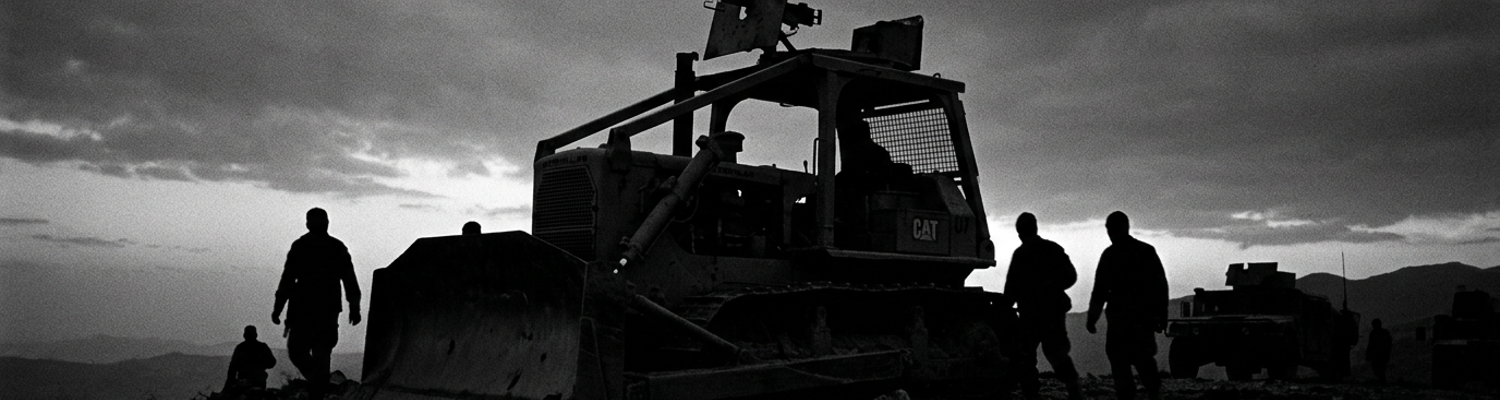
Archival evidence shows that heavy equipment mechanics from Support Company, 7th Engineer Battalion, initiated emergency weapons modifications inside the Area 64 motor yard on the morning of April 29. Lacking dedicated armored cavalry support or factory-built gun platforms, shop welders field-welded non-standard M60 machine gun pintle mounts directly onto earthmovers and bulldozers. Maintenance technicians cannibalized M4 pedestal mounts from damaged M151A2 utility trucks. The welders cut three-inch thick-wall carbon steel pipe into improvised vertical stanchions using oxyacetylene torches. Arc welders then fused these tubular stanchions onto the structural steel rollover protective structures and front engine cowlings of Caterpillar D7F crawlers and Michigan 290M tractor scrapers. Heavy vibration from the turbocharged diesel engines threatened to snap hastily laid bead welds. Crews reinforced the bases with triangular gusset plates cut from scrap grader blade edges. The improvised mount configurations allowed assistant operators or security riders to snap 7.62x51mm NATO M60 machine guns onto pintle pins. This provided three hundred sixty degrees of fire traverse directly over the twelve-foot bulldozer blades.
Civilian earthmovers were converted into armed assault platforms inside twenty-four hours.
A close review of operational logs indicates that six of these armed earthmovers deployed along the forward berms of Camp San Mateo and Camp Talega before sunset. Drivers operated the twenty-ton tracked vehicles along ridgeline perimeters. The drivers scraped continuous eight-foot anti-vehicle ditches while gunners kept loaded fifty-round assault belts locked into the M60 feed trays. The machines functioned as mobile pillboxes capable of flattening barbed wire entanglements, crushing natural cover, and screening access roads against potential vehicular infiltration from civilian approach points. Motor transport teams delivered thirty cases of linked 7.62mm ball ammunition directly to the heavy equipment motor park at Area 62. This sustained twenty-four-hour continuous perimeter sentry posts.
At 2330 on April 29, the third modified Caterpillar D7F rolled into Revetment Sector Charlie at coordinate 33 27 14 N, 117 32 42 W. The driver cut the diesel engine to monitor the highway boundary. A locked weapon pointed directly into the dark scrub.
Perimeter Security Wire and Commercial Floodlight Arrays
When examining the historical record from the dusk hours of April 29, 1975, the perimeter of Camp Talega required immediate structural containment. This prevented civilian disorientation in the pitch-black coastal canyons. Electricians from Support Company, 7th Engineer Battalion, climbed wooden utility poles along the perimeter road using steel climbing gaffs and safety harnesses. Battalion supply officers had stripped local commercial electrical wholesalers in Oceanside of their industrial stock. The supply officers hauled hundreds of 1,000-watt quartz-halogen lamp fixtures, heavy Romex conductor reels, and porcelain split-bolt taps directly to the camp boundaries. Marine wiremen tapped directly into raw 220-volt overhead base power lines. The wiremen stripped back heavy insulation with utility knives and torqued mechanical lug connectors with insulated wrenches while balancing on pole steps. Secondary branch circuits dropped down to wooden crossarms mounted ten feet up the poles. This fed electrical current into hastily installed four-gang breaker boxes. Work parties drove thousands of galvanized steel U-shaped engineer pickets into the rocky topsoil with twelve-pound sledgehammers. The Marines strung heavy miles of standard military triple-strand concertina razor wire along the newly cleared firebreaks.
Copper wire melted inside overloaded junction boxes before the first midnight watch ended.
Archival evidence shows that coastal salt fog rolled off the Pacific into Cristianitos Canyon by 0100 on April 30. The unsealed commercial splices were coated in corrosive moisture. Moisture penetration triggered continuous phase-to-ground electrical arcs across the tap points. Primary distribution fuses blew, plunging long perimeter sectors into total darkness. Combat engineers replaced blown ceramic cutout links using fiberglass hot-sticks while standing in the wet chaparral. Standard military generator trailers could not sustain the continuous amp draw of commercial floodlight arrays alongside medical refrigeration circuits. Battalion technicians ran bypass lines through fifty-amp residential circuit breakers salvaged from condemned base housing units. Below the floodlight towers, working parties uncoiled three tiers of 24-inch spring-steel concertina wire in standard combat configurations. Two baseline coils were pinned to the earth with screw pickets. These were crowned by a single top coil lashed tight with galvanized tie-wire. The razor-sharp steel barbs tore through leather work gloves and dungarees. Deep lacerations were inflicted on dozens of combat engineers as they pulled the coils taut across five linear miles of broken canyon rim.
Disoriented civilians risked stumbling into live impact zones bordering the unpaved boundary lines.
A close review of operational logs indicates that Camp San Mateo and Camp Talega sat directly adjacent to Range 130 and the Delta live-fire artillery impact areas. Marine artillery batteries and infantry rifle companies maintained active firing schedules across these sectors. High-explosive 105mm shells and 7.62mm machine gun rounds were fired into designated target draws less than twelve hundred yards from the civilian cantonments. Vietnamese evacuees spoke no English and could not read military red danger placards. They frequently attempted to hike out of the dust-choked tent rows at dawn to find dry firewood or gather edible vegetation in the draws. Captain R.M. Higgins and engineering planners from the 1st Marine Division determined that standard open boundaries invited disaster. Combat engineers deployed Caterpillar D7F bulldozers to push continuous seven-foot dirt revetments along the western and southern edges of the camp. This blocked direct access to the steep drainage arroyos leading down-range. Crews anchored eight-foot heavy timber posts into concrete-filled postholes. The engineers strung double layers of cyclone chain-link fencing intertwined with low-visibility concertina coils along the base to seal every natural foot trail heading toward the impact fan.
Field construction logs from Area 62 demonstrate that engineers built geometric channelization funnels at every camp perimeter exit. Salvaged exterior-grade plywood sheets painted bright yellow and framed with four-by-four Douglas fir posts were used. Working parties formed three-hundred-foot walking corridors that physically forced all civilian pedestrian traffic toward illuminated provost marshal checkpoints and central intake quads. Sentry posts were placed every seventy-five yards along the funnels. These were illuminated by overhead floodlights wired into auxiliary five-kilowatt military diesel generators to guarantee zero dark gaps. The funnels terminated in physical timber chicanes. These prevented sudden civilian surges onto the live firing range access roads while leaving clear openings for military ambulances and water supply tankers.
At 0515 on May 1, the 7th Engineer Battalion completed the final barrier segment at coordinate 33 26 12 N, 117 31 05 W. The last chain-link gate across the northern gully trail was locked with a hardened steel padlock.