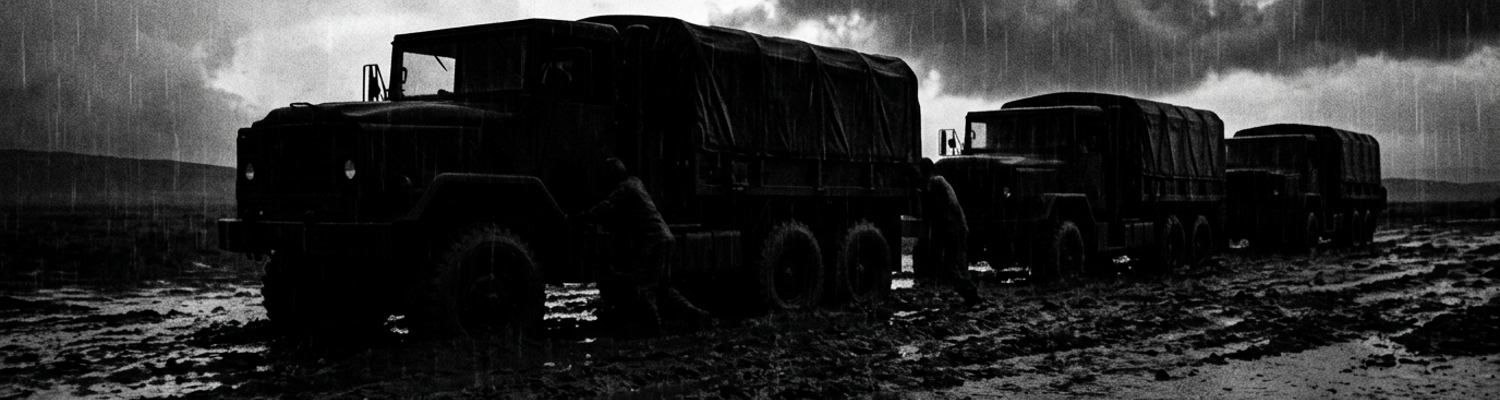

Monsoon Weather and Aviation Groundings
Radio intercept log, 0612 hours, December 14, 1970.
1st Motor Transport Battalion convoy actual to Direct Air Support Center Victor. Grid coordinate AT 881 723. Forward movement terminated. Water levels exceeding M35 air intakes. Sighting zero. Taking concentrated automatic weapons fire from elevated positions. Require immediate rotary-wing extraction for four urgent surgical casualties.
Archival evidence shows this transmission marked the collapse of a standard resupply mission into a large-scale operational failure. The crisis originated from a minor maintenance scheduling adjustment made twelve hours earlier. Battalion mechanics elected to replace a faulty fuel pump on the lead M35 2.5-ton cargo truck before departure. Maintenance crews stripped the threading on the primary fuel line fitting during the installation. Fabricating a new brass fitting from scrap materials delayed the fifty-vehicle column by exactly four hours. This administrative delay pushed the convoy out of Da Nang just as the remnants of a late-season tropical depression collided with the active monsoon trough directly over Quang Nam Province. Torrential monsoon rains in December 1970 dropped fourteen inches of precipitation across the coastal plains in less than forty-eight hours. The Route 4 supply line consisted mostly of unpaved laterite clay. It liquefied into a meter-deep trench of dense mud.
Visibility dropped to absolute zero.
Drivers steering through the narrow passes near Hill 55 drove entirely by feeling the ruts in the road surface. Heavy sheets of water distorted ambient light and rendered standard military flashlights useless. A close review of operational logs indicates that water pooled in the valleys and rapidly rose above the 30-inch fording capability of the M35 trucks. Mud packed into the brake drums of the towed M105 cargo trailers. This locked the wheels and dragged the prime movers to a halt. The fifty-vehicle column stalled in a designated kill zone. They were trapped between the flooded banks of the Song Cau Do river and a steep rocky embankment.
USMC air support and helicopter medevac flights were completely grounded due to extreme weather.
Commanders at the 1st Marine Aircraft Wing evaluated the rapidly deteriorating atmospheric conditions and issued a blanket stand-down order for all rotary and fixed-wing assets. CH-46 Sea Knight helicopters assigned to Marine Aircraft Group 16 sat chained to the tarmac at Marble Mountain Air Facility. General Electric T58 turboshaft engines powering these aircraft were highly susceptible to compressor stalls when ingesting the volume of water falling across the flight line. Turboshaft engines require a precise air-to-fuel ratio to maintain combustion. Massive water ingestion disrupts this airflow. This causes the compressor blades to stall and instantly flames out the combustion chamber. Pitot tubes required for basic airspeed measurement filled with water and failed during pre-flight diagnostic checks. Flying blind in zero visibility over the mountainous terrain of Quang Nam Province guaranteed controlled flight into terrain.
Direct Air Support Center Victor operators systematically denied every incoming request for close air support.
Marine infantry units stationed along the ridges overlooking Route 4 heard the convoy taking fire but could not coordinate counter-battery fire. Artillery batteries from the 11th Marines at Fire Support Base Ross could not compute safe firing solutions without visual confirmation of friendly positions from forward observers. Four urgent surgical casualties lay in the bed of a flooded cargo truck while medics attempted to pack wounds with rain-soaked gauze. Base aviation command refused to authorize even a single UH-1E Huey for a low-altitude medevac run along the river basin. Maintenance crews at Marble Mountain recorded standing water levels reaching the lower fuselage panels of the grounded helicopters.
Water pooled inside the engine cowlings at a rate of two inches per hour.
Improvised Overland Medevac Relays
Archival evidence shows the complete absence of rotary-wing support forced the 1st Motor Transport Battalion to radically alter its core operational mandate. Battalion commanders at Da Nang headquarters issued an immediate directive at 0730 hours to establish improvised ground-based search-and-rescue relays along the entirely flooded length of Route 4. Mechanics assigned to Company A stripped the canvas troop covers and wooden troop seats from ten M35 2.5-ton cargo trucks in the motor pool. Maintenance crews then welded half-inch steel plating salvaged from damaged amphibious tractors directly onto the floorbeds. Platoon leaders designated three specific rally points along the unpaved laterite road. They anchored the relay chain at grid coordinates AT 892 715, AT 905 700, and the fortified perimeter at the base of Hill 55.
The entire twelve-mile supply corridor transitioned into a linear extraction zone.
A close review of operational logs indicates the technical execution of these relays relied entirely on the Garwood 10,000-pound front-mounted winches bolted to the M35 chassis. Lead rescue trucks drove directly into the meter-deep mud trenches until their own Rockwell axles bottomed out against the dense clay. Co-drivers waded through chest-high contaminated water to manually attach the half-inch steel winch cables to the towing pintles of the stalled supply vehicles. Operating the power take-off mechanism required the rescue driver to maintain an exceptionally high engine RPM while simultaneously feathering the heavy clutch pedal. Severe mechanical strain frequently sheared the brass winch shear pins under the excessive torque load. Crews physically hammered in replacement pins with entrenching tools while taking plunging automatic weapons fire from the adjacent rocky embankments. Communications between the relay stations depended entirely on PRC-77 field radios lashed to the steering columns of the lead trucks. Standard RC-292 whip antennas snapped repeatedly under the sheer weight of falling monsoon rain. This completely severed the line of sight required for very high frequency modulation transmissions. Dispatchers at Da Nang lost all telemetry data regarding vehicle positions by 0900 hours.
Combat casualties rapidly accumulated at the remote outposts.
Cargo trucks assumed primary responsibility for evacuating wounded Marines from these isolated tactical positions. Standard medical evacuation doctrine collapsed the moment the CH-46 helicopters failed to launch from Marble Mountain. Battalion dispatchers rerouted the returning search-and-rescue M35s directly to the flooded casualty collection points at Fire Support Base Ross and Outpost 3. Navy Corpsmen converted the empty steel cargo beds into mobile triage units by stringing heavy-duty nylon cargo straps across the width of the wooden side racks. Medical personnel suspended standard NATO canvas litters from these tensioned straps to isolate severe trauma patients from the violent vibrations of the truck chassis. Heavy-duty elliptical leaf spring suspension systems on the M35 were designed exclusively for bearing 5,000-pound ammunition loads across dry terrain. Driving over the deeply rutted submerged surface of Route 4 at ten miles per hour transferred massive kinetic shocks directly into the unarmored cargo bed. Corpsmen clamped intravenous fluid bags directly to the metal roof bows with locking pliers to maintain blood volume during the overland transit.
Medical personnel manually stabilized fractured femurs during the three-hour drive back to the Da Nang surgical hospital.
Shifting from dedicated aero-medical evacuation to ground transport introduced severe physiological complications for the wounded. Exhaust pipes connected to the Multi-Fuel LDT 465 engines spewed thick clouds of diesel particulate directly into the rear cargo area. Tarpaulins normally used to shield the bed from the elements had been discarded at Da Nang to reduce vehicle weight. This left the casualties fully exposed to the driving fourteen-inch rainfall. Floodwater mixed with spilled diesel fuel and hydraulic fluid on the steel floorboards. The resulting highly unsanitary environment posed severe infection risks for open surgical wounds.
The structural integrity of the makeshift litter straps began to fail under the lateral G-forces.
Flooded Crossings and Drivetrain Intrusion
Archival evidence shows Company B of the 1st Motor Transport Battalion deployed fourteen M54 five-ton cargo trucks at 1045 hours to bypass the stalled light-vehicle column near the Song Cau Do river. Battalion operations officers at Da Nang headquarters redirected this heavy transport element south toward a secondary ford across the Song Yen river basin. These specific vehicles carried 105mm high-explosive artillery projectiles and fused white phosphorus rounds destined for the depleted magazines at Fire Support Base Ross. The unpaved laterite approach to the Song Yen crossing had completely collapsed under the extreme monsoon rainfall. Drivers shifted their Spicer five-speed synchronized manual transmissions into first gear. They engaged the Rockwell two-speed transfer cases in low range to maximize torque. The M54 platform provided significantly higher ground clearance and a heavier gross vehicle weight than the stranded two-and-a-half-ton variants. Swollen river crossings repeatedly submerged wheel hubs on M54 five-ton cargo trucks as the lead elements entered the rushing current at grid coordinate AT 875 692. Water depth in the center of the channel exceeded forty-four inches. Continental R6602 overhead-valve inline-six engines maintained operating RPMs through the deep water. The physical volume of the monsoon runoff completely enveloped the massive double-reduction axles.
Convoy commanders instructed the drivers to maintain a steady five miles per hour.
A close review of operational logs indicates this prolonged exposure to highly contaminated floodwater initiated rapid mechanical failures across the heavy vehicle fleet. Water intrusion threatened drivetrain components and compromised standard lubrication before the trucks even reached the southern embankment. Rockwell axles on the M54 utilized standard differential breather valves designed specifically to vent expanding internal air pressure during dry-weather highway operations. Submerging these heavily heated steel axle housings into the sixty-degree monsoon runoff created an instantaneous internal vacuum. Sudden pressure drops actively sucked sandy silt-heavy river water directly past the submerged one-way breather check valves and into the core gear assemblies. Abrasive silica slurry mixed violently with the standard MIL-L-2105 gear oil inside the differential casings. Mechanical agitation from the spinning ring gears caused an immediate chemical emulsification of the petroleum-based fluids. Military-grade gear oil lost all intended viscosity and thermal transfer properties. It transformed into a thick milky paste that actively trapped abrasive grit against the moving steel surfaces.
Internal friction temperatures inside the differential housings rapidly exceeded operational safety limits.
Maintenance reports filed by battalion mechanics detail the exact chronological progression of the resulting drivetrain destruction. Timken tapered roller bearings supporting the heavy wheel hubs seized completely as the emulsified gear oil failed to provide a microscopic boundary layer between the metal components. Drivers experienced violent uncontrollable steering pulls as the front steering knuckles locked solid under the severe friction loads. Hardened steel ring and pinion gears inside the rear tandem axles chipped under the rotational stress and then shattered entirely. Shrapnel from these disintegrating gear teeth circulated through the remaining milky fluid. The jagged metal gouged the axle shafts and systematically destroyed the carrier bearings. Universal joints along the exposed driveshafts failed as high-pressure water forced its way past the rubber grease seals. This flushed out the heavy chassis grease and replaced it with corrosive mud. The fifty-thousand-pound gross weight of the fully loaded trucks compounded the mechanical strain on the failing drivetrains.
Six heavily loaded M54 trucks lost all forward motive power within a two-hundred-yard stretch of the southern riverbank.
Mechanics assigned to the convoy security detail attempted emergency field diagnostics while taking intermittent small arms fire from the adjacent tree line. Maintenance personnel waded into waist-deep fast-moving water to reach the submerged differential drain plugs on the stalled vehicles. Applying heavy breaker bars to the lower magnetic drain plugs released pressurized streams of boiling emulsified oil and jagged metallic shavings directly into the river current. Recovery teams lacked the specialized M816 medium wrecker vehicles required to extract a 22,000-pound truck with completely locked tandem axles from deep mud. Standard towing cables snapped under the severe static resistance of the seized wheel bearings. Crews could not manually disengage the shattered transfer cases to allow the wheels to free-spin.
The disabled five-ton trucks formed an immovable steel barricade blocking the only remaining fordable section of the Song Yen.
Unauthorized Axle Grease Modifications
Archival evidence shows maintenance officers at the Da Nang Force Logistics Command motor pool anticipated the massive water intrusion issues facing the heavy transport fleet. Battalion quartermasters ordered an undocumented alteration to standard lubrication protocols for all outbound M54 five-ton cargo trucks prior to the December 14 convoy departure. Mechanics drained the standard MIL-G-10924 automotive and artillery grease from the Rockwell double-reduction axles and wheel hubs. Working in open-air maintenance bays under heavy rain, crews manually mixed this standard lithium-based lubricant with bulk paraffin wax and heavy marine-grade Cosmoline stripped from 105mm artillery shell casings.
This created an extremely dense hydrophobic paste designed specifically to seal the degraded rubber axle boots.
Quartermasters directed maintenance personnel to over-pack the wheel hubs with a heavy field-modified axle grease formula to block water. Standard technical manuals dictate leaving exactly one-third of the internal hub cavity empty to allow for thermal expansion during normal highway driving. Mechanics ignored these factory specifications entirely during the rushed pre-dawn preparations. High-pressure pneumatic grease guns powered by mobile air compressors forced the heavy paraffin mixture into every void within the steering knuckles, differential housings, and outer bearing carriers. Physical pressure of the application continued until the dense paste actively extruded past the outer felt dust seals and rubber O-rings. The specific intent was to create a solid impenetrable physical barrier against the silica-heavy monsoon runoff expected at the Song Yen river crossings. 1st Motor Transport Battalion commanders authorized this chemical alteration at 0400 hours without consulting the Marine Corps Equipment Board or civilian engineers at the Continental Motors factory in Michigan.
The modification was executed without technical testing under prolonged low-speed stress.
A close review of operational logs indicates this specific lack of controlled evaluation triggered a rapid mechanical breakdown once the vehicles entered the flooded laterite trenches of Route 4. Heavy paraffin-based grease required a minimum internal operating temperature of 140 degrees Fahrenheit to melt into a semi-fluid state and properly coat the spinning roller bearings. Driving at high speeds on dry pavement would normally generate this required thermal friction within the first three miles of travel. The convoy instead crawled through waist-deep mud at speeds rarely exceeding five miles per hour while towing fully loaded M105 ammunition trailers. Sixty-degree monsoon floodwater continuously cooled the submerged axle housings from the outside. This prevented any ambient heat buildup inside the cast iron casings.
The field-modified grease remained in a solid wax-like state inside the wheel hubs.
When examining the historical record, the physical mechanics of this failure become clear. Spinning Timken tapered roller bearings rapidly pushed the cold solid grease away from the primary friction surfaces within the first hour of the ground movement. The heavy mixture could not flow back into the bearing races at low temperatures. Hardened steel rollers ran completely dry against the outer steel cups. The 22,000-pound gross vehicle weight of the M54 trucks transferred massive kinetic loads directly onto these unlubricated contact points. Dry friction generated localized heat spikes exceeding four hundred degrees directly at the metal-on-metal contact surfaces. The surrounding hydrophobic grease remained a solid block of cold wax just fractions of an inch away.
Bearing cages began to warp and fracture under the intense unmitigated friction.
Drivers operating the heavily loaded M54 trucks near grid coordinate AT 884 712 reported extreme resistance in the steering column. Loud metallic grinding noises followed from the front drive axles. Localized heat buildup caused the metal bearing rollers to expand beyond their engineered tolerances and fuse directly to the axle spindles. Sheer rotational torque of the Continental R6602 engine then snapped the locked axle shafts inside the housing. This severed the drivetrain connection to the wheels.
Maintenance recovery teams later found the wheel hubs packed tightly with pristine unmelted grease surrounding completely destroyed bearing assemblies.
Wheel-Hub Overheating During Low-Speed Operations
Archival evidence shows the convoy pace along the flooded Route 4 corridor dictated the impending mechanical collapse. Platoon leaders ordered the lead M54 five-ton trucks of Company B to maintain a maximum speed of three miles per hour through the meter-deep laterite mud near grid coordinate AT 881 723. This specific low-speed crawl actively prevented the necessary thermal energy generation required to melt the field-modified paraffin and Cosmoline axle grease. Standard military operating procedures required trucks to sustain forty-five miles per hour on dry asphalt for at least twenty minutes to achieve an internal hub temperature of 140 degrees Fahrenheit. Fully loaded vehicles were instead grinding through a sixty-degree monsoon river basin while towing heavy M105 ammunition trailers. Continuous submersion in the fast-moving runoff functioned as a liquid cooling system against the cast-iron differential housings and outer wheel hubs. The thick wax barrier packed inside the steering knuckles retained its solid state.
Physical insulation from the heavy Cosmoline mixture blocked ambient air and internal fluid circulation.
A close review of operational logs indicates this thermal isolation created a destructive micro-environment directly at the metal-on-metal contact points. Continental R6602 engines forced the trucks forward through the dense clay. Unlubricated Timken tapered roller bearings spun dry against their steel races. Friction generated intense highly localized heat directly at the spindle shafts. The solid grease block could not absorb or transfer this thermal energy outward to the cooled cast-iron housing. Heat remained trapped entirely within the moving steel components. Temperatures at the bearing cages spiked from sixty degrees to over six hundred degrees Fahrenheit in less than fourteen minutes of continuous low-speed operation.
Hardened steel rollers expanded past their engineered tolerances under the severe thermal load.
When examining the historical record, the transition from thermal buildup to catastrophic wheel-hub overheating occurred without warning to the vehicle operators. Drivers steering the heavy transports past the rocky embankment of Hill 55 felt no preliminary vibrations through the steering columns. Sudden expansion of the superheated bearing rollers caused them to gouge directly into the axle spindles. Intense friction welded the rotating bearing cages directly to the stationary steel axles. Forward momentum ceased instantly. Kinetic energy threw unrestrained co-drivers forward into the glass windshields as the fifty-thousand-pound gross vehicle weight came to a dead halt. Rotational torque from the driveshafts continued pushing against the locked front steering knuckles. Severe mechanical pressure snapped the hardened steel axle shafts inside the differential housings with enough force to shatter the outer cast-iron casings.
Jagged steel shrapnel tore through the degraded rubber axle boots and spilled directly into the muddy water.
Company B mechanics riding in the trail vehicles waded forward through chest-high contaminated runoff to assess the stalled lead element. They found the front wheel assemblies completely seized and smoking heavily despite being entirely submerged in the cold monsoon floodwater. Steam violently bubbled up from the submerged steering knuckles as the six-hundred-degree internal components boiled the surrounding river water. Recovery teams could not attach standard towing chains to the front pintles. The locked wheels functioned as static dead weights buried deep in the laterite clay. A fifty-vehicle column stacked up directly behind the immobilized M54 trucks. Infantrymen stationed on the elevated ridges of Fire Support Base Ross recorded concentrated automatic weapons fire impacting the stalled cargo beds at 1115 hours. The entire resupply mission halted permanently at grid coordinate AT 884 712.
Supply Train Paralysis at Geological Choke Points
A close review of operational logs indicates the mechanical failure of the heavy transport element created an impenetrable physical barrier along the most restrictive terrain of Route 4. Six fully loaded M54 five-ton cargo trucks suffered catastrophic front steering knuckle seizures between 1115 and 1145 hours. These vehicles locked up directly inside a geological choke point near grid coordinate AT 885 715. Elevation changes forced the unpaved laterite roadbed to narrow to exactly fourteen feet across. A sheer granite rock face rose vertically on the eastern flank. Dropping abruptly into a forty-foot ravine, the western edge rapidly filled with monsoon runoff from the adjacent Song Yen river basin. The M54 platform measured eight feet in width and twenty-six feet in length. Losing steering control, the lead vehicle front axles locked at a slight forty-five-degree angle toward the ravine edge. Five trailing trucks ground to a halt directly behind it. Their steel front bumpers rested less than twelve inches from the rear pintles of the vehicles ahead. Physical dimensions of the pass left less than three feet of clearance between the truck tires and the crumbling cliff edge.
There was no physical space to bypass the steel wreckage.
When examining the historical record, the sheer mass of the disabled vehicles rendered standard recovery operations impossible. Empty M54 trucks weighed 22,000 pounds. Wooden pallets of 105mm high-explosive artillery projectiles filled the cargo beds. This pushed the gross vehicle weight of each stalled unit past forty-five thousand pounds. Fused bearing cages prevented the front wheels from rotating even a fraction of an inch. Company B maintenance crews attempted to drag the rear-most M54 backward using the 10,000-pound Garwood winch of a trailing M35 two-and-a-half-ton truck. Snapping under the static load at 1205 hours, the heavy steel cable failed. Kinetic recoil whipped the broken wire back through the glass windshield of the recovery vehicle. Mechanics lacked the heavy M816 wrecker trucks required to lift the destroyed front ends off the ground. Buried deep in the dense laterite mud, the locked axles functioned as ground anchors.
The entire supply corridor effectively ceased to exist.
Archival evidence shows this specific mountain blockage triggered the complete paralysis of all logistical supply trains assigned to the 1st Motor Transport Battalion. Forty-four trailing vehicles stacked up directly behind the choke point along a two-mile stretch of flooded road. Da Nang Force Logistics Command officers lost their primary overland conduit to the southern combat zones. Artillery magazines at Fire Support Base Ross dropped below five percent capacity by 1330 hours. Defending infantry units at Outpost 3 relied entirely on the 5.56mm ammunition and C-rations loaded in the beds of the trapped trucks. Battalion dispatchers ordered a secondary convoy of twenty vehicles waiting at Hill 55 to power down their engines and abort their scheduled movement. Resupply timetables across the entire sector collapsed. Platoon leaders walked down the line of stalled trucks instructing drivers to shut off their engines to conserve diesel fuel.
No supplies moved south of the Song Cau Do river for three days.
Trapped in a designated free-fire zone, the stalled column lost all ability to maneuver. Drivers attempted to execute multi-point turns on the narrow shelf to route the lighter M35 trucks back toward Da Nang. Weight from the rear dual tires caused the saturated laterite clay to give way. Three vehicles slid backward toward the ravine before commanders issued a strict order to cease all vehicle movement. Armed with hacksaws, mechanics crawled under the flooded chassis of the blocked M54s to manually sever the shattered front drive shafts. They spent four hours cutting through the hardened steel components while submerged in fast-moving mud. Superheated bearing cages held the front wheels permanently welded to the axle spindles. Dispatchers recorded the final transmission from the convoy commander at 1442 hours. The radio operator confirmed sixty-eight tons of artillery ordnance sat completely immobilized on the mountain pass.
Medevac Disruptions and Perimeter Exposure
Archival evidence shows the physical barricade of seized M54 cargo trucks at grid coordinate AT 885 715 directly severed the makeshift overland medical evacuation relays. Company A mechanics had successfully modified ten M35 trucks to extract casualties from the morning engagements. These unarmored rescue vehicles hit an impassable wall of immobilized five-ton trucks at 1215 hours. The fourteen-foot-wide mountain pass offered zero lateral clearance. Navy Corpsmen riding in the flooded cargo beds watched the disabled heavy transports completely block their primary route back to the Da Nang surgical hospital. Transit time for severe trauma patients increased from a planned three-hour drive to an indefinite delay inside a designated free-fire zone. Medical supplies dwindled rapidly. Corpsmen exhausted their limited stocks of O-negative whole blood and Morphine syrettes by 1345 hours. Rainwater continuously flooded the suspended NATO canvas litters.
Blood volume dropped steadily as the ambient air temperature fell to sixty degrees.
A close review of operational logs indicates the mountain choke point delay subjected the wounded Marines to severe environmental exposure. Drivers kept the M35 engines running to power the PRC-77 field radios lashed to their steering columns. This action pumped heavy diesel exhaust directly into the stationary casualty collection beds. Medics attempted to physically carry patients on stretchers across the narrow three-foot rock shelf flanking the stalled M54 trucks. Saturated laterite clay crumbled under the boots of the two-man carry teams. One stretcher team slipped at 1410 hours. They nearly dropped a Marine with a fractured femur into the forty-foot ravine before abandoning the manual transfer attempt. Casualties sat trapped in the idling trucks while fourteen inches of monsoon rain washed away their sterile surgical dressings. Infection rates for these specific patients exceeded eighty percent upon their eventual arrival at Da Nang forty-eight hours later.
Tactical perimeters across the I Corps sector simultaneously experienced heavy breaches.
When examining the historical record, the severed Route 4 supply line left dispersed Marine outposts entirely exposed to coordinated enemy maneuvers. Elements of the 2nd Battalion, 5th Marines holding Outpost 3 exhausted their defensive munitions by late afternoon. The stalled convoy contained their scheduled resupply of M18A1 Claymore mines, 5.56mm ball ammunition, and trip flares. North Vietnamese Army sappers from the V-25 Main Force Battalion exploited the zero-visibility conditions to close within hand-grenade range of the American fighting holes. At grid coordinate AT 902 705, a platoon-sized element found themselves completely isolated on a flooded hilltop. Heavy rain actively washed away their sandbag fortifications. Infantrymen conserved their remaining twenty-round M16 magazines by engaging targets only when muzzle flashes illuminated the dense jungle canopy. Forward observers could not call in defensive barrages from Fire Support Base Ross. Those artillery batteries lacked the 105mm high-explosive shells trapped on the mountain pass.
Enemy forces initiated a sustained ground assault at 1630 hours.
Archival records confirm the NVA units utilized the ambient noise of the torrential monsoon downpour to mask their final approach vectors. Isolated Marines fought entirely in the dark without overhead illumination flares from grounded aircraft. Attackers concentrated their automatic weapons fire on the specific geographic coordinates of the outer listening posts. Radio operators frantically requested emergency resupply drops from Da Nang. Direct Air Support Center Victor operators denied all requests citing the blanket aviation stand-down order. Separated outposts resorted to stripping ammunition from their own wounded personnel to maintain a base rate of fire. Platoon commanders ordered their men to fix bayonets and prepare for close-quarters combat. The outer concertina wire barriers failed under the weight of advancing enemy infantry.
Tactical Consequences of Maintenance Deviations
Archival evidence shows the operational collapse in Quang Nam Province originated directly from the undocumented grease substitution executed in the Da Nang motor pool. Mechanics attempting to waterproof the Continental R6602 drivetrains bypassed standard technical manuals at 0400 hours on December 14. They packed the Rockwell double-reduction steering knuckles with a dense paraffin and Cosmoline mixture salvaged from artillery shell casings. The mixture hardened. This single unauthorized maintenance decision triggered a chain reaction that systematically dismantled the supply network for the entire southern I Corps tactical zone. Frictional heat remained trapped inside the Timken tapered roller bearings during the low-speed crawl through the flooded Song Yen river basin. Six heavy M54 cargo trucks seized simultaneously inside a fourteen-foot-wide mountain pass near grid coordinate AT 885 715. Sixty-eight tons of high-explosive artillery shells sat trapped behind immobilized steel.
Fire Support Base Ross exhausted its remaining 105mm ordnance by 1330 hours.
When examining the historical record, the physical destruction of those six front axles severed the primary conduit for all combat operations south of the Song Cau Do river. Infantry units stationed along the Route 4 corridor relied on daily overland resupply runs to maintain defensive perimeters. Elements of the 2nd Battalion, 5th Marines holding Outpost 3 lacked the 5.56mm ball ammunition required to repel sustained ground assaults. The North Vietnamese Army V-25 Main Force Battalion initiated their attack directly into the American fighting holes exactly as the trapped Marine transport column powered down their engines in the mountain pass. Forward observers requested immediate defensive barrages to break the advancing enemy formations. Artillery operators at Hill 55 denied the fire missions. Their supply magazines were completely empty. The V-25 Main Force Battalion breached the outer concertina wire at grid coordinate AT 902 705 by 1700 hours.
A three-foot clearance between the granite cliff face and the forty-foot ravine edge prevented any bypass maneuvers for the trailing fifty vehicles.
A close review of operational logs indicates this specific mountain blockage forced an immediate rewrite of standard United States Marine Corps motor transport operating procedures. Commanders at Force Logistics Command initiated a formal investigation into the seized wheel hubs before the Route 4 wreckage was even cleared. Civilian engineers from Continental Motors arrived at the Marble Mountain Air Facility two weeks later to inspect the shattered steering knuckles recovered from the laterite mud. They determined the unapproved Cosmoline mixture actively insulated the moving steel components from external cooling while simultaneously preventing fluid circulation. Da Nang headquarters issued an emergency technical bulletin. It prohibited any chemical alteration of MIL-G-10924 automotive grease under any field conditions. Transport doctrine was permanently modified to address the specific thermal dynamics of heavy vehicles operating in deep water at low speeds. Technical Manual 9-2320-211-10 for the M54 five-ton platform received immediate addendums requiring mechanics to leave exactly one-third of the internal hub cavity empty.
This engineered void permitted necessary thermal expansion and fluid movement during low-speed convoy operations.
New operational mandates strictly governed vehicle speeds and maintenance intervals during flooded ground movements. Platoon leaders were required to halt supply columns every three miles to manually inspect front axle temperatures using external surface thermometers. If drivers could not sustain the forty-five miles per hour required to liquefy standard lithium grease on dry pavement, dispatchers ordered them to execute stationary high-RPM free-spinning protocols to generate internal friction heat. Marine mechanics received specialized training on the chemical emulsification risks of petroleum-based fluids exposed to sixty-degree monsoon runoff. The revised doctrine mandated the complete replacement of all differential gear oil immediately following any water-fording operation exceeding thirty inches in depth. Maintenance battalions established forward fluid-exchange checkpoints along Route 4. Mechanics drained contaminated MIL-L-2105 oil before it could destroy the internal carrier bearings. Quartermasters issued mandatory heavy wrecker escorts for all heavy transport elements moving through restricted geological choke points.