
An Impossible Directive
The air over Luzon in early 1945 was a physical presence. It was a thick, wet blanket of heat that alternated with chilling, torrential rains, turning the volcanic soil into a slurry that could swallow a boot or a man's morale with equal indifference. This was the environment into which the 158th Regimental Combat Team was thrown, an arena where the ground underfoot was as much an enemy as the entrenched Japanese forces they were sent to destroy.
Operational logs from Sixth Army reveal the cold calculus of their deployment. The 158th Regimental Combat Team, the Bushmasters, landed at Lingayen Gulf on January 11, 1945. This unit, composed heavily of Mexican-American and Native American soldiers from Arizona and trained extensively in the jungles of Panama, was a seasoned force. Nothing could fully prepare them for the task ahead. Initially attached to the 43rd Division, they were thrust into the advance south toward Manila. Their immediate objective was to secure the road junction connecting Routes 3 and 11 near Damortis and Rosario. It was here, just six miles from the headquarters of General Tomoyuki Yamashita, that the unit was savaged by a massive, well-coordinated artillery barrage that earned the day the grim moniker Bloody Sunday.
Following this engagement and subsequent hard fighting, the battered but intact RCT was detached from the 11th Airborne Division. They received a new, seemingly impossible directive from General Walter Krueger's Sixth Army headquarters.
The order was absolute.
Sixth Army command mandated the construction of a comprehensive defensive line within 36 hours. This was a rigid timetable imposed upon a unit already depleted by continuous combat and operating at the extreme end of a strained supply chain. Archival evidence (Record Group 407, Army Adjutant General) shows that the concept of digging in was fundamentally at odds with the tools and condition of the men. Entrenching tools were scarce, and those on hand were often worn or broken. The volcanic soil of Luzon was punishing, and the physical state of the soldiers, weary from weeks of fighting and plagued by tropical ailments, made the large-scale engineering feat a near-physical impossibility. The order, issued from a strategic map far from the front, failed to account for the mechanical and human exhaustion that defined the ground-level situation.
This hastily ordered defensive line was meant to protect the approaches to the main Allied axis of advance, a corridor known as the Shori Line. The tactical centerpiece of this entire problem was a single, nondescript ridge. Geographically, it was one of many, but its position gave it an outsized importance. It dominated the low ground, offering any force that held it a commanding field of fire over the most likely avenues of a Japanese armored or infantry assault. From its crest, artillery spotters could direct fire with pinpoint accuracy onto American supply routes and assembly areas. Losing this ridge would not just be a tactical setback; it would compromise the integrity of the entire forward line. The 36-hour timeline was a desperate race to fortify this specific piece of high ground before its value was recognized and exploited by the enemy.
The Failure of Fortification
The 36-hour mandate was an exercise in fantasy. A review of operational logs for the 158th RCT reveals a unit hollowed out by attrition and mechanically exhausted before the first shovelful of dirt could be turned. The core of any rapid field fortification effort, the combat engineer company, was effectively a shell. A standard Regimental Combat Team in 1945 would have an attached engineer component equipped with D-7 bulldozers, graders, and sufficient blasting materials to carve tank ditches and deep weapon emplacements. The engineers available to the 158th, however, had been bled white by continuous operations since the Lingayen Gulf landing. Equipment rosters show their heavy machinery was largely non-operational. Engines were fouled by volcanic dust, hydraulic systems had failed, and spare parts were a low-priority item somewhere far down the supply chain. The directive from Sixth Army presupposed a robust engineering capacity that did not exist on the front line, forcing the burden of large-scale earthmoving onto infantrymen equipped with little more than hand-held E-tools.
This was not a job for shovels.
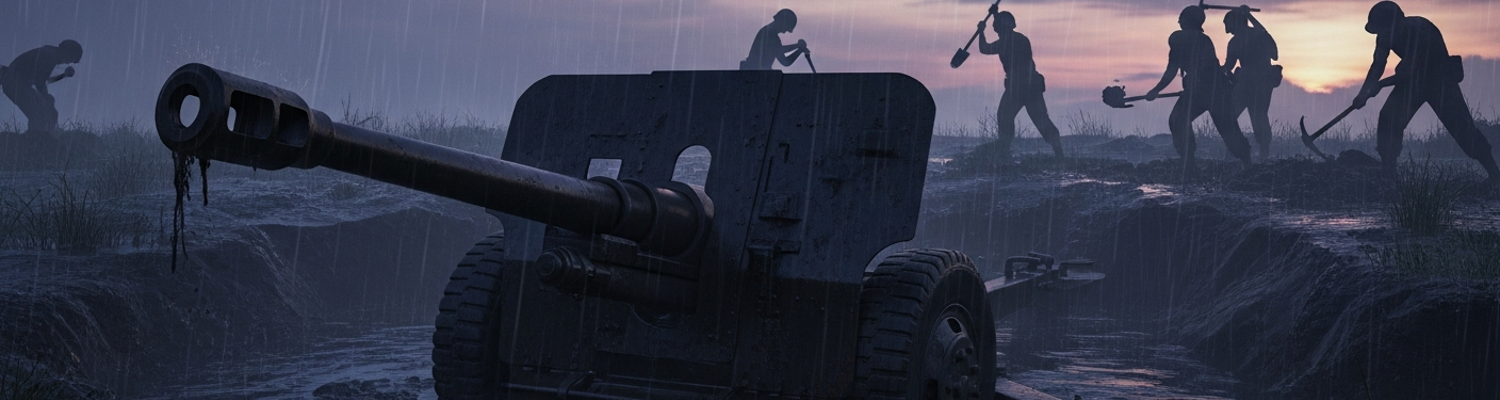
The infantrymen were asked to construct, by hand, what heavy machinery was designed to do. The very ground resisted them, a mix of rock-hard sun-baked earth and slick, grasping mud. The result was a series of shallow scrapes in the ground, not a cohesive defensive line.
Compounding the construction deficit was a severe shortage of adequate anti-tank weaponry. The primary threat was an armored counterattack by Japanese tank units. While Japanese armor was generally thinly protected compared to German counterparts, a Type 97 Chi-Ha or Type 95 Ha-Go tank was a formidable psychological and physical weapon against infantry. The standard-issue M9 Bazooka rocket launcher could penetrate these tanks at close range, but required the operator to expose himself to direct fire. The more effective weapon was the towed 37mm M3 anti-tank gun. While largely obsolete in Europe, it remained effective against all models of Japanese tanks. The problem was one of scarcity. The 158th’s anti-tank company was understrength, having lost guns and crews in the fighting around Damortis and Rosario. There were not enough of these cannons to cover all likely avenues of approach to the ridge, forcing commanders into an operational triage. Entire sectors were protected only by riflemen and the hope that a bazooka team would be in the right place at the right time.
The absence of engineering assets directly impacted the effectiveness of the few anti-tank guns they did possess. A properly emplaced 37mm gun required a dug-in position offering both cover and a clear field of fire. Without bulldozers to excavate gun pits, crews were forced to set up in hastily prepared, exposed positions. This left the guns and their crews highly vulnerable. A Japanese tank, spotting the exposed American gun, could easily eliminate it with its own main cannon before the 37mm crew could get off more than a single shot. The 36-hour time limit made it impossible for the infantry to dig the deep, protected emplacements that could have made a difference.
Existence Under Barrage
The Japanese response to the 158th’s tenuous hold on the ridge was not a single, grand assault but a methodical, grinding application of firepower. After-action reports indicate the use of well-concealed Type 41 75mm mountain guns and Type 92 70mm infantry guns, weapons perfectly suited for the terrain. These were not employed in massed, preparatory bombardments but in a campaign of incessant, harassing fire. The shelling was deliberately erratic, timed to disrupt meals, prevent sleep, and terrorize repair parties. A single round might land at noon, followed by a dozen in the middle of the night, then silence for hours, cultivating a paralyzing uncertainty. For the men in their shallow scrapes, each incoming whistle was a fresh referendum on their survival, ending in a violent eruption of soil and hot metal. The exposed positions of the 37mm anti-tank guns made them priority targets, their crews suffering disproportionately.
This was warfare by extermination schedule.
The physical structure of the defense was in a state of constant collapse. The ground itself was an active participant in the assault. During torrential downpours, the walls of foxholes and weapon pits would dissolve into a thick, flowing slurry. Unit records note that men spent as much time bailing mud and water as they did observing the enemy. When the tropical sun emerged, it baked the volcanic earth into a brick-like consistency, making any attempt to deepen positions with worn E-tools an exercise in futility. Compounding this was the relentless encroachment of the jungle. Clearing a field of fire through the razor-sharp cogon grass was a temporary measure at best, as the vegetation would begin to reclaim the cleared ground within days. The root systems of the dense foliage were like iron cables woven through the soil, deflecting shovels and breaking the backs of the men trying to dig in.
The psychological attrition was perhaps the most effective weapon deployed against the 158th. The soundscape of the ridge line was a carefully orchestrated assault on human sanity. Beyond the unpredictable crump of artillery, the air was frequently torn by the distinct, rhythmic thud of the Japanese Type 92 heavy machine gun. Its slower rate of fire, a methodical thump-thump-thump, was an unnerving contrast to the high-speed rip of American Brownings. An examination of soldier memoirs from the campaign reveals that the most corrosive sound was the one heard during the quietest moments of the night. It was the faint, metallic scrape of enemy shovels. Japanese doctrine emphasized infiltration and the digging of small, concealed spider holes, often mere yards from American lines. This persistent, scratching noise suggested an enemy that was always advancing, always digging closer in the oppressive darkness, preparing for a sudden, close-quarters attack. Sleep became a casualty, replaced by a state of hyper-vigilant exhaustion.
The Silence of Command
Signal corps after-action reports reveal a catastrophic failure in the 158th RCT’s command-and-control fabric. The standard battalion-level radio, the SCR-300 walkie-talkie, was a 35-pound backpack set that had proven itself dependable in Europe. On Luzon, it was being systematically defeated by the environment. The island’s combination of extreme humidity, rain, and volcanic soil created a uniquely hostile space for 1940s electronics. Moisture infiltrated the casings of the SCR-300s, causing short circuits and corroding the delicate contacts of their eighteen vacuum tubes. Batteries, already possessing a limited operational life, drained at an accelerated rate in the tropical heat. The very topography of the ridge line, a maze of steep, jungle-choked ravines, compounded the technical failures. The dense, wet foliage of the jungle canopy absorbed and scattered the FM radio waves (operating between 40.0 and 48.0 MHz), a phenomenon known as jungle effect. This drastically reduced the SCR-300’s effective range from its theoretical three miles to, in some cases, less than a few hundred yards.
The electronic nervous system of the battalion was dead.
With radios useless, commanders reverted to a method of communication that would have been familiar to a Roman legionary: the human runner. This was not a casual jog with a message slip. It was a desperate, high-stakes gamble. For a message to get from a battalion command post to a forward platoon, a single soldier had to leave the relative safety of a bunker and physically traverse terrain under direct enemy observation. Japanese tactics on Luzon showed a sophisticated understanding of interdiction; snipers and machine gun teams were specifically trained to watch for and eliminate lone figures moving between American positions. The runner had to navigate open killing fields swept by fire from Type 92 heavy machine guns, cross ravines pre-registered by Japanese 70mm infantry guns, and avoid sniper positions concealed in the dense jungle. A radio call that should have taken five seconds to convey a critical order now became a thirty-minute or hour-long ordeal with a high probability of failure. Many messages never arrived, the runner becoming another casualty.
Command was now a function of luck.
This breakdown led directly to the disintegration of tactical cohesion. Platoons and squads, intended to fight as interlocking parts of a greater whole, became isolated islands of resistance, blind and deaf to the status of the units on their flanks. A platoon leader, holding a vital section of the ridge, would have no way of knowing if the platoon to his left had been overrun or if the company to his right had been forced to withdraw. This informational blackout forced junior leaders into impossible decisions. When a position became untenable, a lieutenant, having received no new orders, had to choose between holding his ground until his platoon was annihilated or ordering a retreat on his own initiative. A retreat, however uncoordinated, exposed the flank of the neighboring platoon, which would then be struck by surprise from a new direction. This triggered a domino effect. The result was not a planned, fighting withdrawal, but a series of uncoordinated, desperate flights for survival that unraveled the ridge line defense far more effectively than any single frontal attack could have achieved.
The Unwritten History
The accepted history of the war in the Pacific is one of overwhelming American industrial strength and inevitable victory. The operational records of the 158th Regimental Combat Team on Luzon expose this as a dangerous fiction. The reality for the men on the ground was one of systemic failure, where the vaunted American war machine broke down. Instead of limitless supply, there was a crippling shortage of everything from anti-tank guns to radio batteries. Rather than technological dominance, there was the spectacle of modern SCR-300 radios rendered useless by jungle humidity, forcing soldiers to rely on runners like ancient couriers. The popular conception of the campaign as a clean, strategic success fulfilling General MacArthur’s promise belies the truth of a grinding struggle where American units were often isolated, under-equipped, and fighting for survival against a determined enemy, the environment, and the failure of their own logistics.
This was a conflict where disease and decay inflicted more casualties than bullets.
A close examination of post-campaign medical reports from the Pacific theater reveals an army being consumed from within. U.S. Army Medical Department records show that for every two men lost to combat in the Southwest Pacific, five were lost to sickness. The men of the 158th were not exempt. Beyond the terror of artillery, they were engaged in a debilitating war against malaria, dengue fever, dysentery, and a host of other tropical ailments. Unit journals document the physical manifestation of this breakdown: soldiers weakened by constant, low-grade illness, unable to properly digest their rations, and plagued by skin infections that refused to heal in the perpetual damp. This physical decay was mirrored by a psychological collapse. The constant nervous tension of erratic shelling and infiltration attacks bred a specific form of mental exhaustion. Psychiatrists during the war began to recognize what was termed old sergeant syndrome, a state where even the most hardened combat veterans became emotionally burned out and incapable of further combat duty. This was not a sudden break, but a slow erosion of the human spirit.
The tactical disintegration of the 158th’s defensive line was the direct, inevitable result of this systemic rot. It was a cascade of failures. The initial command directive to fortify the ridge in 36 hours was impossible not only because of the exhausted state of the men, but because the engineering equipment needed for the task was non-functional and the supply chain to repair it was broken. This forced the deployment of the few available anti-tank guns into exposed positions, where they were systematically destroyed by Japanese artillery. The breakdown of radio communication then ensured that company and battalion commanders were blind. Without information, tactical control vanished. A platoon overrun on one section of the ridge could not warn its neighbors, leading to a domino-like collapse as adjacent units were suddenly struck from an exposed flank. The decision-making of junior officers, already impaired by exhaustion and sickness, was now based on incomplete information and desperation. The fact of Luzon combat was that American soldiers were being fed into a meat grinder whose gears were rusty and disconnected, a battle dictated less by strategy and more by the compounding consequences of logistical and communicative collapse.