
Post-Flood Damage Assessment Protocols
Engineers assigned to stabilize Forward Operating Base Salerno faced a repair effort that was structurally impossible to execute with the equipment remaining on the installation.
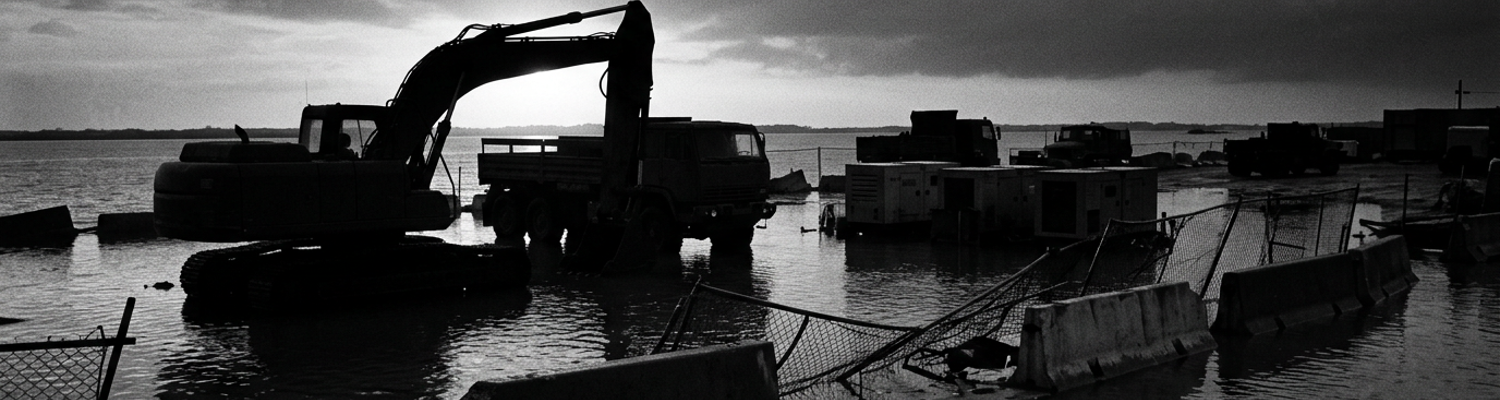
A close review of operational logs indicates the destruction confronting the 4th Brigade Combat Team, 101st Airborne Division in early August 2013 was total. A sudden torrent from the steep mountain drainage basins surrounding the Khost bowl surged directly across the 1200-acre installation. Dry access routes turned into fast-moving rivers. Heavy water saturation throughout the northern and eastern boundary lines caused multi-tiered Hesco Bastion barriers to fail mechanically. Underground corrugated steel culverts buckled under backpressure. They clogged with vegetative debris and backed up water into the defensive berms. Wire-mesh cells packed with local sandy loam and gravel liquefied from internal water pressure. They bulged outward until the synthetic geotextile seams ripped apart under the load. Precast concrete guard towers and reinforced machine-gun bunkers leaned sideways or slid entirely into deep sinkholes.
Tactical operations centers took on three feet of turbulent runoff.
This destroyed low-mounted power distribution boxes and halted vehicle maintenance across the base.
Water had dissolved the exterior defenses in under four hours.
Emergency damage surveys began the moment the primary surface surge receded. Teams from the 4th Brigade Special Troops Battalion pushed through standing water in light tactical vehicles. They found massive breaches where uncontrolled runoff had cut twelve-foot gaps through dirt berms. Using survey rods, engineers recorded mud deposits measuring between eighteen and thirty-six inches deep across the primary flight line. This sediment dried into a dense crust that grounded rotary-wing medevac flights. Heavy fuel tankers on the apron were immobilized. Floodwaters eroded historical impact craters, exposing unexploded mortar rounds and buried ordnance alongside internal roads. Along the western perimeter, more than four hundred meters of concertina wire and picketed razor coils were ripped from their footings. Tons of mountain silt buried the wire.
Submerged conduit cables killed perimeter surveillance cameras.
Ground-radar stations and acoustic sensors failed.
Defensive sectors went unmonitored along an active insurgent rocket corridor.
Defensive security rested on riflemen posted in exposed vehicle turrets.
Archival evidence shows base commanders immediately faced a direct conflict between strict drawdown schedules and raw base survival. Earth-moving equipment had to be pulled from shipping compounds to dig emergency diversion channels. This included Caterpillar D7 bulldozers, skid-steer loaders, and hydraulic excavators (NARA Record Group 338 inventory logs) already scrubbed for shipment to Bagram Airfield. Mechanics from the 801st Brigade Support Battalion worked around the clock to pump out drowned fuel systems. They cleared silt-choked air filters and restored flooded tactical quiet generator sets. Infantry details cleared foot-thick layers of mud from ammunition storage points using hand shovels. Armed pickets scanned the gaps in the perimeter.
Damage reports radioed to Regional Command East confirmed operational capability was severely degraded across all sectors.
By late afternoon on August 5, brigade engineering assessment sheets logged seventeen distinct perimeter breaches. Five structurally collapsed observation towers were recorded. More than eight thousand cubic yards of silt covered essential service roads.
Retrograde Shipping Quotas and Demolition
Operational directives originating from International Security Assistance Force headquarters in Kabul placed measurable property reduction above functional terrain maintenance.
Throughout early 2013, the CENTCOM Materiel Recovery Element and the 401st Army Field Support Brigade enforced strict drawdown targets. Task Force Currahee had to zero out property books ahead of the scheduled installation transfer to the Afghan National Army 203rd Corps. Base commanders faced relentless evaluation on weekly container throughput. Rolling-stock transit manifests took priority. Meeting these shipping quotas demanded the total diversion of mechanical assets. Instead of reinforcing perimeter drainage ditches, heavy equipment operators spent duty shifts loading twenty-foot equivalent shipping containers onto commercial flatbed transports. Base engineers were ordered to treat civil engineering projects as secondary to the timeline for clearing Class II, Class IV, and Class IX supply yards.
Spreadsheet metrics dictated the daily operational priority.
A close review of operational logs indicates combat engineers actively demolished the physical systems that kept Forward Operating Base Salerno dry. Starting in June 2013, soldiers from the 4th Brigade Special Troops Battalion used Caterpillar 345D hydraulic excavators and D7R bulldozers to dismantle concrete culverts. They systematically removed wastewater retention berms and HESCO barriers across FOB Salerno. Excavator operators pulled three-foot precast concrete drainage pipes from beneath the secondary perimeter roads. They broke the sections apart with hydraulic hammers to demilitarize the culverts before abandonment. Construction teams flattened five large earthen wastewater retention berms along the western graywater lagoons. The intent was to grade the terrain flat for a simplified Afghan security boundary. Heavy equipment crews sliced the wire mesh of three tiers of HESCO Mil 7 wall systems along the southwest sector. Bulldozer blades pushed hundreds of tons of sandy fill directly into the low-lying runoff channels. This eliminated the natural drainage gradients that directed mountain runoff away from the living areas.
Each demolished earthwork removed a functional buffer against seasonal mountain runoff.
When examining the historical record of Task Force Currahee, the physical consequences of this rapid deconstruction became obvious weeks before the surge. Heavy equipment operators had crushed the main concrete drainage canals that fed the southern drainage wash. Fragmented masonry slabs blocked the natural outlet toward the Khost plain. Wastewater evaporation basins were graded into shallow depressions. Any sudden influx of surface runoff would immediately mix with raw sewage. Excavator teeth scored the subsoil. They stripped away compacted top layers and exposed unconsolidated silt along two kilometers of base perimeter.
By the final week of July 2013, engineering survey logs documented that five thousand linear meters of protective berms had been stripped of their HESCO revetments.
Sixty concrete conduit sections lay pulverized in scrap collection yards.
The primary base runoff ditch was filled with loose backfill to a depth of four feet.
Hydraulic Failure and Soil Liquefaction
Archival evidence shows an unusually intense late-monsoon weather front drifted westward across the Spin Ghar mountain range from the Pakistani border on the evening of August 3, 2013.
Meteorological stations at Forward Operating Base Salerno recorded sustained cloudbursts dumping over four inches of rain within a six-hour operational window across the Khost bowl. The surrounding mountain basin funneled torrential runoff from three hundred square kilometers of high-altitude granite slopes straight into the dry wadi networks converging near 33 degrees 21 minutes North, 69 degrees 57 minutes East. By 0200 hours on August 4, dry riverbeds transformed into ten-foot walls of rushing, debris-laden water moving at twenty-two feet per second. Surface water collected across the upper alluvial fans. It picked up gravel, boulders, and scrub brush. This mass of debris slammed into the northeastern boundary of the installation. Duty officers in the Task Force Currahee tactical operations center watched remote sensor telemetry flatline. Electrical ground trunks flooded and field telephone links severed.
The sheer physical volume of liquid overwhelmed the base before perimeter sentries could deploy mobile sandbag reserves.
Runoff surged down the steep gradient of the surrounding foothills. It bypassed the dismantled peripheral berms and flooded into the drainage channels that 4th Brigade Special Troops Battalion engineers had graded shut only weeks earlier. Drainage swales designed to manage low-velocity desert rain filled beyond capacity within ninety minutes. Dirty water backed up into living areas, fuel containment pits, and motor pools. Water accumulated at a rate of roughly forty thousand gallons per minute against the north security fence. Heavy runoff backed up behind the concrete footings of the outer wire perimeter. This created an ad-hoc dam that exerted lateral pressures far exceeding the shear capacity of the local aggregate.
The ground under the perimeter gave way completely.
When examining the historical record of Task Force Currahee, the primary tactical failure occurred where unreinforced perimeter saps met the stripped topsoil along the forward defensive line. Bulldozer operators had scraped the protective crust of native clay and gravel down to unconsolidated subsoil during demilitarization operations. Raw, uncompacted sandy silt was exposed directly to the torrential downpour. Unreinforced fighting saps channeled the rushing floodwaters directly into the foundation soil of the perimeter wall. Soil saturation hit one hundred percent within three hours. This triggered complete soil liquefaction along twelve hundred meters of the eastern security zone. The unconsolidated dirt shifted from solid earth to viscous mud with zero shear resistance.
Saps that infantry squads from the 1st Battalion, 506th Infantry Regiment used for listening posts caved inward under their own hydrostatic weight.
Communication wires, weapons caches, and fighting positions were buried under three vertical feet of liquefied mud. Field engineers dispatched to the breach logged soil collapse depths reaching five feet along the base of guard towers. Sediment flow rates measured forty cubic yards of displaced fill per hour along the outer sap line. The perimeter wall lost all foundational support. Concrete T-walls weighing several tons tilted outward into the mudflats. The structural integrity of the eastern boundary ceased to exist.
Generator Farm Inundation and Biohazard Zones
Power died across the entire perimeter in seconds.
A close review of operational logs indicates the central power plant for Forward Operating Base Salerno collapsed when floodwaters breached the secondary containment berms surrounding the primary electrical node. At 0315 hours on August 4, a rising slurry of spilled JP-8 fuel, crankcase oil, and mountain silt swept through the primary generator farm. This area housed twelve commercial Caterpillar 1000-kilowatt diesel generators and three banks of skid-mounted MEP-806B tactical quiet generators operated by Task Force Currahee. Water levels rose thirty-two inches above the gravel pads in under twenty minutes. Low-slung turbocharger air intakes drew hundreds of gallons of liquid straight into running engine blocks. Connecting rods bent and crankshafts snapped before safety shutoffs could trip. Below the engine housings, primary distribution switchboards and automatic transfer switches were completely submerged.
High-voltage copper busbars short-circuited violently beneath the surface.
Circuit breakers threw and internal junction coils melted. Floating diesel from ruptured thousand-gallon bladder tanks mixed with raw effluent from ruptured sewage lines. This coated sensitive alternator stators in a greasy, conductive film. Mechanics from Company B, 801st Brigade Support Battalion waded into waist-deep runoff with flashlights. They found five prime-power generator sets mechanically seized with crankcases full of water and fuel.
Every backup generator set sat flooded and dead.
The installation went entirely dark. Emergency battery backups in the tactical operations center provided exactly forty-five minutes of partial illumination. After that, the command posts operated by chemical light.
Archival evidence shows the human waste system failed directly into the garrison living footprint. Just north of the runway, three unlined wastewater retention basins contained an estimated six hundred thousand gallons of untreated sewage. These basins overtopped their bulldozed dirt rims under the pressure of twenty-two thousand gallons of incoming stormwater per minute. A viscous wave of blackwater washed across the unpaved company streets into the sleeping quarters of the 1st Battalion, 506th Infantry Regiment. B-hut plywood floors buckled instantly as saturated fecal sludge pushed through wall vents. Field gear, medical kits, and individual body armor staged on floor racks were ruined. This contaminated surge then poured through the raised subflooring of the 4th Brigade Special Troops Battalion communications shelter.
Tactical communications racks housing SIPRNET routing hardware, NIPR switch stacks, and unshielded CAT-5 patch panels took on eight inches of wastewater.
Direct electrical grounds triggered across the core server arrays. External satellite terminals lost signal when water filled the unsealed junction boxes of low-loss coaxial cables connected to the AN/TSC-156 Phoenix tactical satellite dishes. Secure digital links with Regional Command East headquarters terminated.
Fecal bacteria coated the base communications hardware.
When examining the historical record of Task Force Currahee, preventive medicine detachments flagged the entire central compound as an active Class III biohazard zone within daylight hours. Soldiers from the 4th Brigade Special Troops Battalion attempted to divert blackwater from the brigade joint operations center using hand-held entrenching tools and makeshift sandbag walls. The sheer volume of effluent overwhelmed their work lines. Raw sewage mixed with five hundred gallons of leaking motor oil to form an emulsified chemical sludge. This sludge filled low-lying cable trenches between the communications hub and the primary tactical operations center. Field medics recorded sixty-four personnel presenting with contact dermatitis, ocular burns, and gastrointestinal symptoms within thirty-six hours of wading through the contaminated areas to salvage encryption keys and crypto-ignition keys. By midday on August 5, base engineers logged that eighteen communication distribution nodes were submerged under twenty-four inches of toxic waste. Coliform bacteria counts across the tactical operations center floor exceeded ten thousand colony-forming units per hundred milliliters.
Tactical Psychological Operations Counter-Messaging
Loudspeakers replaced defensive gunfire along the fractured perimeter.
Archival evidence shows local Afghan scavengers began gathering along the pulverized eastern boundary near 33 degrees 21 minutes North, 69 degrees 58 minutes East by the morning of August 5. Silt deposits had buried the concertina wire beneath three feet of mud. The collapse of five guard towers left hundreds of meters of shredded Class IV supply yards completely exposed to the adjacent Khost City outskirts. Tactical Psychological Operations detachments under the 318th Psychological Operations Company mounted Long Range Acoustic Devices and directional speaker horns onto the roof turrets of up-armored M1151 HMMWVs. Operating in two-vehicle patrols along the washed-out patrol road, these teams broadcast continuous warnings in Pashto and Dari across the mudflats. The automated scripts warned approaching crowds that the breach zones contained live 240-volt electrical conduits. Submerged anti-personnel hazards from washed-out defensive minefields were also broadcast as threats. Unexploded 82mm mortar ordnance exposed by the runoff presented a severe hazard.
Patrol commanders coordinated broadcast sectors directly with forward observers from the 1st Battalion, 506th Infantry Regiment.
They timed acoustic warning pulses to intercept civilian groups before they crossed the seventy-five-meter lethal engagement line. When visual observation posts identified clusters of twenty to thirty individuals moving toward exposed cargo containers, the gunners rotated the acoustic arrays. They increased output to 135 decibels, causing immediate acoustic disorientation that turned back the scavengers.
The acoustic wall held the perimeter line without a single rifle shot.
A close review of operational logs indicates an equally volatile threat developed inside the installation fence line at Camp Maiwand. Across the inner partition, soldiers of the 2nd Brigade, 203rd Corps of the Afghan National Army faced raw blackwater flooding their barracks. Contaminated mess facilities and the total loss of shared municipal water pumps compounded the crisis. Rumors spread rapidly through the Afghan barracks that Task Force Currahee was executing an emergency unilateral evacuation. The rumors claimed the Afghan garrison was being left stranded without rations, power, or perimeter defense amid an impending Taliban assault. Tactical Psychological Operations teams mobilized their Tactical Digital Media production systems to counter the panic before armed friction ignited between the garrisons. Operating out of a damp shelter on the brigade footprint, print specialists ran modular Risograph duplicators around the clock. They produced ten thousand emergency bilingual handbills on water-resistant stock. Detachments moved on foot through the mud to deliver these printed notices directly to Afghan squad leaders. The handbills outlined joint recovery timelines, confirmed shared fuel distribution schedules, and identified coordinated emergency water points established at Joint Gate 3.
Panic was rising faster than the drainage ditches could clear.
When examining the historical record of Task Force Currahee, targeted messaging had to neutralize active Taliban radio propaganda. Insurgent broadcasts claimed the flood was divine punishment that had eradicated American forces. Detachment commanders from the 318th Psychological Operations Company conducted direct information engagements with Afghan Kandak commanders inside their flooded tactical operations center. They presented joint aerial reconnaissance imagery to disprove rumors of an American withdrawal. Handbills placed into the hands of Afghan soldiers emphasized shared hardship. These documents paired technical schematics of ongoing water purification repairs executed by the 801st Brigade Support Battalion with clear warnings against unauthorized movements near American arms rooms. Distribution manifests logged four thousand handbills handed out across the 2nd Kandak compound by August 6. Sixty-eight tactical loudspeaker engagements were aimed at Afghan guard pickets along the interior division wall. By the end of the shift, tactical teams had distributed another two thousand leaflets to the 3rd Kandak motor pool. Mechanics there were refusing to mount guard details. Operational logs recorded that the 203rd Corps garrison returned to joint perimeter watches at 1800 hours on August 7.