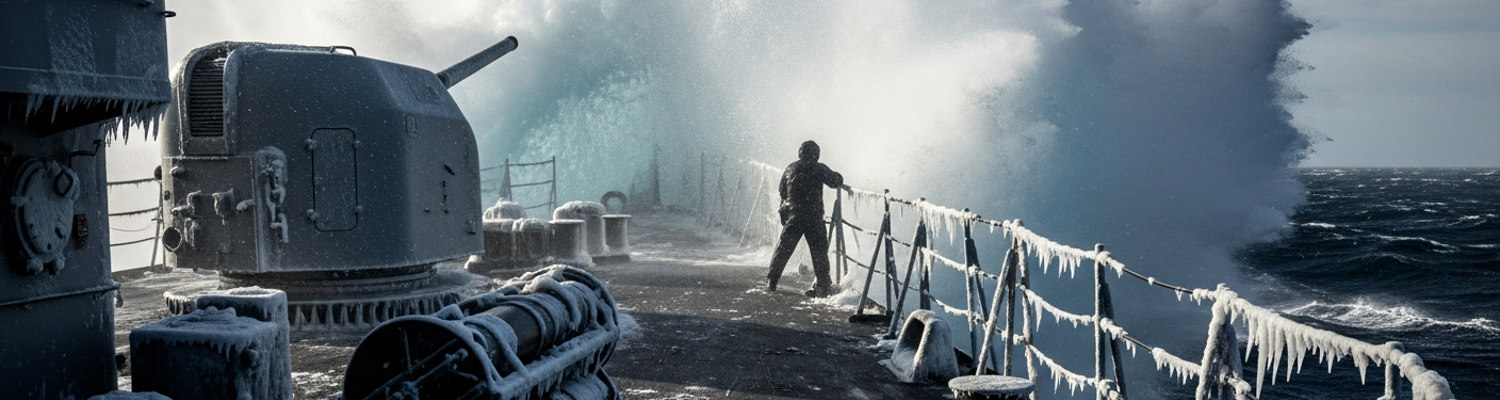

Arctic Theater Medical Demands
The medical challenges confronting naval forces in the Arctic theater during World War II were unlike those in any other operational area. A review of operational logs from convoy escort ships on the Murmansk Run shows a catalog of injuries shaped by the environment. Blast and shrapnel wounds were common to all naval theaters. In the Arctic, they were made worse by immediate, catastrophic freezing of exposed tissue. A sailor suffering a flash burn from an exploding torpedo would simultaneously experience severe frostbite on the same wound. This created a complex trauma that resisted conventional treatment. Medics and Sick Berth Attendants (SBAs), often the sole medical personnel on smaller escort vessels, found that tourniquets applied to control bleeding from a mangled limb almost guaranteed its loss. The cold temperature drastically shortened the window before tissue death became irreversible. Immersion in the sub-zero water was a near-certain death sentence. Survival times were measured in minutes. Rescue was a race against hypothermia that was seldom won. Even for those pulled from the sea, the thawing process itself was perilous. Medical guidance stressed that frozen extremities had to be warmed with extreme slowness, often by immersing an unaffected limb in hot water to induce reflex vasodilation in the frozen one, as direct heat from a galley stove could cause massive tissue damage.
The environment was a weapon.
This theater was defined by extreme photoperiods. The perpetual darkness of the polar winter and the unending daylight of summer inflicted a severe psychological and physiological toll on both medical staff and their patients. During the winter runs, the near-constant darkness was chosen to provide cover from German reconnaissance and attack aircraft operating from occupied Norway. This absence of natural light profoundly disrupted the circadian rhythms of the crew. Medical logs document a pervasive sense of fatigue, melancholy, and impaired cognitive function among personnel. For the wounded, this was especially damaging. The endless night could induce a state of deep lethargy and depression, complicating recovery and depressing the will to live. Conversely, the 24-hour daylight of the Arctic summer, while removing the cover of darkness, created its own set of medical problems. It became nearly impossible for exhausted medical staff or recuperating sailors to achieve restorative sleep. This led to a different kind of fatigue and a higher incidence of judgment errors. Military research has shown that these seasonal light extremes directly correlate with reduced sleep quality and quantity, impacting cognitive effectiveness.
Standard-issue medical equipment, designed for temperate climates, failed systematically in the Barents Sea. A close review of operational after-action reports (AARs) and medical purser inventories highlights a consistent theme of material failure. Rubber components became brittle and useless. The simple tubing for an IV drip or a catheter would crack and snap in the intense cold. Glass ampules of medicine, carried in a warm pocket and then exposed to the frigid air of a destroyer’s deck, could shatter from thermal shock. Morphine syrettes, essential for pain management, were a constant source of trouble. The analgesic would freeze solid, rendering it impossible to administer. The metal needle would become so brittle it would snap off during an attempted injection. Plasma, a life-saving innovation of the war, had to be kept from freezing, often by storing it inside a medic’s own clothing, close to their body heat. The high humidity and constant sea spray caused metal surgical instruments to corrode at an accelerated rate. Sterilization itself became a significant hurdle. On-ship boiling kits were a fallback, but they could not destroy all bacterial spores, meaning every procedure carried a high risk of subsequent infection.
Medical Equipment Reliability
A close review of operational logs from Royal Navy and U.S. Navy vessels on the Murmansk Run reveals a consistent pattern of equipment failure that profoundly complicated medical treatment. Diagnostic tools, in particular, proved exceptionally vulnerable. Portable X-ray machines, such as the U.S. Army field unit developed by Picker X-Ray Corporation, were a significant innovation but were designed for terrestrial, temperate use. Aboard a destroyer escort in the Barents Sea, the challenges were manifold. The cold cathode or early Coolidge tubes used in these devices were sensitive to extreme temperature fluctuations. The intense cold could cause the glass envelope of the tube to become brittle and susceptible to fracture from the constant, jarring vibration of the ship’s engines or the shock of a nearby depth charge detonation. Power regulation, already a challenge on a ship’s strained electrical grid, became even more precarious. The cold increased the internal resistance of generators and power cables, leading to voltage drops that could prevent the X-ray tube from reaching the necessary energy to produce a usable image. Even when a radiograph could be taken, the development process became a near-impossible task. Photographic chemicals would freeze solid. Even if they could be thawed, maintaining the precise temperature required for development and fixing was unfeasible in a frigid, pitching darkroom. A technician attempting to diagnose a shrapnel wound would find their developing baths turning to slush, rendering the film useless.
The administration of anesthesia, a procedure requiring stability and precision, became a high-stakes improvisation. Anesthesia machines of the era, like the Ohio Model 685A or the British Shipway apparatus, were complex mechanical devices with flowmeters and vaporizers calibrated for steady, room-temperature conditions. On the violent, pitching deck of a corvette in a gale, these calibrations were meaningless. The delicate glass bobbins in the flowmeters, meant to give a precise reading of oxygen or nitrous oxide flow, would jump and stick with the ship’s lurching. This made it impossible for the medical officer to know the true composition of the gas mixture being delivered. More dangerously, fluctuating cabin temperatures, which could swing wildly from near-freezing to stiflingly hot near a steam pipe, directly affected the vaporization of liquid anesthetics like ether. As the ambient temperature dropped, the vapor pressure of the anesthetic would decrease, delivering a leaner, less effective mixture to the patient. A sudden increase in temperature could do the opposite, dangerously deepening the level of anesthesia without warning. Surgeons and Sick Berth Attendants were forced to rely on clinical signs. The patient’s breathing, pulse, and color were their only guides, titrating the anesthetic drip by instinct while being thrown against the operating table by the unforgiving sea.
The very tools of the surgeon’s trade betrayed them in the Arctic cold. Archival evidence shows that material science was a persistent and often fatal blind spot in naval procurement. Surgical instruments of the 1940s were typically made from high-carbon steel, prized for its ability to hold a sharp edge. A well-documented property of steel is that as it approaches temperatures near and below freezing, its molecular structure can transition from ductile to brittle. This phenomenon, known as brittle fracture, meant that a scalpel, hemostat, or pair of forceps that was perfectly reliable in a naval hospital in Portsmouth could become as fragile as glass in the Arctic. The continuous, high-frequency vibration transmitted through the ship’s structure from its engines and propeller shafts made this problem worse, introducing microscopic fatigue cracks into the metal over time. A surgeon attempting to clamp a bleeding artery might find the tips of their hemostat snapping off at the moment of application. A bone saw, essential for amputations, could shatter mid-stroke. These failures were not isolated incidents but a systemic problem rooted in the material properties of the equipment, a problem that turned routine surgical procedures into a gamble against the physics of the cold.
Asepsis in Icy Conditions
A core tenet of surgery is control. In the Arctic theater, control was a fantasy. The battle for asepsis began with the sterilization of surgical instruments, a process rendered profoundly difficult by the environment. On larger vessels, steam-fed autoclaves could provide sterile instrument packs. On smaller escorts like Flower-class corvettes, a Sick Berth Attendant often had to rely on boiling or less effective chemical sterilization. Even with a proper autoclave, the procedure was fraught. A typical cycle would complete, but the moment the hot, cloth-wrapped instrument pack was removed into the frigid air of a makeshift sickbay, physics became the enemy. Condensation would immediately form on the metal instruments and inside the packaging as the warm, moist air trapped within hit its dew point against the cold steel. This moisture would then freeze as it was carried to a windswept deck or an unheated compartment, coating the supposedly sterile field in a fine layer of ice.
The sterile field was a fiction.
When the time came for an emergency procedure, a debridement of a frostbitten shrapnel wound or an amputation, the pack would be brought into the relative warmth of the operating space. This was often a curtained-off section of the mess. The ice would melt, leaving the instruments soaking in non-sterile water pooled inside their own wrappings. Every scalpel, hemostat, and needle was contaminated before it even touched the patient. Post-action medical logs from escorts on the Murmansk Run consistently document high rates of post-operative gas gangrene and sepsis. This was a direct consequence of this unavoidable cycle of condensation, freezing, and thawing. A surgeon could perform a technically perfect operation only to watch the patient die days later from an infection introduced by the very tools meant to save him.
The challenge of hand hygiene was just as fundamental. Warships of the era produced fresh water using steam-powered evaporators, a process that was energy-intensive and secondary to the needs of the propulsion boilers. On a destroyer pushing through a gale, priority for fresh water went to the engines; human needs were a distant second. Water for drinking and cooking was already rationed. The idea of using gallons of it for surgical scrubbing was often out of the question. Medical officers and their attendants were forced to use cold, unfiltered seawater, a substance teeming with its own microbial life. Scrubbing with the harsh, lye-based soaps of the period in frigid salt water was a painful, skin-stripping ordeal that offered a poor substitute for a proper pre-operative wash with warm, fresh water. The spaces designated for surgery, often far from the engine room's warmth, were notoriously difficult to heat. Without reliable heating, maintaining even a semblance of effective hand hygiene became nearly impossible, forcing medical staff to operate with hands that were numb from cold and questionably clean.
Compounding these failures was the inescapable risk of airborne contamination. The enclosed, steel-walled environment of a warship is an ideal incubator for respiratory and wound pathogens. Ventilation systems on vessels like Fletcher-class destroyers were designed for air circulation, not filtration. They were often shut down during action stations to maintain watertight integrity and reduce noise. In the Arctic, hatches and portholes were kept sealed against the weather, creating a closed loop of recycled air. A single sailor with influenza or streptococcus could, within days, infect dozens of his shipmates crowded into poorly ventilated mess decks and berthing compartments. These pathogens circulated continuously, inevitably finding their way into the sickbay and the operating theater. For a patient with a severe burn or a large open wound, the very air in the ship became a source of lethal cross-infection. The concentration of men, the lack of filtered air, and the impossibility of isolating infectious patients from surgical casualties meant that every wound was immediately exposed to a rich aerosol of bacteria from the dozens of other sick and injured men packed into the decks below.
Hypothermia and Frostbite Treatment
A medical officer’s log from an escort destroyer on the Murmansk Run details the calculus of rewarming men pulled from the Barents Sea. The primary technique was improvisation, dictated by the ship’s own machinery. Aboard a pitching Flower-class corvette, the only sources of consistent, powerful heat were in the engine room. Sick Berth Attendants would commandeer exhaust vents or position stretchers near hot steam pipes, creating makeshift rewarming bays in the deafening, vibrating heart of the ship. The process was a dangerous art. Rapid, uncontrolled heating from a steam line could cause severe burns to insensate, hypothermic skin. Rewarming too slowly risked a fatal physiological phenomenon known as afterdrop, where cold blood from the extremities returns to the core, plunging body temperature past the point of no return. Medics learned to create baffles from canvas and blankets to diffuse the raw heat, creating a flow of warm air rather than direct, damaging contact. Hot, sweet tea was the universal first-line internal treatment, providing hydration, sugar for metabolic energy, and a small degree of internal warmth.
Rewarming was only the first battle.
Surgical intervention for frostbite presented a series of near-impossible decisions for naval surgeons. Doctrine developed in terrestrial conflicts often proved lethal in the Arctic. A limb that appeared black, frozen solid, and functionally dead would, by standard practice, be amputated immediately to prevent the onset of gas gangrene. Yet, operational reports from convoy surgeons indicate a hard-won, counterintuitive lesson: patience. Tissues that seemed beyond saving sometimes revealed surprising viability after days of slow, careful thawing. The decision to delay amputation was a high-stakes wager. Waiting too long risked systemic sepsis from necrotic tissue, a death sentence on a small ship with limited antibiotics. Amputating too early meant condemning a sailor to a permanent disability when the limb might have been saved. The surgery itself was a nightmare. Frozen tissue did not behave like normal flesh; it was brittle and resisted the scalpel, shattering rather than cutting cleanly. Suturing was often impossible, as needles struggled to penetrate the semi-frozen fascia and the compromised tissue lacked the integrity to hold stitches. Surgeons were forced to rely on wide excisions of dead tissue, packing the resulting wounds, and hoping that infection did not take hold before the ship reached port.
The only reliable treatment was prevention. For sailors rescued from the sea, the moments after being hauled aboard were as dangerous as the immersion itself. Wet clothing, whipped by Arctic winds, could induce fatal hypothermia in minutes. Escort crews developed brutally efficient procedures. A rescued man was stripped of his sodden clothes on deck, regardless of the temperature, and immediately wrapped in thick, dry wool blankets. On ships like the American Fletcher-class destroyers, crews would sometimes establish makeshift shelters by lashing tarpaulins and spare canvas near a galley or engine room exhaust. This created a pocket of relatively warm, still air to shield survivors from the wind. The U.S. Navy’s N-1 deck jacket, lined with alpaca pile, and layered wool garments were stripped from active crew members to clothe rescued men. This ad-hoc system focused entirely on breaking the cycle of wetness and wind, understanding that getting a man dry and shielded from the moving air was the most critical intervention available. Hot liquids were administered as soon as the survivor could safely swallow.
Heating System Emergency Repairs
On an Arctic convoy escort, the first sign of a heating failure was often auditory. A high-frequency shriek would emanate from a low-pressure steam line. This was followed by a concussive rupture that would vent superheated steam into a frigid passageway. Aboard a Flower-class corvette or a Fletcher-class destroyer, these pipes ran through uninsulated voids and along weather-exposed bulkheads. Their asbestos lagging quickly became saturated with condensation and sea spray, rendering it useless. The intense cold would freeze the condensate inside the pipe, creating an ice plug. Steam pressure from the auxiliary boiler would build behind the blockage until the steel pipe wall failed. Archival evidence shows that Damage Control Parties were tasked with the near-impossible repair. In a compartment thick with scalding vapor that flash-froze onto every surface, they had to first reach the stop valves to isolate the rupture. These valves were often seized by ice, requiring the dangerous application of a blowtorch in a confined space filled with fuel lines and electrical cables. Once isolated, the crew would have to cut out the ruined section and attempt a patch, often using nothing more than sheet rubber, clamps, and mechanical force to create a temporary seal.
The system was designed to fail.
This loss of pressure forced an immediate triage of the ship’s most vital resource: heat. The Chief Engineer would report the failure to the bridge, where the ship’s captain had to make a zero-sum decision. Operational logs from Murmansk Run escorts reveal a stark command hierarchy. The limited steam remaining had to be directed to spaces critical for combat effectiveness. First priority was the bridge, to ensure navigation equipment and watchstanders could function. Second was the sickbay or the designated operating theater. This meant that an engineer would be dispatched into the ship’s frozen labyrinth of pipes to manually close the valves feeding the crew’s berthing areas and mess decks. They were plunged into absolute sub-freezing darkness. A conscious choice was made to sacrifice the comfort and health of the general crew to preserve the lives of the wounded and the operational capacity of the command team. The surgical patient under anesthesia on the mess table was kept warm at the direct expense of the sailors trying to sleep in their ice-cold bunks one deck below.
Even with diverted steam, a makeshift sickbay was often barely above freezing, forcing medical staff to implement their own heating solutions. When the ship’s system failed entirely, improvisation became the only doctrine. A close review of medical logs and diaries describes the use of portable coke-fired stoves in medical spaces. This practice created an extreme fire hazard and risked filling the poorly ventilated compartment with carbon monoxide. Ship’s electricians were known to jury-rig circuits, bypassing overloaded transformers to power high-wattage lamps clustered around a patient’s bunk or an operating table. This unauthorized wiring frequently overheated, creating another significant fire risk. On a smaller scale, Sick Berth Attendants would heat bricks and sandbags in the ship’s galley, wrap them in blankets, and place them around a patient to provide localized warmth. Hot water, when available, was put into repurposed food tins and tucked into beds to keep intravenous fluids from turning to slush in their glass bottles. Each of these solutions was a temporary, labor-intensive fix in the constant battle to maintain a survivable micro-environment for a single patient.
Improvised Surgical Environments
The decision to convert a non-medical space into an operating theater was born of immediate necessity. When a torpedo strike or aerial bomb rendered a destroyer’s designated sickbay unusable, the ship’s captain, in consultation with the senior medical officer or Sick Berth Attendant, had to instantly designate an alternative. Operational records show the most frequently chosen locations were the wardroom or the enlisted men’s mess deck. These spaces were selected for their relative size and proximity to the ship’s galley, which offered a source of hot water. The transformation was a hasty affair. Off-duty sailors and damage control parties would be ordered to clear the space, dragging heavy wooden tables and benches out into the passageways. There was no true sterilization. The process involved swabbing the steel deck and bulkheads with whatever disinfectant was available before stringing up canvas sheets, often soaked in water to reduce dust, to partition the area.
This was now the surgical ward.
A review of blueprints for vessels like the Fletcher-class destroyers reveals the fundamental unsuitability of these spaces. The crew mess was a large, open area deep within the ship, chosen for crew access, not medical functionality. Lighting was the first critical failure. The space was lit by low-wattage overhead fixtures, sometimes augmented with shaded red battle lanterns, which cast long, deceptive shadows across the operating field. Ship’s electricians were tasked with the dangerous job of jury-rigging extra illumination, running unsecured electrical cables from strained junction boxes to hang bare, high-wattage bulbs over the makeshift table. Ventilation, a system designed to circulate air for crew comfort in the Pacific, was a liability in the Arctic. It was often shut down during action stations to maintain watertight integrity, and in the freezing north, intakes were sealed against the cold, creating a closed atmospheric loop. The air quickly became thick with the sweet, sickly smell of ether, the metallic tang of blood, and airborne pathogens from dozens of unwashed men crowded below decks. Waste disposal was the most primitive of all. There were no dedicated sanitation systems. Buckets were filled with amputated tissue, blood-soaked dressings, and contaminated fluids. A rating would then be tasked with the grim duty of carrying these containers topside, navigating pitching ladders and icy decks, to heave the contents over the side into the churning, sub-zero sea.
The final, constant battle was against the motion of the ship itself. An operating table improvised from a mess table had to be physically anchored to the vessel. Damage control teams would use heavy-gauge rope and steel wire, lashing the table legs to structural stanchions, steam pipes, or welded cleats on the deck. Every piece of equipment was a potential projectile in the heavy seas common to the Murmansk Run. Instrument trays could not be simply set down; they would slide across the deck with every roll. A Sick Berth Attendant’s primary task was often to physically hold the tray for the surgeon, while another braced both of them against a bulkhead. The patient himself had to be secured. In a violent lurch, an unconscious man could be thrown from the table. Orderlies were assigned the task of becoming human restraints, physically holding the patient’s body in place, timing their own bracing against the unpredictable rhythm of the waves. A surgeon learned to work with the sea, pausing a delicate cut as the deck dropped away beneath him, then moving with precision in the brief, weightless moment of stability at the crest of a swell.
Shipboard Power Generation
The electrical heart of a convoy escort was its direct-current (DC) generator, a piece of machinery unsuited for the Arctic. On a Fletcher-class destroyer, two steam turbine-driven ship service generators provided the main power, with a 100 KW emergency diesel generator as a backup. Aboard the smaller Flower-class corvettes, a single-shaft triple-expansion steam engine provided propulsion and drove the generator. Engineering after-action reports consistently detail the effort required to keep these systems online. Salt spray, driven by gale-force winds, would atomize and penetrate the engine room, coating every surface in a conductive, corrosive film. This saline moisture would work its way into the generator’s commutator and carbon brush gear, causing arcing and short circuits that could trip the entire power grid. Maintenance in the violent, pitching seas of the Barents Sea was a life-threatening evolution. An engineering rating attempting to clean a commutator or replace a worn brush would have to time his movements to the 45-degree rolls of the ship, bracing against a hot bulkhead while using a solvent-soaked rag, all in a space filled with moving, unshielded machinery. The extreme cold itself was a weapon, causing diesel fuel to gel and block fuel lines, batteries to lose their charge, and metal components to become brittle and prone to fracture from the constant, high-frequency vibration of the ship’s engine.
This was not a stable power grid.
The result was an electrical supply characterized by chronic instability. Power surges, brownouts, and complete blackouts were a constant threat, with devastating consequences for the ship’s medical equipment. The portable X-ray machines of the era, such as the U.S. Army field unit by Picker, required a steady input to operate their delicate cold cathode or early Coolidge tubes. A sudden voltage drop during an exposure would render the resulting image faint and diagnostically useless. A power surge could burn out the tube’s filament entirely, destroying the machine. For a surgeon attempting to locate deeply embedded shrapnel in a pitching mess deck, the loss of this capability was catastrophic. Anesthesia machines and early suction devices, equally dependent on the ship’s power, could fail without warning. A medical officer’s log describes the terror of a power outage mid-surgery, leaving the patient on the table, the surgical site open, and the only light coming from red-lensed battle lanterns as the emergency diesel generator struggled to engage.
When the main generators failed, the Chief Engineer implemented an electrical triage. Aboard a Fletcher-class destroyer, the emergency diesel generator was designed to automatically power the most essential systems first, beginning with the steering gear. Any remaining power was then manually rationed by the electricians. Following a rigid command hierarchy, power was cut to crew berthing, galleys, and non-essential ventilation systems to preserve every available watt for the bridge, the internal communications, the radar, and the sickbay. This created islands of light and life in a ship otherwise plunged into a freezing, silent darkness. When even the emergency generator failed or proved insufficient, medical staff had to improvise. Sick Berth Attendants would connect lights and small devices to the ship’s 24-volt battery backup systems, which were intended for radio equipment and provided only a fraction of the necessary power. In the most desperate circumstances, portable gasoline-powered generators, intended for field use, were lashed to the icy deck. This was a severe fire and carbon monoxide hazard, with their cables run through hatches to power a single high-wattage lamp over a surgical table.
Arctic Medical Supply Chains
A review of convoy loading manifests for the Murmansk Run reveals a failed effort to supply a theater that consumed medical resources at a terrifying rate. Standard medical kits were insufficient. The Arctic demanded specialized assemblies containing vastly larger quantities of burn dressings, cold-weather medications, and sterile supplies for amputation. Resupplying these specific items was a logistical nightmare. A single merchant ship might carry the entire replacement stock of surgical instruments or frostbite treatment supplies for an entire escort group, making its survival a matter of life and death for future casualties. The loss of one ship meant the loss of a specific, irreplaceable capability. Blood products represented a particularly difficult challenge. While dried plasma, an innovation of the war, could be transported as a powder and reconstituted with sterile water, its effectiveness was limited. Whole blood was far superior for treating massive hemorrhage but had a short shelf life and required constant refrigeration, a near impossibility on a pitching, overloaded freighter. Planners had to gamble, allocating precious refrigerated space for whole blood that might expire before it was ever used, or relying on dried plasma that might not be enough to save a man bleeding out from a torpedo blast.
The system was a constant wager against physics.
The journey from Iceland or Scotland to the ports of Murmansk and Arkhangelsk was a gauntlet of thermal failure. A close examination of medical supply catalogs and after-action reports shows that heat-sensitive pharmaceuticals were a point of constant failure. Glass ampules of morphine, essential for pain management, would freeze solid. Medics trying to thaw them quickly could cause the glass to shatter from thermal shock. Insulin, necessary for diabetic sailors, would lose its chemical potency if frozen. The elaborate process of reconstituting dried plasma was dependent on a supply of sterile water, which itself was prone to freezing or contamination within the ship’s frigid compartments. There was no standardized solution for protecting these supplies. Sick Berth Attendants developed improvised methods, stashing critical medicines near engine room steam pipes or inside their own clothing, using body heat to keep the fluids viable. This turned the medic himself into a living incubator, a fragile, last-ditch defense against the physics of the cold.
Every mile closer to Russia brought the convoys deeper into a kill zone. The seasonal sea ice forced the convoys south, pushing them into a narrow channel of open water directly adjacent to German-occupied Norway. This corridor was within easy striking distance of Luftwaffe bomber and torpedo aircraft wings, U-boat wolfpacks, and heavy surface raiders like the battleship Tirpitz. Enemy action was not a risk; it was a certainty. The sinking of a merchant vessel was a catastrophic event that went far beyond the loss of tanks or ammunition. When a supply ship went down, its cargo of replacement medical officers, specialist surgeons, and tons of bandages, anesthetics, and plasma was lost completely. The destruction of Convoy PQ-17 in July 1942 was a brutal illustration of this reality. Of the 35 ships that set out, only 11 reached port. The 24 ships lost took with them hundreds of vehicles, aircraft, and tanks, but also a catastrophic volume of medical supplies, instantly erasing the fragile buffer of resources for the entire theater.