
Pre-Assault Bombardment and Intelligence Failures
At 0938 hours on January 9, 1945, saltwater flooded the primary SCR-299 radio truck. It rolled into the surf off Lingayen. This severed the frontline battalions of the 6th Infantry Division from Seventh Fleet flagship communications. Assault waves scrambling across Blue Beach found themselves isolated without a link to Rear Admiral Daniel E. Barbey or Vice Admiral Thomas C. Kinkaid. Archival evidence shows that Task Force 78 had marshaled over 850 vessels to drive Lieutenant General Walter Krueger's Sixth Army onto the shores of Lingayen Gulf. Amphibious transports deposited elements of Major General Innis P. Swift's I Corps and Major General Oscar W. Griswold's XIV Corps across a twenty-mile front. They targeted beaches designated Crimson, Yellow, Blue, and Orange between San Fabian and Lingayen. Ramp doors dropped on Landing Craft Infantry and Landing Ship Tanks. They discharged 68,000 men during S-Day. Army officers clashed with naval beachmasters over unload rates. Barbey ordered the discharge of bulk supplies directly onto narrow sandy shelves. Sixth Army quartermasters demanded selective discharge of combat vehicles and artillery ammunition. The naval beach parties prioritized clearing ship holds quickly. They ignored requests to deliver combat-loaded crates to designated inland dumps.
Beachmasters refused to alter the unloading schedule.
A close review of operational logs indicates that the pre-assault fire plan generated severe friction between ground planners and naval gunners. From January 6 onward, Vice Admiral Jesse B. Oldendorf's Task Group 77.2 directed heavy salvos from ten battleships and cruisers. The USS Pennsylvania and USS California pulverized the low-lying terrain of Pangasinan province. The bombardment threw thousands of high-explosive 14-inch and 8-inch projectiles across the littoral fringe. Concrete road spans across the Agno and Bued rivers collapsed. Rail lines running parallel to Route 3 shattered under sustained naval aircraft strafing and rolling barrages. This wrecked the steel trestles that Krueger had earmarked to rush heavy armor toward Manila. Navy gunnery officers operated under doctrine requiring total suppression of beach defenses. They ignored Sixth Army maps identifying bridges needed for transport trucks. Engineer reconnaissance teams from the 544th Engineer Boat and Shore Regiment moved inland past Dagupan. They encountered swampy terrain cratered into waterlogged trenches. Severed telephone lines and collapsed bridge abutments halted two-and-a-half-ton GMC supply trucks at the water edge.
The naval shells did the Japanese army demolition work for them.
When examining the historical record of naval aerial intelligence, the root of this tactical misjudgment becomes obvious. Reconnaissance planes launched from Seventh Fleet escort carriers focused surveillance on the central plains leading to Manila. Land-based PB4Y-1 Liberators operating out of Leyte did the same. They operated on the naval staff assumption that the Imperial Japanese Army would contest the beaches directly. General Tomoyuki Yamashita commanded the Fourteenth Area Army. He had rejected a coastal stand weeks prior. His staff shifted over 150,000 troops of the Shobu Group into the Caraballo, Sierra Madre, and Cordillera mountain ranges northeast and east of the gulf. Naval aerial observers reported deserted beach defense trenches and empty artillery emplacements near San Fabian. They interpreted the silence as total enemy destruction rather than a deliberate evacuation. Intelligence officers at Kinkaid's headquarters in Lingayen Gulf failed to map the camouflaged tunnel complexes. They missed the concealed caves and interlocking reverse-slope gun positions carved into the ridges surrounding Damortis and Rosario. Seventh Fleet spotters logged minimal activity across Pangasinan. Japanese infantry divisions quietly stockpiled rations, 75mm mountain guns, and ammunition inside deep subterranean bunkers overlooking the invasion corridors.
Yamashita waited in the ridgelines without firing a single shot.
Sixth Army intelligence officers under Colonel Horton V. White tried to warn Seventh Fleet liaisons. Radio intercepts indicated defensive concentration in northern Luzon highlands. Navy planners dismissed these warnings. They stuck to the standard amphibious playbook dictating saturation fire on the tideline followed by rapid shoreline dumps. The 43rd Infantry Division pressed toward the foothills of the Caraballo Mountains near Pozorrubio. Heavy artillery fire from undetected 150mm howitzers slammed into their exposed flanks. Frontline communication links to naval gun support broke down repeatedly. Portable field radios could not reach ships through coastal atmospheric interference and broken terrain. Beach congestion worsened by the hour. Thousands of pallets of unneeded beach-matting and small-arms ammunition stacked up at Dagupan. Frontline combat teams requested pack howitzers and engineering bulldozers to cross craters blown open by their own fleet.
Hydrographic Hazards and Beach Sandbar Broachings
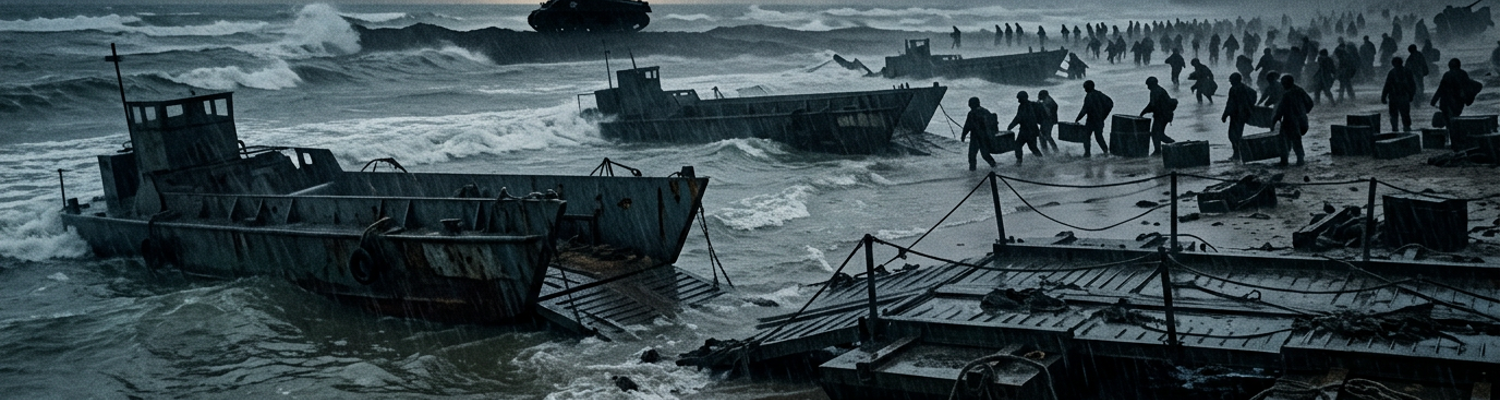
A close review of operational logs indicates that hydrographic surveys conducted prior to S-Day completely missed the shifting bottom profile off San Fabian. Winter monsoon swells sweeping down the western coast of Luzon pushed heavy underwater sandbars close to White Beach 1 and White Beach 2. These sat positioned between seventy-five and one hundred yards offshore. The heavy bow doors of Navy LST-564 and LST-610 cracked open. Vehicle crews discovered eight to ten feet of open water instead of firm sand. Twin-screw diesel landing craft driving behind them met sudden deceleration. Their keels struck the submerged ridges. Heavy five-to-eight-foot surf hammered exposed hulls. Stern anchor cables snapped under the continuous strain of the sea swell. These cables were designed to hold craft perpendicular to incoming breakers during beaching. Broaching followed within seconds. Over forty Landing Craft Vehicle Personnel and a dozen larger Landing Craft Mechanized swung broadside into the surf line. Cresting waves dumped tons of salt water straight into open engine compartments. This drowned the six-cylinder Detroit Diesel engines and locked transmission drives with abrasive sand.
Rudders sheared off on the submerged shoals.
When examining the historical record of Task Force 78 salvage units, the physical barrier created by these disabled hulls paralyzed the entire landing schedule. Damaged craft did not drift clear. Driven by rolling breaker lines, the deadweight hulls settled deep into the soft sand bottom along the narrow littoral shelf. They pinned themselves firmly against the shallows. Inbound waves carrying the heavy weapons of the 43rd Infantry Division suddenly found every marked channel impassable. Landing Craft Tanks hauling M4 Sherman tanks reversed their screws in panic to avoid collisions with stranded wrecks. They collided with incoming DUKWs loaded with 105mm artillery shells. Navy beachmasters on White Beach refused to permit offshore discharge into the water. Sixth Army officers demanded that crews ram through the debris to get artillery ashore. They feared Japanese gunners in the hills would zero in on the fleet. Over twenty thousand tons of ammunition and engineering gear remained locked inside cargo holds five miles offshore. Beach access points were completely plugged with sunken steel.
The shoreline became an impassable collection of flooded machinery.
Archival evidence shows that combat engineers of the 544th Engineer Boat and Shore Regiment attempted to bypass the sandbars. Navy Seabees from Pontoon Assembly Detachment 3 joined them. They drove strings of three-by-seven-foot steel pontoon cells into the surf. The mechanical strain proved unmanageable. Breakers surging across the shelf slammed into the pontoon assemblies with enough kinetic energy to shear half-inch steel tie-bolts. Heavy angle-iron stiffeners bent under the pressure. Engineers working shoulder-deep in rolling surf attempted to anchor the seaward ends of the pontoons using five-hundred-pound Danforth anchors. The shifting sand offered no purchase for the flukes. Irregular diurnal tides fluctuated across a single twenty-four-hour cycle without standard high and low intervals. They alternately left pontoon causeways suspended dry six feet above the water or twisted their wooden ramps into splinters during sudden high-water surges. Three separate ninety-foot pontoon sections buckled in half between 1300 and 1530 hours. They sent heavy Caterpillar D7 bulldozers sliding into fifteen feet of water.
Naval beach parties had neither the heavy towing winches nor the clearance authority to drag the drowned bulldozers clear of the remaining pontoon approaches. By nightfall on January 9, six complete LSTs sat stranded high on the San Fabian shoals with warped hull frames and flooded shaft alleys.
Seventh Fleet Beachmasters and Civil Affairs Disputes
A close review of operational logs indicates that naval beachmasters subordinated all discharge schedules to fleet survival within forty-eight hours of the initial landings. Off the coast of Lingayen, Japanese Special Attack formations operating out of remaining airstrips in central Luzon attacked. They plunged Mitsubishi A6M Zeros and Ki-43 Oscars straight into the transport anchorage of Task Group 78. Heavy strikes damaged the battleship USS Mississippi, the cruiser HMAS Australia, and numerous assault transports anchored three to five miles out. Seventh Fleet beach parties received emergency dispatches from Rear Admiral Daniel E. Barbey's supply officers. They needed to clear ammunition and high-octane gasoline from cargo holds before secondary explosions tore troop transports apart. Winches aboard Attack Cargo Ships strained under round-the-clock sling shifts. They lowered pallets of 105mm high-explosive shells, mortar rounds, and steel drums of 100-octane aviation fuel straight into waiting Landing Craft Mechanized. Naval beachmasters ordered every coxswain to dump these volatile stores onto the open sand of Blue Beach and Yellow Beach without stopping for sorting or inland transport.
Combustible drums of aviation fuel stacked up along the high-water line under direct sun.
Archival evidence shows that this narrow focus on ordnance triggered immediate confrontations with the Army Philippine Civil Affairs Units attached to Lieutenant General Walter Krueger's Sixth Army. Over thirty thousand displaced Filipino civilians gathered behind the shoreline dunes. They were fleeing Japanese artillery fire and scorched-earth destruction in towns like San Carlos, Calasiao, and Mangaldan. They suffered from acute starvation, malaria, and dysentery. PCAU Detachments 1 and 2 demanded immediate allocations of landing craft to bring civilian survival relief ashore. Army civil affairs personnel insisted that five hundred tons of bagged rice, evaporated milk, sulfadiazine tablets, and blood plasma held aboard the transport SS Marcus Daly take precedence over standard combat re-supply. Beachmasters refused to divert a single mechanized landing craft from the ammunition run. Shouting matches erupted at beachfront command tents. Naval officers turned empty LCVPs back out to sea to collect more artillery crates. Medical officers treated civilian shrapnel wounds on dirt roads with field dressings salvaged from wounded soldiers.
When examining the historical record of shore party operations, the dispute over physical jurisdiction paralyzed craft turnaround times. Naval doctrine established that the Seventh Fleet beachmaster exercised absolute command from the surf line out to the transport anchorage. Army shore commanders held authority from the high-water mark inland. The high-water mark was an undefined, shifting strip of wet sand where neither branch recognized the other branch authority. Army shore party captains refused to supply Caterpillar D7 tractors to drag broached naval craft back into the water. They insisted the machines belonged exclusively to inland road clearance. Naval dispatchers barred empty Army-crewed DUKWs from leaving the water without direct naval clearance slips. Dozens of Higgins boats and medium landing craft remained anchored in four feet of rolling surf for up to six hours. Their coxswains waited for contradictory paperwork while six-cylinder diesel engines burned through limited reserves of fuel.
Unloaded craft drifted into sand spits while officers disputed ownership of the tideline.
Operational records show that during the initial seventy-two-hour assault phase from January 10 to January 12, landing craft turnaround times between the transport area and the San Fabian landing beaches increased from forty-five minutes to over three hours. Transports offshore waited under repeated air raids with half-emptied holds of food, medicine, and engineering bridge parts. They weighed anchor and maneuvered under smoke screens to evade incoming suicide aircraft. Sixth Army logisticians calculated that over forty percent of daily lighterage capacity was lost solely to administrative standoffs at the surf edge. Navy shore officers refused to yield operational control over boat control signals at the seaward markers. Army shore parties retaliated by impounding naval vehicle trailers deposited above the high-tide mark.
Unsorted Supply Dumps and Guerrilla Factionalism
Archival evidence shows that by January 13, the lack of a unified shore party command turned the high-water line between Dagupan and Mangaldan into an impassable, half-mile-wide belt of uncataloged supplies. Seventh Fleet beachmasters continued ordering cargo winches on amphibious transports to clear holds at maximum speed. They dropped cargo nets onto wet sand without attaching cargo manifests (NARA Record Group 338). Army combat engineers from the 532nd and 544th Engineer Boat and Shore Regiments lacked the heavy wheeled tractors needed to haul these bulk deliveries inland. Wooden packing crates splintered under the high-tide wash. Rations, .30-caliber carbine cartridges, BA-38 radio dry-cell batteries, and field telephone wire bundles accumulated in five-foot-high heaps across three miles of shoreline. Salt spray coated ungreased machinery components. Heavy tank tracks, steel Marston matting, and rolls of concertina wire collapsed directly onto delicate communications gear. They crushed BD-72 switchboards under five tons of dead weight.
Supply crates vanished beneath incoming tides.
A close review of operational logs indicates that this chaos directly stopped the forward momentum of Major General Oscar W. Griswold's XIV Corps. Outside the town of Aguilar, mechanized advance columns of the 37th Infantry Division ground to a dead halt along Route 13. M4A3 Sherman tanks and M8 light armored cars ran out of 75mm and 37mm high-explosive shells. Ordnance officers sent three-quarter-ton Dodge trucks back to Blue Beach to secure specific AP-M72 armor-piercing projectiles and point-detonating M48 fuses for 105mm divisional howitzers. Finding those shells proved impossible. Naval supply crews had unloaded ammunition pallets across three separate beach sectors without labeling dump boundaries or sorting calibers. Quartermaster personnel spent eighteen hours prying open hundreds of unmarked wooden cases with crowbars. They discovered mortar baseplates, aviation spark plugs, and wool blankets shipped by mistake from depots in New Guinea. Tank engines idled dry. Artillery batteries rationed guns to two rounds per hour. Front-line infantry companies were pinned down in open rice paddies by dug-in Japanese machine guns.
Mechanized columns sat motionless on open roads.
When examining the historical record of rear-area security, an explosive domestic crisis pulled necessary manpower away from the beachheads. Armed clashes broke out five miles inland between rival Filipino resistance organizations. The United States Armed Forces in the Far East loyalist guerrillas operated under Colonel Russell Volckmann's recognized command. They engaged in pitched gunfights with communist-led Hukbalahap cadres under regional commanders near Binalonan and San Fabian. Both groups sought to seize weapons shipments and control local municipal taxation. Rear Admiral Barbey's shore party administrators and Sixth Army logistics colonels had to act. They pulled two full companies of the 544th Engineer Boat and Shore Regiment and armed Navy shore patrol details from the tideline to establish armed checkpoints. Soldiers and sailors conducted perimeter sweeps across marshy sugarcane fields. They confiscated weapons and detained partisan fighters. Unloading operations ground to a complete crawl.
Naval ensigns stood armed watch in village plazas while cargo ships waited offshore.
Records from the Sixth Army ordnance section confirm that between January 12 and January 15, over twelve thousand tons of ammunition sat unclassified along the Lingayen shore. Beachmasters continued running Landing Craft Mechanized directly onto the surf line despite warnings from shore party officers that the sands could absorb no more freight. By the evening of January 15, salvage teams had located only thirty percent of the specific armor-piercing shells requisitioned for the push south toward Tarlac. Six hundred Navy personnel and combat engineers were deployed in the interior to prevent guerrilla ambushes on the coastal supply corridor.
Inter-Service Command Friction and Supply Reorganization
A close review of operational logs indicates that by January 14, explosive jurisdictional disputes between Rear Admiral Daniel E. Barbey's amphibious group commanders and Sixth Army G-4 supply officers forced an emergency reorganization of shore party command hierarchies. Under initial Navy doctrine, naval beachmasters exercised overriding control over landing craft movements, dump locations, and discharge quotas across all littoral sectors from Lingayen to San Fabian. Brigadier General William F. Heavey commanded the 2nd Engineer Special Brigade. He lodged direct protests with Krueger regarding the resulting gridlock. Naval beachmasters routinely countermanded Army shore battalion orders. They prioritized hold-clearance metrics over combat-loaded equipment delivery to the 25th and 37th Infantry Divisions. Barbey and Krueger stripped the naval beachmasters of operational shore jurisdiction seventy-two hours ahead of schedule. Command of the entire beach area past the extreme low-water mark shifted directly to Army shore battalion commanders. This placed naval beach parties under the tactical direction of Army Engineer Special Brigade colonels.
Dual authority on the tideline failed structurally.
Archival evidence shows that Seventh Fleet and Sixth Army staffs belatedly established joint Army-Navy logistics boards on January 16. Prior to this intervention, individual naval transport commanders discharged cargo manifests whenever hatch crews became available. They dumped unmanifested artillery charges, pontoon segments, and dry rations onto the sand without notifying Army quartermasters. The newly formed Joint Cargo Control Board operated out of a requisitioned schoolhouse in Dagupan. It took absolute charge of coordinating cargo priorities with offshore transport divisions. Navy transport quartermasters and Sixth Army supply colonels sat at the same plotting tables. They matched specific battalion requisitions directly to vessel hatch schedules before landing craft ever lowered their ramps. Lighterage allocations were strictly rationed by this board. It assigned LCM and DUKW flotillas specifically to vessels carrying high-priority ordnance and bridging materials. This ended the practice of naval coxswains discarding freight at random shore coordinates.
Uncoordinated ship discharge ceased after five days of complete beachhead paralysis.
When examining the historical record of amphibious doctrine, the operational lessons from Lingayen Gulf exposed systemic friction in command structures governing the transition from ship-to-shore to inland sustainment. Pre-invasion doctrine split administrative control at an arbitrary high-water line. This created an institutional division between naval landing forces focused on rapid ship turnaround and ground field armies needing structured supply corridors. Field operations across Pangasinan proved that dividing lighterage control, beach salvage, and inland supply dumps between separate service branches produced catastrophic bottlenecks. Mechanized infantry divisions ground to an operational halt not from enemy counterattacks, but because neither service possessed complete authority over the pipeline spanning from cargo holds five miles offshore to supply depots ten miles inland. The Joint Chiefs of Staff redrafted joint amphibious manuals. They standardized unified shore party commands and permanently integrated Army engineer brigades into naval transport task group command structures for the planned invasion of Okinawa (Directive 45-98).
Barbey surrendered unilateral naval control over beach operations after sixty-four assault transports swung idle in the gulf.